Crypto Traders On Alert: Is CLARITY The Last Chance To Protect Stablecoin Yield?

bitcoinistPublicado a 2026-04-14Actualizado a 2026-04-14

Resumen

A U.S. Senator is preparing to release a compromise draft of the CLARITY Act to resolve the ongoing dispute over stablecoin yields. The key issue is whether crypto firms can pay interest on idle stablecoin holdings, which banks oppose as it competes with traditional deposits. The draft aims to distinguish between prohibited passive yield and permitted activity-based rewards. This legislation will significantly impact stablecoin yields, liquidity, and where traders hold their capital, potentially affecting competition with foreign digital currencies and offshore platforms.

A U.S. Senator might unveil a “compromise draft” aimed at settling the crypto-stablecoin yield dispute in the forthcoming CLARITY Act.

Another Update On The Crypto Legislation

Republican U.S. Senator Thom Tillis (R-N.C.) claimed this Monday he aims to unveil a draft deal this week to break the stalemate over stablecoin yield between banks and crypto firms. According to Politico, he has been collaborating with Sen. Angela Alsobrooks (D‐Md.) on new CLARITY Act language designed to finally settle whether crypto companies can pay interest on idle stablecoin holdings.

According to the report, the text has already been shared with both banking groups and crypto firms. Banks still oppose key elements, the report says, and Tillis has left room for changes.

The already long-standing yield dispute is the main roadblock keeping the landmark CLARITY Act stuck in the Senate, even after the House passed its version last year. Although the GENIUS Act that was passed last year prohibits stablecoin issuers from paying interest directly to holders, it still allows third‐party platforms like exchanges to offer yield.

At the beginning of the month, Coinbase’s chief legal officer Paul Grenwal suggested that negotiators in the Senate were “very close” to a deal on the CLARITY Act’s most contentious crypto issue: the stablecoin yield.

The Stablecoin Yield Dispute

Let’s remember the dispute lays on the fact that yield-bearing stablecoins compete directly with traditional bank deposits because they offer dollar-denominated assets that can move instantly on-chain while still paying attractive returns, thus making them a compelling alternative to savings and money-market accounts.

Banks fear this could drain deposits that fund their lending and investment activities, especially from younger and more digitally native customers who are comfortable holding value in tokenized form. As a result, they push for strict limits or outright bans on interest-like payments to stablecoin holders, arguing that such products should be regulated like banking and that unchecked yield could undermine financial stability and their core funding base.

From the crypto side, however, yield on parked stablecoin balances is seen as a fundamental feature: it’s one of the main ways exchanges and DeFi platforms attract and retain users by turning idle cash into a revenue-generating product. These returns help differentiate on-chain dollars from traditional bank accounts, support token incentive programs, and deepen liquidity across lending markets, perpetuals, and automated market makers.

For many platforms, cutting off or sharply limiting stablecoin yield would hit their core business model, weaken DeFi integrations, and make it harder to compete for global capital that can move to more permissive jurisdictions with a few clicks.

What This Means For The Market

Lately, the emerging policy line seems to be in the direction of no “passive” yield for idle balances, but possible rewards tied to payments, transfers, and other “active use”. Tillis’ compromise draft is meant to codify around it, clarifying what counts as prohibited interest versus allowed activity-based rewards.

The way the U.S. defines stablecoin yield will shape dollar competition with foreign central bank digital currencies (CBDCs) and offshore stablecoin venues that still offer yield. U.S. exchanges may have to pivot to activity-based “rewards” and offshore platforms could attract yield-chasing capital.

Any final text will heavily influence stablecoin APY, liquidity, and where serious traders park their dry powder.
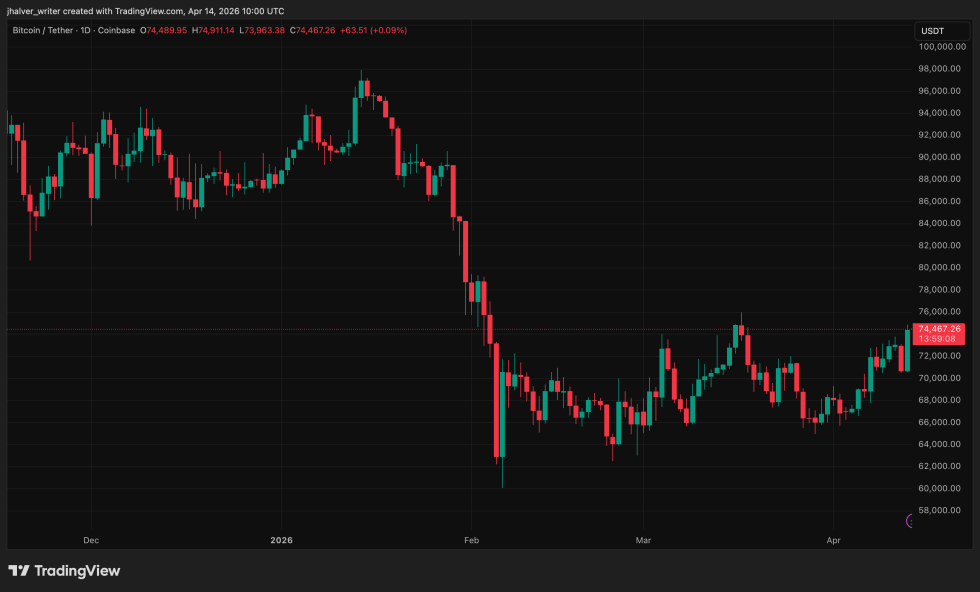
At the moment of writing, BTC trades for more than $74k on the daily chart. Source: BTCUSDT on Tradingview.

Cover image from Perplexity. BTCUSDT chart from Tradingview.

Preguntas relacionadas

QWhat is the main purpose of the upcoming 'compromise draft' in the CLARITY Act, according to Senator Thom Tillis?

AThe main purpose of the compromise draft is to break the stalemate over the stablecoin yield dispute between banks and crypto firms by clarifying whether crypto companies can pay interest on idle stablecoin holdings.

QWhy do traditional banks oppose yield-bearing stablecoins?

ABanks oppose them because they compete directly with traditional bank deposits by offering attractive returns on dollar-denominated assets that can move instantly on-chain. This could drain deposits that fund their lending and investment activities, especially from younger, digitally native customers.

QHow does the crypto industry view the ability to offer yield on stablecoins?

AThe crypto industry views yield on stablecoin balances as a fundamental feature. It is a primary way for exchanges and DeFi platforms to attract and retain users, turn idle cash into a revenue-generating product, differentiate from traditional banks, support token incentives, and deepen liquidity in various markets.

QWhat is the emerging policy direction for stablecoin yield as mentioned in the article?

AThe emerging policy direction seems to be against 'passive' yield for idle balances but allows for possible rewards that are tied to payments, transfers, and other forms of 'active use' of the stablecoins.

QWhat potential market impact could the CLARITY Act's final text have?

AThe final text will heavily influence stablecoin APY (Annual Percentage Yield), liquidity, and where serious traders park their capital. It could force U.S. exchanges to pivot to activity-based rewards and may lead yield-seeking capital to move to offshore platforms or impact competition with foreign CBDCs.

Lecturas Relacionadas

How Many Tokens Away Is Yang Zhilin from the 'Moon Chasing the Light'?

The article explores the intense competition between two leading Chinese AI companies, DeepSeek and Kimi (Moon Dark Side), and the mounting pressure on Yang Zhilin, the founder of Kimi. While DeepSeek re-emerged after 15 months of silence with its powerful V4 model—boasting 1.6 trillion parameters and low-cost, long-context capabilities—Kimi has been focusing on long-context processing and multi-agent systems with its K2.6 model. Yang faces a threefold challenge: technological rivalry, commercialization pressure, and investor expectations. Despite Kimi’s high valuation (reaching $18 billion), its revenue heavily relies on a single product with low paid conversion rates, while DeepSeek’s strategic silence and open-source influence have strengthened its market position and valuation prospects, now targeting over $20 billion. Both companies reflect broader trends in China’s AI ecosystem: Kimi aims for global influence through open-source contributions and agent-based advancements, while DeepSeek prioritizes foundational innovation and hardware independence, notably shifting to Huawei’s chips. Their competition is seen as vital for China’s AI progress, with the gap between top Chinese and U.S. models narrowing to just 2.7% on the Elo rating scale. Ultimately, the article argues that this rivalry, though anxiety-inducing for leaders like Zhilin, is essential for driving innovation and solidifying China’s role in the global AI landscape.

marsbitHace 2 hora(s)

How Many Tokens Away Is Yang Zhilin from the 'Moon Chasing the Light'?

marsbitHace 2 hora(s)

TechFlow Intelligence Bureau: ChatGPT Helps Amateur Mathematician Crack 60-Year-Old Problem, CFTC Sues New York Regulator Over Coinbase and Gemini

An amateur mathematician, with the assistance of ChatGPT, has solved a combinatorial mathematics puzzle originally proposed by Hungarian mathematician Paul Erdős in the 1960s. This marks another milestone in AI-aided mathematical research, demonstrating the evolving capabilities of large language models in formal reasoning. In other AI developments, OpenAI introduced a new privacy filter tool for enterprise API usage, automatically screening sensitive data. Meanwhile, the Qwen3.6-27B model achieved 100 tokens per second on a single RTX 5090 GPU using quantization, significantly lowering the cost barrier for local AI deployment. In crypto and Web3, the U.S. CFTC sued New York’s financial regulator, challenging its oversight of Coinbase and Gemini—a first-of-its-kind federal-state regulatory clash. Following a vulnerability, KelpDAO and major DeFi protocols established a recovery fund. Tether froze $344 million in assets linked to Iran’s central bank upon U.S. Treasury request, highlighting the centralized control risks in stablecoins. Separately, Litecoin underwent a 3-hour chain reorganization to undo a privacy-layer exploit. In the U.S., former President Trump invoked the Defense Production Act to address power grid bottlenecks affecting AI data centers and dismissed the entire National Science Board, raising concerns over research independence. A retail trader gained 250% on a $600k Intel options bet amid AI-related speculation. Xiaomi announced its first performance electric vehicle, targeting rivals like Tesla. Meanwhile, iPhone users reported devices automatically reinstalling a hidden app daily, suspected to be MDM-related. A Chinese securities report noted that A-share institutional crowding has reached its second-longest streak since 2007, signaling high valuations and potential style rotation. The day’s developments reflect a dual narrative: AI is enabling unprecedented individual breakthroughs, while centralized power structures—whether governmental or corporate—are becoming more assertive, underscoring that decentralization is as much a political-economic challenge as a technical one.

marsbitHace 3 hora(s)

TechFlow Intelligence Bureau: ChatGPT Helps Amateur Mathematician Crack 60-Year-Old Problem, CFTC Sues New York Regulator Over Coinbase and Gemini

marsbitHace 3 hora(s)

Trading

Spot
Futuros
活动图片





