Crypto Shockwave: Circle Sued As $280 Million Drift Hack Unravels

bitcoinistPublicado a 2026-04-17Actualizado a 2026-04-17

Resumen

A class action lawsuit has been filed in a Massachusetts federal court against Circle Internet Financial, alleging the stablecoin issuer was negligent and aided in the theft of $280 million from the Drift Protocol. The plaintiffs, representing over 100 investors, argue Circle had the means to stop the stolen USDC from being moved across blockchains using its Cross-Chain Transfer Protocol but failed to act. They point to Circle's prior action of freezing wallets in a separate civil case as proof it could have intervened. The April 1st hack is attributed to North Korean state-backed actors who moved the funds to Ethereum and laundered them through Tornado Cash. The case raises significant questions about the responsibility of centralized entities in the decentralized crypto ecosystem.

North Korean hackers likely pocketed hundreds of millions in stolen crypto — and now a US court is being asked to decide whether a stablecoin giant should have stopped them.

Circle’s Own Track Record Becomes A Key Weapon

A class action lawsuit filed in a Massachusetts federal court this week names Circle Internet Group as the defendant, with plaintiffs arguing the company had both the means and the opportunity to stop roughly $280 million in stolen USDC from moving across blockchains — and did nothing.

The case was brought by Drift Protocol investor Joshua McCollum, representing more than 100 affected members. Their attorneys put it plainly: Circle allowed criminal use of its own technology.
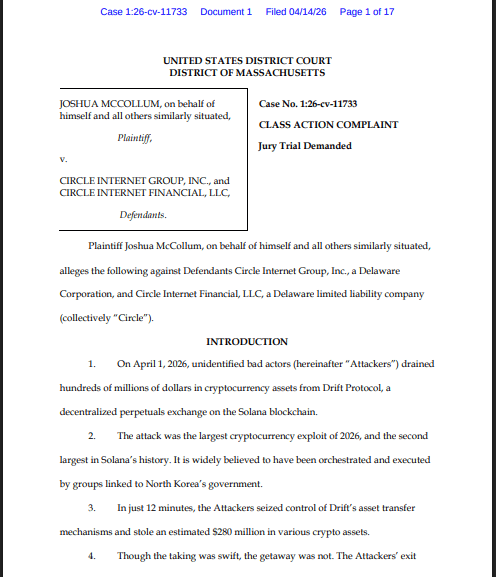
The complaint was filed Wednesday in a Massachusetts US district court by Drift investor Joshua McCollum, representing more than 100 members.

The April 1 attack on Drift Protocol saw attackers drain funds and route them from Solana to Ethereum using Circle’s Cross-Chain Transfer Protocol, a bridging tool the company operates. The transfers happened over several hours, according to reports. The window was wide open.

What makes the lawsuit particularly pointed is what happened just days before the hack. About a week prior, Circle froze 16 USDC wallets tied to a sealed US civil case. Plaintiffs seized on that detail. If Circle could move fast for a court-adjacent matter, they argue, it could have acted here too. That single fact sits at the center of the legal fight.

Accusations Range From Negligence To Aiding The Crime

The suit carries two main charges: negligence and aiding and abetting conversion — a legal term for helping someone unlawfully take another person’s property. The law firm Mira Gibb is handling the case for McCollum and the other Drift investors. Damages have not yet been set and will be determined at trial.

BTCUSD trading at $75,081 on the 24-hour chart: TradingView

Circle has not responded to requests for comment.

Crypto analytics firm Elliptic flagged the attack as the work of North Korean state-backed operatives. Based on Elliptic’s analysis, the hackers executed more than 100 transactions through Circle’s bridging infrastructure during regular US business hours. After moving the funds to Ethereum, the stolen assets were converted and pushed through Tornado Cash, a privacy protocol used to obscure transaction trails.
Image: SOPA Images/Getty Images

ARK Invest Defends Circle, But The Moral Stakes Remain High

Not everyone is pointing fingers at Circle. Lorenzo Valente, ARK Invest’s director of digital asset research, argued that Circle made the right call by not acting without a legal order.

His concern: give a company like Circle the power to freeze funds on judgment alone, and every decision becomes political. He questioned aloud where the line would be drawn — between a North Korean hacker and a suspicious wallet elsewhere in the world.

Featured image from B&G Lawyers, chart from TradingView

Criptos en tendencia

Preguntas relacionadas

QWhat is the main allegation against Circle Internet Group in the class action lawsuit?

AThe plaintiffs allege that Circle had both the means and the opportunity to stop roughly $280 million in stolen USDC from moving across blockchains but did nothing, thereby allowing criminal use of its technology.

QWhich hacking group is suspected to be behind the $280 million attack on Drift Protocol?

ACrypto analytics firm Elliptic flagged the attack as the work of North Korean state-backed operatives.

QWhat key precedent from just days before the hack do the plaintiffs use to strengthen their case against Circle?

AThe plaintiffs point out that about a week prior to the hack, Circle froze 16 USDC wallets tied to a sealed US civil case, arguing that if Circle could act quickly in that instance, it could have acted to stop the stolen funds.

QWhat are the two main legal charges brought against Circle in the lawsuit?

AThe two main charges are negligence and aiding and abetting conversion, which is a legal term for helping someone unlawfully take another person's property.

QWhat was the primary method the hackers used to obscure the trail of the stolen funds after the attack?

AAfter moving the funds to Ethereum, the stolen assets were converted and pushed through Tornado Cash, a privacy protocol used to obscure transaction trails.

Lecturas Relacionadas

The Turning Point of the AI Bull Market: Leverage Blow-ups, Overcapacity in Compute, Why This Macro Analyst is Fully Bearish

AI Bull Market Reaches Inflection Point: Analyst Turns Bearish Due to Leverage, Chinese Competition, and Overcapacity Fidenza Macro analyst Geo Chen explains his decision to sell all AI semiconductor and infrastructure holdings in June, offering a comprehensive bearish thesis. He argues the AI-driven bull market has peaked, citing several key factors. First, unsustainable buying pressure: a massive influx of "low-quality" capital from Korean retail investors using highly leveraged ETFs on stocks like SK Hynix created a parabolic, fragile rally. Recent liquidations have wiped out billions and impacted over a million accounts, removing a key market driver. Second, a competitive threat: the rapid rise of powerful, cost-effective open-source AI models from China, such as MoonShot AI's Kimi K3 and Alibaba's Qwen 3.8, is commoditizing intelligence. This undermines the pricing power and high-valuation financing prospects of closed-source leaders like OpenAI and Anthropic, potentially creating a "single point of failure" for the ecosystem. Third, an impending capacity glut: while AI compute and components are currently in shortage, Chen warns this is typical of a cycle top. Massive, committed capex from cloud providers will likely lead to a supply overhang within 1-2 years. Data shows token spending has already peaked and declined since June, while bond spreads for data center companies are widening, signaling rising credit risk. Chen also highlights broader macro headwinds: the protracted Iran conflict acts as a persistent stagflationary force, and the Federal Reserve under Chair Kevin Warsh is losing credibility in its inflation fight. Long-term Treasury yields breaking above 5.2% present a new challenge for equities. In summary, Chen believes the convergence of speculative excesses, competitive disruption, looming overcapacity, and adverse macroeconomic conditions marks a significant turning point for the AI investment theme.

marsbitHace 14 min(s)

The Turning Point of the AI Bull Market: Leverage Blow-ups, Overcapacity in Compute, Why This Macro Analyst is Fully Bearish

marsbitHace 14 min(s)

Saeed Al-Marri: How Tokenization Unlocks New Opportunities for Shipping Funds

Said Al-Marri: How Tokenization Opens New Opportunities for Shipping Funds For centuries, commercial shipping has been a capital-intensive asset class limited to institutional funds and shipping dynasties. Said bin Saleh Al-Marri, CEO of Ethra Invest and Ethra Ship, aims to break down these barriers by combining Real World Asset (RWA) tokenization with conservative private equity principles. This bridges decentralized finance (DeFi) with the physical realities of global trade. Tokenization allows fractional ownership of ships on a blockchain, giving smaller investors access to previously inaccessible markets. However, Al-Marri warns it is not a regulatory loophole or a cure for asset illiquidity. The core physical risks are isolated in Special Purpose Vehicles (SPVs) for qualified investors. While tokenization enhances transparency and ownership record-keeping, Al-Marri stresses that a liquid secondary market depends on transparent asset valuation and must not interfere with ship operations managed by professionals. Regarding legal enforcement, smart contracts cannot physically seize a ship. Legal recourse still relies on traditional maritime courts, ship mortgages, and flag state laws, with blockchain records needing to mirror legal ownership in the SPV perfectly. Beyond ownership, the industry faces administrative hurdles like paper-based bills of lading. Al-Marri argues the bottleneck is legal and operational standardization, not technology. He advocates for a hybrid model combining digital trade documents and programmable settlements with support from regulated financial institutions, rather than a full crypto replacement for tools like Letters of Credit. A major challenge is decarbonizing the global fleet by 2050. Transitioning to green fuels requires massive upfront investment. Al-Marri emphasizes a conservative, holistic approach to underwriting these projects, evaluating technology, fuel availability, safety, and resale value. Investments must be justified under conservative forecasts, not just optimistic ones. By combining pragmatic risk management with digital infrastructure, leaders like Al-Marri show that the evolution of maritime finance is about mobilizing capital to build a modernized and sustainable global fleet, not just putting ships on a blockchain.

cryptonews.ruHace 29 min(s)

Saeed Al-Marri: How Tokenization Unlocks New Opportunities for Shipping Funds

cryptonews.ruHace 29 min(s)

Trading

Spot

Artículos destacados

Cómo comprar DRIFT

¡Bienvenido a HTX.com! Hemos hecho que comprar Drift Protocol (DRIFT) sea simple y conveniente. Sigue nuestra guía paso a paso para iniciar tu viaje de criptos.Paso 1: crea tu cuenta HTXUtiliza tu correo electrónico o número de teléfono para registrarte y obtener una cuenta gratuita en HTX. Experimenta un proceso de registro sin complicaciones y desbloquea todas las funciones.Obtener mi cuentaPaso 2: ve a Comprar cripto y elige tu método de pagoTarjeta de crédito/débito: usa tu Visa o Mastercard para comprar Drift Protocol (DRIFT) al instante.Saldo: utiliza fondos del saldo de tu cuenta HTX para tradear sin problemas.Terceros: hemos agregado métodos de pago populares como Google Pay y Apple Pay para mejorar la comodidad.P2P: tradear directamente con otros usuarios en HTX.Over-the-Counter (OTC): ofrecemos servicios personalizados y tipos de cambio competitivos para los traders.Paso 3: guarda tu Drift Protocol (DRIFT)Después de comprar tu Drift Protocol (DRIFT), guárdalo en tu cuenta HTX. Alternativamente, puedes enviarlo a otro lugar mediante transferencia blockchain o utilizarlo para tradear otras criptomonedas.Paso 4: tradear Drift Protocol (DRIFT)Tradear fácilmente con Drift Protocol (DRIFT) en HTX's mercado spot. Simplemente accede a tu cuenta, selecciona tu par de trading, ejecuta tus trades y monitorea en tiempo real. Ofrecemos una experiencia fácil de usar tanto para principiantes como para traders experimentados.

312 Vistas totalesPublicado en 2024.12.11Actualizado en 2026.06.02

Cómo comprar DRIFT

Discusiones

Bienvenido a la comunidad de HTX. Aquí puedes mantenerte informado sobre los últimos desarrollos de la plataforma y acceder a análisis profesionales del mercado. A continuación se presentan las opiniones de los usuarios sobre el precio de DRIFT (DRIFT).

活动图片