Crypto Rules Are Changing—But Congress Still Decides The Endgame

bitcoinistPublicado a 2026-03-20Actualizado a 2026-03-20

Resumen

Republican senators met with a White House crypto adviser in a closed-door session, signaling progress on digital asset oversight legislation. A key sticking point—stablecoin yield—is nearly resolved, moving the Senate’s CLARITY Act forward. Simultaneously, SEC Chair Paul Atkins announced a major policy shift, stating that most cryptocurrencies are not securities. Only tokenized traditional securities remain under SEC jurisdiction. The SEC’s new interpretive guidance, described as a temporary bridge, aligns with a recent agreement with the CFTC, which is poised to take a larger regulatory role once Congress passes comprehensive legislation.

Republican senators huddled with a White House crypto adviser Thursday in a closed-door session that participants called “very productive” — a sign that Washington’s push to rewrite the rules of digital asset oversight may be gaining real momentum.

Stablecoin Sticking Point Nears Resolution

A spokesperson for Wyoming Sen. Cynthia Lummis confirmed the meeting with White House crypto adviser Patrick Witt, saying lawmakers are now “99% of the way there on stablecoin yield” — the thorny issue that has held up a broader market structure bill in the Senate Banking Committee for months.

Concerns over how stablecoin yield should be treated across the crypto and banking industries had effectively frozen progress. Based on reports from Lummis’ office, negotiations on the digital assets portion of the bill are also in good shape.

The bill, known as the CLARITY Act, cleared the House of Representatives back in July 2025. As of Thursday, it had not been scheduled for a markup hearing in the Senate Banking Committee. The Senate Agriculture Committee had already advanced its own version of the legislation in January.
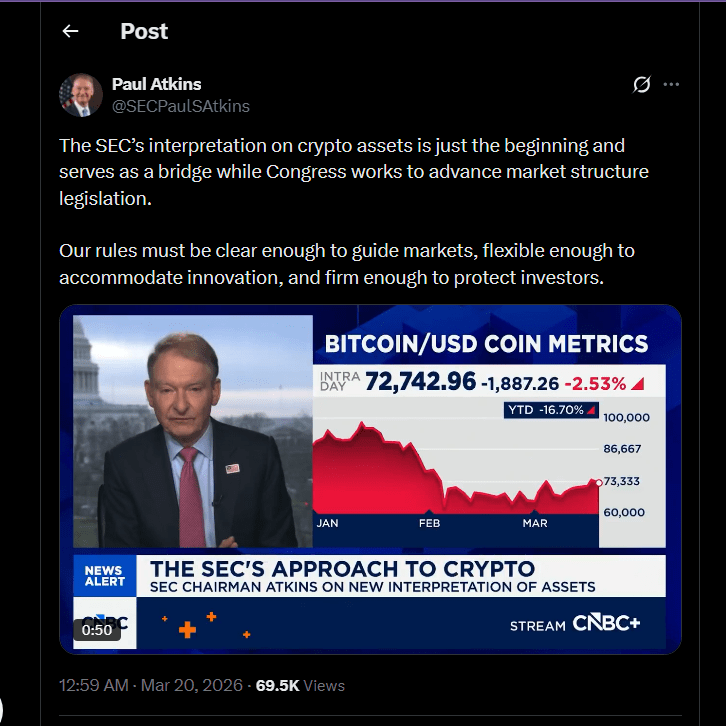
Source: Paul Atkins

SEC Draws A New Line On What Counts As A Security

The closed-door meeting came the same day SEC Chair Paul Atkins delivered prepared remarks at the Practising Law Institute in which he outlined a sharp departure from how his agency has handled crypto in the past.

Gone, he said, is the “regulation by enforcement” approach that defined the previous administration’s posture toward digital assets.

Earlier in the week, the agency published an interpretive notice laying out which crypto assets it considers securities and which it does not. The answer, under the new framework, is that most cryptocurrencies are not securities.

Total crypto market cap currently at $2.39 trillion. Chart: TradingView

Only one category remains under SEC oversight: traditional securities that have been converted into token form. Digital commodities, digital tools, non-fungible tokens, and stablecoins were all identified as falling outside the agency’s reach.

Atkins was direct about the limits of what the agency had done. The interpretation, he said, is a “beginning, not an end.”

A Bridge Until Congress Acts

The SEC’s move follows a memorandum of understanding signed last week between the agency and the Commodity Futures Trading Commission.

Under the expected market structure legislation, the CFTC would take on a larger role in regulating and overseeing digital assets — a shift the SEC appears willing to accept.

Atkins framed the interpretive notice as a necessary bridge while Congress works toward a permanent statutory framework. Administrative interpretations can be revised or reversed.

A law cannot be undone as easily. That distinction is why the Thursday meeting between senators and the White House carries weight beyond the usual Washington optics.

For an industry that spent years under threat of enforcement action, the week’s developments represent a visible change in direction from the country’s top securities regulator.

Featured image from Unsplash, chart from TradingView

Criptos en tendencia

Preguntas relacionadas

QWhat was the main purpose of the closed-door meeting between Republican senators and the White House crypto adviser?

AThe meeting was held to discuss and advance the push to rewrite the rules of digital asset oversight, specifically making progress on the stablecoin yield issue that had been holding up broader market structure legislation.

QWhich specific sticking point in the Senate Banking Committee's crypto bill is reportedly close to being resolved?

AThe issue of 'stablecoin yield' is reportedly 99% resolved, according to a spokesperson for Senator Cynthia Lummis.

QHow did SEC Chair Paul Atkins describe the agency's new approach to crypto regulation, contrasting it with the past?

AAtkins stated that the 'regulation by enforcement' approach of the previous administration is gone, and the SEC has now published a new interpretive framework that clarifies which crypto assets are considered securities.

QAccording to the new SEC framework, which category of crypto assets remains under its oversight?

AOnly traditional securities that have been converted into token form remain under SEC oversight. Digital commodities, digital tools, NFTs, and stablecoins are considered outside the agency's reach.

QWhat role did SEC Chair Atkins say the agency's interpretive notice plays while Congress works on legislation?

AAtkins framed the interpretive notice as a 'necessary bridge' to provide guidance until Congress can establish a permanent statutory framework for digital asset regulation.

Lecturas Relacionadas

Bitcoin Withdrawals Continue: 8 Years of Storage in a Coldcard Cold Wallet Ended in Zero

Coldcard Hardware Wallet Hacked: Losses Mount Due to Vulnerable Seed Generation A critical vulnerability in Coldcard hardware wallets has led to a continued wave of fund thefts. According to Galaxy Research, the total stolen has reached 1,367.05 BTC (approx. $88.6 million) from 4,585 addresses, a significant increase from the initial 594.5 BTC reported on July 30, 2026. Most of the stolen funds remain on the attackers' addresses. The issue is not with the current firmware, which Coinkite has updated, but with seed phrases generated on vulnerable devices between March 2021 and the release of fixed firmware versions. Due to a programmer error, devices switched from using a hardware random number generator to the software-based Yasmarang generator, which was initialized with publicly accessible data like the chip's serial number. This made the seed phrases predictable through offline brute-force attacks, meaning wallets remain at risk until funds are moved to a new wallet generated with the patched firmware. Affected devices include Mk2/Mk3 with firmware 4.0.1–4.1.9 (and up to 5.0.3), Mk4/Mk5 up to version 5.6.0, and Q models up to 1.5.0Q. The only exceptions are seeds created with a high-entropy method like at least 50 independent dice rolls or a strong unique BIP-39 passphrase. All other owners must generate a new seed on the fixed firmware and transfer their assets. A case highlighting the human impact involves a 39-year-old long-term investor who lost 2 BTC (approx. $130,000) in minutes. He had accumulated the Bitcoin over eight years through physical labor, viewing it as a financial lifeline and a retirement plan in a country suffering from hyperinflation. His story underscores that even conservative "buy and hold in cold storage" strategies can be compromised by such underlying technical flaws. From a technical perspective, this incident echoes historical failures where weak random number generators undermined cryptographic security, challenging the assumption that offline storage is automatically foolproof.

cryptonews.ruHace 4 hora(s)

Bitcoin Withdrawals Continue: 8 Years of Storage in a Coldcard Cold Wallet Ended in Zero

cryptonews.ruHace 4 hora(s)

Trading

Spot

Artículos destacados

Cómo comprar HOUSE

¡Bienvenido a HTX.com! Hemos hecho que comprar Housecoin (HOUSE) sea simple y conveniente. Sigue nuestra guía paso a paso para iniciar tu viaje de criptos.Paso 1: crea tu cuenta HTXUtiliza tu correo electrónico o número de teléfono para registrarte y obtener una cuenta gratuita en HTX. Experimenta un proceso de registro sin complicaciones y desbloquea todas las funciones.Obtener mi cuentaPaso 2: ve a Comprar cripto y elige tu método de pagoTarjeta de crédito/débito: usa tu Visa o Mastercard para comprar Housecoin (HOUSE) al instante.Saldo: utiliza fondos del saldo de tu cuenta HTX para tradear sin problemas.Terceros: hemos agregado métodos de pago populares como Google Pay y Apple Pay para mejorar la comodidad.P2P: tradear directamente con otros usuarios en HTX.Over-the-Counter (OTC): ofrecemos servicios personalizados y tipos de cambio competitivos para los traders.Paso 3: guarda tu Housecoin (HOUSE)Después de comprar tu Housecoin (HOUSE), guárdalo en tu cuenta HTX. Alternativamente, puedes enviarlo a otro lugar mediante transferencia blockchain o utilizarlo para tradear otras criptomonedas.Paso 4: tradear Housecoin (HOUSE)Tradear fácilmente con Housecoin (HOUSE) en HTX's mercado spot. Simplemente accede a tu cuenta, selecciona tu par de trading, ejecuta tus trades y monitorea en tiempo real. Ofrecemos una experiencia fácil de usar tanto para principiantes como para traders experimentados.

321 Vistas totalesPublicado en 2025.04.27Actualizado en 2026.06.02

Cómo comprar HOUSE

Discusiones

Bienvenido a la comunidad de HTX. Aquí puedes mantenerte informado sobre los últimos desarrollos de la plataforma y acceder a análisis profesionales del mercado. A continuación se presentan las opiniones de los usuarios sobre el precio de HOUSE (HOUSE).

活动图片













