Crypto Project Pudgy Penguins Appears on the Sphere Dome in Las Vegas

RBK-cryptoPublicado a 2025-12-25Actualizado a 2025-12-25

Resumen

Popular NFT project Pudgy Penguins has achieved a major marketing milestone by placing its advertisement on the exterior of the Sphere in Las Vegas, the world's largest spherical LED media platform. The project, which began as a flagship NFT collection on Ethereum, has transformed into a global retail brand by 2025. It now boasts global sales of toys, partnerships with retailers like Walmart and Amazon, the release of animated content, and the launch of its PENGU token on the Solana network. The project has deliberately avoided crypto-themed advertising for this campaign, focusing instead on its physical goods and animated content without mentioning tokens or NFTs. This contrasts with a previous attempt by the Dogwifhat (WIF) meme coin community to run a similar campaign, which was rejected by Sphere despite raising $700,000. The floor price for a Pudgy Penguins NFT is currently around 4 ETH (approximately $12,000). The PENGU token was one of the top-performing major crypto assets in 2025, though it later corrected by more than 70% from its July peak alongside most altcoins. Its previous growth was accompanied by the launch of the Pengu Clash mini-game on Telegram and partnerships with Lufthansa and NASCAR. The project also gained significant attention when dozens of executives from major crypto companies temporarily changed their social media avatars to Pudgy Penguins images.

The team behind the popular NFT project became the first in the crypto industry to secure advertising placement on the world's largest LED screen

The characters of the Pudgy Penguins brand have become part of the outdoor advertising on the giant LED screen Sphere — the world's largest spherical media platform, located in Las Vegas.
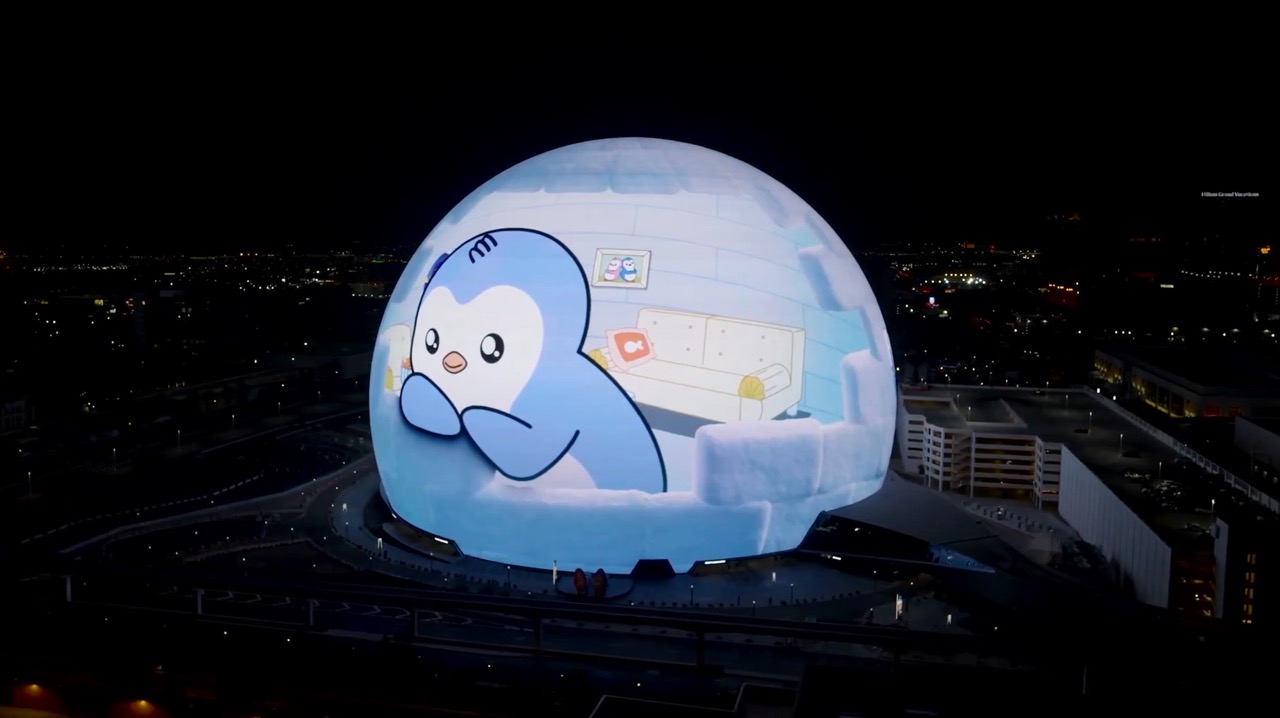
Animation on the LED screen of the Sphere in Las Vegas. Source: pudgypenguins / X

The Pudgy Penguins project began as one of the flagship NFT collections on the Ethereum network, but by 2025 it had transformed into a retail brand with global sales of toys, partnerships with retailers Walmart and Amazon, the release of animated films, and the launch of the PENGU token on the Solana network.

NFT (non-fungible tokens) — these are unique digital objects with ownership confirmed on the blockchain. They became part of the crypto-mania of 2021-2022, when images, videos, and other collectible tokens on the Ethereum or Solana networks were sold for hundreds of thousands of dollars.

The project avoided a ban on crypto advertising from the sphere's operators by focusing on physical goods — toys, merchandise, and animated content, without mentioning tokens or NFTs. Earlier, an attempt by the Dogwifhat (WIF) meme coin community to run a similar campaign was rejected, despite raising $700 thousand for it.

The minimum price (floor price) for one NFT image from the collection is 4 ETH (about $12 thousand), according to CoinGecko data on December 25th.

RBC-Crypto Telegram channel — subscribe and stay up to date with the most important and current news about cryptocurrency.

Join the RBC-Crypto forum on Telegram to discuss news and trends in the crypto world.

The PENGU token showed one of the best growth results among major crypto assets in 2025, but by the end of the year, along with most altcoins, it corrected by more than 70% from its July peak.

That period of growth was accompanied by the launch of the game Pengu Clash as a mini-app on Telegram, a partnership of the project with the airline Lufthansa and the organizer of NASCAR auto races. The same period was marked by a mass flashmob when dozens of leaders and managers of large crypto companies temporarily changed their avatars on social network X to images of Pudgy Penguins.

Volatility interrupted. How the price of bitcoin changed over 10 years at Christmas

AI beat people in a crypto trading tournament. What were the results?

"Capitalization" of miners was called a bullish factor for bitcoin. Why?
Lecturas Relacionadas

Bitcoin Short-term Adjustment Continues, HYPE Approaches Critical Support | Guest Analysis

This article provides a technical analysis of Bitcoin (BTC) and HYPE for the current week. For Bitcoin, the daily chart suggests an ongoing b-wave correction within a larger pattern since the May high, currently testing the $60,900-$61,500 support zone. The analysis outlines that if this area holds (with the critical level at $57,820), a potential c-wave rally towards $67,300 could follow. Key resistance levels are identified at $63,600, $65,700-$67,300, and $69,500-$71,000. The author presents both mid-term and short-term trading strategies, including two specific short-term plans (Plan A and B) for potential long entries based on support holds or breaks above resistance. Regarding HYPE, the daily chart indicates it is in the final stages (C-wave) of a correction from its June high, now approaching a crucial support zone of $50-$52. The analysis notes oversold conditions and warns against chasing the downtrend, instead advising to watch for signs of a stabilizing bounce (potential D-wave). Key resistance levels are $58.5-$60, $63.5-$66, and near $72.97. The short-term strategy suggests considering a light long position if the $50-$52 support holds. The article also includes a verification of last week's analysis, noting that BTC's price action aligned with predictions, and details a successful short-term BTC short trade that yielded approximately 2.58% profit using proprietary trading models. General risk management rules for stop-loss placement are reiterated. The author concludes by emphasizing that all analysis is for personal trading purposes and does not constitute investment advice.

Odaily星球日报Hace 2 min(s)

Bitcoin Short-term Adjustment Continues, HYPE Approaches Critical Support | Guest Analysis

Odaily星球日报Hace 2 min(s)

China's Tech Industry Is Crossing the 'Visibility Threshold' in Bulk

China's tech industries are successively crossing a "visibility threshold" into the global market spotlight. This wave, exemplified by AI, robotics, and innovative pharmaceuticals (the "new-new three"), differs from past waves like garments/appliances or EVs/batteries/solar panels. Earlier industries met existing demand, but these new sectors are helping to *define* emerging markets and applications. Crossing this threshold signifies an industry has achieved scale, competitive advantages, rapid growth, and the ability to drive its supply chain. Recent data shows China's AI sector growing over 30%, producing 80% of certain intelligent robots, and a surge in new drug approvals. This acceleration stems from China's industrial evolution from "completeness" to "density": different sectors now share technologies, talent, and infrastructure, enabling capabilities (e.g., from EVs) to rapidly migrate to adjacent fields (e.g., robotics). This dense ecosystem, combined with improved system integration and faster market access, acts as an infrastructure for generating new industries. The nature of competition is also evolving. The visible product is just an interface; long-term advantage lies in the underlying patents, standards, and open ecosystems. While building this "moat," China's approach emphasizes openness—through open-source models and collaborative R&D—to foster wider adoption and iterative improvement. Crossing the visibility line marks the start of market validation. The consecutive emergence of these industry waves signals China is developing a sustained capacity to generate new, globally relevant innovations, shifting from being defined by global narratives to participating in shaping them.

marsbitHace 48 min(s)

China's Tech Industry Is Crossing the 'Visibility Threshold' in Bulk

marsbitHace 48 min(s)

10 Billion Repurchase Fails to Halt HYPE's Decline, Are Core Members and Multicoin Quietly Selling Tokens?

Foresight News reports that despite a massive $1 billion buyback program by the Assistance Fund, the HYPE token has fallen from its July high of $70 to around $52.40. Analyst MLM tracked data showing that since team token vesting began in December 2025, approximately 4.93 million HYPE (worth ~$270M) were allocated to core contributors. Of these, 1.19 million (~$32.5M) were sold on the open market, and 3.14 million (~$132M) were transferred to OTC desks. However, the report argues that direct team selling is not the primary driver of the price decline. In the same period, the protocol's Assistance Fund used 99% of trading fees to repurchase about 9.8 million HYPE for approximately $364 million, a rate more than double the team's selling pressure. The analysis points to other significant factors: major venture capital firms like Multicoin Capital and a16z have been unstaking and moving substantial amounts of HYPE to exchanges, with some confirming sales for portfolio management. Additionally, HYPE spot ETFs have experienced consistent daily net outflows since early July, reversing the strong inflows seen in May and June. The report concludes that while protocol buybacks absorb team selling, declining trading volume reduces this buyback power, and combined selling pressure from large investors and ETFs has significantly impacted the price.

marsbitHace 1 hora(s)

10 Billion Repurchase Fails to Halt HYPE's Decline, Are Core Members and Multicoin Quietly Selling Tokens?

marsbitHace 1 hora(s)

Trading

Spot
活动图片