Crypto Prediction Markets Face Existential Threat — 3 States Move To Shut Traders Out

bitcoinistPublicado a 2026-04-03Actualizado a 2026-04-03

Resumen

The U.S. federal government, through the CFTC and DOJ, is suing Illinois, Arizona, and Connecticut to block their attempts to shut down crypto prediction markets like Polymarket and Kalshi. The federal agencies argue they have exclusive jurisdiction to regulate these markets as derivatives, while the states classify them as illegal gambling. This legal clash represents a significant existential threat to the industry. A federal victory would centralize oversight under the CFTC, creating a single regulatory framework. If the states prevail, platforms would face a fragmented landscape of state gambling laws, potentially pushing markets offshore and increasing costs for traders.

Illinois, Arizona and Connecticut are trying to regulate crypto predictions markets, such as Polymarket and Kalshi. The Commodity Futures Trading Commission and the Justice Department are coming to the rescue.

For The First Time, The Scale Moves In Crypto Prediction Markets’ Favor

As contradictory as it may sound, the Trump administration is trying to save crypto prediction markets from the State itself. The coordinated lawsuits the CFTC and the DOJ have filed against the three states argue that only the federal derivatives regulator can police prediction markets.

The lawsuits go as far as to claim the three states are bypassing the CFTC’s authority by trying to shut down “federally regulated DCMs” (designated contract markets). Regarding Illinois, the federal regulator said the state spent the past year issuing cease‐and‐desist letters to Kalshi, Crypto.com, and Polymarket, which the complaint argues are all under CFTC authority:

Illinois’s attempt to shut down federally regulated DCMs intrudes on the exclusive federal scheme Congress designed to oversee national swaps markets.

Related Reading: Crypto Traders On Edge As Korea Stalls Key Law — Is The “Kimchi Premium” At Risk Next?

Put simply, Washington says prediction markets are federally regulated derivatives. States insist, however, that prediction markets are just unlicensed gambling products harming local consumers.

CFTC Chairman Michael Selig explained that this is not the first time states “have tried to impose consistent and contrary obligations on market participants”. Just this past month, a bipartisan Senate bill targeting sports‐style bets on platforms like Polymarket and Kalshi was introduced by Senators Adam Schiff (D-CA) and John Curtis (R-UT).

Also on March, democratic representative Seth Moulton of Massachusetts (MA-06) formally banned all his staff from participating in prediction markets. That same day, Congressman Adrian Smith (R-NE-03) and Congresswoman Nikki Budzinski (D-IL-13) from Nebraska introduced the PREDICT Act, banning members of Congress from trading on political and policy outcome markets.

These are the first lawsuits by the CFTC to block state gaming regulators ​from policing operators of prediction markets, according to Reuters. The outlet also highlighted the fact that all the defendants are Democrats.

Market Implications

The CFTC’s lawsuits build on its recent push to assert “exclusive jurisdiction” over event contracts, including sports and politics, reversing the Biden‐era move that tried to ban broad categories of prediction markets.

Prediction markets are morphing into an information layer and hedging tool for traders, with liquidity increasingly coming from crypto‐native capital and exchange integrations.

A federal win would likely centralize rule‐making at the CFTC, potentially clearing a single regulatory path for crypto prediction platforms, but also tightening surveillance and enforcement. Conversely, if states prevail, platforms may face a patchwork of gambling rules that fracture liquidity, push some markets offshore, and raise operational risk premia for traders.
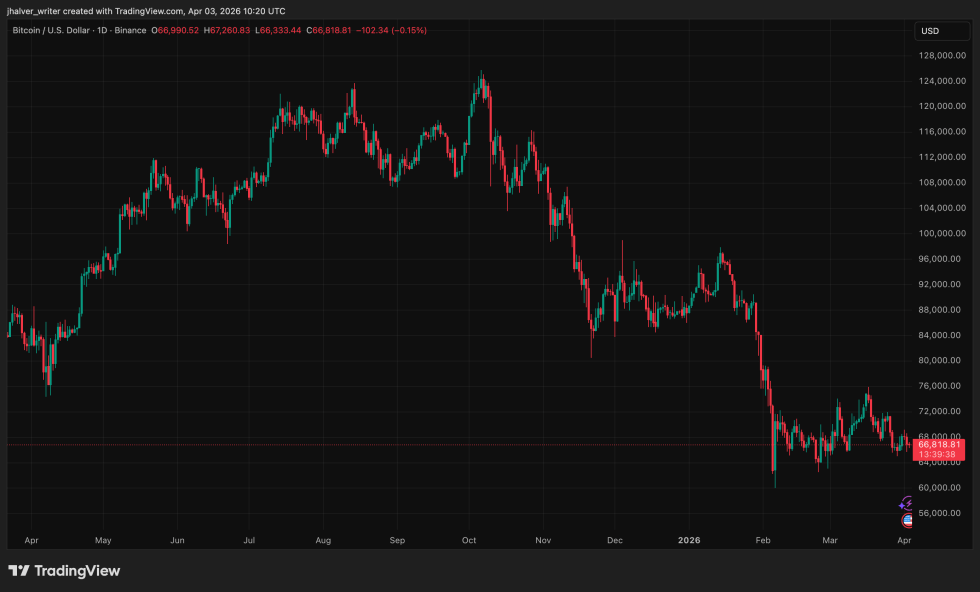
At the moment of writing, BTC trades for almost $67k on the daily chart. Source: BTCUSD on Tradingview.

Cover image from Perplexity. BTCUSD chart from Tradingview.

Preguntas relacionadas

QWhich three states are mentioned as trying to regulate crypto prediction markets in the article?

AIllinois, Arizona, and Connecticut.

QWhat federal agencies are taking legal action against these states to protect crypto prediction markets?

AThe Commodity Futures Trading Commission (CFTC) and the Department of Justice (DOJ).

QAccording to the CFTC, what is the core legal argument against the states' actions?

AThe CFTC argues that it has exclusive federal jurisdiction to regulate prediction markets as derivatives, and the states are intruding on this federal regulatory scheme.

QWhat is the name of the bipartisan Senate bill mentioned that targets sports-style bets on platforms like Polymarket?

AThe article mentions a bipartisan Senate bill but does not provide its specific name. It was introduced by Senators Adam Schiff and John Curtis.

QWhat are the two potential outcomes for crypto prediction markets discussed, depending on who wins the legal battle?

AA federal win would centralize rule-making at the CFTC, creating a single regulatory path. If states prevail, platforms would face a patchwork of state gambling rules, fracturing liquidity and pushing some markets offshore.

Lecturas Relacionadas

On-Chain Figures on the Eve of Kickoff: 1.6 Billion Traded Before the World Cup Even Begins

"On-Chain Numbers on the Eve of the World Cup: $1.6 Billion Traded Before Kick-off" Analysis of on-chain markets before the 2026 FIFA World Cup reveals significant crypto integration into football. The most striking figure is the approximately **$1.6 billion** in total trading volume on the single "World Cup Winner" contract on the Polymarket prediction market platform, accumulated before a single match was played. This represents explosive growth for a sector whose annual volume surged from ~$16B in 2024 to ~$64B in 2025. The ecosystem is maturing beyond speculation. Key developments include: 1) **Infrastructure upgrades** like Polymarket's migration to native, regulated USDC stablecoin for settlements; 2) **Reliable data oracles**, such as Chainlink, being used to resolve real-world match outcomes on-chain; and 3) **Official recognition**, with FIFA appointing its first-ever "Prediction Markets" partner. Over 100 contracts now cover everything from the outright winner to individual match results and even non-sporting risks like venue relocation. This evolution marks a fundamental shift. While crypto firms are absent from FIFA's top-tier sponsor list, the technology has deeply penetrated the tournament's financial and predictive infrastructure through regulated stablecoin settlements, decentralized oracles, and new official partnership categories. The regulatory landscape remains complex and varies by jurisdiction, but on-chain markets for the World Cup are already a multi-billion-dollar reality.

marsbitHace 4 min(s)

On-Chain Figures on the Eve of Kickoff: 1.6 Billion Traded Before the World Cup Even Begins

marsbitHace 4 min(s)

From SpaceX's IPO to the Future of Crypto: Which Crypto Sectors Will Host the Trillion-Dollar Narrative?

From the SpaceX IPO, which targets a $750 billion raise at a $1.77 trillion valuation, we can extrapolate capital flow trends relevant to crypto. The focus shifts from speculative narratives to foundational infrastructure and real-world asset (RWA) integration. Key crypto sectors poised to benefit include: 1. **AI Infrastructure**: The narrative is moving from consumer-facing AI applications to underlying, scarce resources like compute power and decentralized GPU networks (e.g., TAO, RENDER, AKT, IO). These protocols are positioning as the essential "picks and shovels" providers for the AI economy. 2. **Real-World Assets (RWA)**: Beyond tokenized treasury bonds, RWA's future lies in on-chain equity and pre-IPO assets like SpaceX. This could democratize access to high-growth assets and reshape global capital flows, benefiting infrastructure projects like ONDO, LINK, and Plume that facilitate issuance, data, and liquidity. 3. **Core Financial Infrastructure**: Stablecoins, payment networks, and DePIN (Decentralized Physical Infrastructure Networks) are critical for settling the future on-chain economy. Their role expands from internal trading tools to foundational layers for global finance, AI systems, and real-world asset networks, leading to potential value reassessment. In summary, the next cycle may prioritize long-term infrastructure value—AI compute, asset tokenization networks, and settlement layers—over short-lived application hype, mirroring the broader market's shift towards funding the foundational systems of the future.

marsbitHace 25 min(s)

From SpaceX's IPO to the Future of Crypto: Which Crypto Sectors Will Host the Trillion-Dollar Narrative?

marsbitHace 25 min(s)

Tech Stocks Plunge and Bitcoin Slumps, Retail Investors Face Ultimate Test Ahead of SpaceX IPO

Technology stocks suffered their biggest drop in months, and Bitcoin fell below the $60,000 mark, coinciding with the eve of SpaceX's massive IPO plans. The sell-off was triggered by strong U.S. jobs data, dashing hopes for Fed rate cuts and reviving fears of further hikes. High-valuation sectors like AI and semiconductors led the declines, with the Nasdaq plunging over 4%. Cryptocurrencies, sensitive to higher interest rates and a strong dollar, also tumbled sharply. This market stress test raises critical questions about the limits of retail investor capital and its next destination. SpaceX's upcoming IPO, which plans to allocate an unusually high 30% of shares to retail investors, now faces a more uncertain landscape. Analysts warn that to buy SpaceX,散户 may need to sell existing holdings, with Tesla seen as a potential source of funds. The market is saturated with speculative options—from crypto and meme stocks to zero-day options and AI-themed ETFs—all competing for the same pool of retail attention and capital. While SpaceX's listing could inject fresh excitement, it also enters a fiercely competitive environment where investor loyalty is fleeting. The ease of zero-commission trading and lower barriers to margin trading accelerate capital rotation between narratives, making it difficult for any single story, even a historic IPO like SpaceX's, to dominate for long.

华尔街日报Hace 1 hora(s)

Tech Stocks Plunge and Bitcoin Slumps, Retail Investors Face Ultimate Test Ahead of SpaceX IPO

华尔街日报Hace 1 hora(s)

Trading

Spot
Futuros
活动图片





