Crypto Prediction Markets Continue To Be Under Siege — Are Traders Now Fair Game For Prosecutors?

bitcoinistPublicado a 2026-04-09Actualizado a 2026-04-09

Resumen

U.S. federal regulators, including the CFTC and DOJ, are seeking a court order to prevent Arizona from enforcing its gambling laws against crypto prediction-market platform Kalshi. They argue that contracts tied to sports, elections, and real-world events qualify as financial derivatives ("swaps") under federal law, not state-regulated gambling. This legal action is part of a broader conflict between federal and state authorities over jurisdiction on prediction markets. Arizona and other states contend these platforms constitute illegal gambling and have initiated criminal charges. Similar legal pressures are affecting Kalshi’s rival, Polymarket, which faces lawsuits and investigations in multiple states. The outcome could either legitimize and boost U.S. prediction markets or fragment them into riskier offshore operations.

U.S. regulators are urging a court to stop Arizona from enforcing its gambling laws against crypto prediction‐market platform Kalshi.

Another Battle Over Crypto Prediction Markets

In a filing from yesterday, the Commodity Futures Trading Commission (CFTC) and the Justice Department (DOJ) commended a federal court to stop Arizona from using its gambling laws against crypto prediction‐market platform Kalshi.

The agencies are asking for a temporary restraining order and preliminary injunction to halt Arizona’s criminal case and gambling‐law enforcement.

Related Reading: Bitcoin Creator Exposed? New Investigation Points At The Real Identity Of Satoshi Nakamoto

CFTC argues that these contracts tied to sports, elections and other real‐world events qualify as swaps (financial derivatives) under U.S. law, rather than falling under state gambling statutes. The federal regulators based their arguments on the fact that since the contracts are settled on future events with economic impact, they are governed by the Commodity Exchange Act and fall under federal law rather than state authority.

Such interpretation curbs how far individual states can go in blocking or constraining these platforms, which regulators say would otherwise splinter the market into a patchwork of state‐by‐state rules.

The Arizona Lawsuit Explained

Arizona charged Kalshi with illegal gambling over sports and election markets. Arizona, along with an expanding list of other states, argue that contracts tied to sports results operate like ordinary bets and must be treated as gambling, subject to licensing rules, age limits, and consumer safeguards.

According to the court filing, Arizona first sent a cease‐and‐desist order to KalshiEx LLC and Kalshi Trading LLC in May 2025, alleging they were taking unlawful bets in breach of state law. The state then brought criminal charges against both entities for “betting and wagering” under several Arizona statutes, with an arraignment set for April 13.

On Monday, a Third Circuit (one of the 13 U.S. federal courts of appeals) ruling stated that sports event contracts on designated contract markets (DCMs) are “swaps” preempting state gambling laws. However, one judge disagreed, blasting Kalshi’s stance as a “performative sleight” designed to hide the fact that its offerings are, in substance, sports betting.

Crypto Prediction Markets Under A Coordinated State Pushback

This move follows a broader CFTC and DOJ litigation against Arizona, Connecticut, and Illinois over prediction‐market jurisdiction. Bitcoinist reported on it last week. This past month, a bipartisan Senate bill targeting sports‐style bets on platforms like Polymarket and Kalshi was introduced by Senators Adam Schiff (D-CA) and John Curtis (R-UT).

Also on March, democratic representative Seth Moulton of Massachusetts (MA-06) formally banned all his staff from participating in prediction markets. That same day, Congressman Adrian Smith (R-NE-03) and Congresswoman Nikki Budzinski (D-IL-13) from Nebraska introduced the PREDICT Act, banning members of Congress from trading on political and policy outcome markets.

Related Reading: SEC Admits Flaws In Crypto Enforment, What Went Wrong?

Kalshi’s main rival, Polymarket, is also under mounting legal fire, with a New York class action filed in February alleging it runs an unlicensed sports‐betting operation. Regulators in Nevada have launched a civil case against its parent company, and authorities in Ohio, Utah, and Iowa have likewise begun probing the platform.

Not too long ago, Argentinian authorities ordered a full national ban of Polymarket after it “predicted” inflation data back in February. On top of that, the platform faced terrible backlash recently after bettors sent death threats to Times of Israel military reporter Emanuel Fabian, following his report of an Iranian ballistic missile on March 10.

Both Kalshi and Polymarket updated their rules at the end of March to preemptively block politicians, candidates and sports insiders from trading on related markets

If the federal preemption is upheld, it will de‐risks U.S. prediction venues, potentially boosting liquidity and making them more attractive as macro and sports‐beta tools for crypto‐savvy traders. However, if states carve out sports and politics as gambling, markets may fragment offshore or into on‐chain, harder‐to‐police venues, raising operational and legal risk premia for anyone treating these contracts as serious hedging instruments.
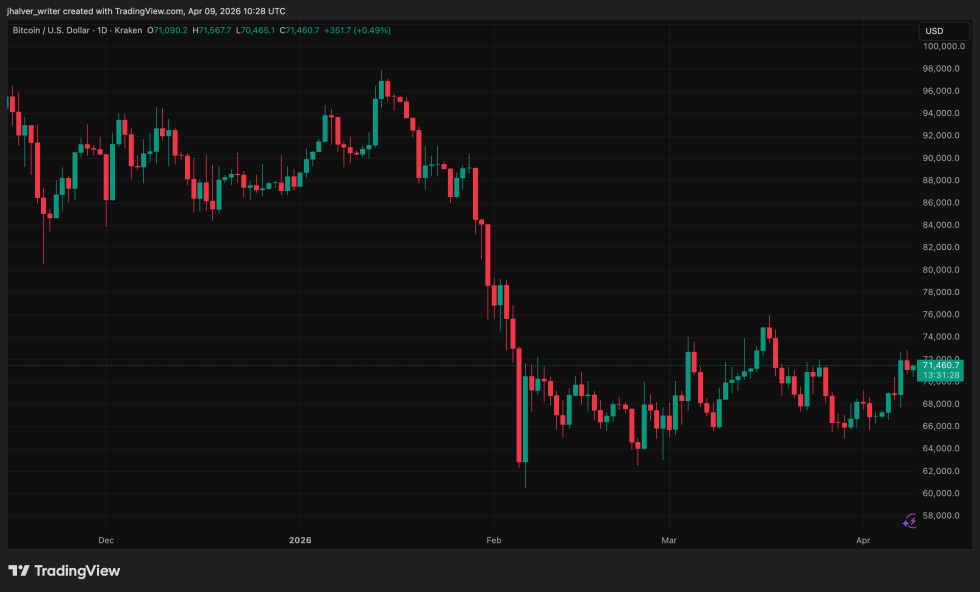
Yesterday, Bitcoin bounced back and reclaimed $72k. At the moment of writing, BTC trades for around $71k on the daily chart. Source: BTCUSD on Tradingview.

Cover image from Perplexity. BTCUSD chart from Tradingview.

Preguntas relacionadas

QWhat is the main argument of the U.S. regulators (CFTC and DOJ) against Arizona's enforcement of its gambling laws on Kalshi?

AThe CFTC and DOJ argue that the contracts offered by Kalshi, which are tied to sports, elections, and other real-world events, qualify as financial derivatives (swaps) under U.S. federal law, specifically the Commodity Exchange Act. They contend that these contracts, because they are settled on future events with economic impact, fall under federal jurisdiction and preempt state gambling statutes.

QWhat specific legal measures are the federal agencies requesting from the court regarding Arizona's case against Kalshi?

AThe Commodity Futures Trading Commission (CFTC) and the Justice Department (DOJ) are asking the court for a temporary restraining order and a preliminary injunction to halt Arizona's criminal case and its enforcement of gambling laws against Kalshi.

QAccording to the article, what was the recent ruling by the Third Circuit court regarding sports event contracts on designated contract markets (DCMs)?

AA recent Third Circuit ruling stated that sports event contracts on designated contract markets (DCMs) are considered 'swaps,' which preempts state gambling laws. However, one judge dissented, calling Kalshi's stance a 'performative sleight' designed to disguise what is essentially sports betting.

QBesides Kalshi, which other major prediction market platform is facing significant legal challenges, and what are some examples?

AKalshi's main rival, Polymarket, is also under significant legal pressure. A New York class action lawsuit was filed in February alleging it runs an unlicensed sports-betting operation. Regulators in Nevada have launched a civil case against its parent company, and authorities in Ohio, Utah, and Iowa are probing the platform. It was also completely banned in Argentina.

QWhat are the two potential future scenarios for U.S. prediction markets outlined at the end of the article, depending on the legal outcome?

AIf federal preemption is upheld, it would de-risk U.S. prediction venues, potentially boosting their liquidity and attractiveness as trading tools. Conversely, if states successfully classify these markets as gambling, the markets may fragment and move offshore or into on-chain venues that are harder to police, thereby raising operational and legal risks for traders.

Lecturas Relacionadas

On-Chain Figures on the Eve of Kickoff: 1.6 Billion Traded Before the World Cup Even Begins

"On-Chain Numbers on the Eve of the World Cup: $1.6 Billion Traded Before Kick-off" Analysis of on-chain markets before the 2026 FIFA World Cup reveals significant crypto integration into football. The most striking figure is the approximately **$1.6 billion** in total trading volume on the single "World Cup Winner" contract on the Polymarket prediction market platform, accumulated before a single match was played. This represents explosive growth for a sector whose annual volume surged from ~$16B in 2024 to ~$64B in 2025. The ecosystem is maturing beyond speculation. Key developments include: 1) **Infrastructure upgrades** like Polymarket's migration to native, regulated USDC stablecoin for settlements; 2) **Reliable data oracles**, such as Chainlink, being used to resolve real-world match outcomes on-chain; and 3) **Official recognition**, with FIFA appointing its first-ever "Prediction Markets" partner. Over 100 contracts now cover everything from the outright winner to individual match results and even non-sporting risks like venue relocation. This evolution marks a fundamental shift. While crypto firms are absent from FIFA's top-tier sponsor list, the technology has deeply penetrated the tournament's financial and predictive infrastructure through regulated stablecoin settlements, decentralized oracles, and new official partnership categories. The regulatory landscape remains complex and varies by jurisdiction, but on-chain markets for the World Cup are already a multi-billion-dollar reality.

marsbitHace 5 min(s)

On-Chain Figures on the Eve of Kickoff: 1.6 Billion Traded Before the World Cup Even Begins

marsbitHace 5 min(s)

From SpaceX's IPO to the Future of Crypto: Which Crypto Sectors Will Host the Trillion-Dollar Narrative?

From the SpaceX IPO, which targets a $750 billion raise at a $1.77 trillion valuation, we can extrapolate capital flow trends relevant to crypto. The focus shifts from speculative narratives to foundational infrastructure and real-world asset (RWA) integration. Key crypto sectors poised to benefit include: 1. **AI Infrastructure**: The narrative is moving from consumer-facing AI applications to underlying, scarce resources like compute power and decentralized GPU networks (e.g., TAO, RENDER, AKT, IO). These protocols are positioning as the essential "picks and shovels" providers for the AI economy. 2. **Real-World Assets (RWA)**: Beyond tokenized treasury bonds, RWA's future lies in on-chain equity and pre-IPO assets like SpaceX. This could democratize access to high-growth assets and reshape global capital flows, benefiting infrastructure projects like ONDO, LINK, and Plume that facilitate issuance, data, and liquidity. 3. **Core Financial Infrastructure**: Stablecoins, payment networks, and DePIN (Decentralized Physical Infrastructure Networks) are critical for settling the future on-chain economy. Their role expands from internal trading tools to foundational layers for global finance, AI systems, and real-world asset networks, leading to potential value reassessment. In summary, the next cycle may prioritize long-term infrastructure value—AI compute, asset tokenization networks, and settlement layers—over short-lived application hype, mirroring the broader market's shift towards funding the foundational systems of the future.

marsbitHace 25 min(s)

From SpaceX's IPO to the Future of Crypto: Which Crypto Sectors Will Host the Trillion-Dollar Narrative?

marsbitHace 25 min(s)

Tech Stocks Plunge and Bitcoin Slumps, Retail Investors Face Ultimate Test Ahead of SpaceX IPO

Technology stocks suffered their biggest drop in months, and Bitcoin fell below the $60,000 mark, coinciding with the eve of SpaceX's massive IPO plans. The sell-off was triggered by strong U.S. jobs data, dashing hopes for Fed rate cuts and reviving fears of further hikes. High-valuation sectors like AI and semiconductors led the declines, with the Nasdaq plunging over 4%. Cryptocurrencies, sensitive to higher interest rates and a strong dollar, also tumbled sharply. This market stress test raises critical questions about the limits of retail investor capital and its next destination. SpaceX's upcoming IPO, which plans to allocate an unusually high 30% of shares to retail investors, now faces a more uncertain landscape. Analysts warn that to buy SpaceX,散户 may need to sell existing holdings, with Tesla seen as a potential source of funds. The market is saturated with speculative options—from crypto and meme stocks to zero-day options and AI-themed ETFs—all competing for the same pool of retail attention and capital. While SpaceX's listing could inject fresh excitement, it also enters a fiercely competitive environment where investor loyalty is fleeting. The ease of zero-commission trading and lower barriers to margin trading accelerate capital rotation between narratives, making it difficult for any single story, even a historic IPO like SpaceX's, to dominate for long.

华尔街日报Hace 1 hora(s)

Tech Stocks Plunge and Bitcoin Slumps, Retail Investors Face Ultimate Test Ahead of SpaceX IPO

华尔街日报Hace 1 hora(s)

Trading

Spot
Futuros
活动图片





