Crypto nears its ‘Netscape moment’ as industry approaches inflection point

cointelegraphPublicado a 2025-12-09Actualizado a 2025-12-09

Resumen

The cryptocurrency industry is approaching its "Netscape moment," driven by advancements in blockchain infrastructure and the rise of regulated investment products, according to Paradigm co-founder Matt Huang. This inflection point mirrors the early internet's mass adoption phase, where ease of use and institutional accessibility became key catalysts. Onchain systems enable open, programmable finance, while regulated products like ETFs attract traditional investors by offering familiar, compliant access. Analysts note over 200 crypto ETPs may launch soon, broadening participation. Despite concerns about speculation and memecoin dominance on some networks, experts argue that centralized platforms and ETFs expand the onchain economy rather than threaten it. The true risk lies in slowed technological progress; continued innovation in functionality and market structures is essential for long-term value creation.

The cryptocurrency industry is approaching its “Netscape moment,” as steady progress in blockchain infrastructure and the rise of regulated investment products drive a new wave of institutional adoption, according to Paradigm co-founder Matt Huang.

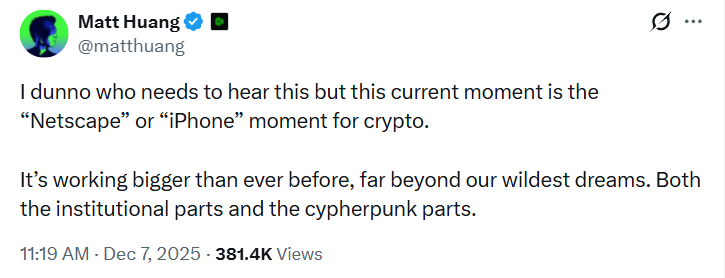
The crypto sector is “facing its ‘Netscape’ or ‘iPhone’ moment,” Huang wrote Sunday in a post on X. “It’s working bigger than ever before, far beyond our wildest dreams. Both the institutional parts and the cypherpunk parts.”

Netscape launched the first easy-to-use web browser for mainstream users in 1994 before going public with a successful initial public offering (IPO) in August 1995, marking the first building block that triggered the internet’s mass adoption.

However, Microsoft saw the large-scale interest and capitalized on it on it by freely bundling Internet Explorer as a pre-installed component of the Windows operating system, outcompeting Netscape to become the most widely used internet browser.
Source: Matt Huang

Onchain usability meets regulated access

In the crypto world, Bitcoin’s (BTC) peer-to-peer model and decentralized finance (DeFi) have enabled a new vision of an open, programmable financial system that cuts out intermediaries.

At the same time, centralized platforms and traditional investment vehicles are attracting a growing share of new capital because they are easier to use and fit within familiar regulatory frameworks.

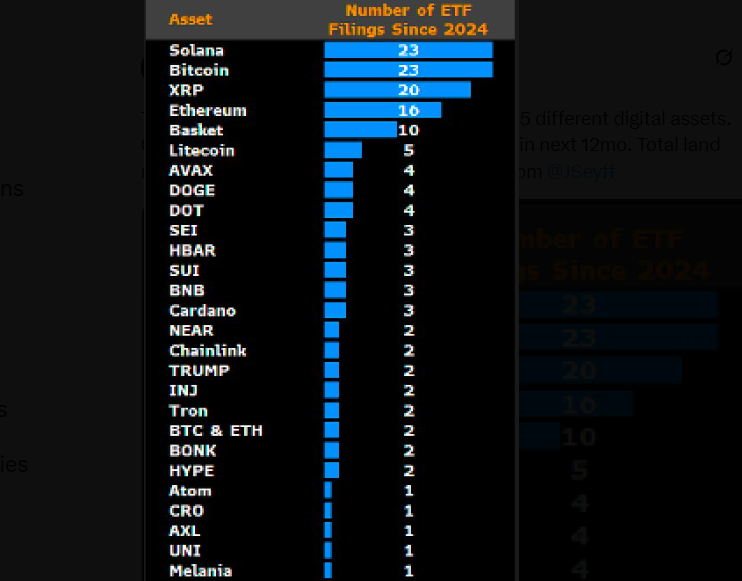
About 200 crypto-based exchange-traded products (ETPs) could launch on the market in the next year, with 155 awaiting approval as of Oct. 22, according to Bloomberg’s senior ETF analyst, Eric Balchunas.

Crypto ETPs provide easier access to altcoins for traditional investors on brokerage platforms that don’t have an account on a centralized cryptocurrency exchange.
Source: Eric Balchunas

Related: Prediction markets emerge as speculative ‘arbitrage arena’ for crypto traders

Onchain products are becoming easier to use, while “regulated” investment vehicles are making crypto more accessible, signaling that the industry may be at the tipping point ahead of mass adoption, Lacie Zhang, market analyst at Bitget Wallet, told Cointelegraph.

“ETFs and similar products legitimize digital assets but don’t replace what onchain systems uniquely offer, such as direct ownership, programmable settlement, and real-time transfers.”

She added that regulated access points tend to pull more liquidity onto underlying networks by drawing in institutional capital and new participants, rather than “displacing onchain activity.”

Related: Bitcoin now settles Visa-scale volumes, but most is for wholesale, not coffee

Despite some concerns about centralization, the rise of centralized finance (CeFi) platforms and ETFs is an “expansion of the onchain economy,” not an inherent threat, according to Marcin Kazmierczak, co-founder of RedStone, a blockchain oracle solutions provider.

“The Netscape moment isn’t about onchain versus CeFi. It’s about the broader crypto ecosystem finally attracting capital that actually stays around long-term,” he told Cointelegraph, adding that the two ecosystems are “not adversarial.”

Netscape moment or dot-com bubble repeat?

However, the crypto industry may still risk a market crash akin to the dot-com bubble, considering that the majority of revenue is derived from speculative memecoin trading for some blockchain networks.

On Solana, memecoin trading accounted for 62% of the network’s decentralized app revenue in June, and the majority of its $1.6 billion in revenue for the first half of 2025.

To reach its true potential, the developers need to focus on advancing the industry’s real-world utility, as the only “real risk” to the industry is a “slowdown in technological development,” according to Edwin Mata, lawyer, co-founder and CEO of tokenization platform Brickken.

“What matters is that onchain environments continue creating functionality, automation, and new market structures, because that is where fundamental value is produced,” he told Cointelegraph.

Magazine: Solana vs Ethereum ETFs, Facebook’s influence on Bitwise — Hunter Horsley

Lecturas Relacionadas

Polymarket's "2028 Presidential Election" Volume King Is... LeBron James???

An article from Odaily Planet Daily, authored by Azuma, discusses a peculiar phenomenon observed on the prediction market platform Polymarket regarding the "2028 US Presidential Election" event. Despite having a real-time probability of less than 1%, unlikely candidates such as NBA star LeBron James (with $48.41 million in trading volume), celebrity Kim Kardashian ($33.84 million), and even ineligible figures like Elon Musk ($23.14 million) and New York City Mayor Zohran Mamdani ($18.39 million) account for approximately 70% of the total trading volume. In contrast, high-probability candidates like Vice President JD Vance ($10.58 million), California Governor Gavin Newsom ($15.71 million), and Secretary of State Marco Rubio ($9.32 million) have significantly lower trading activity. The article explains that this counterintuitive trend is not driven by irrational speculation but by rational strategies. Polymarket offers a 4% annualized holding reward for certain markets, including the 2028 election, to maintain long-term pricing accuracy. This yield exceeds the current 5-year US Treasury rate (3.98%), attracting large investors ("whales") to hold "NO" shares on low-probability candidates for risk-free returns. Additionally, some users utilize a platform feature that allows converting a set of "NO" shares into corresponding "YES" shares for better liquidity or pricing efficiency, rather than directly buying "YES" shares for their preferred candidates. Thus, the seemingly absurd trading activity is strategically motivated.

marsbitHace 30 min(s)

Polymarket's "2028 Presidential Election" Volume King Is... LeBron James???

marsbitHace 30 min(s)

Dialogue with ViaBTC CEO Yang Haipo: Is the Essence of Blockchain a Libertarian Experiment?

"ViaBTC CEO Yang Haipo: Blockchain as a Hardcore Libertarian Experiment" In a deep-dive interview, ViaBTC CEO Yang Haipo reframes the essence of blockchain, arguing it is not merely a new technology or infrastructure but a hardcore libertarian experiment. This experiment, born from the 2008 financial crisis and decades of cypherpunk ideology, tests a fundamental question: to what extent can freedom and self-organization exist without centralized trust? The discussion highlights the experiment's verified outcomes. On one hand, it has proven its core value of censorship resistance, providing critical financial lifelines for entities like WikiLeaks and individuals in hyperinflationary or sanctioned countries via tools like stablecoins. However, Yang points out a key paradox: the most successful product, USDT, is itself a centralized compromise, showing users prioritize a less-controlled pipeline over pure decentralization. On the other hand, the experiment has exposed the severe costs of this freedom—a "dark forest" without safeguards. Events like the collapses of LUNA, Celsius, and FTX, resulting in massive wealth destruction and prison sentences for founders, underscore the system's fragility and the inherent risks of an unregulated environment. Yang observes that despite decentralized protocols, human nature inevitably recreates centralized power structures, speculative frenzies, and narrative-driven cycles (from ICOs to Meme coins), where emotion and belonging often trump technological substance. Looking forward, he believes blockchain's future is significant but niche. Its real value lies in serving specific, real-world needs for financial sovereignty and bypassing traditional controls, not as a universal infrastructure replacing all centralized systems. For the average participant, Yang's crucial advice is to cultivate independent judgment. True freedom is not holding a crypto wallet, but possessing a mind resilient to groupthink and narrative hype in a high-risk, often irrational market.

marsbitHace 44 min(s)

Dialogue with ViaBTC CEO Yang Haipo: Is the Essence of Blockchain a Libertarian Experiment?

marsbitHace 44 min(s)

Trading

Spot
Futuros
活动图片