Crypto Morning Report: US ADP Data Falls Short of Expectations, Binance SAFU Fund Buys Another $100 Million in Bitcoin

marsbitPublicado a 2026-02-05Actualizado a 2026-02-05

Resumen

U.S. ADP employment data fell short of expectations, reporting 22,000 jobs vs. 48,000 expected. Binance's SAFU fund purchased an additional $100 million worth of Bitcoin. In regulatory news, U.S. Senate Democrats are discussing crypto market structure, while the SEC charged three crypto market makers—ZM Quant, Gotbit, and CLS Global—with market manipulation. CME Group is exploring the launch of its own cryptocurrency, "CME Coin." On the investment front, TRM Labs raised $70 million, while Tether lowered its fundraising target to $5 billion amid investor skepticism. Solana co-founder updated his profile picture, sparking speculation about Backpack's upcoming TGE. Yi Lihua’s Trend Research transferred significant amounts to Binance, likely for loan repayments. Prediction markets Opinion and BLUFF secured $20 million and $21 million in funding, respectively.

Author: Deep Tide TechFlow

Yesterday's Market Dynamics

US Senate Democrats Restart Cryptocurrency Market Structure Discussions

According to Crypto in America, Senate Democrats plan to restart discussions on cryptocurrency market structure this afternoon. This is an important meeting following the postponement of last month's markup session for the "Clarity Act." The meeting will focus on key issues including ethics and DeFi. Previously, the White House had convened representatives from the cryptocurrency and banking industries for "constructive" dialogue on topics such as stablecoin yields. Patrick Witt, Executive Director of the White House Cryptocurrency Committee, urged all parties to reach an agreement by the end of the month.

US January ADP Employment: 22,000, Expected 48,000

US January ADP employment was 22,000, compared to an expectation of 48,000 and a previous value of 41,000.

US SEC Files Market Manipulation Charges Against Three Crypto Market Makers ZM Quant, Gotbit, and CLS Global

According to Financefeeds, the US Securities and Exchange Commission (SEC) has filed market manipulation charges against three crypto market makers—ZM Quant, Gotbit, and CLS Global. The SEC alleges that these companies used algorithms for wash trading, creating artificial trading volume to deceive retail investors. Additionally, the SEC has sued nine individuals, including promoters and company employees, accusing them of hiring manipulation services and executing meaningless trades, violating the anti-fraud and registration provisions of securities laws.

As part of the investigation, the US Federal Bureau of Investigation (FBI) conducted a sting operation using a fictional token called NexFundAI, exposing these companies' willingness to engage in wash trading. This case has led to 15 entities being charged and has triggered related criminal proceedings.

Binance SAFU Fund Buys Another $100 Million in Bitcoin

According to on-chain data monitoring, the Binance SAFU Fund withdrew 1,315 Bitcoin from a Binance hot wallet address one minute ago, worth approximately $100 million.

Solana Co-Founder Changes Avatar, Adds Backpack and Laser Eye Elements; Community Speculates TGE May Be Imminent

Solana co-founder Toly changed his X platform avatar, adding laser eyes and Backpack elements to the original Moonbird derivative avatar.

Some community users interpreted this change as a possible hint that Backpack's Token Generation Event (TGE) is approaching.

CME Group Plans to Launch Token "CME Coin," Collaborates with Google on Tokenized Cash Solution

According to CoinDesk, derivatives exchange CME Group CEO Terry Duffy revealed that the company is exploring the launch of its own cryptocurrency, "CME Coin," which may operate on a decentralized network.

Duffy stated in the latest earnings call that CME Group is evaluating different forms of margin and is collaborating with Google to develop a "tokenized cash" solution, expected to launch later this year.

Yi Lihua's Trend Research Transferred Another 25,000 ETH to Binance Early This Morning, Worth Approximately $53.24 Million

According to monitoring by Onchain Lens (@OnchainLens), Yi Lihua's Trend Research transferred another 25,000 ETH (worth approximately $53.24 million) to Binance exchange early this morning.

Data shows that Trend Research has now deposited a cumulative total of 188,588 ETH (worth approximately $426.87 million) into Binance for sale and loan repayment.

Prediction Market Opinion Completes $20 Million Series A Funding

According to CoinDesk, blockchain prediction market platform Opinion announced the completion of a $20 million Pre-A funding round. Investors included Hack VC, Jump Crypto, Primitive Ventures, and Decasonic, among others. The platform uses a fully on-chain settlement mechanism and currently handles one-third of the global prediction market trading volume, with open interest exceeding $130 million.

Prediction Market Platform BLUFF Completes $21 Million Funding Round, Led by 1kx

According to Chainwire, prediction market platform BLUFF has completed a $21 million strategic funding round led by 1kx, with participation from Makers Fund, Maximum Frequency Ventures, Delphi Ventures Founders, and other institutions, as well as sports champion and tech investor Tristan Thompson.

The BLUFF team consists of former executives from platforms like Stake, Bet365, William Hill, and Bodog, and is building a socialized prediction market platform for the new generation. The platform focuses on speed, transparency, and user benefit alignment, offering instant registration, real-time settlement, provably fair prediction mechanisms, and reward mechanisms for user participation in the ecosystem.

Blockchain Intelligence Company TRM Labs Completes $70 Million Series C Funding, Led by Blockchain Capital

According to Fortune magazine, UK-based blockchain intelligence company TRM Labs announced the completion of a $70 million Series C funding round, reaching a valuation of $1 billion. This round was led by early investor Blockchain Capital, with participation from traditional institutions such as Goldman Sachs, Bessemer, Brevan Howard, Thoma Bravo, and Citi Ventures.

Financial Times: Tether Lowers Funding Target to Just $5 Billion as Investors Question $500 Billion Valuation

According to the Financial Times, global largest stablecoin issuer Tether has lowered its funding target, from the original $15-20 billion to possibly just $5 billion, due to investor skepticism about its $500 billion valuation target.

Tether CEO Paolo Ardoino stated in an interview that the $15-20 billion funding amount was a "misunderstanding," and it was merely the maximum amount they were willing to sell, not the target. He emphasized that the company is highly profitable and "very satisfied" even without selling equity.

Ardoino also compared Tether to AI companies, saying: "AI companies generate the same amount of profit as us, just with a negative sign in front." It is reported that Tether's profit last year was approximately $10 billion, mainly from returns on its held assets, but profits in 2025 decreased by about 25% year-on-year.

Last September, it was reported that stablecoin giant Tether was seeking to raise up to $20 billion at a $500 billion valuation.

Market Dynamics
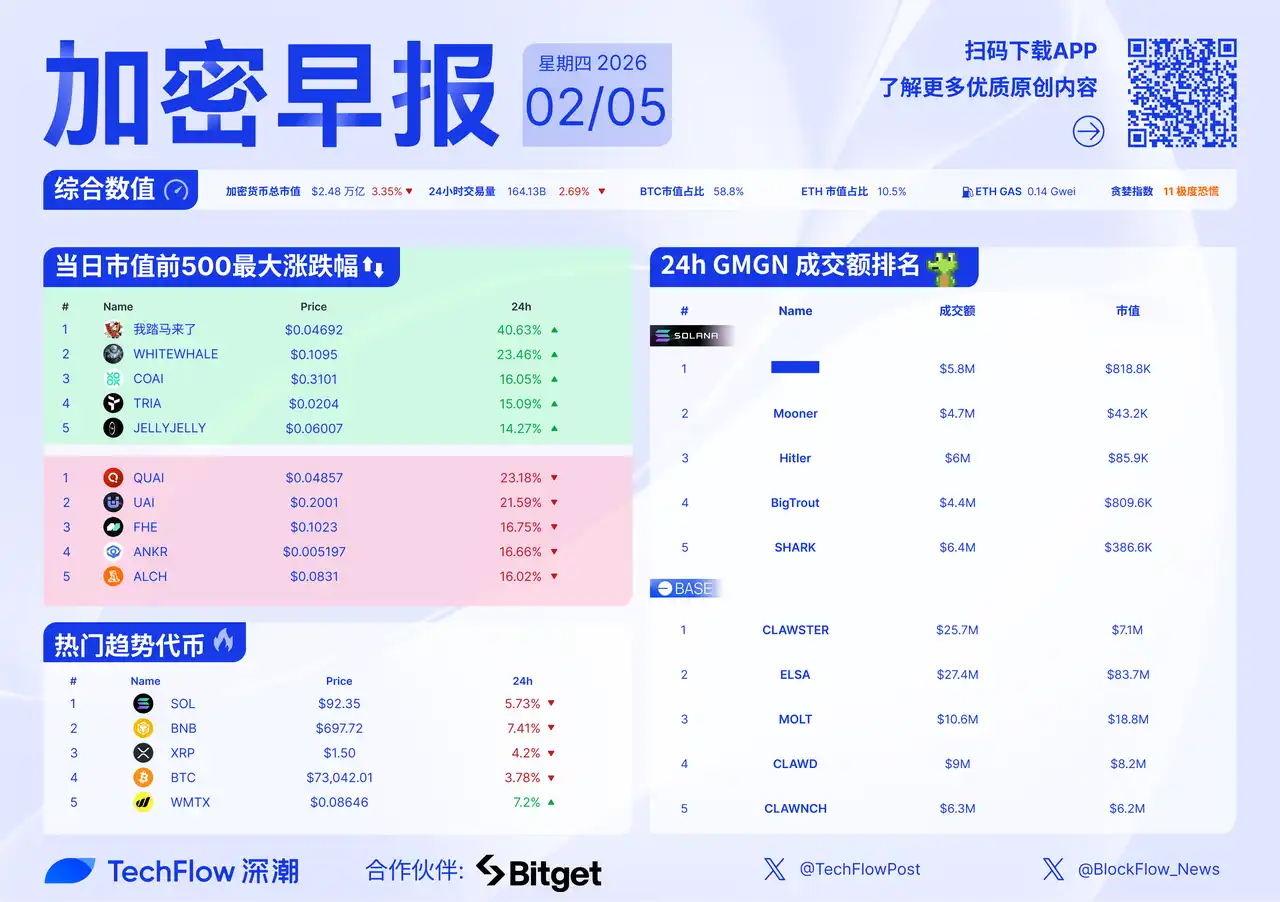
Recommended Reading

GameStop Exits and Runs Away, Saylor Keeps Buying

This article discusses how GameStop once attempted to explore new growth paths through Bitcoin investment but ultimately chose to exit. In contrast, Strategy company firmly holds and continues to accumulate Bitcoin, demonstrating a completely different belief and strategy. The article analyzes the logic and risks of companies using Bitcoin as a treasury asset and predicts three possible future development paths.

X Spends $1 Million Rewarding Good Articles; What Kind of Content Finally Got the Money?

This article discusses a long-form content creation contest hosted by platform X with a total prize pool of $2.15 million, aimed at incentivizing creators to produce high-quality original content, while attracting paying users and supporting the platform's long-form content features and AI models.

February 4th Market Summary: Software Stock Crash Triggers Chain Reaction, Safe-Haven Assets Rally Sharply

This article analyzes the volatility in global markets on February 4, 2026, particularly the crash in software stocks and the cryptocurrency market. It explores the impact of AI technology on SaaS companies, the reasons behind gold's rebound, and the core contradictions in the market.

OpenClaw and Moltbook Event Recap: From AI Social Narrative to Agent Economy Outlook

This article explores the latest developments in AI Agent technology, particularly the events surrounding OpenClaw and Moltbook and their market impact. It analyzes OpenClaw's technical architecture and innovation, discusses the false prosperity phenomenon of the Moltbook platform, and looks at future trends in the combination of AI × Crypto.

Tiger Research: How Is This Crypto Winter Different?

This article analyzes that the current crypto market is in a downward cycle, with increasing skepticism. Past crypto winters were mainly triggered by internal issues, while current market fluctuations are more driven by external factors such as ETF approvals, tariff policies, and interest rate changes. The macroeconomic environment is crucial for the future of the crypto market, and expectations of interest rate cuts and liquidity release may be key to driving market recovery. The future bull market will no longer be a blanket rise but will see separate development in compliant and non-compliant zones, with differentiated market performance.


Preguntas relacionadas

QWhat was the reported US ADP employment number for January, and how did it compare to expectations?

AThe US ADP employment number for January was 22,000, which was significantly below the expected 48,000.

QWhich three crypto market makers did the US SEC charge with market manipulation?

AThe US SEC charged ZM Quant, Gotbit, and CLS Global with market manipulation.

QHow much Bitcoin did the Binance SAFU fund recently purchase, and what was its approximate value?

AThe Binance SAFU fund purchased 1,315 Bitcoin, valued at approximately $100 million.

QWhat is the name of the new cryptocurrency that CME Group is exploring, and who are they partnering with for its development?

ACME Group is exploring a cryptocurrency called 'CME Coin' and is partnering with Google to develop a tokenized cash solution.

QWhat was the final adjusted fundraising target for Tether, and why was it lowered from the initial goal?

ATether lowered its fundraising target to potentially just $5 billion from an initial $15-20 billion because investors were skeptical of its $500 billion valuation target.

Lecturas Relacionadas

Has the 'Digital Gold' Narrative for BTC Failed?

**Title: Has the "Digital Gold" Narrative for Bitcoin Failed?** The article argues that Bitcoin's "digital gold" narrative remains valid despite a recent sharp price decline (from a peak near $126k in Oct 2025 to briefly under $61k in Feb 2026). It presents a long-term investment framework based on three core points: **1. Viewing Bitcoin as an Asset:** Bitcoin is presented as a superior potential store of value compared to gold. Key arguments are its absolute scarcity (21 million cap), superior portability, and transparent auditability via its public ledger. While acknowledging its current use in early, volatile stages (~3-4% global adoption), the author draws parallels to the early, disruptive phases of the internet and e-commerce. **2. Understanding the Recent Downturn:** The current ~50% correction is framed as a predictable, consensus-driven cycle following its post-halving peak (the 2024 halving preceded the Oct 2025 high). A crucial factor is a historic "changing of hands": the influx of new institutional buyers via ETFs allowed early, low-cost holders (miners, OG believers) to take profits. The author notes that while severe, Bitcoin's historical drawdowns (e.g., 93% in 2011, 77% in 2021-22) have been progressively smaller, suggesting maturing holder structure and decreasing volatility over time. **3. The Long-Term Perspective:** The long-term thesis hinges on Bitcoin capturing a portion of gold's market value. With Bitcoin's market cap at ~$1.4 trillion (at $70k) versus gold's ~$20 trillion, significant upside potential exists if the "digital gold" narrative is partially realized. However, the author strongly cautions that short-term risks remain, the bottom is unpredictable, and high volatility is inherent. The real risk is not Bitcoin failing but poor personal position management (over-leverage, wrong capital) and a lack of deep understanding, which can force investors out during severe downturns. The conclusion uses Amazon's 95% crash post-2000 dot-com bubble and subsequent 42x recovery as an analogy. The ultimate question is not if Bitcoin's price will rise, but if an investor's strategy and conviction can withstand the volatility to see the long-term play out. The recent divergence (gold up, Bitcoin down) is posed not as a narrative failure, but as potential evidence of this ongoing, painful transition from a speculative asset to a mainstream allocation.

marsbitHace 3 hora(s)

Has the 'Digital Gold' Narrative for BTC Failed?

marsbitHace 3 hora(s)

Has BTC's 'Digital Gold' Narrative Failed?

The article discusses Bitcoin's "digital gold" narrative, its recent price drop, and long-term outlook through the perspective of "Jason". It argues the narrative is not a failure but that Bitcoin represents a superior, new asset class due to its fixed supply (21 million), portability, and auditability. The piece compares its current ~3-4% global adoption rate to early internet/e-commerce, suggesting significant growth potential. Regarding the 2025-2026 price decline (from ~$126k to briefly under $61k), the author views it as a predictable, consensus-driven sell-off within Bitcoin's ~4-year cycle post-halving, exacerbated by a major "handover" from early, low-cost holders to new institutional buyers via ETFs. A key observation is that historical peak-to-trough drawdowns have lessened over time (e.g., 93% in 2011 to ~50% in 2026), indicating maturing volatility as holder structure changes. For the long term, the author uses a simple framework: Bitcoin's total market cap (~$1.4T at $70k) is only about 7% of gold's (~$20T). Even capturing 30-50% of gold's value would imply substantial upside. However, the article strongly cautions against viewing this as investment advice, emphasizing extreme volatility and the critical importance of risk management, position sizing, and deep fundamental understanding to survive severe drawdowns. It concludes by drawing a parallel to Amazon's 95% crash in 2000 and subsequent 42x recovery, stressing that the key is surviving market cycles to realize long-term potential.

链捕手Hace 3 hora(s)

Has BTC's 'Digital Gold' Narrative Failed?

链捕手Hace 3 hora(s)

From Code to Cognition: A Ten-Thousand-Word Guide to the Evolution of the Robot Brain

"From Code to Cognition: The Evolution of Robot Brains" The journey of robotic intelligence has shifted dramatically from manually coded systems to AI-driven brains. For decades, robots relied on layered software stacks—perception, state estimation, planning, control—each handcrafted. While predictable, they lacked adaptability. The 2010s saw deep learning revolutionize perception (e.g., object detection) and control (via reinforcement learning), but learned skills remained narrow. The arrival of Large Language Models (LLMs) marked a turning point. LLMs acted as high-level planners, interpreting natural language instructions and generating sequences of actions for traditional robotic systems to execute. However, true integration came with Visual-Language-Action (VLA) models, which fused vision, language, and motion prediction into a single network. Pioneered by models like RT-2 and open-source projects like OpenVLA, VLAs enable robots to reason and act directly from visual input and commands. The most advanced humanoid robots now employ a "dual-brain" architecture: a slow-thinking, large VLA (System 2) for reasoning and planning, and a fast-reacting, small network (System 1) for high-frequency motion control, sometimes with an even lower-level System 0 for balance. This split balances cognition with the physics of real-time movement. Computation is split between onboard hardware (e.g., NVIDIA Jetson) for safety-critical control loops and cloud/edge servers for non-critical tasks like learning and interfaces. A crucial driver is the open-source ecosystem—models like GR00T and OpenVLA allow startups to build upon pre-trained brains and fine-tune them with their own data, accelerating development. Despite progress, current systems struggle with recovery from errors, sample inefficiency, and long-horizon tasks. This has spurred the rise of **World Models**—neural networks that predict the consequences of actions. By simulating possible futures before acting (like NVIDIA Cosmos or Meta V-JEPA), robots can plan, recover, and generalize better. This represents the next frontier: shifting intelligence from learned reactions to an internal model of physics and cause-and-effect. The field is rapidly evolving. While not yet at its "ChatGPT moment," the convergence of cheaper hardware, scalable simulation, and world models points toward robots that are increasingly capable, adaptive, and useful. The question is shifting from "what can robots do?" to "what *should* they do?"

marsbitHace 4 hora(s)

From Code to Cognition: A Ten-Thousand-Word Guide to the Evolution of the Robot Brain

marsbitHace 4 hora(s)

AI Bubble Is Bursting

The AI Bubble is Bursting: A Necessary Purge on the Path to Ubiquitous Intelligence Market volatility has reignited debates about an AI bubble, with figures like Ray Dalio pointing to high valuations. However, this parallels the dot-com bubble, which, despite its crash, laid the physical infrastructure for today's internet era. The current AI investment frenzy, with tech giants planning trillions in infrastructure spending far outstripping current AI application revenues, appears similarly imbalanced. This 'bubble' is seen as an inevitable phase for a disruptive technology, paying the "innovation tax." Critically, AI inference costs have plummeted over 99.7% since 2023, making intelligence nearly free at the margin. This hasn't reduced spending but has instead unlocked massive new demand, as seen in enterprise AI cloud expenditure tripling. This follows the Jevons Paradox: efficiency gains lead to greater total consumption. The market is now entering a cleansing phase, weeding out speculative ventures lacking real moats. The deeper shift is a move from capital expenditure (CapEx) on hardware to value creation in operational expenditure (OpEx) through AI applications that solve real industry problems. While infrastructure valuations are high, rapid earnings growth from widespread AI adoption across sectors—from manufacturing and finance to law and healthcare—may digest these valuations over time. Ultimately, this creative destruction will leave behind robust infrastructure and optimized models, cheaply powering an AI-augmented future for all industries, much as the internet became indispensable after its own bubble burst. The core productive potential remains undiminished.

链捕手Hace 4 hora(s)

AI Bubble Is Bursting

链捕手Hace 4 hora(s)

Trading

Spot
Futuros

Artículos destacados

Qué es BITCOIN

Entendiendo HarryPotterObamaSonic10Inu (ERC-20) y Su Posición en el Espacio Cripto En los últimos años, el mercado de criptomonedas ha sido testigo de un aumento en la popularidad de las monedas meme, capturando el interés no solo de los comerciantes, sino también de aquellos que buscan compromiso comunitario y valor de entretenimiento. Entre estos tokens únicos se encuentra HarryPotterObamaSonic10Inu (ERC-20), un proyecto intrigante que mezcla referencias culturales en el tejido de las criptomonedas. Este artículo profundiza en los aspectos clave de HarryPotterObamaSonic10Inu, explorando sus mecanismos, ethos impulsado por la comunidad y su relación con el paisaje cripto más amplio. ¿Qué es HarryPotterObamaSonic10Inu (ERC-20)? Como su nombre sugiere, HarryPotterObamaSonic10Inu es una moneda meme construida sobre la blockchain de Ethereum, clasificada bajo el estándar ERC-20. A diferencia de las criptomonedas tradicionales que pueden enfatizar la utilidad práctica o el potencial de inversión, este token prospera en el valor de entretenimiento y la fuerza de su comunidad. El proyecto tiene como objetivo fomentar un entorno donde los usuarios comprometidos puedan reunirse, compartir ideas y participar en actividades inspiradas por diversos fenómenos culturales. Una característica notable de HarryPotterObamaSonic10Inu es su cero impuestos en las transacciones. Este atractivo elemento tiene como objetivo incentivar el comercio y la participación comunitaria, sin cargos adicionales que puedan disuadir a los comerciantes de pequeña escala. El suministro total de la moneda está establecido en mil millones de tokens, una cifra que marca su intención de mantener una circulación sustancial dentro de la comunidad. Creador de HarryPotterObamaSonic10Inu (ERC-20) Los orígenes de HarryPotterObamaSonic10Inu están algo envueltos en misterio; los detalles sobre el creador siguen siendo desconocidos. El desarrollo de este token carece de un equipo identificable o de un plan explícito, lo cual no es inusual dentro del sector de monedas meme. En cambio, el proyecto ha surgido de manera orgánica, con su progreso muy dependiente del entusiasmo y la participación de su comunidad. Inversores de HarryPotterObamaSonic10Inu (ERC-20) En cuanto a inversiones externas y respaldo, HarryPotterObamaSonic10Inu también sigue siendo ambiguo. El token no lista ninguna fundación de inversión conocida o apoyo organizacional significativo. En cambio, la savia del proyecto es su comunidad de base, que informa su crecimiento y sostenibilidad a través de la acción colectiva y el compromiso en el espacio cripto. ¿Cómo Funciona HarryPotterObamaSonic10Inu (ERC-20)? Como una moneda meme, HarryPotterObamaSonic10Inu opera principalmente fuera de los marcos tradicionales que a menudo rigen el valor de los activos. Hay varios aspectos distintivos que definen cómo funciona el proyecto: Transacciones Sin Impuestos: Sin tarifas impositivas en las transacciones, los usuarios pueden comprar y vender el token libremente sin preocuparse por costos ocultos. Compromiso Comunitario: El proyecto prospera en la interacción comunitaria, aprovechando plataformas de redes sociales para crear entusiasmo y facilitar la participación. Las discusiones, el intercambio de contenido y el compromiso son elementos cruciales que ayudan a expandir su alcance y fomentar la lealtad entre los seguidores. Sin Utilidad Práctica: Cabe señalar que HarryPotterObamaSonic10Inu no ofrece utilidad concreta dentro del ecosistema financiero. Más bien, se clasifica como un token principalmente para actividades de entretenimiento y comunitarias. Referencia Cultural: El token incorpora astutamente elementos de la cultura popular para atraer interés, conectando con entusiastas de los memes y seguidores de las criptomonedas por igual. HarryPotterObamaSonic10Inu ejemplifica cómo las monedas meme operan de manera diferente a los proyectos de criptomonedas más tradicionales, ingresando al mercado como construcciones sociales innovadoras en lugar de activos utilitarios. Cronología de HarryPotterObamaSonic10Inu (ERC-20) La historia de HarryPotterObamaSonic10Inu está marcada por varios hitos notables: Creación: El token surgió de un meme viral, capturando la imaginación de muchos entusiastas de las criptomonedas. Las fechas específicas de creación no están disponibles, subrayando su ascenso orgánico. Listado en Exchanges: HarryPotterObamaSonic10Inu ha llegado a varios exchanges, permitiendo un acceso y comercio más fácil por parte de la comunidad. Iniciativas de Compromiso Comunitario: Actividades continuas destinadas a mejorar la interacción comunitaria, incluyendo concursos, campañas en redes sociales y generación de contenido por parte de fanáticos y defensores. Planes de Expansión Futuros: La hoja de ruta del proyecto incluye el lanzamiento de una colección de NFT, mercancía y un sitio de comercio electrónico relacionado con sus temas culturales, involucrando aún más a la comunidad e intentando añadir más dimensiones a su ecosistema. Puntos Clave Sobre HarryPotterObamaSonic10Inu (ERC-20) Naturaleza Impulsada por la Comunidad: El proyecto prioriza la participación colectiva y la creatividad, asegurando que la involucración de los usuarios esté a la vanguardia de su desarrollo. Clasificación como Moneda Meme: Representa la epítome de las criptomonedas basadas en el entretenimiento, diferenciándose de los vehículos de inversión tradicionales. Sin Afiliación Directa con Bitcoin: A pesar de la similitud en el nombre del ticker, HarryPotterObamaSonic10Inu es distinto y no tiene relación con Bitcoin u otras criptomonedas establecidas. Enfoque en la Colaboración: HarryPotterObamaSonic10Inu está diseñado para crear un espacio para la colaboración y el intercambio de historias entre sus poseedores, proporcionando una vía para la creatividad y el vínculo comunitario. Perspectivas Futuras: La ambición de expandirse más allá de su premisa inicial hacia NFTs y mercancías describe un camino para que el proyecto potencialmente ingrese a avenidas más tradicionales dentro de la cultura digital. A medida que las monedas meme continúan capturando la imaginación de la comunidad de criptomonedas, HarryPotterObamaSonic10Inu (ERC-20) se destaca debido a sus lazos culturales y su enfoque centrado en la comunidad. Si bien puede no encajar en el molde típico de un token impulsado por la utilidad, su esencia radica en la alegría y la camaradería fomentadas entre sus seguidores, destacando la naturaleza en evolución de las criptomonedas en una era cada vez más digital. A medida que el proyecto continúa desarrollándose, será importante observar cómo las dinámicas comunitarias influyen en su trayectoria en el cambiante paisaje de la tecnología blockchain.

1.7k Vistas totalesPublicado en 2024.04.01Actualizado en 2024.12.03

Qué es BITCOIN

Cómo comprar BTC

¡Bienvenido a HTX.com! Hemos hecho que comprar Bitcoin (BTC) sea simple y conveniente. Sigue nuestra guía paso a paso para iniciar tu viaje de criptos.Paso 1: crea tu cuenta HTXUtiliza tu correo electrónico o número de teléfono para registrarte y obtener una cuenta gratuita en HTX. Experimenta un proceso de registro sin complicaciones y desbloquea todas las funciones.Obtener mi cuentaPaso 2: ve a Comprar cripto y elige tu método de pagoTarjeta de crédito/débito: usa tu Visa o Mastercard para comprar Bitcoin (BTC) al instante.Saldo: utiliza fondos del saldo de tu cuenta HTX para tradear sin problemas.Terceros: hemos agregado métodos de pago populares como Google Pay y Apple Pay para mejorar la comodidad.P2P: tradear directamente con otros usuarios en HTX.Over-the-Counter (OTC): ofrecemos servicios personalizados y tipos de cambio competitivos para los traders.Paso 3: guarda tu Bitcoin (BTC)Después de comprar tu Bitcoin (BTC), guárdalo en tu cuenta HTX. Alternativamente, puedes enviarlo a otro lugar mediante transferencia blockchain o utilizarlo para tradear otras criptomonedas.Paso 4: tradear Bitcoin (BTC)Tradear fácilmente con Bitcoin (BTC) en HTX's mercado spot. Simplemente accede a tu cuenta, selecciona tu par de trading, ejecuta tus trades y monitorea en tiempo real. Ofrecemos una experiencia fácil de usar tanto para principiantes como para traders experimentados.

5.1k Vistas totalesPublicado en 2024.12.12Actualizado en 2026.06.02

Cómo comprar BTC

Qué es $BITCOIN

ORO DIGITAL ($BITCOIN): Un Análisis Integral Introducción al ORO DIGITAL ($BITCOIN) ORO DIGITAL ($BITCOIN) es un proyecto basado en blockchain que opera en la red Solana, cuyo objetivo es combinar las características de los metales preciosos tradicionales con la innovación de las tecnologías descentralizadas. Aunque comparte un nombre con Bitcoin, a menudo referido como “oro digital” debido a su percepción como un refugio de valor, ORO DIGITAL es un token separado diseñado para crear un ecosistema único dentro del paisaje Web3. Su meta es posicionarse como un activo digital alternativo viable, aunque los detalles sobre sus aplicaciones y funcionalidades aún están en desarrollo. ¿Qué es ORO DIGITAL ($BITCOIN)? ORO DIGITAL ($BITCOIN) es un token de criptomoneda diseñado explícitamente para su uso en la blockchain de Solana. A diferencia de Bitcoin, que proporciona un papel de almacenamiento de valor ampliamente reconocido, este token parece centrarse en aplicaciones y características más amplias. Aspectos notables incluyen: Infraestructura Blockchain: El token está construido sobre la blockchain de Solana, conocida por su capacidad para manejar transacciones de alta velocidad y bajo costo. Dinámicas de Suministro: ORO DIGITAL tiene un suministro máximo limitado a 100 cuatrillones de tokens (100P $BITCOIN), aunque los detalles sobre su suministro circulante no se han divulgado actualmente. Utilidad: Si bien las funcionalidades precisas no están delineadas explícitamente, hay indicios de que el token podría ser utilizado para diversas aplicaciones, potencialmente involucrando aplicaciones descentralizadas (dApps) o estrategias de tokenización de activos. ¿Quién es el Creador de ORO DIGITAL ($BITCOIN)? En la actualidad, la identidad de los creadores y el equipo de desarrollo detrás de ORO DIGITAL ($BITCOIN) sigue siendo desconocida. Esta situación es típica entre muchos proyectos innovadores dentro del espacio blockchain, particularmente aquellos alineados con las finanzas descentralizadas y fenómenos de monedas meme. Si bien tal anonimato puede fomentar una cultura impulsada por la comunidad, intensifica las preocupaciones sobre la gobernanza y la responsabilidad. ¿Quiénes son los Inversores de ORO DIGITAL ($BITCOIN)? La información disponible indica que ORO DIGITAL ($BITCOIN) no tiene patrocinadores institucionales conocidos ni inversiones destacadas de capital de riesgo. El proyecto parece operar en un modelo de peer-to-peer centrado en el apoyo y la adopción de la comunidad en lugar de rutas de financiamiento tradicionales. Su actividad y liquidez se sitúan principalmente en intercambios descentralizados (DEX), como PumpSwap, en lugar de plataformas de trading centralizadas establecidas, lo que resalta aún más su enfoque de base. Cómo Funciona ORO DIGITAL ($BITCOIN) Los mecanismos operativos de ORO DIGITAL ($BITCOIN) pueden elaborarse en función de su diseño blockchain y atributos de red: Mecanismo de Consenso: Al aprovechar el único proof-of-history (PoH) de Solana combinado con un modelo de proof-of-stake (PoS), el proyecto asegura una validación de transacciones eficiente que contribuye al alto rendimiento de la red. Tokenómica: Si bien los mecanismos deflacionarios específicos no se han detallado extensamente, el vasto suministro máximo de tokens implica que podría atender microtransacciones o casos de uso nicho que aún están por definirse. Interoperabilidad: Existe el potencial de integración con el ecosistema más amplio de Solana, incluyendo varias plataformas de finanzas descentralizadas (DeFi). Sin embargo, los detalles sobre integraciones específicas permanecen no especificados. Cronología de Eventos Clave Aquí hay una cronología que destaca hitos significativos relacionados con ORO DIGITAL ($BITCOIN): 2023: El despliegue inicial del token ocurre en la blockchain de Solana, marcado por su dirección de contrato. 2024: ORO DIGITAL gana visibilidad al estar disponible para trading en intercambios descentralizados como PumpSwap, permitiendo a los usuarios comerciar contra SOL. 2025: El proyecto presencia actividad de trading esporádica y potencial interés en compromisos liderados por la comunidad, aunque no se han documentado asociaciones notables o avances técnicos hasta el momento. Análisis Crítico Fortalezas Escalabilidad: La infraestructura subyacente de Solana soporta altos volúmenes de transacciones, lo que podría mejorar la utilidad de $BITCOIN en varios escenarios de transacción. Accesibilidad: El potencial bajo precio de trading por token podría atraer a inversores minoristas, facilitando una participación más amplia debido a oportunidades de propiedad fraccionada. Riesgos Falta de Transparencia: La ausencia de patrocinadores, desarrolladores o un proceso de auditoría conocidos públicamente puede generar escepticismo sobre la sostenibilidad y confiabilidad del proyecto. Volatilidad del Mercado: La actividad de trading depende en gran medida del comportamiento especulativo, lo que puede resultar en una volatilidad de precios significativa y en incertidumbre para los inversores. Conclusión ORO DIGITAL ($BITCOIN) surge como un proyecto intrigante pero ambiguo dentro del ecosistema de Solana en rápida evolución. Si bien intenta aprovechar la narrativa del “oro digital”, su alejamiento del papel establecido de Bitcoin como refugio de valor subraya la necesidad de una diferenciación más clara de su utilidad y estructura de gobernanza previstas. La aceptación y adopción futura dependerán probablemente de abordar la actual opacidad y de definir sus estrategias operativas y económicas de manera más explícita. Nota: Este informe abarca información sintetizada disponible hasta octubre de 2023, y pueden haber ocurrido desarrollos más allá del período de investigación.

83 Vistas totalesPublicado en 2025.05.13Actualizado en 2025.05.13

Qué es $BITCOIN

Discusiones

Bienvenido a la comunidad de HTX. Aquí puedes mantenerte informado sobre los últimos desarrollos de la plataforma y acceder a análisis profesionales del mercado. A continuación se presentan las opiniones de los usuarios sobre el precio de BTC (BTC).

活动图片













