Crypto Morning Report: Crypto Market Bloodbath, Strategy Releases Q4 Earnings

marsbitPublicado a 2026-02-06Actualizado a 2026-02-06

Resumen

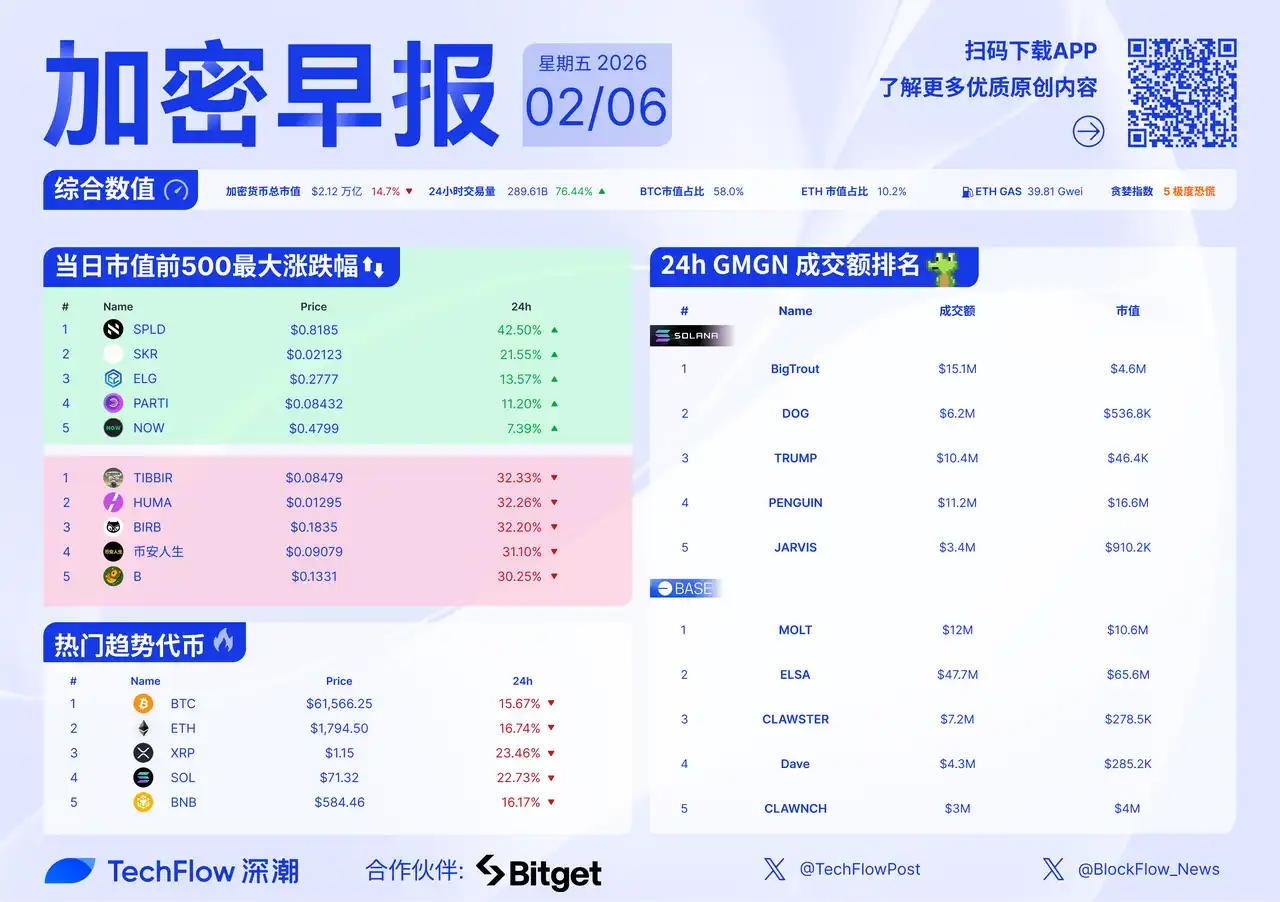
Crypto Market Bloodbath: Key Updates & Strategy's Q4 Report The crypto market experienced significant turmoil, with Bitcoin dropping below $73,000. Major developments include: U.S. economic data showed higher-than-expected weekly jobless claims. The CFTC withdrew a proposal to ban political prediction markets. Treasury Secretary Scott Bessent testified that the U.S. will not "bail out" Bitcoin or direct banks to buy crypto, though the government holds over $15B in seized BTC. Policy moves included Virginia proposing a bill to create a state cryptocurrency reserve fund. The House launched an investigation into a $500M deal between a Trump-linked crypto project and an UAE entity. Company news featured Espresso releasing its ESP tokenomics with a 10% airdrop. Binance denied sending legal threats to a user who alleged insolvency. A wallet labeled Trend Research moved 8,000 ETH to Binance. Strategy Inc. reported a massive Q4 net loss of $12.4B, citing digital asset depreciation. It holds 713,502 BTC at an average cost of ~$76,052. Tether announced a $100M strategic investment in Anchorage Digital. The report also covered broader themes like AI's need for crypto-based trust systems and crypto's evolving role as a settlement layer for the internet economy.

Author: Deep Tide TechFlow

Yesterday's Market Dynamics

US Initial Jobless Claims for the Week Ending Jan 31: 231K, Expected 212K

US Initial Jobless Claims for the week ending January 31 were 231,000, compared to an expectation of 212,000 and a previous reading of 209,000.

US CFTC Withdraws Biden-Era Proposal to Ban Political Prediction Markets

According to The Block, the US Commodity Futures Trading Commission (CFTC) has formally withdrawn a 2024 proposed rule on "event contracts" that would have banned political prediction market contracts. CFTC Chairman Michael S. Selig called the initial proposal "policy overreach" and announced the Commission will develop a new framework to support "legitimate innovation".

Bessent: US Will Not "Bail Out" Bitcoin, Has No Authority to Direct Private Banks to Buy Bitcoin or TRUMP Coin

According to Cointelegraph, US Treasury Secretary Scott Bessent testified before Congress on Wednesday, stating that the US will retain Bitcoin obtained through asset forfeiture but will not direct private banks to buy more Bitcoin during a market downturn.

In an exchange with California Representative Brad Sherman, Bessent made clear that he, as Treasury Secretary and Chairman of the Financial Stability Oversight Council (FSOC), does not have the authority to direct private banks to buy more Bitcoin or "TRUMP coin" by altering bank reserve requirements.

Bessent added that the value of Bitcoin seized and held by the US government has grown to over $15 billion. According to an executive order signed by Trump in March 2025, the US can only acquire more Bitcoin through asset forfeiture cases or budget-neutral strategies, not through open market operations.

Virginia Proposes SB557 Bill to Establish State-Level Cryptocurrency Reserve Fund

According to Virginia Senate Bill No. 557, submitted on January 14, 2026, the state plans to amend the Code of Virginia by adding Article 6 to Chapter 18 of Title 2.2, establishing the "Commonwealth Strategic Cryptocurrency Reserve Fund".

The bill was introduced by Senator Reeves and has been referred to the Committee on General Laws and Technology for consideration.

US House Launches Investigation into $500M Deal Between Trump-Linked Crypto Project and UAE

According to The Block, Senior Democrat Rep. Ro Khanna of the House Select Committee on the Strategic Competition Between the United States and the Chinese Communist Party has launched an investigation into the Trump-linked crypto project World Liberty Financial (WLFI) over its reported acceptance of a $500 million investment from Aryam Investment 1, an entity linked to the UAE royal family. The investigation letter notes that the deal was signed four days before Trump's inauguration, with an initial payment of $250 million, of which $187 million flowed to Trump family entities.

Rep. Khanna questioned whether this investment may have influenced US policy on advanced AI chip exports to the UAE and whether there is a temporal correlation with Binance founder Changpeng Zhao receiving a presidential pardon. The representative requested that World Liberty Financial respond to 16 specific questions and submit relevant documents by March 1, 2026.

Previous market news: A member of the UAE royal family secretly acquired a 49% stake in World Liberty Financial for $500 million.

Espresso Reveals ESP Tokenomics Model, Initial Supply of 3.59 Billion Tokens, Airdrop Allocation 10%

Blockchain infrastructure Espresso has revealed the economics model for its ESP token. ESP is an Ethereum ERC-20 token with an initial total supply of 3.59 billion tokens and no fixed maximum supply.

The ESP token allocation includes:

Contributors: 27.36%;

Investors: 14.32%;

Airdrop: 10%;

Community Launchpad: 1%;

Staking Rewards: 3.01%;

Future Airdrops & Incentives: 24.81%;

Foundation Operations: 15%;

Liquidity Provision: 4.5%.

ESP tokens will be used to support the network's Proof-of-Stake consensus. Holders can participate in network operation by running validator nodes or delegating tokens. Espresso uses a staking reward formula similar to Ethereum's, providing higher incentives when the staking ratio is low and gradually decreasing the reward rate as staking participation increases to ensure network security and stable operation.

Previous news: Espresso completed a $28 million Series B funding round led by a16z in 2024.

Binance Denies Sending Legal Threat Letter to User Who Alleged Insolvency

According to The Block, cryptocurrency exchange Binance has clarified that a cease-and-desist notice widely circulated online is a forgery. The notice was purportedly issued against an individual alleging the exchange was insolvent.

Social media user Lewsiphur claimed on platform X on Wednesday that Binance was insolvent, warning it would have a "catastrophic" impact on the market. The user later claimed to have received a cease-and-desist from Binance, attaching an image of a document. The official Binance Customer Support account responded: "This letter is not from Binance, it is an imaginative forgery."

Rumors about Binance's insolvency have been circulating in recent weeks, often linked to the cryptocurrency market crash in October 2025. Binance co-founder He Yi stated that despite user-initiated withdrawal campaigns, assets on Binance addresses have actually increased.

Trend Research Transfers Another 8,000 ETH to Binance, Worth Approximately $14.8 Million

According to on-chain analyst EmberCN (@EmberCN) monitoring, Trend Research transferred another 8,000 ETH to Binance, worth approximately $14.8 million.

Strategy Releases Q4 Earnings Early This Morning: Average Bitcoin Holding ~$76,052, Q4 Net Loss $12.4 Billion

According to an official announcement, Bitcoin treasury company Strategy Inc. released financial data for the fourth quarter and full year 2025. As of February 1, 2026, it holds 713,502 BTC with a total cost of $54.26 billion, averaging approximately $76,052 per bitcoin. The company raised $25.3 billion in financing for the full fiscal year 2025.

Fourth-quarter financial data shows the company had a loss of $17.4 billion and a net loss of $12.4 billion, primarily affected by the decline in digital assets. As of December 31, 2025, the company held $2.3 billion in cash and cash equivalents. Strategy has built a $2.25 billion US dollar reserve, which can cover approximately 2.5 years of dividend and interest expenses.

Market News: Polymarket Parent Company Blockratize Files $POLY Trademark Application

According to market news, prediction market platform Polymarket's parent company, Blockratize, has filed a trademark application for $POLY.

Tether Announces $100 Million Strategic Investment in Anchorage Digital

According to an official Tether message, Tether Investments announced on February 5, 2026, a $100 million strategic equity investment in Anchorage Digital, the first federally chartered digital asset bank in the US. Anchorage Digital provides staking, custody, governance, settlement, and stablecoin issuance services for global institutions and innovators.

Market Trends
Recommended Reading

Using Claude to Scrape 260,000 Records, I Uncovered Epstein's Crypto Connections

This article analyzes Epstein's connections to the crypto industry, revealing his behavioral patterns in the field, including funding academic research, direct communication with crypto technology developers, and attempts to influence industry development. Through database records and auxiliary analysis, the article shows Epstein's deep penetration into the crypto space and offers speculation about his actions.

Kyle Left the Crypto Industry, and I'm a Bit Sad

This article discusses知名VC Kyle Samani's announcement of leaving the crypto industry to focus on AI, longevity technology, and robotics. His departure is seen as a shake in confidence in the crypto industry. Nonetheless, the author remains hopeful about the prospects of Crypto's financial applications, believing it still holds value in areas like stablecoins and DeFi, and expresses willingness to continue exploring the industry's possibilities. The crypto industry may be undergoing a transition from "faith" to "rationality," which might be a necessary path in its development.

February 5 Market Summary: AMD Plunge Triggers Chip Stock Crash, Bitcoin Falls Below $73K

This article analyzes recent market dynamics, including the performance of tech stocks, cryptocurrencies, and precious metals markets, revealing concerns about the AI bubble bursting and the impact of cost失控 on tech company profitability. Additionally, the article mentions the strong rebound in gold prices and the reasons behind it.

Wintermute Ventures: In 2026, Crypto Gradually Becomes the Clearing Layer for the Internet Economy

This article explores the trend of crypto technology gradually becoming a clearing and settlement layer for the internet economy and analyzes the future development directions in related fields. The article focuses on five themes: everything becomes tradable, stablecoin interoperability, tokenomics returning to fundamentals, DeFi and TradFi convergence, and privacy becoming a regulatory driver.

a16z: Why Does AI Urgently Need Crypto Technology?

This article analyzes how artificial intelligence lowers the cost of large-scale operations but makes trust difficult to establish, while blockchain technology can重塑 the trust system. AI systems can forge identities on a large scale at low cost; blockchain can effectively limit forgery through decentralized proof-of-humanity systems. Blockchain serves as the infrastructure for an AI-native internet, restoring trust and protecting human-scale interaction.


Preguntas relacionadas

QWhat was the main reason for Strategy Inc.'s $12.4 billion net loss in Q4 2025?

AThe net loss was primarily due to the decline in the value of its digital asset holdings.

QWhat action did the U.S. CFTC take regarding political prediction markets, and what was the reason given by its chairman?

AThe CFTC withdrew a 2024 rule proposal that would have banned political prediction market contracts. Chairman Michael S. Selig called the initial proposal 'policy overreach' and announced the committee would develop a new framework to support 'legitimate innovation'.

QWhat is the purpose of Virginia's proposed Senate Bill No. 557?

AThe bill proposes to establish a 'Commonwealth Strategic Cryptocurrency Reserve Fund' to create a state-level cryptocurrency reserve.

QWhat was the significant transaction involving Trump-associated crypto project World Liberty Financial that prompted a U.S. House committee investigation?

AThe investigation was prompted by a reported $500 million investment from the UAE王室-related entity Aryam Investment 1. The deal was signed four days before Trump's inauguration, with an initial payment of $250 million, of which $187 million flowed to Trump family entities.

QWhat is the total initial supply of Espresso's ESP token and what percentage is allocated for the airdrop?

AThe initial total supply of ESP tokens is 3.59 billion, and 10% of that supply is allocated for the airdrop.

Lecturas Relacionadas

Anthropic and OpenAI Have Single-Handedly Severed the Logic of Pre-IPO Stock Tokenization

The pre-IPO stock token market is experiencing significant turmoil following strong statements from AI giants Anthropic and OpenAI. Both companies have updated their official policies, declaring that any transfer of their company shares—including sales, transfers, or assignments of share interests—without prior board approval is "invalid" and will not be recognized in their corporate records. This means buyers in such unauthorized transactions would not be recognized as shareholders and would have no shareholder rights. A major point of contention is the use of Special Purpose Vehicles (SPVs), which are legal entities commonly used by pre-IPO token platforms to pool investor funds and indirectly acquire shares from employees or early investors. The companies explicitly state they do not permit SPVs to acquire their shares, and any such transfer violates their restrictions. They warn that third parties selling shares through SPVs, direct sales, forward contracts, or stock tokens are likely engaged in fraud or are offering worthless investments due to these transfer limits. This stance directly threatens the core model of many pre-IPO token platforms, which rely on SPV structures. The announcement revealed additional risks within this model, such as complex "SPV-within-SPV" layering that obscures legal transparency, increases management fees, and creates a chain reaction risk of invalidation. Following the news, tokens like ANTHROPIC and OPENAI on platforms like PreStocks fell sharply (over 20%). The market reaction highlights a divergence: while asset-backed pre-IPO tokens plummeted, purely speculative pre-IPO futures contracts, which are bilateral bets on future IPO prices with no claim to actual shares, remained relatively stable as they are unaffected by the transfer restrictions. The industry is split on the implications. Some believe the fundamental logic of pre-IPO token trading is broken if leading companies reject SPV-held shares, potentially causing a domino effect. Others, like Rivet founder Nick Abouzeid, argue that buyers of such unofficial tokens always knowingly accepted the risk of non-recognition by the company. The statements serve as a stark risk warning and a corrective measure for a market where valuations for some AI-related pre-IPO tokens had soared to irrational levels, far exceeding recent funding round valuations.

marsbitHace 40 min(s)

Anthropic and OpenAI Have Single-Handedly Severed the Logic of Pre-IPO Stock Tokenization

marsbitHace 40 min(s)

Anthropic and OpenAI Personally Sever the Logic of Pre-IPO Crypto-Stocks

The pre-IPO token market has been rocked by strong statements from Anthropic and OpenAI. Both AI giants have updated official warnings, declaring that any sale or transfer of their company shares without explicit board approval is "invalid" and will not be recognized on their corporate records. This directly targets Special Purpose Vehicles (SPVs), the common legal structure used by pre-IPO token platforms. These platforms typically use an SPV to acquire shares from employees or early investors, then issue blockchain-based tokens representing a claim on the SPV's economic benefits. Anthropic and OpenAI's position means that if an SPV's share purchase lacked authorization, the underlying asset could be deemed worthless, nullifying the token's value. Anthropic explicitly warned that any third party selling its shares—via direct sales, forwards, or tokens—is likely fraudulent or offering a valueless investment. The crackdown highlights risks in the popular SPV model, including complex multi-layered "Russian doll" SPV structures that obscure legal ownership, add fees, and concentrate risk. If one layer is invalidated, the entire chain could collapse. Following the announcements, tokens like ANTHROPIC and OPENAI on platforms like PreStocks fell sharply (over 20%). In contrast, purely speculative pre-IPO prediction contracts remained stable, as they involve no actual share ownership. The move is seen as a corrective measure amid a market frenzy where some pre-IPO token valuations (e.g., Anthropic's token hitting a $1.4 trillion implied valuation) far exceeded recent official funding rounds. Opinions are split: some believe this undermines the core logic of pre-IPO token trading if top companies reject SPVs, while others argue buyers always assumed this legal risk when accessing unofficial channels. The statements serve as a stark warning and a potential catalyst for market de-leveraging and clearer boundaries.

Odaily星球日报Hace 43 min(s)

Anthropic and OpenAI Personally Sever the Logic of Pre-IPO Crypto-Stocks

Odaily星球日报Hace 43 min(s)

The Waged Worker Driven to Poverty by AI Subscriptions

"AI Membership: The Hidden Cost Pushing Workers Toward 'Poverty'" The widespread corporate push for AI adoption is creating a hidden financial burden for employees. Companies, from giants like Alibaba to small firms, are mandating AI use, often tying token consumption to KPIs, but frequently refuse to cover the costs. Workers are forced to pay for subscriptions out of pocket to stay competitive and avoid being replaced. Front-end developer Long Shen spends up to 2000 RMB monthly on tools like Cursor and ChatGPT Plus, seeing it as a necessary 3% salary investment to handle 90% of his coding tasks. While it boosted his performance and led to promotions, he now faces idle time at work, pretending to be busy. Designer Peng Peng navigates strict company firewalls by using personal devices and accounts for AI image generation tools like Midjourney, spending hundreds monthly without reimbursement, while her boss demands faster, more numerous revisions. The pressure creates workplace anxiety and suspicion. Programmer Li Huahua, after a friend's experience of raised KPIs following AI success, fears being branded a "traitor" for using it yet worries about falling behind if she doesn't. The dynamic allows management to demand results without understanding the tools or covering expenses, treating employees like AI "agents." While some, like entrepreneur Jin Tu, find high value in paid AI, building entire systems and winning competitions, for most, it's a trap. Free tools like Kimi and Doubao are introducing fees, closing off alternatives. The initial efficiency gains individual advantage, but as AI becomes ubiquitous, the personal edge disappears, workloads increase, and a cycle of dependency begins. Workers like Long Shen realize they cannot maintain AI-generated code without AI, making stopping harder than continuing to pay. The tool promising liberation is instead becoming a compulsory, costly chain in the modern workplace.

marsbitHace 1 hora(s)

The Waged Worker Driven to Poverty by AI Subscriptions

marsbitHace 1 hora(s)

SK Hynix's Trillion-Won Empire: The Successors

"SK Hynix's Trillion-Won Empire and Its Heirs" explores the unconventional succession narrative within SK Group, South Korea's second-largest conglomerate, following SK Hynix's dramatic market rise. Unlike traditional chaebol scripts prioritizing the eldest son, ownership, and political marriages, Chairman Choi Tae-won's three children from his first marriage are charting distinct paths. The eldest daughter, Choi Yun-jeong, is considered the most visible candidate. With a background in biology, consulting, and a PhD, she holds executive roles at SK Bioscience and SK Inc.'s growth strategy unit, focusing on biopharma and new businesses. Her marriage is to an AI infrastructure entrepreneur, not a traditional chaebol heir. The second daughter, Choi Min-jeong, took a unique route by voluntarily serving as a South Korean naval officer, including a tour in the Gulf of Aden. She later worked on policy and strategy for SK Hynix in Washington D.C. before co-founding an AI-driven healthcare startup in San Francisco. She married a former U.S. Marine Corps officer, connecting the family to U.S. defense and policy networks. The son, Choi In-geun, who has Type 1 diabetes, followed a more classic preparatory path with a physics degree and a stint at SK E&S but left to join McKinsey's Seoul office. He remains publicly silent and holds no SK shares, defying the traditional "crown prince" archetype. Their paths unfold against the backdrop of their parents' high-profile, contentious divorce and a record-setting asset division lawsuit. The article argues that as SK Hynix becomes a geopolitical asset in the AI era, the conventional rules of chaebol inheritance are changing. The heirs are being groomed not simply to take over, but to navigate a complex global landscape defined by AI, biotech, geopolitics, and policy, forging legitimacy through their own expertise and networks rather than birth order alone.

marsbitHace 1 hora(s)

SK Hynix's Trillion-Won Empire: The Successors

marsbitHace 1 hora(s)

Trading

Spot
Futuros
活动图片

