Crypto Morning Brief: Offshore RMB Breaks Through 7.0 Against USD Again, Trust Wallet Users' Funds Stolen

marsbitPublicado a 2025-12-26Actualizado a 2025-12-26

Resumen

China's offshore yuan strengthened past 7.0 against the U.S. dollar, reaching its highest level since September 2024. Bitcoin mining difficulty saw a slight increase to 148.26 T. In regulatory developments, Hong Kong is advancing legislation for OTC digital asset trading and custody services to enhance compliance and combat fraud. A significant security breach affected Trust Wallet users, with at least $6 million stolen due to a vulnerability in its browser extension. Meanwhile, an analyst confirmed that Trend Research’s Ethereum holdings are facing approximately $143 million in unrealized losses. In political news, the Wall Street Journal reported that Changpeng Zhao benefited from an emerging "informal pardon" system during Trump’s presidency, where lobbying for clemency reportedly involved multi-million dollar fees. The AI-related cryptocurrency sector experienced a sharp decline, losing 75% of its market value—approximately $53 billion—in 2025, with several major tokens dropping over 70%. Infinex reduced the valuation for its INX token sale to $99.99 million following market feedback. Pantera Capital’s Jay Yu shared 12 predictions for 2026, including the rise of tokenized gold, AI-integrated crypto interfaces, and consolidation among digital asset trading platforms. An annual CoinGlass report highlighted Binance, OKX, and Bitget as leaders in BTC and ETH liquidity and derivatives trading volume. Finally, Caixin warned about legal risks associated with the use of...

Author: Deep Tide TechFlow

Yesterday's Market Dynamics

Offshore RMB breaks through the 7.0 mark against the USD again, onshore RMB breaks through the 7.01 mark against the USD

According to Sina quotes, the offshore RMB broke through the 7.0 mark against the USD again. According to China Foreign Exchange Trade System, the onshore RMB broke through the 7.01 mark against the USD, hitting a new high since September 27, 2024.

Bitcoin mining difficulty increases by 0.04% to 148.26 T

According to CloverPool data, Bitcoin mining difficulty adjusted at 11:48:06 on December 25, 2025 (at block height 929,376), increasing by 0.04% to 148.26 T. The current seven-day average network hash rate is 1.08 EH/s.

Wu Jiezhuang: Legislation on digital asset OTC trading and custody can establish the legitimacy of related services and combat fraud

Hong Kong Legislative Council member Wu Jiezhuang posted on X platform: "Welcome the new developments by the Hong Kong SAR Government's Financial Services and the Treasury Bureau in promoting digital asset trading. The legislative proposals for digital asset trading and custody services have officially entered consultation, representing a further clarification of related digital asset regulatory activities and responding to market demands and ideas. Past consultations with the industry regarding the direction of related OTC trading and custody services have received many opinions. This proposed legislation can not only establish the legitimacy of crypto and digital asset OTC trading and custody services, allowing the industry to operate more compliantly, but also combat suspected fraudulent activities disguised as such operations."

"On-chain detective" ZachXBT: Trust Wallet users' stolen funds reach at least $6 million

According to on-chain detective ZachXBT (@zachxbt) monitoring, hundreds of Trust Wallet platform users suffered fund theft, with losses amounting to at least $6 million. ZachXBT stated that if the responsibility for the incident is confirmed to belong to Trust Wallet, the platform may need to compensate the affected users.

Additionally, Trust Wallet issued an announcement: A security vulnerability was found in browser extension version 2.68, users need to upgrade immediately.

Analyst: Verified Trend Research ETH actual entry cost is about $3150

On-chain analyst Ai Auntie (@ai 9684xtpa) posted, stating that according to confirmation by Yi Lihua himself, the actual entry cost for the 645,000 Ethereum (ETH) accumulated since November by his institution Trend Research is about $3150, currently with a floating loss of approximately $143 million. Yi Lihua stated that an additional $1 billion will be invested to continue increasing holdings, expecting to control the average ETH holding cost at around $3050.

WSJ: Changpeng Zhao becomes a beneficiary of Trump's "informal pardon," reveals "pardon deal" market price of one million dollars

The Wall Street Journal published an article disclosing that "Changpeng Zhao became one of the beneficiaries of a new, informal presidential pardon path that emerged during Trump's second term. According to people around Trump, this new approach is partly driven by Trump's own experience as a criminal defendant, spawning a 'pardon deal' industry where lobbyists say their market rate is $1 million.

It was revealed that those seeking pardons offered success fees as high as $6 million to some lobbyists close to the president, conditional on them getting it done."

AI crypto tokens' market value plummets 75% in 2025, evaporating $53 billion

According to a CryptoPresales.com report, AI-related cryptocurrencies experienced a severe correction in 2025, with market value falling approximately 75% year-on-year, wiping out about $53 billion in market capitalization. Despite explosive growth in 2023-2024, with the heat subsiding and liquidity decreasing, the market continued to be under pressure in 2025. The decline intensified in the fourth quarter, with nearly $10 billion evaporated in December alone. Eight major AI tokens fell more than 70%, with Artificial Superintelligence Alliance, Render, and The Graph all dropping over 80%. The total market value of AI and big data tokens has now fallen to $16.8 billion.

Infinex founder: Lowers INX token Sonar sale valuation to $99.99 million

Infinex founder Kain Warwick @kaiynne announced a significant reduction of the fully diluted valuation (FDV) for the INX token Sonar sale from the originally planned $300 million to $99.99 million, in response to market feedback that the initial pricing was too high. This sale will open for registration on December 27 and officially launch on January 3, aiming to raise $5 million, representing 5% of the total supply. Tokens will have a one-year lock-up period but retain an early unlock mechanism; the unlock price will gradually decrease from $300 million to $100 million over time. Due to the lowered valuation, the sale is expected to be significantly oversubscribed, so allocations for Patron NFT holders cannot be guaranteed. The entire sale will use an RNG mechanism, with a minimum investment of $200 and a maximum of $2500.

Pantera Capital partner: Predicts DAT consolidation next year, tokenized gold will rise, prediction markets will differentiate

Pantera Capital Junior Partner Jay Yu posted on social media making 12 predictions for 2026 crypto trends, including:

· Capital-efficient consumer credit: Launch of convenient lending applications through on-chain/off-chain credit modeling, modular design, and AI behavior learning.

· Differentiation of prediction markets: Prediction markets split into financial direction (integrated with DeFi, leveraged) and cultural direction (community-driven, long-tail enthusiasts).

· Agent commerce & x402 extension: Agent commerce extends to micro-payments and regular payments using x402 endpoints, Solana surpasses Base in low-value transaction volume.

· AI as a crypto interface layer: AI-assisted trading (e.g., trend analysis) becomes mainstream, gradually integrated into consumer applications.

· Rise of tokenized gold: Tokenized gold becomes an important RWA (Real World Asset) asset, chosen as a store of value due to US dollar issues.

· Bitcoin quantum panic: Quantum technology breakthroughs spark institutional discussion on Bitcoin's quantum resistance, technology not yet a threat to value.

· Unified privacy development experience: Privacy technologies (e.g., Ethereum's Kohaku) provide simplified development interfaces, possibly launching Privacy-as-a-Service.

· Consolidation of DATs: Digital Asset Trading platforms (DAT) consolidate to 2-3 per major market, achieved through liquidation or merger.

· Rethinking token and equity separation: Governance token crisis prompts companies to choose privatization, possibly introducing redeemable equity tokens.

· Perpetual DEX consolidation: Hyperliquid dominates the market, HIP-1 market and yield stablecoins (e.g., HyENA) become key, USDC loses ground on HYPE.

· Multi-chain Prop AMM: Prop AMM extends to multi-chain, accounts for over half of Solana's trading volume, prices more assets like RWA.

· Traditional fintech adoption of stablecoins: Stripe, Ramp, etc., use stablecoins for international payments, stablecoin chains like Tempo become fiat on-ramp bridges.

Jay Yu claimed his prediction accuracy rate for 2025 was as high as 7/10, including accurate predictions on Solana developer migration.

CoinGlass annual report: Binance, OKX, Bitget lead BTC, ETH liquidity

CoinGlass released the "2025 Cryptocurrency Derivatives Market Annual Report." The report shows that in the 2025 bilateral liquidity depth ranking for major assets like BTC and ETH, Binance, OKX, and Bitget ranked as the top three global CEXs respectively.

In terms of derivatives trading volume and market share, Binance ranked first with approximately $77.45 billion in average daily trading volume and a 29.3% market share; OKX ranked second with an average daily volume of $33.2 billion and a 12.5% market share; Bybit ranked third with an average daily volume of approximately $29.1 billion and an 11% market share; Bitget ranked fourth with an average daily volume of $25.2 billion and a 9.5% market share.

Additionally, CoinGlass provided comprehensive scores and rankings for major derivatives exchanges in the report. The assessment used basic trading data as the core weight, combined with multiple dimensions such as product system, security, transparency, and market quality, to form sub-item scores and a weighted total score. The results showed Binance ranked first with a score of 94.33, OKX ranked second with a score of 88.77, and Bitget ranked third with a score of 83.10.

Caixin: Issuance and use of U Cards domestically carries an additional layer of special legal risk

Caixin.com authored an article "The Crazy Ads for U Cards on Xiaohongshu: The Secret of Their Popularity and Fatal Risks". The article pointed out that users can use bank cards printed with the Visa logo to make payments such as ChatGPT Plus subscription fees, with the deduction made through USDT in cryptocurrency wallets. These types of overseas bank cards are commonly known as "U Cards," which are overseas bank cards based on US dollar stablecoin payments. The Caixin article also pointed out that the issuance and use of U Cards domestically carries an additional layer of special legal risk. Whether it is a short-lived transitional product or hides the password of the future payment landscape remains unknown.

Market Dynamics
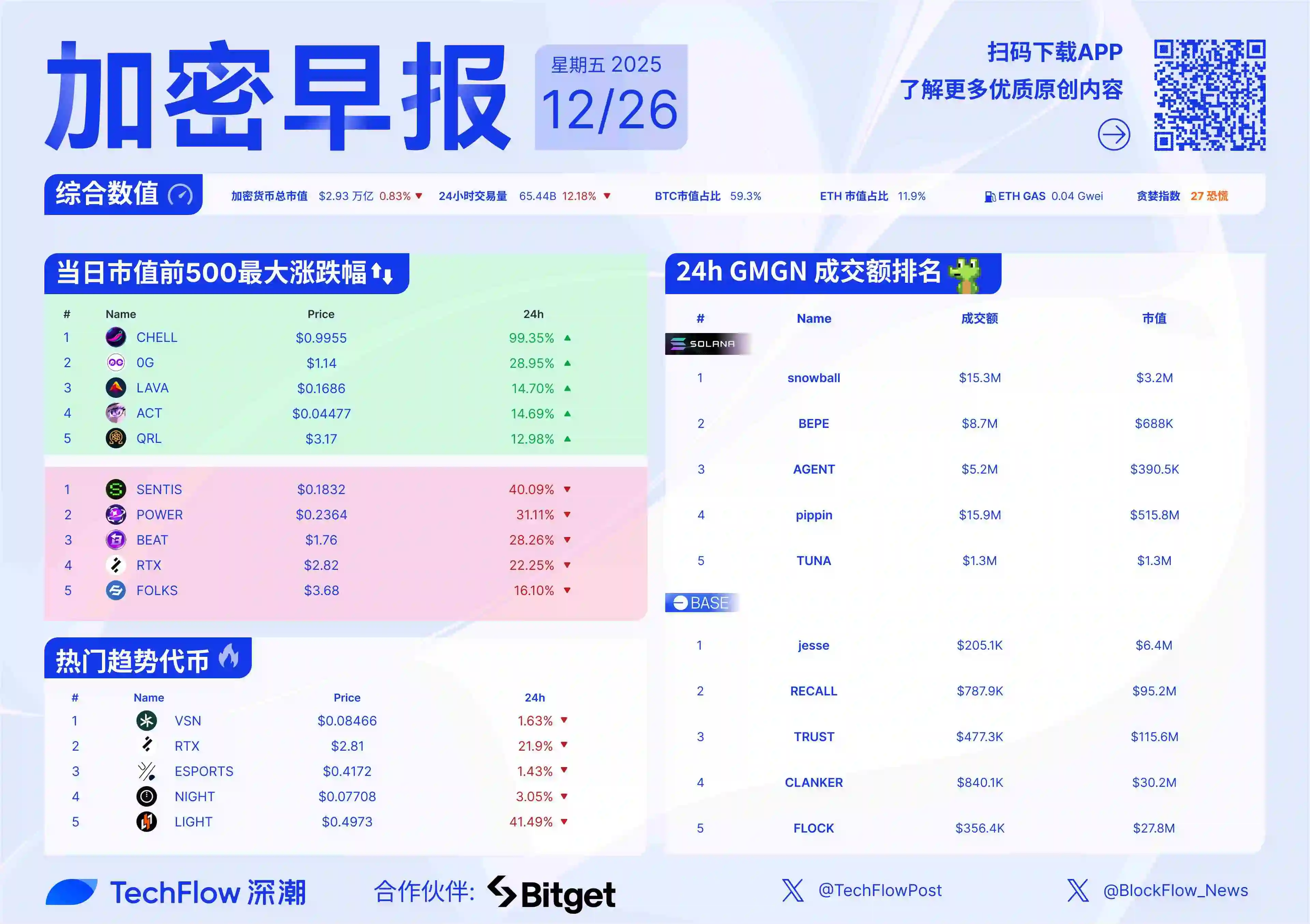
Recommended Reading

Ten People Redefining the Power Boundaries of Cryptocurrency in 2025

This article describes how 2025 was a key year for the institutionalization of the cryptocurrency industry, with traditional financial institutions and governments beginning to participate in the crypto market on a large scale, pushing it from an "anti-system tool" to a "core component of the system." Simultaneously, the influence of individual authority, political power, and institutionalization trends on the crypto market increased significantly, challenging the original intent of decentralization.

Conversation with Raoul Pal: The 2026 Decisive Point Under the Five-Year Cycle, Choosing the Right Assets for Long-Term Holding Without Relying on Luck

This article is a detailed summary of Raoul Pal's views and insights on cryptocurrency investment from an interview. He proposed a success framework for 2026 cryptocurrency investment, emphasizing choosing the right assets, long-term holding, understanding the importance of liquidity, and maintaining patience. Additionally, the article explores future trends in the cryptocurrency market, the potential of smart contracts, the current state of NFTs and their value contribution to the underlying blockchain, and how to succeed in the crypto market through research and conviction.

Even Satoshi Nakamoto Would Have to Kowtow to the God of Wealth

This article explores how an increasing number of people in the cryptocurrency industry view Feng Shui and metaphysics as a form of psychological support to cope with market volatility and uncertainty. Through several cases, the article analyzes the application of Feng Shui in the cryptocurrency field, including investment decisions, risk avoidance, and psychological comfort.

Crypto Circle People Fortune-Telling in K-Line Charts

This article describes the trend of metaphysics becoming popular as a psychological compensation and social tool in the cryptocurrency market. It focuses on analyzing the phenomenon of the爆火 (explosive popularity) of the "Life K-Line" application, which generates K-line charts based on birth dates, and the demand and psychological dependence of cryptocurrency traders on metaphysics. The article also mentions that the popularity of metaphysics in the crypto circle is not only because it alleviates traders' anxiety about uncertainty but also because its ambiguity and social attributes make it a popular culture.

Circle 2025 Annual Review: Building a Full-Stack Crypto Economy Platform

This article is Circle's 2025 annual review report, detailing its progress in building a full-stack crypto economy platform, including the application of stablecoins in mainstream finance, the landing of global regulatory frameworks, the growth of digital assets, the expansion of institutional cooperation, and the newly launched Arc blockchain, among other contents. The article also mentions that Circle has promoted the transformation of the global financial system towards an open, inclusive internet-native form through technological innovation and ecological synergy.


Preguntas relacionadas

QWhat was the new high for the offshore yuan (CNH) against the US dollar, and when was the previous high set?

AThe offshore yuan (CNH) broke through the 7.0 mark against the US dollar, reaching a new high since September 27, 2024.

QAccording to the 'chain detective' ZachXBT, what was the minimum amount of funds stolen from Trust Wallet users and what was the potential consequence for the platform?

AAccording to ZachXBT, at least $6 million was stolen from Trust Wallet users. If the responsibility is confirmed to belong to Trust Wallet, the platform may need to compensate the affected users.

QWhat significant adjustment did Infinex founder Kain Warwick announce regarding the INX token Sonar sale?

AKain Warwick announced a significant reduction in the fully diluted valuation (FDV) for the INX token Sonar sale, lowering it from the originally planned $300 million to $99.99 million in response to market feedback that the initial pricing was too high.

QWhich three exchanges led in BTC and ETH liquidity according to the CoinGlass 2025 Annual Report?

AAccording to the CoinGlass 2025 Annual Report, Binance, OKX, and Bitget were the top three centralized exchanges (CEX) for BTC and ETH liquidity.

QWhat major trend did the Pantera Capital partner predict for AI in the crypto space for 2026?

AThe Pantera Capital partner predicted that AI would act as a crypto interface layer, with AI-assisted trading (such as trend analysis) becoming mainstream and gradually integrating into consumer applications.

Lecturas Relacionadas

Morning Post | Trump Media Group Releases Q1 Financial Report; Top Three DeFi Applications Return Nearly $100 Million in Revenue to Token Holders in 30 Days; Michael Saylor Shares Bitcoin Tracker Info Again

**Title: Daily Briefing | Trump Media Group Releases Q1 Report; Top 3 DeFi Apps Return Nearly $100M to Token Holders; Michael Saylor Signals Potential Bitcoin Buy** **Summary:** Key developments in the past 24 hours include: * **Economic Outlook:** Goldman Sachs has pushed back its forecast for the next two Federal Reserve interest rate cuts to December 2026 and March 2027, citing persistent inflationary pressures from energy costs. This delayed timeline is expected to tighten liquidity flow into risk assets, including cryptocurrencies. * **DeFi & Revenue:** Data from DefiLlama shows that three leading DeFi applications—Hyperliquid, Pump.fun, and EdgeX—collectively distributed $96.3 million in revenue to their token holders over the last 30 days. This trend highlights a shift in the crypto community's focus towards real protocol earnings and sustainable economic models. * **Corporate Bitcoin Moves:** Michael Saylor, founder of MicroStrategy (note: referred to as 'Strategy' in the text, likely a typographical error), has signaled potential upcoming Bitcoin purchases by posting a "Bitcoin Tracker" update, following a pattern that typically precedes the company's official disclosure of new acquisitions. * **Market Integrity:** Prediction market platform Polymarket announced updates to address platform issues, including identifying and banning clusters of accounts involved in "ghost-fill" activities and implementing measures to prevent bulk account creation. * **Regulation:** The Bank of England Governor warned that stablecoin regulation could lead to tensions between US and international regulators. In South Korea, the National Tax Service has launched a pilot program to entrust seized virtual assets to private custody firms for management. * **Meme Token Trends:** GMGN data lists the top trending meme tokens on Ethereum (e.g., HEX, SHIB), Solana (e.g., FWOG, TROLL), and Base (e.g., SKITTEN, PEPE) over the past day. **Financial Note:** Trump Media & Technology Group reported a Q1 loss of approximately $4 billion, primarily attributed to unrealized losses on its Bitcoin and other digital asset holdings.

链捕手Hace 27 min(s)

Morning Post | Trump Media Group Releases Q1 Financial Report; Top Three DeFi Applications Return Nearly $100 Million in Revenue to Token Holders in 30 Days; Michael Saylor Shares Bitcoin Tracker Info Again

链捕手Hace 27 min(s)

Telegram Takes Direct Control of TON, Social Traffic Rewrites the Public Chain Narrative

Telegram founder Pavel Durov announced that Telegram will replace the TON Foundation as the core driver and largest validator of The Open Network (TON). Key initiatives include a sixfold reduction in transaction fees, performance upgrades, and improved developer tools within the next few weeks. This marks a strategic shift from Telegram merely providing user access to deeply integrating TON into its platform's core infrastructure. The goal is to transform Telegram's massive social traffic into sustainable on-chain activity. While viral mini-apps like Notcoin have demonstrated Telegram's ability to drive user adoption, TON aims to support frequent, low-value transactions inherent to social platforms—such as tipping, in-app payments, and game rewards. Ultra-low fees and sub-second finality (0.6 seconds) are crucial to making blockchain interactions seamless and nearly invisible within the Telegram user experience. However, Telegram's increased central role raises questions about network decentralization. Durov argues that Telegram's participation will attract more large validators, thereby enhancing decentralization. TON also offers high annual staking rewards (18.8%), aiming to retain capital within its ecosystem. The fundamental challenge for TON is no longer leveraging Telegram's user base, but becoming an indispensable, seamless infrastructure layer for Telegram's everyday applications—moving from an adjacent chain to an embedded utility.

marsbitHace 29 min(s)

Telegram Takes Direct Control of TON, Social Traffic Rewrites the Public Chain Narrative

marsbitHace 29 min(s)

Telegram Takes Direct Control of TON, Social Traffic Reshapes Public Chain Narrative

Telegram's founder, Pavel Durov, has announced a major shift in the development of The Open Network (TON). Telegram will now become the core driver of TON, replacing the TON Foundation and becoming its largest validator. The focus will be on technical upgrades over the next few weeks, including slashing network fees by six times to near-zero and improving finality time to 0.6 seconds. This move signifies a deeper integration between Telegram and TON, moving beyond just providing a user base. The goal is to transform Telegram's vast social traffic and built-in features—like Mini Apps, payments, and bots—into sustainable, on-chain usage scenarios. The reduced fees and faster speeds are crucial for enabling the small, frequent transactions typical of social interactions. While this promises stronger execution and product alignment, it raises questions about centralization. Durov argues Telegram's involvement will attract more validators, enhancing decentralization, but the outcome remains to be seen. Additionally, TON's high annual staking reward of 18.8% aims to retain capital within the ecosystem. The key challenge for TON is no longer just leveraging Telegram's entry point, but becoming an invisible, seamless infrastructure layer within Telegram's daily use. Its success hinges on converting viral attention into lasting, embedded utility.

Odaily星球日报Hace 39 min(s)

Telegram Takes Direct Control of TON, Social Traffic Reshapes Public Chain Narrative

Odaily星球日报Hace 39 min(s)

OpenAI Post-Training Engineer Weng Jiayi Proposes a New Paradigm Hypothesis for Agentic AI

OpenAI engineer Weng Jiayi's "Heuristic Learning" experiments propose a new paradigm for Agentic AI, suggesting that intelligent agents can improve not just by training neural networks, but also by autonomously writing and refining code based on environmental feedback. In the experiment, a coding agent (powered by Codex) was tasked with developing and maintaining a programmatic strategy for the Atari game Breakout. Starting from a basic prompt, the agent iteratively wrote code, ran the game, analyzed logs and video replays to identify failures, and then modified the code. Through this engineering loop of "code-run-debug-update," it evolved a pure Python heuristic strategy that achieved a perfect score of 864 in Breakout and performed competitively with deep reinforcement learning (RL) algorithms in MuJoCo control tasks like Ant and HalfCheetah. This approach, termed Heuristic Learning (HL), contrasts with Deep RL. In HL, experience is captured in readable, modifiable code, tests, logs, and configurations—a software system—rather than being encoded solely into opaque neural network weights. This offers potential advantages in explainability, auditability for safety-critical applications, easier integration of regression tests to combat catastrophic forgetting, and more efficient sample use in early learning stages, as demonstrated in broader tests on 57 Atari games. However, the blog acknowledges clear limitations. Programmatic strategies struggle with tasks requiring long-horizon planning or complex perception (e.g., Montezuma's Revenge), areas where neural networks excel. The future vision is a hybrid architecture: specialized neural networks for fast perception (System 1), HL systems for rules, safety, and local recovery (also System 1), and LLM agents providing high-level feedback and learning from the HL system's data (System 2). The core proposition is that in the era of capable coding agents, a significant portion of an AI's learned experience could be maintained as an auditable, evolving software system.

marsbitHace 1 hora(s)

OpenAI Post-Training Engineer Weng Jiayi Proposes a New Paradigm Hypothesis for Agentic AI

marsbitHace 1 hora(s)

Your Claude Will Dream Tonight, Don't Disturb It

This article explores the recent phenomenon of AI companies increasingly using anthropomorphic language—like "thinking," "memory," "hallucination," and now "dreaming"—to describe machine learning processes. Focusing on Anthropic's newly announced "Dreaming" feature for its Claude Agent platform, the piece explains that this function is essentially an automated, offline batch processing of an agent's operational logs. It analyzes past task sessions to identify patterns, optimize future actions, and consolidate learnings into a persistent memory system, akin to a form of reinforcement learning and self-correction. The article draws parallels to similar features in other AI agent systems like Hermes Agent and OpenClaw, which also implement mechanisms for reviewing historical data, extracting reusable "skills," and strengthening long-term memory. It notes a key difference from human dreaming: these AI "dreams" still consume computational resources and user tokens. Further context is provided by discussing the technical challenges of managing AI "memory" or context, highlighting the computational expense of large context windows and innovations like Subquadratic's new model claiming drastically longer contexts. The core critique argues that this strategic use of human-centric vocabulary does more than market products; it subtly reshapes user perception. By framing algorithms with terms associated with consciousness, companies blur the line between tool and autonomous entity. This linguistic shift can influence user expectations, tolerance for errors, and even perceptions of responsibility when systems fail, potentially diverting scrutiny from the companies and engineers behind the technology. The article concludes by speculating that terms like "daydreaming" for predictive task simulation might be next, continuing this trend of embedding the idea of an "inner life" into computational processes.

marsbitHace 1 hora(s)

Your Claude Will Dream Tonight, Don't Disturb It

marsbitHace 1 hora(s)

Trading

Spot
Futuros
活动图片