Crypto Morning Brief: New Virtual Currency Regulations Introduced, Major Unlocks for AVAX, APT, STRK, and Other Tokens This Week

marsbitPublicado a 2026-02-09Actualizado a 2026-02-09

Resumen

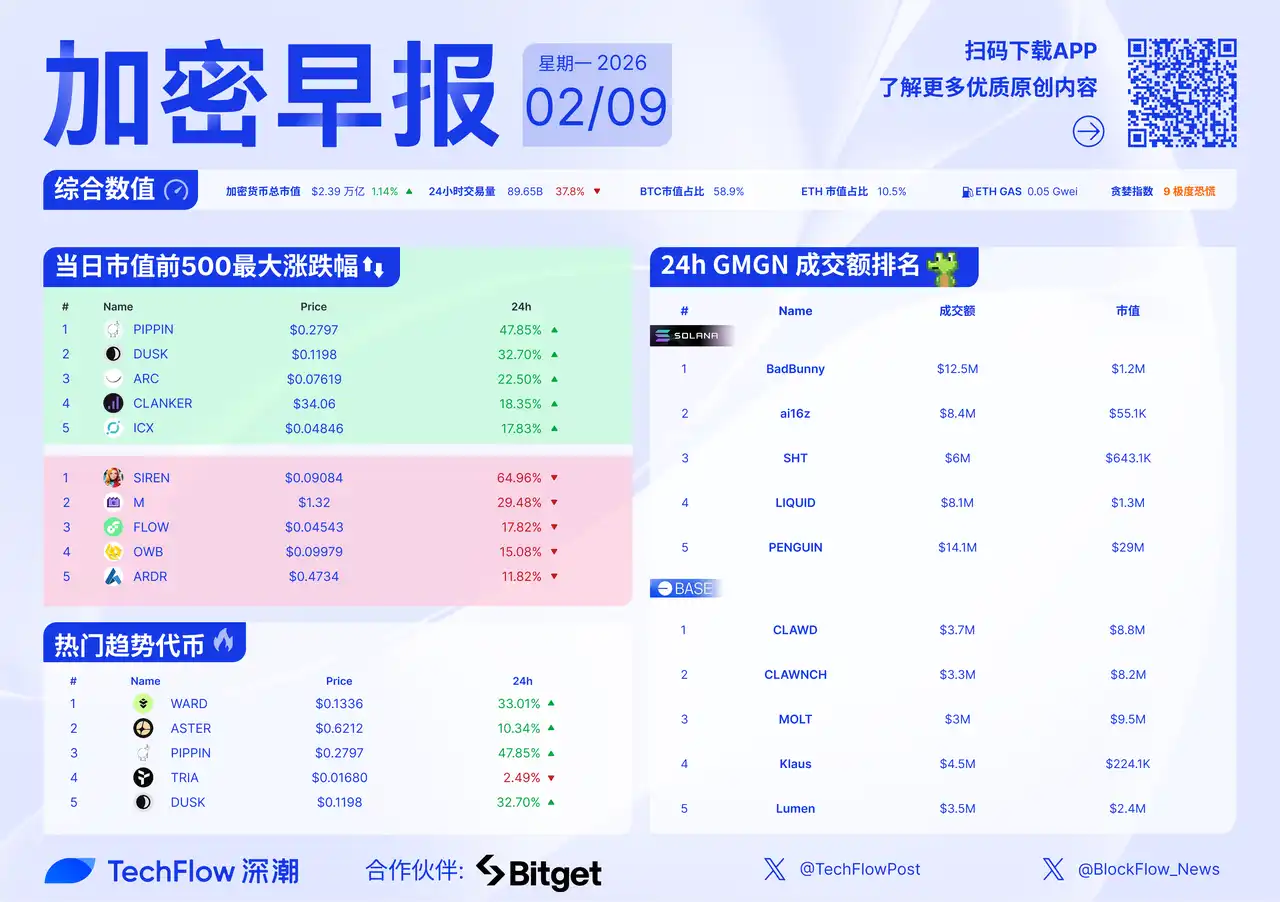
Cryptocurrency Daily Digest: Key regulatory and market developments occurred. China's central bank and seven other ministries jointly issued a notice explicitly banning all virtual currency transactions and Real World Asset (RWA) tokenization businesses, declaring such activities illegal financial operations. In other news, the White House will hold its next stablecoin policy meeting next Tuesday. Illinois proposed a state-operated Bitcoin reserve program. Michael Saylor hinted at potential Bitcoin purchases by MicroStrategy following his social media post. Significant token unlocks are scheduled this week: AVAX ($15.2M unlock on Feb 11), APT ($12.3M on Feb 10), STRK ($6.3M on Feb 15), among others. Additional updates include: 21Shares filed for an Ondo ETF, Bithumb announced full compensation for a major BTC distribution error, and Li Bin denied rumors about investment and token sales. The Nikkei 225 index surged 4%. Market analysts suggest potential consolidation among Solana treasury firms amid current conditions.

Author: Deep Tide TechFlow

Yesterday's Market Dynamics

Nikkei 225 Index surges 4.00% intraday, now at 56,437.40 points

Nikkei 225 Index surged 4.00% intraday, now at 56,437.40 points.

Crypto Journalist: Next White House Meeting on Stablecoin Revenue Scheduled for Next Tuesday

According to crypto journalist Eleanor Terrett, informed sources stated that the next round of White House discussions on stablecoin revenue is scheduled for next Tuesday. This meeting will still be held at the staff level, and this time bank representatives themselves will attend, along with industry association representatives.

Illinois Proposes "Community Bitcoin Reserve Act" This Week, Aims to Establish State-Operated Bitcoin Reserve Program

According to Bitcoincom News, the state of Illinois proposed the "Community Bitcoin Reserve Act" this week, aiming to establish a state-operated Bitcoin reserve program using multi-signature cold wallet custody, with the first reserve named Altgeld Bitcoin Reserve. The bill stipulates that BTC in the reserve can only be traded or sold after new legislative authorization.

Central Bank and Seven Other Departments Jointly Issue Notice: Comprehensive Ban on Virtual Currency Trading and RWA Tokenization Business

The People's Bank of China, jointly with seven other departments, issued the "Notice on Further Preventing and Disposing of Risks Related to Virtual Currency and Other Activities" (Yin Fa [2026] No. 42) today, clarifying that virtual currency does not have legal tender status and related business activities constitute illegal financial activities.

The notice prohibits virtual currency trading and Real World Asset (RWA) tokenization activities within China. Without approval from relevant departments, domestic entities are not allowed to issue virtual currency or conduct tokenization business overseas.

Financial institutions are prohibited from providing services for related activities, and internet companies are prohibited from providing online venues and promotional services. The notice requires strengthening risk monitoring and industry supervision, and cracking down on related illegal and criminal activities. This notice takes effect from the date of issuance, simultaneously repealing the 2021 relevant regulations.

Bloomberg Analyst: 21Shares Has Filed Ondo ETF Application

Bloomberg Senior ETF Analyst Eric Balchunas disclosed via a post that 21Shares has submitted an Ondo ETF application document.

ETH in Yi Lihua's On-Chain Address Completely Liquidated

According to Arkham data, the on-chain address associated with Yi Lihua transferred the final 534 ETH to Binance. The ETH in his on-chain address has been completely liquidated, currently holding only 0.165 ETH.

Bithumb: To Provide Full Compensation for Customers Affected by "Incorrectly Issuing 620,000 BTC" Incident

According to an official announcement, South Korean cryptocurrency exchange Bithumb released a comprehensive compensation plan for the "incorrect issuance of 620,000 BTC" incident that occurred on February 6th. Bithumb承诺 to provide affected customers with 110% special compensation, with estimated losses around 10 billion KRW.

The announcement stated that Bithumb will strengthen its internal control system, including upgrading the asset verification system, improving multi-level approval processes, enhancing abnormal transaction detection and automatic blocking AI systems, and conducting system audits through global security professional agencies.

Additionally, Bithumb will provide 20,000 KRW compensation to all users who logged in during the incident period, offer zero-fee trading for all users for 7 days, and establish a "Customer Protection Fund" with a scale of 100 billion KRW to ensure the security of customer assets.

Li Lin Responds to Rumors: Not an Investor in LD or Garrett Gin, Did Not Reduce BTC or ETH Holdings During This Market Cycle

Huobi founder Li Lin stated in a post, "I am not an investor in LD or Garrett Gin, and did not reduce my Bitcoin or Ethereum holdings during this market cycle. I have been resting for many years, but almost every year I still need to clarify related rumors."

FWDI CIO: If Industry Faces Funding Shortage, Will Adopt Offensive Strategy and Integrate Other SOL Treasury Companies

According to Coindesk, Ryan Navi, Chief Investment Officer of the largest Solana treasury company Forward Industries (FWDI), stated that market mispricing is creating opportunities. Forward has no debt; if the industry faces a funding shortage, it will adopt an offensive strategy and integrate other SOL treasury companies.

FWDI holds nearly 7 million SOL, making it the listed company with the largest SOL reserves, more than the sum of its next three competitors.

Ryan Navi reiterated, "A leverage-free balance sheet is the true advantage in the crypto treasury market. While others are defending, Forward Industries will maintain an overweight position. The future will also be without leverage, without debt, and we view Solana as a long-term investment in strategic infrastructure, not short-term speculation."

Michael Saylor Again Posts Bitcoin Tracker Information, May Increase Bitcoin Holdings Next Week

MicroStrategy founder and executive chairman Michael Saylor posted information related to the Bitcoin Tracker on platform X again, writing "Orange Dots Matter.".

Based on previous patterns, MicroStrategy always discloses Bitcoin acquisition information the day after related messages are posted.

Major Unlocks for AVAX, APT, STRK, and Other Tokens This Week

Token Unlocks data shows that multiple cryptocurrency projects will undergo token unlocks this week.

CONX will unlock 1.32 million tokens on February 15, worth approximately $15.6 million, 1.56% of circulating supply;

AVAX will unlock 1.67 million tokens on February 11, worth approximately $15.2 million, 0.32% of circulating supply;

APT will unlock 11.31 million tokens on February 10, worth approximately $12.3 million, 0.69% of circulating supply;

STRK will unlock 127 million tokens on February 15, worth approximately $6.3 million, 4.61% of circulating supply;

SEI will unlock 55.56 million tokens on February 15, worth approximately $4.2 million, 1.03% of circulating supply;

MOVE will unlock 164 million tokens on February 9, worth approximately $3.8 million, 5.46% of circulating supply;

ME will unlock approximately 1.48 million tokens on February 9, worth approximately $1.48 million, 2.32% of circulating supply;

LINEA will unlock approximately 4.38 million tokens on February 10, worth approximately $4.38 million, 5.96% of circulating supply.

Market Dynamics
Recommended Reading

Dialogue with Jeff Park: We Are in a Bear Market, Quantitative Easing No Longer Effective, Silver Will Crash Like Altcoins

This article explores the current changing trends in the Bitcoin market, fluctuations in the precious metals market, and the future direction of the Federal Reserve and fiscal policy. Through a dialogue format, it provides an in-depth analysis of the relationship between Bitcoin and the global economic environment, and introduces the concept of "positive correlation Bitcoin." The article also discusses the potential of Kevin Warsh as Fed Chair and the current situation and future of the silver market.

Interpreting MicroStrategy's Latest Earnings Report: After a $12.4 Billion Loss, How Long Can the Bitcoin Flywheel Keep Spinning?

This article analyzes the close relationship between MicroStrategy and Bitcoin. The earnings report shows its operating condition heavily relies on Bitcoin price fluctuations. Although its capital operations perform excellently, in the long run, a continuous decline in Bitcoin price may threaten its operational model.

Forbes Editorial, The Most Accurate Short Signal in Crypto?

This article explores the relationship between the cryptocurrency market and Forbes magazine cover figures, pointing out that market frenzies often peak when mainstream media pays attention. It analyzes the logic behind this phenomenon through multiple cases, including the experiences of crypto figures like CZ, SBF, and Michael Saylor.

Bloodbath in US Stocks, Bitcoin, and Silver: A Bizarre Global Asset Massacre

This article discusses the "liquidity black hole" style asset massacre experienced by global markets on February 6th, where multiple asset classes including US stocks, silver, and cryptocurrencies fell sharply simultaneously. Despite no obvious external black swan event, a liquidity crisis became the core reason for this market crash. The article analyzes the causes of this global market turmoil in detail from the perspectives of changes in US stocks, silver, cryptocurrencies, and the Japanese government bond market.

Darkest Hour for Crypto, Real Vision Founder: Hold Firmly, Buy the Dip Boldly

This article describes the current market being in a低迷 state, with investors普遍 feeling panic and confusion, but the author emphasizes holding firmly and buying the dip boldly. It highlights the advantages of long-term holding and分批加仓, pointing out that high market volatility is a price that must be accepted. The author is optimistic about the future market, believing the current market低迷 is a panic sell-off within a bull market, and plans to continue buying the dip on crypto assets.


Criptos en tendencia

Preguntas relacionadas

QWhat is the key content of the new virtual currency regulation issued by the People's Bank of China and seven other departments?

AThe new regulation explicitly states that virtual currencies do not have legal tender status and related business activities are illegal financial activities. It prohibits virtual currency trading and Real World Asset (RWA) tokenization activities within China. It also mandates that domestic entities cannot issue virtual currencies or conduct tokenization business overseas without approval from relevant departments.

QWhich tokens are scheduled for significant unlocks this week according to the article?

AAccording to the article, the tokens scheduled for significant unlocks this week are: CONX, AVAX, APT, STRK, SEI, MOVE, ME, and LINEA.

QWhat did the US state of Illinois propose regarding Bitcoin this week?

AThe US state of Illinois proposed the 'Community Bitcoin Reserve Act', which aims to establish a state-operated Bitcoin reserve program. The plan involves using multi-signature cold wallets for custody, with the first reserve named the Altgeld Bitcoin Reserve. The legislation stipulates that BTC in the reserve can only be traded or sold after new legislative authorization.

QWhat action did Michael Saylor hint at with his post 'Orange Dots Matter.'?

ABased on previous patterns, Michael Saylor's post 'Orange Dots Matter.' on the X platform, which included Bitcoin Tracker information, is a hint that his company, MicroStrategy, is likely to announce another purchase of Bitcoin the following day.

QWhat was Bithumb's response to the 'misissuance of 620,000 BTC' incident?

ABithumb announced a comprehensive compensation plan for customers affected by the incident. They promised to provide 110% special compensation to affected clients, estimated at a loss of about 10 billion KRW. Additionally, they will offer 20,000 KRW to all users who logged in during the incident period, provide zero-fee trading for all users for 7 days, and establish a 'Customer Protection Fund' with a scale of 100 billion KRW to ensure the safety of customer assets.

Lecturas Relacionadas

He Just Raised 2.7 Billion, and Li Fei-Fei Also Invested

Pete Florence, a former senior research scientist at Google DeepMind and a key contributor to the Vision-Language-Action (VLA) model architecture, is deliberately distancing his startup, Generalist AI, from the trendy "world model" label. He argues that the industry should prioritize concrete goals over buzzwords. His goal is to create robots that can perform a vast range of unseen tasks with high speed and success rates, without needing task-specific training data. Recently, his company raised $400 million (¥2.7 billion) at a $2 billion valuation. Notable investors include NVIDIA's NVentures, Bezos Expeditions, NFDG, as well as Xiaomi co-founder Lin Bin, Zoom founder Eric Yuan, and renowned AI scientist Fei-Fei Li. Florence's approach stems from his academic background at MIT under Professor Russ Tedrake, focusing on understanding the physical world. After joining DeepMind, he developed models like Transporter Network and co-created the VLA framework. He left in 2025 to found Generalist AI. The company has launched two models: GEN-0, which demonstrated that scaling laws apply to physical motion, and GEN-1. GEN-1 was trained on over 500,000 hours of physical interaction data collected via a specialized wearable device. It achieves a 99% success rate on precise mechanical tasks like folding boxes and maintains performance three times faster than its predecessor. Florence believes GEN-1 is reaching a commercial utility threshold similar to the GPT-3 inflection point. The substantial funding round, following GEN-1's release, signifies strong investor confidence in Generalist AI's practical, goal-driven path to creating versatile, useful robots, regardless of the "world model" terminology.

marsbitHace 4 min(s)

He Just Raised 2.7 Billion, and Li Fei-Fei Also Invested

marsbitHace 4 min(s)

Two Legends Lost in Three Days: Is Google's AI Talent Dam Cracking?

In three days, Google lost two AI legends. On June 18, Noam Shazeer, co-author of the seminal "Attention is All You Need" paper and Gemini co-lead, left for OpenAI. Just 48 hours later, John Jumper, 2024 Nobel laureate and AlphaFold lead, departed DeepMind for Anthropic. This follows Andrej Karpathy joining Anthropic in May. These moves highlight a structural trend: top AI talent is concentrating at mission-driven, pre-IPO firms like OpenAI and Anthropic, while Google becomes a primary source. The exodus stems from a core mission mismatch. Google's ad-centric model often subordinates AI research to product and revenue goals, creating friction for pioneers like Shazeer, who returned in 2024 only to leave again. In contrast, OpenAI and Anthropic offer singular focus on pushing AI boundaries, whether towards AGI or safety-aligned models, which deeply appeals to top researchers like Jumper. Financial incentives amplify the pull. With both OpenAI and Anthropic nearing IPO, employees stand to gain immensely from equity, an upside Google's mature stock cannot match. Furthermore, the 2023 merger of Google Brain and DeepMind, intended to consolidate strength, has instead created cultural tension and slowed the path from research to product, as evidenced by Gemini's pace. This talent redistribution is reshaping the AI landscape. While Google retains vast data and compute resources, its true crisis is the quiet, continuous loss of the people who define the field's future. The real moat in AI is not infrastructure, but the concentration of brilliant minds—a battle Google is currently losing.

marsbitHace 2 hora(s)

Two Legends Lost in Three Days: Is Google's AI Talent Dam Cracking?

marsbitHace 2 hora(s)

Behind the AI Report Card, Lies a Chinese 'Exam Setter'

Beyond the familiar performance charts like MMLU-Pro and MMMU, which major AI models strive to ace, stands a key "examiner": Chinese-Canadian researcher Wenhu Chen. An assistant professor at the University of Waterloo and founder of TIGERLab, Chen addresses the crucial need for more rigorous AI evaluation. As models like GPT-4 began scoring near-perfect results on older benchmarks like MMLU, it became difficult to distinguish their true capabilities. In response, Chen introduced MMLU-Pro in 2024, featuring harder, more reasoning-focused questions with more answer choices, successfully reintroducing meaningful performance gaps. His work extends to multi-modal evaluation with MMMU and its enhanced version, MMMU-Pro. These benchmarks test a model's ability to understand and reason with complex information from images, charts, and text across diverse academic subjects, exposing the significant challenges even top models face in genuine comprehension. Chen's background in complex QA, table reasoning, and his experience at Google DeepMind on projects like Gemini inform his approach. He understands that effective benchmarks must anticipate how models might "cheat" by memorizing data or avoiding visual analysis. His lab also actively researches video understanding and generation models (e.g., UniVideo, Vamba), ensuring his evaluation work is grounded in practical model-building challenges. Now at Meta's Super Intelligence Lab, Chen continues his focus on multi-modal data and evaluation, representing the deep yet often unseen contributions of Chinese talent in shaping the fundamental tools of the AI industry.

marsbitHace 2 hora(s)

Behind the AI Report Card, Lies a Chinese 'Exam Setter'

marsbitHace 2 hora(s)

Alliance Co-founder's Letter to Entrepreneurs: Written at the Moment Cursor Sold for $600 Billion

Alliance Co-founder's Letter to Entrepreneurs: On Cursor's $60 Billion Sale Many aspiring founders see massive exits like Cursor's $60B sale and wonder why they can't achieve the same, often concluding opportunities are exhausted. But great companies aren't built in obvious, crowded spaces. Cursor, like Stripe, Figma, and Shopify before it, started with a non-consensus belief about the future. Before ChatGPT, they believed AI would transform knowledge work. They focused on a genuinely exciting domain, became their own customer, and obsessed over power users. Their journey involved years of "glass-chewing" effort before the market was ready. The pattern is consistent: identify a long-term technological shift, find a missed entry point, and execute for years before the trend becomes obvious. First-generation products (PayPal, Adobe, Amazon) prove a market exists. Second-generation winners (Stripe, Figma, Shopify) rebuild that market around new insights, technology, or changing customer behaviors. Founders must identify their phase in the cycle. Early entrants like Coinbase or Cursor focus on making new technology usable for power users. Later entrants find the "yin" to the established "yang"—the blind spots incumbents miss as they grow distant from individual users. The key is deep market immersion. Use every product in your space. Talk to users. Build an audience. Stop looking for ideas and start *seeing* them everywhere. Then, choose one. The idea must offer a 10x improvement or solve a "hair-on-fire" pain point—something severe enough that users are already crafting workarounds. When building, avoid feature bloat. Ask: why would someone switch? Great startups rarely force new behaviors; they improve familiar workflows with drastically lower friction (e.g., Cursor forked VS Code instead of creating a new editor). Distribution is the underestimated moat. Before product-market fit, achieve distribution-market fit. How do customers discover new tools? Founders like those at Airbnb, Stripe, and Cursor did unscalable, manual work to recruit early users. The final, unteachable ingredient is resilience. Cursor built for years pre-market, faced rejection, and persisted. So did Airbnb, Nvidia, and Rain (which launched post-FTX collapse). The lesson isn't that these founders were smarter, but that they stayed in the game long enough for their insights to compound. Framework: Spot technological cycles. Cultivate unique insight. Obsess over your market. Talk to customers. Find a hair-on-fire problem. Build the simplest wedge. Win your distribution channel. Above all, don't quit when it gets hard. Most people won't do these things consistently. The few who do build the next generation of great companies. Go build.

marsbitHace 2 hora(s)

Alliance Co-founder's Letter to Entrepreneurs: Written at the Moment Cursor Sold for $600 Billion

marsbitHace 2 hora(s)

Trading

Spot
Futuros

Artículos destacados

Cómo comprar APT

¡Bienvenido a HTX.com! Hemos hecho que comprar Aptos (APT) sea simple y conveniente. Sigue nuestra guía paso a paso para iniciar tu viaje de criptos.Paso 1: crea tu cuenta HTXUtiliza tu correo electrónico o número de teléfono para registrarte y obtener una cuenta gratuita en HTX. Experimenta un proceso de registro sin complicaciones y desbloquea todas las funciones.Obtener mi cuentaPaso 2: ve a Comprar cripto y elige tu método de pagoTarjeta de crédito/débito: usa tu Visa o Mastercard para comprar Aptos (APT) al instante.Saldo: utiliza fondos del saldo de tu cuenta HTX para tradear sin problemas.Terceros: hemos agregado métodos de pago populares como Google Pay y Apple Pay para mejorar la comodidad.P2P: tradear directamente con otros usuarios en HTX.Over-the-Counter (OTC): ofrecemos servicios personalizados y tipos de cambio competitivos para los traders.Paso 3: guarda tu Aptos (APT)Después de comprar tu Aptos (APT), guárdalo en tu cuenta HTX. Alternativamente, puedes enviarlo a otro lugar mediante transferencia blockchain o utilizarlo para tradear otras criptomonedas.Paso 4: tradear Aptos (APT)Tradear fácilmente con Aptos (APT) en HTX's mercado spot. Simplemente accede a tu cuenta, selecciona tu par de trading, ejecuta tus trades y monitorea en tiempo real. Ofrecemos una experiencia fácil de usar tanto para principiantes como para traders experimentados.

171 Vistas totalesPublicado en 2024.12.11Actualizado en 2026.06.02

Cómo comprar APT

Discusiones

Bienvenido a la comunidad de HTX. Aquí puedes mantenerte informado sobre los últimos desarrollos de la plataforma y acceder a análisis profesionales del mercado. A continuación se presentan las opiniones de los usuarios sobre el precio de APT (APT).

活动图片