Crypto Money On The Move: $110 Billion Flees South Korea In 2025

bitcoinistPublicado a 2026-01-05Actualizado a 2026-01-05

Resumen

According to joint research, approximately $110 billion (₩160 trillion) in crypto assets migrated from South Korean exchanges to overseas platforms in 2025. This capital outflow was primarily driven by domestic regulatory restrictions that limit local exchanges to spot trading, while prohibiting more complex products like derivatives. As a result, traders turned to foreign exchanges such as Binance and Bybit to access a wider range of services. Reports indicate that the number of Korean users holding large balances on overseas platforms more than doubled year-on-year, with significant fee revenues generated for these exchanges. While South Korea has strengthened user protection laws, the regulatory framework remains incomplete, leading traders to seek alternatives abroad. Despite the outflow, trading demand remains high, with capital being relocated rather than withdrawn from crypto markets. Lawmakers are working on broader regulations, but for now, many users continue trading overseas for greater access and tools.

According to joint research cited in news reports, about $110 billion — roughly ₩160 trillion — left South Korean crypto platforms during 2025. Trading activity did not stop. Instead, much of the money moved to foreign exchanges where more products and tools are available to ordinary investors.

Market Limits Fuel Outflows

Reports have disclosed that domestic rules largely confine local exchanges to spot trading. Many complex products remain off limits for retail traders in Korea, so traders turned to overseas platforms such as Binance and Bybit. The joint study by CoinGecko and Tiger Research is cited as the primary basis for the $110 billion figure.

Banking And Rules Shape Choices

South Korea tightened compliance and user protections in recent years. Laws designed to protect customers were passed, such as the Virtual Asset User Protection Act in 2024, but firms and users say the laws did not create a full framework for wider market services.

Lawmakers debated the Digital Asset Basic Act, but delays left gaps that some traders found limiting. As a result, a growing share of Korean-held crypto migrated to wallets and platforms abroad.

Fee Impact And User Behavior

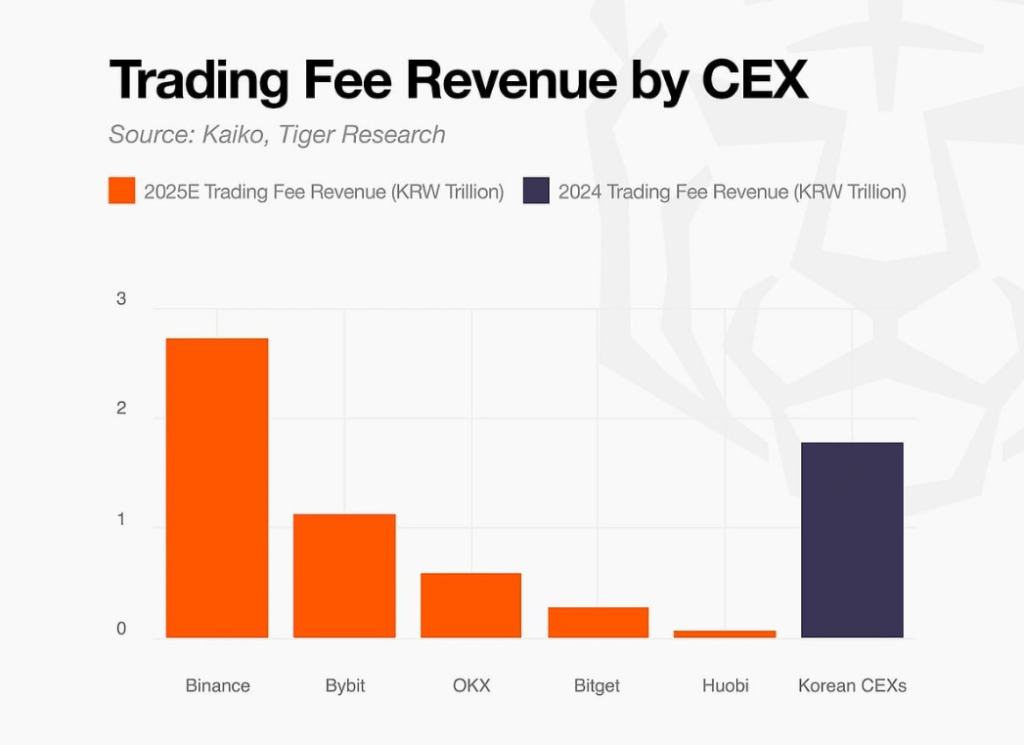
Based on platform analyses, fee revenue from korean users on overseas exchanges became significant. Estimates in the sector put user-based fees at about ₩2.73 trillion for Binance and roughly ₩1.12 trillion for Bybit in 2025.

Total crypto market cap: 3.08 trillion. Chart: TradingView

Reports also indicated the number of Korean accounts with large overseas balances grew by more than double year-on-year. Some capital was shifted into self-custody wallets too, showing that users split bets between exchanges and private wallets.

Authorities point to risks when money crosses borders. Regulators have focused on anti-money-laundering checks and bank partnerships for crypto firms. Traders, on the other hand, emphasize access. They want margin trading, derivatives, and other services that they cannot get at home. This tension between access and oversight is central to the movement of funds.

Trading Demand Remains High

Volume trends suggest Korean interest hasn’t waned, but shifted location. Domestic platforms handled substantial spot trading, but overall demand appears to have flowed into overseas venues instead of disappearing. The $110 billion figure tracks transfers and placements, not asset losses. In other words, value was relocated rather than erased.

Lawmakers in Seoul are said to be working on broader rules, including stablecoin provisions that many industry players have pushed for. If new statutes arrive and markets reopen to a wider set of services, some funds may return. But for now, many users keep trading outside Korea to access a wider menu of choices and tools.

Featured image from Unsplash, chart from TradingView

Preguntas relacionadas

QWhat was the total amount of crypto assets that moved from South Korean exchanges to overseas platforms in 2025, and why did this happen?

AApproximately $110 billion (₩160 trillion) moved from South Korean crypto platforms to overseas exchanges in 2025. This massive outflow occurred because domestic regulations largely restricted local exchanges to spot trading, limiting access to more complex products and tools that were available on foreign platforms.

QWhich two research firms provided the joint study that is the primary source for the $110 billion outflow figure?

AThe joint study was provided by CoinGecko and Tiger Research, which served as the primary basis for the $110 billion figure cited in the reports.

QWhat are two overseas crypto exchanges that benefited from this capital movement, and what were their estimated fee revenues from Korean users in 2025?

ABinance and Bybit were two major overseas exchanges that benefited. It is estimated that Binance earned approximately ₩2.73 trillion in fees from Korean users, while Bybit earned roughly ₩1.12 trillion in 2025.

QBesides moving funds to overseas exchanges, what other method did some South Korean crypto users employ to manage their assets?

AIn addition to using overseas exchanges, some South Korean users shifted capital into self-custody wallets, indicating a diversification of asset storage between third-party platforms and private wallets.

QWhat is the name of the key South Korean law passed in 2024 that was designed to protect crypto users, and why did it fail to prevent the capital outflows?

AThe key law was the Virtual Asset User Protection Act, passed in 2024. It was designed to protect customers but did not create a full framework for wider market services, leaving gaps that traders found limiting. This lack of access to products like margin trading and derivatives drove users to seek services abroad.

Lecturas Relacionadas

Trading

Spot
Futuros

Artículos destacados

Cómo comprar MOVE

¡Bienvenido a HTX.com! Hemos hecho que comprar Movement (MOVE) sea simple y conveniente. Sigue nuestra guía paso a paso para iniciar tu viaje de criptos.Paso 1: crea tu cuenta HTXUtiliza tu correo electrónico o número de teléfono para registrarte y obtener una cuenta gratuita en HTX. Experimenta un proceso de registro sin complicaciones y desbloquea todas las funciones.Obtener mi cuentaPaso 2: ve a Comprar cripto y elige tu método de pagoTarjeta de crédito/débito: usa tu Visa o Mastercard para comprar Movement (MOVE) al instante.Saldo: utiliza fondos del saldo de tu cuenta HTX para tradear sin problemas.Terceros: hemos agregado métodos de pago populares como Google Pay y Apple Pay para mejorar la comodidad.P2P: tradear directamente con otros usuarios en HTX.Over-the-Counter (OTC): ofrecemos servicios personalizados y tipos de cambio competitivos para los traders.Paso 3: guarda tu Movement (MOVE)Después de comprar tu Movement (MOVE), guárdalo en tu cuenta HTX. Alternativamente, puedes enviarlo a otro lugar mediante transferencia blockchain o utilizarlo para tradear otras criptomonedas.Paso 4: tradear Movement (MOVE)Tradear fácilmente con Movement (MOVE) en HTX's mercado spot. Simplemente accede a tu cuenta, selecciona tu par de trading, ejecuta tus trades y monitorea en tiempo real. Ofrecemos una experiencia fácil de usar tanto para principiantes como para traders experimentados.

223 Vistas totalesPublicado en 2024.12.13Actualizado en 2025.03.21

Cómo comprar MOVE

Discusiones

Bienvenido a la comunidad de HTX. Aquí puedes mantenerte informado sobre los últimos desarrollos de la plataforma y acceder a análisis profesionales del mercado. A continuación se presentan las opiniones de los usuarios sobre el precio de MOVE (MOVE).

活动图片