Crypto Miners' Big AI Gamble: Valuations Enter Differentiation Stage, Comeback Fight Proves Tough

链捕手Publicado a 2026-06-20Actualizado a 2026-06-20

Resumen

Crypto Mining Firms' AI Bet: Valuation Divergence and a Challenging Transformation Facing declining profitability in crypto mining, mining companies are pivoting to AI infrastructure, capitalizing on their existing power resources, land, and data center expertise to offer GPU compute power. This transition narrative has boosted their stock prices significantly, with firms like Hut 8 and Bitfarms seeing gains over 100% year-to-date, far outpacing Bitcoin. This has led to a market valuation split, with pioneers like CoreWeave reaching a $62.8B market cap, while others remain below $5B. The market currently prioritizes growth potential over short-term profits, which remain under pressure due to heavy capital expenditures for AI build-outs and crypto asset volatility. However, the transformation is a high-stakes gamble. Bitcoin mining profitability is shrinking, with the average production cost around $63,707 and miner margins contracting. While AI offers a more lucrative long-term path, it requires massive investment—estimated at a $500B near-term funding gap. Success now hinges on execution: delivering on contracted power capacity, securing quality tenants like major cloud providers, and managing the immense financial burden. The valuation focus is shifting from mere power capacity to project delivery, future cash flows, and tenant quality, making this a difficult but critical turnaround attempt.

Author: Nancy, PANews

As crypto assets continue to slump, crypto mining companies are facing increasing pressure to survive. To find new growth curves, more and more miners are accelerating their shift into the AI track. This transformation narrative quickly gained favor in the capital markets, with many miners' stock prices surging significantly, even hitting record highs.

However, while the AI business injects new growth potential into miners, the massive capital expenditures, continuous funding requirements, and long return cycles behind it are pushing miners into another war of financial attrition. At a time when the profitability of their core mining business remains under pressure, this high-stakes gamble of transitioning to AI is testing miners' financial strength and execution capabilities.

Stock Prices Outperform Bitcoin Significantly, Miner Valuations Enter a Phase of Differentiation

Mining companies are transforming into the landlords of computing power in the AI era.

As Bitcoin mining profit margins continue to shrink, with some miners even falling into losses, the AI boom has driven a sharp increase in global demand for data centers, power resources, and GPU computing power. More miners are accelerating their transformation into AI infrastructure, seeking new growth curves.

For miners, this transition offers natural advantages. Over the long term, to meet large-scale mining demands, miners have amassed key assets such as abundant power resources, land reserves, substation access capabilities, and mature cooling systems. Compared to data center operators starting from scratch, miners can quickly enter the AI infrastructure market by upgrading existing facilities, meeting AI computing power demands at lower costs and in shorter timeframes.

Since last year, the pace of miners' transformation to AI has noticeably accelerated. Some miners decisively downplay or even exit traditional mining to fully pivot to AI computing and data center operations; others retain part of their mining business but gradually shift the focus of resource allocation and capital expenditure to the AI field. Today, several miners have become key players in AI infrastructure construction.
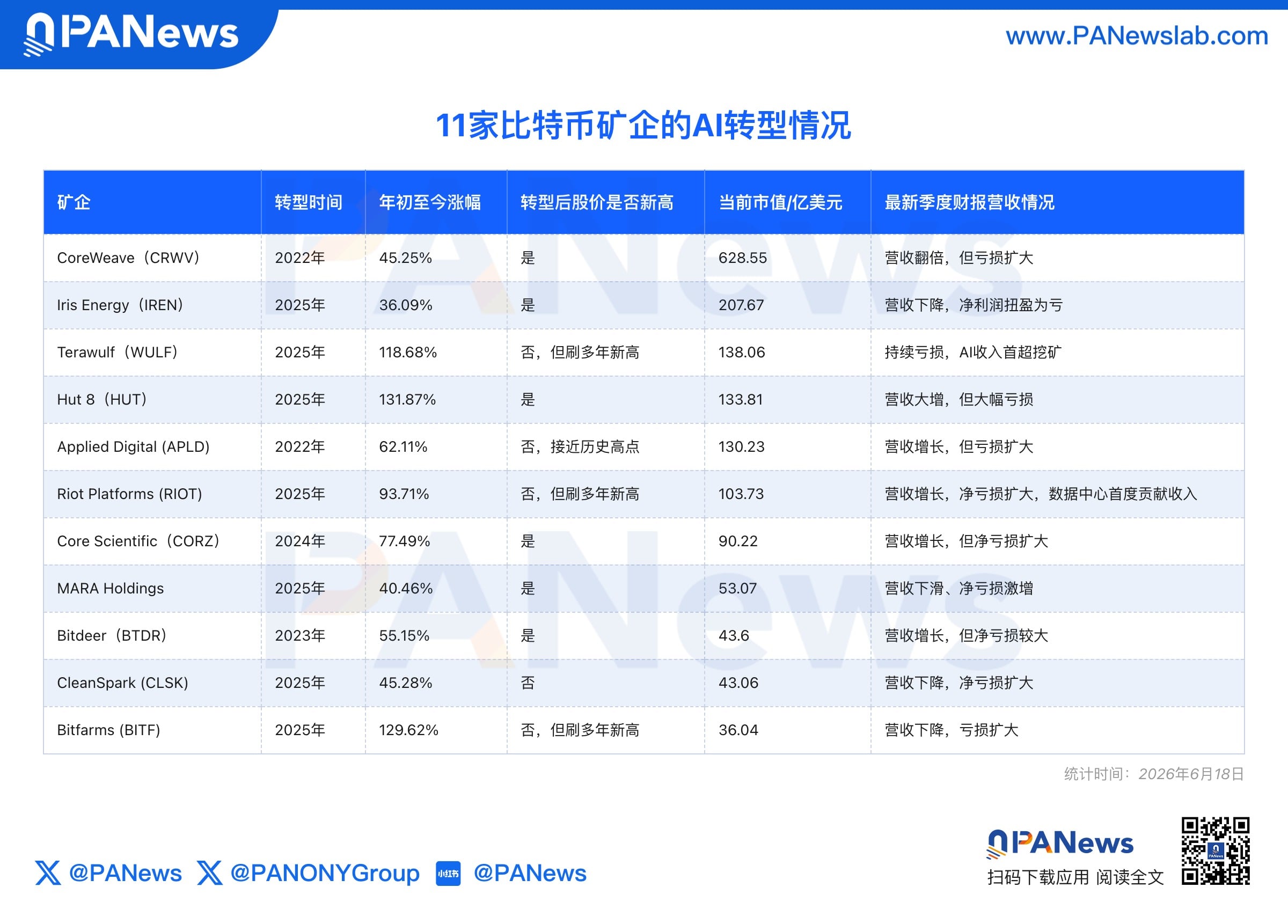
Looking at the timing of transformation, CoreWeave, Applied Digital, and Bitdeer began deploying AI computing and data center businesses as early as 2022-2023, among the industry's early movers; while miners like Iris Energy, Terawulf, Hut 8, Riot Platforms, and Bitfarms started fully ramping up AI infrastructure construction in 2025, coinciding with the AI industry's rapid expansion cycle.

In terms of stock performance, the market has shown high recognition for the AI transformation narrative. The 11 miners have achieved an average year-to-date gain of 75.97%, significantly outperforming Bitcoin over the same period, with most hitting new highs post-transition. Among them, Bitfarms (129.62%), Hut 8 (131.87%), Terawulf (118.68%), and Riot Platforms (93.71%) have stood out, benefiting from this round of AI infrastructure revaluation.

In terms of market capitalization, miners have clearly differentiated. As a successful transformation representative, CoreWeave's market cap has reached $62.855 billion, far exceeding other miners and becoming the industry's new valuation benchmark; Iris Energy, Terawulf, Hut 8, Applied Digital, and Riot Platforms form a tier with market caps between $10 billion and $20 billion; companies like MARA Holdings, Core Scientific, Bitdeer, CleanSpark, and Bitfarms remain in the sub-$5 billion range. This differentiation stems not only from first-mover advantage but also reflects the market's differentiated pricing of each miner's AI strategy execution capability, customer resources, and data center deployment progress.

However, from a fundamental perspective, most miners remain in the heavy-investment phase of AI transformation. Although many miners' latest quarterly reports show revenue growth, overall profitability remains under pressure. On one hand, fluctuations in the value of crypto asset portfolios drag down profit performance; on the other hand, AI data center construction requires massive capital expenditures, with increasing investments in power expansion, infrastructure, and GPU procurement driving continuous operational cost increases, keeping most miners in a loss-making state.

Notably, despite generally pressured earnings, these miners' stock prices have surged significantly, indicating that the current market focus is not on short-term profitability but on the growth potential of miners as new-generation computing power infrastructure operators.

Miners' Survival Battle Escalates, AI Transformation Must Overcome Multiple Hurdles

The downturn in the Bitcoin market is making the survival environment for miners increasingly severe.
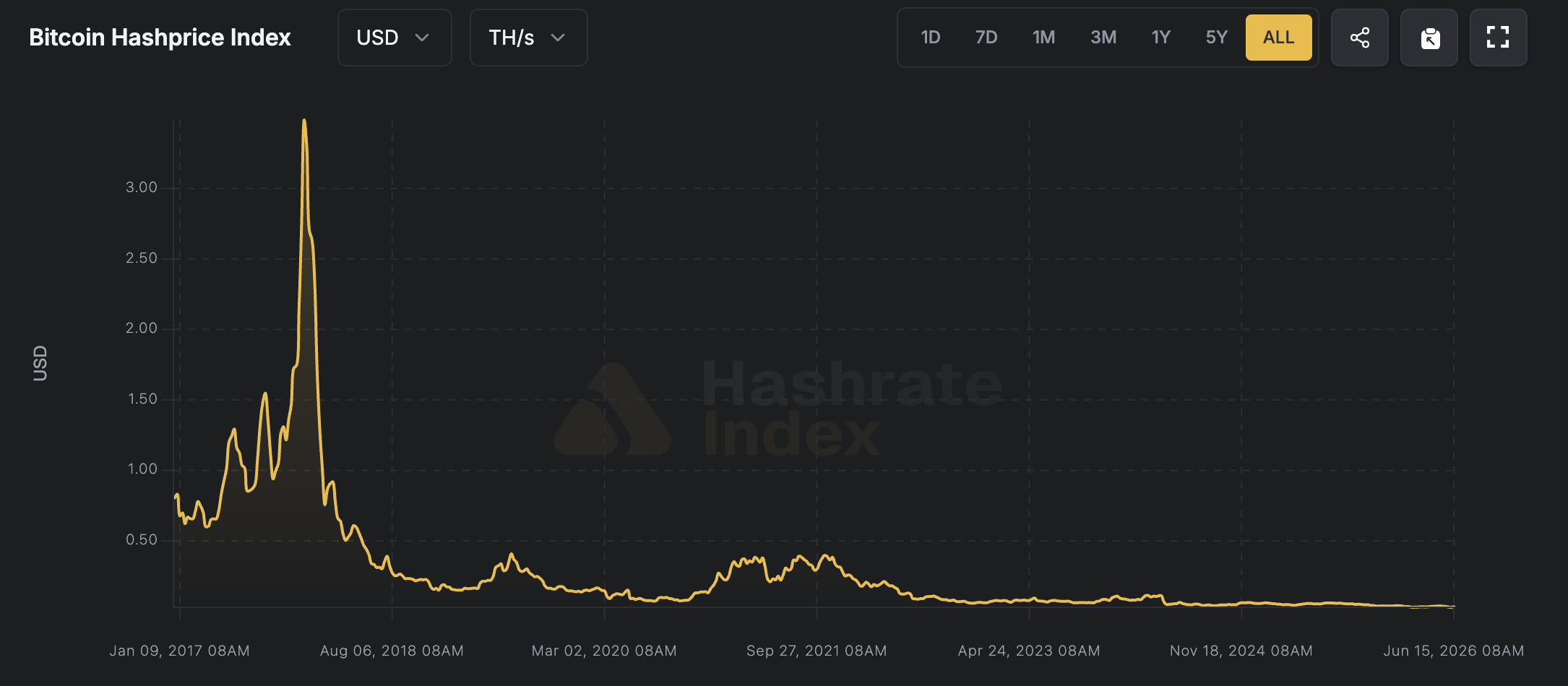
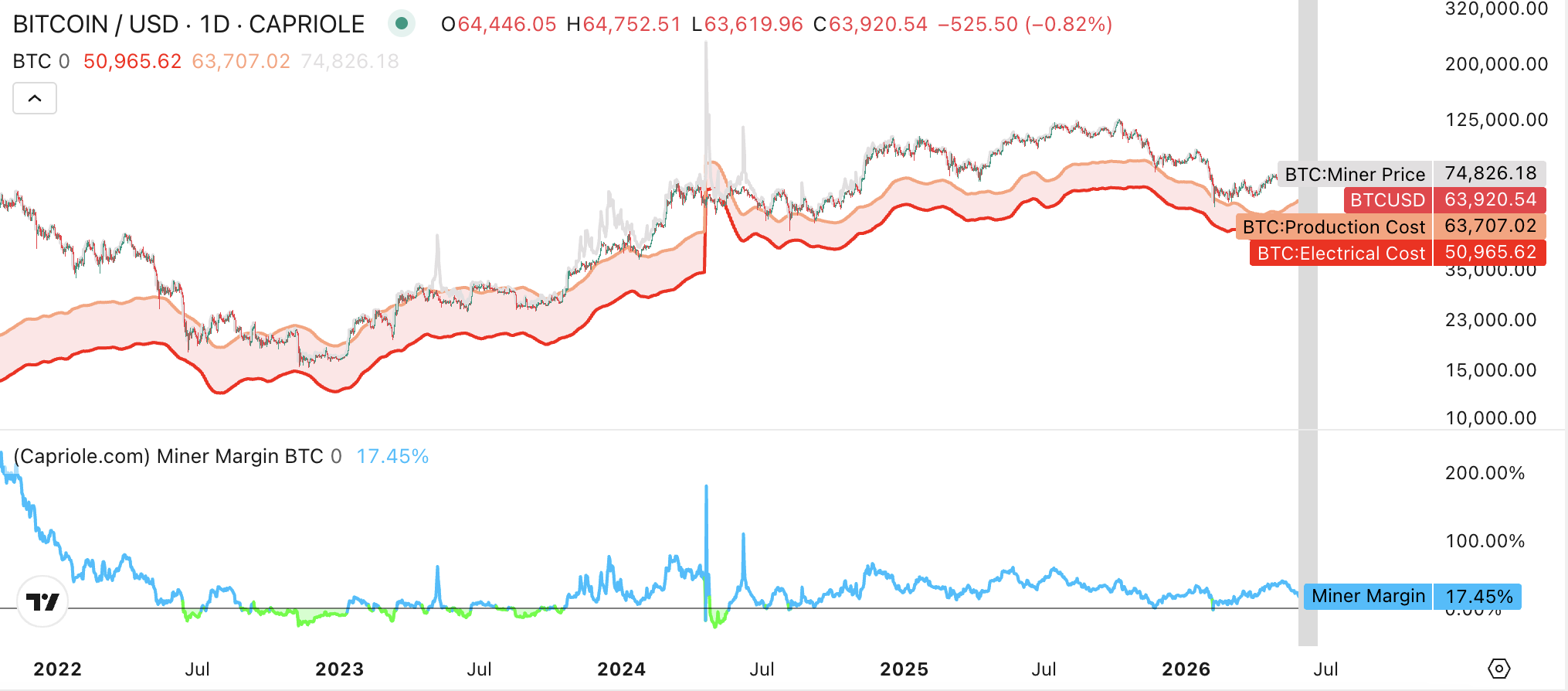
According to Capriole Investments data, as of June 18th, the average Bitcoin production cost was approximately $63,707, with electricity costs around $50,965, resulting in a miner profit margin of just 17.45%. Over the past 30 days, miner profit margins have contracted by 47.8%. Meanwhile, Luxor Hashrate Index data shows that as of June 18th, the daily revenue per 1 TH/s of hashrate has dropped to $0.032, a significant decline from $0.053 a year ago.
With mining revenues continuously shrinking, many miners have had to sell Bitcoin to maintain cash flow, further intensifying survival pressure for small and medium-sized miners, and accelerating the concentration of mining resources towards leading players. Currently, the three largest mining pools—Foundry USA, AntPool, and F2Pool—collectively hold 59% of the network's total hashrate share. In comparison, in 2022, the top three Bitcoin mining pools held only 44% of the hashrate market share.

Although the traditional mining business is struggling, the explosive growth in AI data center demand is also prompting a market revaluation of miners. VanEck's latest research report points out that miners' most valuable assets are not mining rigs, but power resources, substation access capabilities, land reserves, and data center infrastructure—precisely the scarce core resources the AI industry needs most today. Because AI customers are willing to pay electricity rates and rents far higher than those in traditional mining, AI infrastructure is expected to become miners' primary growth engine for the next decade.

A Bernstein report reveals that hyperscale cloud providers, AI cloud service providers, and chip companies have already announced over $90 billion in AI infrastructure collaborations, involving about 3.7 GW of power capacity. Currently, chasing power resources has become the core of AI infrastructure competition, with Bitcoin miners collectively controlling over 27 GW of planned power capacity. In some parts of the US, the timeline for new 1 GW power connections can be as long as 50 months, making existing mining sites key locations for AI data center expansion.

However, the AI transformation is far from an easy path. VanEck notes that the market is still in the early stages of AI transformation, with company valuations primarily based on Gross Energized Power. Miners with signed AI leases generally receive higher valuation premiums, while projects still in the planning stage struggle to gain market recognition. Future industry valuation logic will gradually shift from "power capacity" to "project delivery capability," ultimately returning to core metrics like cash flow, return on capital, and tenant quality. Currently, the industry has only delivered about 25% of its signed capacity. The ability to complete AI data center construction on time and on budget will become a key factor determining company valuations.

VanEck also emphasizes that AI tenant quality will directly impact miner valuation levels. Clients like Microsoft, Amazon, and Google (hyperscale cloud providers) bring more stable cash flows and lower financing costs, while smaller GPU cloud service providers correspond to higher operational risks and capital costs.

The enormous funding required for transformation is also testing miners' financial strength. VanEck estimates that miners' transition to AI infrastructure still faces massive capital expenditure needs, with a short-term funding gap of about $50 billion and long-term capital requirements potentially reaching $221 billion.

Under immense financial pressure, many miners have already started raising funds through various means. For example, miners like Iris Energy, TeraWulf, Bitfarms, and CleanSpark have raised funds by issuing convertible bonds, attracting investors with lower coupon rates and future equity conversion potential; while companies like Core Scientific, Terawulf, MARA, Bitdeer, and Riot Platforms have chosen to sell or even liquidate part of their Bitcoin reserves to continuously fund the AI transition.

Additionally, many miners are beginning to lock in future revenue by signing long-term AI or High-Performance Computing (HPC) contracts, using them to secure project financing and reduce overall operational risk. For instance, CoreWeave signed a $6 billion AI cloud service cooperation agreement with Jane Street; IREN secured a $9.7 billion AI cloud computing contract with Microsoft; Hut 8 signed data center leasing agreements totaling $9.8 billion; and Bitdeer partnered with Norway's DCI to build the country's largest AI data center project, among others.

For miners, AI undoubtedly offers a far more imaginative development path than traditional mining at this stage. However, this transformation is not simply a switch from mining to selling computing power; it is, in essence, a long-term competition centered on capital, resources, and execution capability.

Criptos en tendencia

Preguntas relacionadas

QWhy are cryptocurrency mining companies accelerating their shift towards the AI infrastructure sector?

ACryptocurrency mining companies are accelerating their shift to AI infrastructure due to declining profitability in Bitcoin mining and the explosive growth in global demand for data centers, power resources, and GPU computing power. The AI boom offers a new potential growth curve. Miners also possess natural advantages for this transition, such as existing access to power resources, land, substation connections, and mature cooling systems, allowing them to enter the AI infrastructure market at a lower cost and shorter timeline.

QHow has the market valuation of mining companies changed following their AI transformation narrative?

AThe market valuation of mining companies has entered a differentiated stage following their AI transformation. Their stock prices have significantly outperformed Bitcoin, with many hitting new highs. Companies are now valued based on their progress in AI infrastructure. Leaders like CoreWeave have achieved multi-billion dollar valuations, forming distinct market cap tiers. Valuation is shifting from a focus on short-term mining profitability to the future growth potential as next-generation computing infrastructure operators, with differentiation based on execution capability, customer base, and project delivery.

QWhat are the major challenges mining companies face in their transition to AI businesses?

AThe major challenges include immense capital expenditures, sustained funding needs, and long payback periods for AI data center construction. Companies face a funding gap estimated at $500 billion short-term and up to $2.21 trillion long-term. Other hurdles involve escalating operational costs, the need to secure high-quality AI tenants (like major cloud providers), the ability to deliver projects on time and on budget, and managing the financial pressure while their core mining business remains under profitability strain.

QAccording to the article, what are the key assets of a mining company that are valuable for AI infrastructure development?

AAccording to the article, the most valuable assets of a mining company for AI development are not the mining rigs, but the underlying infrastructure: power resources, substation interconnection capacity, land reserves, and data center facilities. These are scarce core resources crucial for the AI industry. Miners' existing access to significant planned power capacity (over 27 GW collectively) and their ability to repurpose sites give them a strategic advantage in the race for AI infrastructure.

QHow are mining companies financing their expensive transition into AI infrastructure?

AMining companies are employing several methods to finance their AI transition: 1) Issuing convertible notes (e.g., Iris Energy, TeraWulf). 2) Selling or liquidating portions of their Bitcoin reserves (e.g., Core Scientific, Riot Platforms). 3) Securing project financing by signing long-term AI or High-Performance Computing (HPC) contracts with major clients, which lock in future revenue and reduce operational risk. Examples include multi-billion dollar deals with companies like Microsoft, Jane Street, and others.

Lecturas Relacionadas

Two Legends Lost in Three Days: Is Google's AI Talent Dam Cracking?

In three days, Google lost two AI legends. On June 18, Noam Shazeer, co-author of the seminal "Attention is All You Need" paper and Gemini co-lead, left for OpenAI. Just 48 hours later, John Jumper, 2024 Nobel laureate and AlphaFold lead, departed DeepMind for Anthropic. This follows Andrej Karpathy joining Anthropic in May. These moves highlight a structural trend: top AI talent is concentrating at mission-driven, pre-IPO firms like OpenAI and Anthropic, while Google becomes a primary source. The exodus stems from a core mission mismatch. Google's ad-centric model often subordinates AI research to product and revenue goals, creating friction for pioneers like Shazeer, who returned in 2024 only to leave again. In contrast, OpenAI and Anthropic offer singular focus on pushing AI boundaries, whether towards AGI or safety-aligned models, which deeply appeals to top researchers like Jumper. Financial incentives amplify the pull. With both OpenAI and Anthropic nearing IPO, employees stand to gain immensely from equity, an upside Google's mature stock cannot match. Furthermore, the 2023 merger of Google Brain and DeepMind, intended to consolidate strength, has instead created cultural tension and slowed the path from research to product, as evidenced by Gemini's pace. This talent redistribution is reshaping the AI landscape. While Google retains vast data and compute resources, its true crisis is the quiet, continuous loss of the people who define the field's future. The real moat in AI is not infrastructure, but the concentration of brilliant minds—a battle Google is currently losing.

marsbitHace 44 min(s)

Two Legends Lost in Three Days: Is Google's AI Talent Dam Cracking?

marsbitHace 44 min(s)

Behind the AI Report Card, Lies a Chinese 'Exam Setter'

Beyond the familiar performance charts like MMLU-Pro and MMMU, which major AI models strive to ace, stands a key "examiner": Chinese-Canadian researcher Wenhu Chen. An assistant professor at the University of Waterloo and founder of TIGERLab, Chen addresses the crucial need for more rigorous AI evaluation. As models like GPT-4 began scoring near-perfect results on older benchmarks like MMLU, it became difficult to distinguish their true capabilities. In response, Chen introduced MMLU-Pro in 2024, featuring harder, more reasoning-focused questions with more answer choices, successfully reintroducing meaningful performance gaps. His work extends to multi-modal evaluation with MMMU and its enhanced version, MMMU-Pro. These benchmarks test a model's ability to understand and reason with complex information from images, charts, and text across diverse academic subjects, exposing the significant challenges even top models face in genuine comprehension. Chen's background in complex QA, table reasoning, and his experience at Google DeepMind on projects like Gemini inform his approach. He understands that effective benchmarks must anticipate how models might "cheat" by memorizing data or avoiding visual analysis. His lab also actively researches video understanding and generation models (e.g., UniVideo, Vamba), ensuring his evaluation work is grounded in practical model-building challenges. Now at Meta's Super Intelligence Lab, Chen continues his focus on multi-modal data and evaluation, representing the deep yet often unseen contributions of Chinese talent in shaping the fundamental tools of the AI industry.

marsbitHace 56 min(s)

Behind the AI Report Card, Lies a Chinese 'Exam Setter'

marsbitHace 56 min(s)

Alliance Co-founder's Letter to Entrepreneurs: Written at the Moment Cursor Sold for $600 Billion

Alliance Co-founder's Letter to Entrepreneurs: On Cursor's $60 Billion Sale Many aspiring founders see massive exits like Cursor's $60B sale and wonder why they can't achieve the same, often concluding opportunities are exhausted. But great companies aren't built in obvious, crowded spaces. Cursor, like Stripe, Figma, and Shopify before it, started with a non-consensus belief about the future. Before ChatGPT, they believed AI would transform knowledge work. They focused on a genuinely exciting domain, became their own customer, and obsessed over power users. Their journey involved years of "glass-chewing" effort before the market was ready. The pattern is consistent: identify a long-term technological shift, find a missed entry point, and execute for years before the trend becomes obvious. First-generation products (PayPal, Adobe, Amazon) prove a market exists. Second-generation winners (Stripe, Figma, Shopify) rebuild that market around new insights, technology, or changing customer behaviors. Founders must identify their phase in the cycle. Early entrants like Coinbase or Cursor focus on making new technology usable for power users. Later entrants find the "yin" to the established "yang"—the blind spots incumbents miss as they grow distant from individual users. The key is deep market immersion. Use every product in your space. Talk to users. Build an audience. Stop looking for ideas and start *seeing* them everywhere. Then, choose one. The idea must offer a 10x improvement or solve a "hair-on-fire" pain point—something severe enough that users are already crafting workarounds. When building, avoid feature bloat. Ask: why would someone switch? Great startups rarely force new behaviors; they improve familiar workflows with drastically lower friction (e.g., Cursor forked VS Code instead of creating a new editor). Distribution is the underestimated moat. Before product-market fit, achieve distribution-market fit. How do customers discover new tools? Founders like those at Airbnb, Stripe, and Cursor did unscalable, manual work to recruit early users. The final, unteachable ingredient is resilience. Cursor built for years pre-market, faced rejection, and persisted. So did Airbnb, Nvidia, and Rain (which launched post-FTX collapse). The lesson isn't that these founders were smarter, but that they stayed in the game long enough for their insights to compound. Framework: Spot technological cycles. Cultivate unique insight. Obsess over your market. Talk to customers. Find a hair-on-fire problem. Build the simplest wedge. Win your distribution channel. Above all, don't quit when it gets hard. Most people won't do these things consistently. The few who do build the next generation of great companies. Go build.

marsbitHace 1 hora(s)

Alliance Co-founder's Letter to Entrepreneurs: Written at the Moment Cursor Sold for $600 Billion

marsbitHace 1 hora(s)

Weekly Editor's Picks (0613-0619)

Weekly Editor's Picks (0613-0619): Market Insights & Analysis This weekly digest curates in-depth analysis often lost in the information flow, focusing on key insights across macro trends, investment, and technology. **Macro & Geopolitics:** With the Strait of Hormuz reopening and military conflict shifting to negotiation, markets are pivoting from "war shock" to "supply restoration." Trades include shorting crude risk premiums, longing airlines/tourism, Asian energy importers, and bond duration, while shorting inflation expectations. LNG, fertilizer, and chemical chains are also being repriced. **Investment & VC:** Ray Dalio advises against betting on concentrated AI giants dominating indices, advocating for diversified portfolios of high-quality, low-correlation assets instead. Analysis covers the 4-year crypto cycle, predicting the core surviving product by 2029 will be asset trading markets. Current BTC metrics suggest a potential bottoming zone, presenting a patient accumulation window. SpaceX's high-profile IPO at a $2.1T valuation faces scrutiny over fundamentals, with key watchpoints being its likely inclusion in the Nasdaq index and Q2 earnings. Concerns are raised about potential "gamma squeeze" and systemic risks if its narrative-driven valuation gets amplified by passive index funds. Robinhood (HOOD) is noted for breaking its high correlation with crypto, bolstered by its stock trading and new underwriting business. **Web3 & AI:** A warning highlights ~$1.8T in off-balance-sheet AI infrastructure commitments (purchase commitments, leases) as a potential systemic risk if AI monetization lags. AI models are being used for World Cup predictions, adding a new layer for betting markets. A cost breakdown of a $20 AI subscription reveals the supply chain from model companies to cloud, GPUs, and power. **Prediction Markets:** The emergence of prediction market "concept stocks" is noted, with Robinhood developing its own platform, Rothera, signaling a shift from market competition to a "channel war" for user access. **CeFi & DeFi:** The SpaceX IPO tested perpetual contract mechanisms for pre-IPO assets, highlighting challenges in handling corporate actions like stock splits on-chain. The de-pegging of STRC (Strategy's preferred share) to ~$89 reflects market concerns over MicroStrategy's capital structure and BTC-backed leverage model. BlackRock's covered-call Bitcoin ETF (BITA) offers yield but caps upside, appealing to yield-seeking institutions. **Ethereum:** An opinion piece argues Ethereum's core strength is its vast developer community and composability, solidifying its role as the default operating system for the financial internet. **Weekly Hot Topics:** Include the US-Iran deal reopening the Strait of Hormuz, Fed's hawkish hold, Anthropic restricting model access, SpaceX acquiring Cursor, and a humorous stock surge for "Liuliumei" due to its "LLM" ticker.

marsbitHace 1 hora(s)

Weekly Editor's Picks (0613-0619)

marsbitHace 1 hora(s)

Alliance's Co-Founder's Letter to Entrepreneurs: Written on the Occasion of Cursor's $60 Billion Sale

In this letter to entrepreneurs, Alliance reflects on the success of Cursor's $60 billion sale to Elon Musk, using it as a case study to counter the misconception that opportunities in crowded fields like AI or crypto are exhausted. The piece argues that great companies like Cursor, Stripe, Figma, and Shopify are not built by geniuses with perfect ideas, but by founders who start with a non-consensus belief about the future and build for years before that future becomes obvious to everyone. They identify long-term shifts, find overlooked entry points, and execute relentlessly. The framework for success involves: 1. **Identifying your place in the technology cycle**: Early-stage opportunities focus on making new tech usable for power users (e.g., Coinbase, Cursor). Later-stage opportunities involve finding the "yin" to an existing "yang"—the blind spots of first-generation players (e.g., Stripe vs. PayPal, Figma vs. Adobe). 2. **Cultivating unique insights**: Immerse yourself deeply in the market. Use every product, talk to users, and build an audience. Insights will emerge naturally from deep engagement. 3. **Finding a "hair-on-fire" problem**: Look for a 10x improvement or a severe, urgent pain point. The strongest signal is people already building clumsy workarounds. 4. **Building a focused MVP**: Don't just add features because you can. Ask why users would abandon their current tool for yours. The best startups rarely force new behaviors; they improve familiar workflows with drastically lower friction. 5. **Winning a distribution channel**: Distribution is often the moat. Before product-market fit, achieve channel-market fit. Find where your customers are and build an engine to reach them, even through unscalable, manual efforts initially. 6. **Persistence**: The final, unteachable ingredient is resilience. Success stories like Cursor, Airbnb, and Nvidia involved years of grinding, rejection, and perseverance when the path forward seemed unclear. The conclusion is that there is no secret. Most people fail to consistently execute these steps over the long term. The few who do build the companies that define the next era. The world is yours to create.

链捕手Hace 1 hora(s)

Alliance's Co-Founder's Letter to Entrepreneurs: Written on the Occasion of Cursor's $60 Billion Sale

链捕手Hace 1 hora(s)

Trading

Spot
Futuros

Artículos destacados

Qué es GROK AI

Grok AI: Revolucionando la Tecnología Conversacional en la Era Web3 Introducción En el paisaje de rápida evolución de la inteligencia artificial, Grok AI se destaca como un proyecto notable que une los dominios de la tecnología avanzada y la interacción del usuario. Desarrollado por xAI, una empresa liderada por el renombrado empresario Elon Musk, Grok AI busca redefinir la forma en que interactuamos con la inteligencia artificial. A medida que el movimiento Web3 continúa floreciendo, Grok AI tiene como objetivo aprovechar el poder de la IA conversacional para responder consultas complejas, proporcionando a los usuarios una experiencia que no solo es informativa, sino también entretenida. ¿Qué es Grok AI? Grok AI es un sofisticado chatbot de IA conversacional diseñado para interactuar dinámicamente con los usuarios. A diferencia de muchos sistemas de IA tradicionales, Grok AI abraza una gama más amplia de consultas, incluyendo aquellas que normalmente se consideran inapropiadas o fuera de las respuestas estándar. Los objetivos centrales del proyecto incluyen: Razonamiento Confiable: Grok AI enfatiza el razonamiento de sentido común para proporcionar respuestas lógicas basadas en la comprensión contextual. Supervisión Escalable: La integración de asistencia de herramientas asegura que las interacciones de los usuarios sean monitoreadas y optimizadas para la calidad. Verificación Formal: La seguridad es primordial; Grok AI incorpora métodos de verificación formal para mejorar la confiabilidad de sus resultados. Comprensión de Largo Contexto: El modelo de IA sobresale en retener y recordar un extenso historial de conversaciones, facilitando discusiones significativas y contextualizadas. Robustez Adversarial: Al enfocarse en mejorar sus defensas contra entradas manipuladas o maliciosas, Grok AI busca mantener la integridad de las interacciones de los usuarios. En esencia, Grok AI no es solo un dispositivo de recuperación de información; es un compañero conversacional inmersivo que fomenta un diálogo dinámico. Creador de Grok AI La mente detrás de Grok AI no es otra que Elon Musk, una persona sinónimo de innovación en varios campos, incluyendo la automoción, los viajes espaciales y la tecnología. Bajo el paraguas de xAI, una empresa enfocada en avanzar la tecnología de IA de maneras beneficiosas, la visión de Musk busca remodelar la comprensión de las interacciones de IA. El liderazgo y la ética fundacional están profundamente influenciados por el compromiso de Musk de empujar los límites tecnológicos. Inversores de Grok AI Si bien los detalles específicos sobre los inversores que respaldan a Grok AI son limitados, se reconoce públicamente que xAI, el incubador del proyecto, está fundado y apoyado principalmente por el propio Elon Musk. Las empresas y participaciones anteriores de Musk proporcionan un respaldo robusto, fortaleciendo aún más la credibilidad y el potencial de crecimiento de Grok AI. Sin embargo, hasta ahora, la información sobre fundaciones de inversión adicionales u organizaciones que apoyan a Grok AI no está fácilmente accesible, marcando un área para una posible exploración futura. ¿Cómo Funciona Grok AI? La mecánica operativa de Grok AI es tan innovadora como su marco conceptual. El proyecto integra varias tecnologías de vanguardia que facilitan sus funcionalidades únicas: Infraestructura Robusta: Grok AI está construido utilizando Kubernetes para la orquestación de contenedores, Rust para rendimiento y seguridad, y JAX para computación numérica de alto rendimiento. Este trío asegura que el chatbot opere de manera eficiente, escale efectivamente y sirva a los usuarios de manera oportuna. Acceso a Conocimiento en Tiempo Real: Una de las características distintivas de Grok AI es su capacidad para acceder a datos en tiempo real a través de la plataforma X—anteriormente conocida como Twitter. Esta capacidad otorga a la IA acceso a la información más reciente, permitiéndole proporcionar respuestas y recomendaciones oportunas que otros modelos de IA podrían pasar por alto. Dos Modos de Interacción: Grok AI ofrece a los usuarios una elección entre “Modo Divertido” y “Modo Regular”. El Modo Divertido permite un estilo de interacción más lúdico y humorístico, mientras que el Modo Regular se centra en ofrecer respuestas precisas y exactas. Esta versatilidad asegura una experiencia personalizada que se adapta a diversas preferencias de los usuarios. En esencia, Grok AI une rendimiento con compromiso, creando una experiencia que es tanto enriquecedora como entretenida. Cronología de Grok AI El viaje de Grok AI está marcado por hitos cruciales que reflejan sus etapas de desarrollo y despliegue: Desarrollo Inicial: La fase fundamental de Grok AI tuvo lugar durante aproximadamente dos meses, durante los cuales se realizó el entrenamiento inicial y el ajuste del modelo. Lanzamiento Beta de Grok-2: En un avance significativo, se anunció la beta de Grok-2. Este lanzamiento introdujo dos versiones del chatbot—Grok-2 y Grok-2 mini—cada una equipada con capacidades para chatear, programar y razonar. Acceso Público: Tras su desarrollo beta, Grok AI se volvió disponible para los usuarios de la plataforma X. Aquellos con cuentas verificadas por un número de teléfono y activas durante al menos siete días pueden acceder a una versión limitada, haciendo que la tecnología esté disponible para un público más amplio. Esta cronología encapsula el crecimiento sistemático de Grok AI desde su inicio hasta el compromiso público, enfatizando su compromiso con la mejora continua y la interacción del usuario. Características Clave de Grok AI Grok AI abarca varias características clave que contribuyen a su identidad innovadora: Integración de Conocimiento en Tiempo Real: El acceso a información actual y relevante diferencia a Grok AI de muchos modelos estáticos, permitiendo una experiencia de usuario atractiva y precisa. Estilos de Interacción Versátiles: Al ofrecer modos de interacción distintos, Grok AI se adapta a diversas preferencias de los usuarios, invitando a la creatividad y la personalización en la conversación con la IA. Avanzada Infraestructura Tecnológica: La utilización de Kubernetes, Rust y JAX proporciona al proyecto un marco sólido para asegurar confiabilidad y rendimiento óptimo. Consideración de Discurso Ético: La inclusión de una función generadora de imágenes muestra el espíritu innovador del proyecto. Sin embargo, también plantea consideraciones éticas en torno a los derechos de autor y la representación respetuosa de figuras reconocibles—una discusión en curso dentro de la comunidad de IA. Conclusión Como una entidad pionera en el ámbito de la IA conversacional, Grok AI encapsula el potencial de experiencias transformadoras para los usuarios en la era digital. Desarrollado por xAI y guiado por el enfoque visionario de Elon Musk, Grok AI integra conocimiento en tiempo real con capacidades avanzadas de interacción. Busca empujar los límites de lo que la inteligencia artificial puede lograr mientras mantiene un enfoque en consideraciones éticas y la seguridad del usuario. Grok AI no solo encarna el avance tecnológico, sino que también representa un nuevo paradigma de conversación en el paisaje Web3, prometiendo involucrar a los usuarios con tanto conocimiento hábil como interacción lúdica. A medida que el proyecto continúa evolucionando, se erige como un testimonio de lo que la intersección de la tecnología, la creatividad y la interacción similar a la humana puede lograr.

409 Vistas totalesPublicado en 2024.12.26Actualizado en 2024.12.26

Qué es GROK AI

Qué es ERC AI

Euruka Tech: Una Visión General de $erc ai y sus Ambiciones en Web3 Introducción En el paisaje en rápida evolución de la tecnología blockchain y las aplicaciones descentralizadas, nuevos proyectos emergen con frecuencia, cada uno con objetivos y metodologías únicas. Uno de estos proyectos es Euruka Tech, que opera en el amplio dominio de las criptomonedas y Web3. El enfoque principal de Euruka Tech, particularmente su token $erc ai, es presentar soluciones innovadoras diseñadas para aprovechar las crecientes capacidades de la tecnología descentralizada. Este artículo tiene como objetivo proporcionar una visión general completa de Euruka Tech, una exploración de sus objetivos, funcionalidad, la identidad de su creador, posibles inversores y su importancia dentro del contexto más amplio de Web3. ¿Qué es Euruka Tech, $erc ai? Euruka Tech se caracteriza como un proyecto que aprovecha las herramientas y funcionalidades ofrecidas por el entorno Web3, centrándose en integrar inteligencia artificial dentro de sus operaciones. Aunque los detalles específicos sobre el marco del proyecto son algo elusivos, está diseñado para mejorar la participación del usuario y automatizar procesos en el espacio cripto. El proyecto tiene como objetivo crear un ecosistema descentralizado que no solo facilite transacciones, sino que también incorpore funcionalidades predictivas a través de inteligencia artificial, de ahí la designación de su token, $erc ai. El objetivo es proporcionar una plataforma intuitiva que facilite interacciones más inteligentes y un procesamiento eficiente de transacciones dentro de la creciente esfera de Web3. ¿Quién es el Creador de Euruka Tech, $erc ai? En la actualidad, la información sobre el creador o el equipo fundador detrás de Euruka Tech permanece no especificada y algo opaca. Esta ausencia de datos genera preocupaciones, ya que el conocimiento del trasfondo del equipo es a menudo esencial para establecer credibilidad dentro del sector blockchain. Por lo tanto, hemos categorizado esta información como desconocida hasta que se disponga de detalles concretos en el dominio público. ¿Quiénes son los Inversores de Euruka Tech, $erc ai? De manera similar, la identificación de inversores u organizaciones de respaldo para el proyecto Euruka Tech no se proporciona fácilmente a través de la investigación disponible. Un aspecto que es crucial para los posibles interesados o usuarios que consideren involucrarse con Euruka Tech es la garantía que proviene de asociaciones financieras establecidas o respaldo de firmas de inversión de renombre. Sin divulgaciones sobre afiliaciones de inversión, es difícil sacar conclusiones completas sobre la seguridad financiera o la longevidad del proyecto. De acuerdo con la información encontrada, esta sección también se encuentra en estado de desconocido. ¿Cómo Funciona Euruka Tech, $erc ai? A pesar de la falta de especificaciones técnicas detalladas para Euruka Tech, es esencial considerar sus ambiciones innovadoras. El proyecto busca aprovechar el poder computacional de la inteligencia artificial para automatizar y mejorar la experiencia del usuario dentro del entorno de las criptomonedas. Al integrar IA con tecnología blockchain, Euruka Tech tiene como objetivo proporcionar características como operaciones automatizadas, evaluaciones de riesgo e interfaces de usuario personalizadas. La esencia innovadora de Euruka Tech radica en su objetivo de crear una conexión fluida entre los usuarios y las vastas posibilidades que presentan las redes descentralizadas. A través de la utilización de algoritmos de aprendizaje automático e IA, busca minimizar los desafíos de los usuarios primerizos y optimizar las experiencias transaccionales dentro del marco de Web3. Esta simbiosis entre IA y blockchain subraya la importancia del token $erc ai, que actúa como un puente entre las interfaces de usuario tradicionales y las capacidades avanzadas de las tecnologías descentralizadas. Cronología de Euruka Tech, $erc ai Desafortunadamente, como resultado de la información limitada disponible sobre Euruka Tech, no podemos presentar una cronología detallada de los principales desarrollos o hitos en el viaje del proyecto. Esta cronología, típicamente invaluable para trazar la evolución de un proyecto y entender su trayectoria de crecimiento, no está actualmente disponible. A medida que la información sobre eventos notables, asociaciones o adiciones funcionales se haga evidente, las actualizaciones seguramente mejorarán la visibilidad de Euruka Tech en la esfera cripto. Aclaración sobre Otros Proyectos “Eureka” Es importante señalar que múltiples proyectos y empresas comparten una nomenclatura similar con “Eureka”. La investigación ha identificado iniciativas como un agente de IA de NVIDIA Research, que se centra en enseñar a los robots tareas complejas utilizando métodos generativos, así como Eureka Labs y Eureka AI, que mejoran la experiencia del usuario en educación y análisis de servicio al cliente, respectivamente. Sin embargo, estos proyectos son distintos de Euruka Tech y no deben confundirse con sus objetivos o funcionalidades. Conclusión Euruka Tech, junto con su token $erc ai, representa un jugador prometedor pero actualmente oscuro dentro del paisaje de Web3. Si bien los detalles sobre su creador e inversores permanecen no revelados, la ambición central de combinar inteligencia artificial con tecnología blockchain se presenta como un punto focal de interés. Los enfoques únicos del proyecto para fomentar la participación del usuario a través de la automatización avanzada podrían destacarlo a medida que el ecosistema Web3 progresa. A medida que el mercado cripto continúa evolucionando, los interesados deben mantener un ojo atento a los avances en torno a Euruka Tech, ya que el desarrollo de innovaciones documentadas, asociaciones o una hoja de ruta definida podría presentar oportunidades significativas en el futuro cercano. Tal como está, esperamos más información sustancial que podría revelar el potencial de Euruka Tech y su posición en el competitivo paisaje cripto.

389 Vistas totalesPublicado en 2025.01.02Actualizado en 2025.01.02

Qué es ERC AI

Qué es DUOLINGO AI

DUOLINGO AI: Integrando el Aprendizaje de Idiomas con Web3 e Innovación en IA En una era donde la tecnología redefine la educación, la integración de la inteligencia artificial (IA) y las redes blockchain anuncia una nueva frontera para el aprendizaje de idiomas. Entra DUOLINGO AI y su criptomoneda asociada, $DUOLINGO AI. Este proyecto aspira a fusionar la capacidad educativa de las principales plataformas de aprendizaje de idiomas con los beneficios de la tecnología descentralizada Web3. Este artículo profundiza en los aspectos clave de DUOLINGO AI, explorando sus objetivos, marco tecnológico, desarrollo histórico y potencial futuro, mientras mantiene claridad entre el recurso educativo original y esta iniciativa independiente de criptomoneda. Visión General de DUOLINGO AI En su esencia, DUOLINGO AI busca establecer un entorno descentralizado donde los aprendices puedan ganar recompensas criptográficas por alcanzar hitos educativos en la competencia lingüística. Al aplicar contratos inteligentes, el proyecto tiene como objetivo automatizar los procesos de verificación de habilidades y asignación de tokens, adhiriéndose a los principios de Web3 que enfatizan la transparencia y la propiedad del usuario. El modelo se aparta de los enfoques tradicionales para la adquisición de idiomas al apoyarse en gran medida en una estructura de gobernanza impulsada por la comunidad, permitiendo a los poseedores de tokens sugerir mejoras al contenido del curso y a las distribuciones de recompensas. Algunos de los objetivos notables de DUOLINGO AI incluyen: Aprendizaje Gamificado: El proyecto integra logros en blockchain y tokens no fungibles (NFTs) para representar niveles de competencia lingüística, fomentando la motivación a través de recompensas digitales atractivas. Creación de Contenido Descentralizada: Abre avenidas para que educadores y entusiastas de los idiomas contribuyan con sus cursos, facilitando un modelo de reparto de ingresos que beneficia a todos los contribuyentes. Personalización Impulsada por IA: Al emplear modelos avanzados de aprendizaje automático, DUOLINGO AI personaliza las lecciones para adaptarse al progreso de aprendizaje individual, similar a las características adaptativas que se encuentran en plataformas establecidas. Creadores del Proyecto y Gobernanza A partir de abril de 2025, el equipo detrás de $DUOLINGO AI permanece seudónimo, una práctica frecuente en el paisaje descentralizado de criptomonedas. Esta anonimidad está destinada a promover el crecimiento colectivo y la participación de los interesados en lugar de centrarse en desarrolladores individuales. El contrato inteligente desplegado en la blockchain de Solana anota la dirección de la billetera del desarrollador, lo que significa el compromiso con la transparencia en las transacciones a pesar de que la identidad de los creadores sea desconocida. Según su hoja de ruta, DUOLINGO AI aspira a evolucionar hacia una Organización Autónoma Descentralizada (DAO). Esta estructura de gobernanza permite a los poseedores de tokens votar sobre cuestiones críticas como implementaciones de características y asignaciones del tesoro. Este modelo se alinea con la ética del empoderamiento comunitario que se encuentra en diversas aplicaciones descentralizadas, enfatizando la importancia de la toma de decisiones colectiva. Inversores y Asociaciones Estratégicas Actualmente, no hay inversores institucionales o capitalistas de riesgo identificables públicamente vinculados a $DUOLINGO AI. En cambio, la liquidez del proyecto proviene principalmente de intercambios descentralizados (DEXs), marcando un contraste marcado con las estrategias de financiamiento de las empresas de tecnología educativa tradicionales. Este modelo de base indica un enfoque impulsado por la comunidad, reflejando el compromiso del proyecto con la descentralización. En su libro blanco, DUOLINGO AI menciona la formación de colaboraciones con “plataformas de educación blockchain” no especificadas, destinadas a enriquecer su oferta de cursos. Si bien aún no se han divulgado asociaciones específicas, estos esfuerzos colaborativos sugieren una estrategia para fusionar la innovación blockchain con iniciativas educativas, ampliando el acceso y la participación de los usuarios a través de diversas avenidas de aprendizaje. Arquitectura Tecnológica Integración de IA DUOLINGO AI incorpora dos componentes principales impulsados por IA para mejorar su oferta educativa: Motor de Aprendizaje Adaptativo: Este sofisticado motor aprende de las interacciones de los usuarios, similar a los modelos propietarios de las principales plataformas educativas. Ajusta dinámicamente la dificultad de las lecciones para abordar desafíos específicos de los aprendices, reforzando áreas débiles a través de ejercicios dirigidos. Agentes Conversacionales: Al emplear chatbots impulsados por GPT-4, DUOLINGO AI proporciona una plataforma para que los usuarios participen en conversaciones simuladas, fomentando una experiencia de aprendizaje de idiomas más interactiva y práctica. Infraestructura Blockchain Construido sobre la blockchain de Solana, $DUOLINGO AI utiliza un marco tecnológico integral que incluye: Contratos Inteligentes de Verificación de Habilidades: Esta característica otorga automáticamente tokens a los usuarios que superan con éxito las pruebas de competencia, reforzando la estructura de incentivos para resultados de aprendizaje genuinos. Insignias NFT: Estos tokens digitales significan varios hitos que los aprendices logran, como completar una sección de su curso o dominar habilidades específicas, permitiéndoles intercambiar o mostrar sus logros digitalmente. Gobernanza DAO: Los miembros de la comunidad con tokens pueden participar en la gobernanza votando sobre propuestas clave, facilitando una cultura participativa que fomenta la innovación en las ofertas de cursos y características de la plataforma. Línea de Tiempo Histórica 2022–2023: Conceptualización Los cimientos de DUOLINGO AI comienzan con la creación de un libro blanco, destacando la sinergia entre los avances en IA en el aprendizaje de idiomas y el potencial descentralizado de la tecnología blockchain. 2024: Lanzamiento Beta Un lanzamiento beta limitado introduce ofertas en idiomas populares, recompensando a los primeros usuarios con incentivos en tokens como parte de la estrategia de participación comunitaria del proyecto. 2025: Transición a DAO En abril, se produce un lanzamiento completo de la red principal con la circulación de tokens, lo que provoca discusiones comunitarias sobre posibles expansiones a idiomas asiáticos y otros desarrollos de cursos. Desafíos y Direcciones Futuras Obstáculos Técnicos A pesar de sus ambiciosos objetivos, DUOLINGO AI enfrenta desafíos significativos. La escalabilidad sigue siendo una preocupación constante, particularmente en equilibrar los costos asociados con el procesamiento de IA y mantener una red descentralizada y receptiva. Además, garantizar la creación y moderación de contenido de calidad en medio de una oferta descentralizada plantea complejidades en el mantenimiento de estándares educativos. Oportunidades Estratégicas Mirando hacia adelante, DUOLINGO AI tiene el potencial de aprovechar asociaciones de micro-certificación con instituciones académicas, proporcionando validaciones verificadas en blockchain de habilidades lingüísticas. Además, la expansión entre cadenas podría permitir que el proyecto acceda a bases de usuarios más amplias y a ecosistemas blockchain adicionales, mejorando su interoperabilidad y alcance. Conclusión DUOLINGO AI representa una fusión innovadora de inteligencia artificial y tecnología blockchain, presentando una alternativa centrada en la comunidad a los sistemas tradicionales de aprendizaje de idiomas. Si bien su desarrollo seudónimo y su modelo económico emergente traen ciertos riesgos, el compromiso del proyecto con el aprendizaje gamificado, la educación personalizada y la gobernanza descentralizada ilumina un camino hacia adelante para la tecnología educativa en el ámbito de Web3. A medida que la IA continúa avanzando y el ecosistema blockchain evoluciona, iniciativas como DUOLINGO AI podrían redefinir cómo los usuarios se involucran con la educación lingüística, empoderando comunidades y recompensando la participación a través de mecanismos de aprendizaje innovadores.

432 Vistas totalesPublicado en 2025.04.11Actualizado en 2025.04.11

Qué es DUOLINGO AI

Discusiones

Bienvenido a la comunidad de HTX. Aquí puedes mantenerte informado sobre los últimos desarrollos de la plataforma y acceder a análisis profesionales del mercado. A continuación se presentan las opiniones de los usuarios sobre el precio de AI (AI).

活动图片