Crypto market ‘isn’t scared enough’ to call a bottom yet: Santiment

cointelegraphPublicado a 2025-12-21Actualizado a 2025-12-21

Resumen

According to Santiment founder Maksim Balashevich, the crypto market has not yet shown sufficient fear on social media to confirm a bottom, suggesting Bitcoin could still drop to around $75,000. He noted that widespread optimism about a near-term reversal contradicts typical bottom formation sentiment. Despite this outlook, the Crypto Fear & Greed Index has been in "Extreme Fear" territory since mid-December. Other analysts offer mixed predictions, with Fidelity’s Jurrien Timmer warning of a potential decline to $65,000 in 2026, while Bitwise’s Matt Hougan remains bullish. Market indicators show conflicting signals, including risk-off positioning among traders.

Crypto traders have not yet shown enough fear on social media to confirm a market bottom, according to a crypto analyst who suggested Bitcoin could still slide to around $75,000.

“It looks very tempting to come even closer to it,” crypto market sentiment platform Santiment founder, Maksim Balashevich, said on a video published to YouTube on Friday.

A move to that level would represent an approximate 14.77% drop from Bitcoin’s (BTC) current price of $88,350, according to CoinMarketCap.
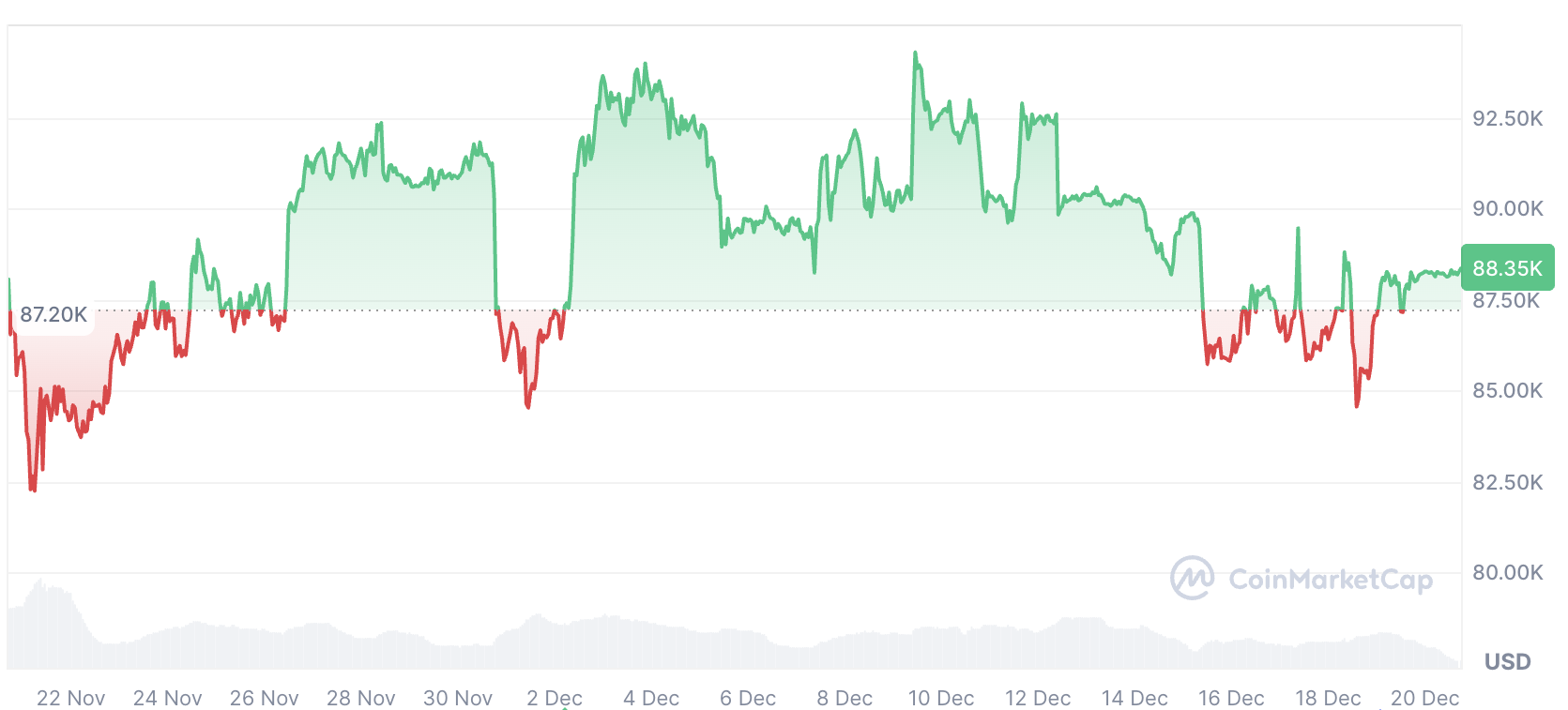
Bitcoin is up 1.81% over the past 30 days. Source: CoinMarketCap

Balashevich explained that his hesitation comes from observing significant optimism online that the downtrend will reverse in the near term, which he said is not usually the case when a true market bottom is forming.

“The crowd isn't scared enough for a bottom,” Santiment said in a report on the same day.

Overly optimistic comments are “not what I want to see,” says Balashevich

“In one particular crowd-dominated or retail-dominated channel, they’re mostly discussing Bank of Japan cut rates, and bears got caught, and now we’ll continue up from here,” he said.

“These kinds of statements are not what I want to see,” he said, adding that if the circumstances were different, he would be “very confident” in calling a market bottom.

Japan’s central bank pushed interest rates to a 30-year high of 0.75% on Friday, a move that has previously been associated with roughly 20% corrections in Bitcoin.

However, Balashevich said a move down to this price level would potentially provide a “very good setup” for traders.

On Thursday, Jurrien Timmer, Fidelity’s director of global macro research, said that Bitcoin could take a “year off” in 2026, with the price potentially falling to around $65,000.

Other analysts, such as Bitwise chief investment officer Matt Hougan, are forecasting 2026 to be an “up year” for Bitcoin.

Crypto market indicators conflict with Balashevich’s outlook

While Balashevich is not convinced that the market has yet reached its bottom, crypto market indicators suggest otherwise.

The Crypto Fear & Greed Index, which measures overall crypto market sentiment, has been lingering in “Extreme Fear” territory since Dec. 14. On Sunday, the Index posted an “Extreme Fear” score of 20.

Related: Bitcoin institutional buys flip new supply for the first time in 6 weeks

Other indicators are suggesting risk-off positioning among crypto traders.

The Altcoin Season Index, which measures the performance of the top 100 altcoins relative to Bitcoin over the past 90 days, posted a “Bitcoin Season” reading of 17 out of 100 on Saturday.

Magazine: Big questions: Would Bitcoin survive a 10-year power outage?

Criptos en tendencia

Preguntas relacionadas

QAccording to Santiment, why hasn't the crypto market bottomed out yet?

ABecause crypto traders have not shown enough fear on social media, and there is significant optimism that the downtrend will reverse, which is not typical when a true market bottom is forming.

QWhat price level does Santiment's founder suggest Bitcoin could potentially drop to?

ABitcoin could still slide to around $75,000, which would represent an approximate 14.77% drop from its current price of $88,350.

QWhat event does Balashevich mention as being discussed optimistically by retail traders, and why is he concerned?

ARetail traders are optimistically discussing the Bank of Japan's rate cut, believing the market will continue upward. Balashevich is concerned because such optimism is not what he wants to see for a market bottom confirmation.

QWhat does the Crypto Fear & Greed Index indicate about current market sentiment?

AThe Crypto Fear & Greed Index has been in 'Extreme Fear' territory since December 14, with a score of 20 on Sunday, indicating high fear among traders.

QWhat conflicting indicator is mentioned regarding Balashevich's outlook on the market bottom?

AThe Crypto Fear & Greed Index shows 'Extreme Fear,' which conflicts with Balashevich's view that there isn't enough fear to call a bottom, as extreme fear typically aligns with potential market bottoms.

Lecturas Relacionadas

From Transaction Fees to Stablecoins: The Revenue Drivers and Economic Moats Behind Web3 Business Models

"From Transaction Fees to Stablecoins: Revenue Drivers and Moats in Verified Web3 Business Models" This analysis explores five established Web3 revenue models, examining their drivers and long-term sustainability. 1. **Transaction Fees**: This model is highly cyclical, with income tied to market activity and user risk appetite (formula: volume × fee rate). Growth depends on expanding the market, gaining market share, and maintaining stable fees amid intense competition. 2. **Stablecoin Reserve Yield**: Revenue stems from the scale of issued stablecoins and the interest earned on their underlying reserves (like US Treasuries). While predictable with strong moats (high user migration costs), growth is tied to adoption as on-chain dollar infrastructure and is sensitive to interest rate cycles. 3. **Funding Rate Arbitrage & Lending Spreads**: Protocols like Aave and Ethena profit from capital supply-demand imbalances. Similar to transaction fees, this model is cyclical and driven by user leverage demand during bullish market phases. 4. **Block Space Sales**: Chains sell computational resources (formula: demand × gas price). A key challenge is the ongoing decline in gas fees due to technological advances and competition among L1s and L2s. Future viability hinges on whether demand growth can offset falling unit prices. 5. **Protocol-Level Service Fees**: Similar to SaaS, this model involves charging other protocols for essential services (e.g., oracles like Chainlink). Revenue scales with ecosystem adoption. The primary moat is high switching costs once integrated, making market leadership crucial. In summary: Transaction fees and funding spreads are highly cyclical. Stablecoin yields and protocol services build strong, durable moats. Block space sales face the structural challenge of perpetually declining unit revenue despite growing demand.

marsbitHace 1 hora(s)

From Transaction Fees to Stablecoins: The Revenue Drivers and Economic Moats Behind Web3 Business Models

marsbitHace 1 hora(s)

Trading

Spot

Artículos destacados

Cómo comprar O

¡Bienvenido a HTX.com! Hemos hecho que comprar O1 exchange (O) sea simple y conveniente. Sigue nuestra guía paso a paso para iniciar tu viaje de criptos.Paso 1: crea tu cuenta HTXUtiliza tu correo electrónico o número de teléfono para registrarte y obtener una cuenta gratuita en HTX. Experimenta un proceso de registro sin complicaciones y desbloquea todas las funciones.Obtener mi cuentaPaso 2: ve a Comprar cripto y elige tu método de pagoTarjeta de crédito/débito: usa tu Visa o Mastercard para comprar O1 exchange (O) al instante.Saldo: utiliza fondos del saldo de tu cuenta HTX para tradear sin problemas.Terceros: hemos agregado métodos de pago populares como Google Pay y Apple Pay para mejorar la comodidad.P2P: tradear directamente con otros usuarios en HTX.Over-the-Counter (OTC): ofrecemos servicios personalizados y tipos de cambio competitivos para los traders.Paso 3: guarda tu O1 exchange (O)Después de comprar tu O1 exchange (O), guárdalo en tu cuenta HTX. Alternativamente, puedes enviarlo a otro lugar mediante transferencia blockchain o utilizarlo para tradear otras criptomonedas.Paso 4: tradear O1 exchange (O)Tradear fácilmente con O1 exchange (O) en HTX's mercado spot. Simplemente accede a tu cuenta, selecciona tu par de trading, ejecuta tus trades y monitorea en tiempo real. Ofrecemos una experiencia fácil de usar tanto para principiantes como para traders experimentados.

82 Vistas totalesPublicado en 2026.06.19Actualizado en 2026.06.29

Cómo comprar O

Cómo comprar PROS

¡Bienvenido a HTX.com! Hemos hecho que comprar Pharos (PROS) sea simple y conveniente. Sigue nuestra guía paso a paso para iniciar tu viaje de criptos.Paso 1: crea tu cuenta HTXUtiliza tu correo electrónico o número de teléfono para registrarte y obtener una cuenta gratuita en HTX. Experimenta un proceso de registro sin complicaciones y desbloquea todas las funciones.Obtener mi cuentaPaso 2: ve a Comprar cripto y elige tu método de pagoTarjeta de crédito/débito: usa tu Visa o Mastercard para comprar Pharos (PROS) al instante.Saldo: utiliza fondos del saldo de tu cuenta HTX para tradear sin problemas.Terceros: hemos agregado métodos de pago populares como Google Pay y Apple Pay para mejorar la comodidad.P2P: tradear directamente con otros usuarios en HTX.Over-the-Counter (OTC): ofrecemos servicios personalizados y tipos de cambio competitivos para los traders.Paso 3: guarda tu Pharos (PROS)Después de comprar tu Pharos (PROS), guárdalo en tu cuenta HTX. Alternativamente, puedes enviarlo a otro lugar mediante transferencia blockchain o utilizarlo para tradear otras criptomonedas.Paso 4: tradear Pharos (PROS)Tradear fácilmente con Pharos (PROS) en HTX's mercado spot. Simplemente accede a tu cuenta, selecciona tu par de trading, ejecuta tus trades y monitorea en tiempo real. Ofrecemos una experiencia fácil de usar tanto para principiantes como para traders experimentados.

102 Vistas totalesPublicado en 2026.06.22Actualizado en 2026.06.29

Cómo comprar PROS

Qué es VERONA

I. Introducción al Proyecto VERONA es una blockchain construida para todos, en todas partes a través de la abstracción de cadenas. Utilizando su capa de Abstracción Generalizada, VERONA se distingue por integrar funcionalidades complejas de blockchain, como cuentas, firmas e interoperabilidad, directamente a nivel de protocolo. Este enfoque permite interactuar con aplicaciones de blockchain sin necesidad de entender las tecnologías subyacentes.1) Información Básica Nombre: VERONA (VERONA)III. Enlaces Relacionados Enlace al sitio web oficial: https://xion.burnt.com/ Libro Blanco: https://xion.burnt.com/whitepaper.pdf Exploradores: https://explorer.burnt.com/ Redes Sociales: https://x.com/burnt_xion Nota: La introducción del proyecto proviene de los materiales publicados o proporcionados por el equipo oficial del proyecto, que es solo para referencia y no constituye asesoramiento de inversión. HTX no se hace responsable de ninguna pérdida directa o indirecta resultante.

115 Vistas totalesPublicado en 2026.06.22Actualizado en 2026.06.22

Qué es VERONA

Discusiones

Bienvenido a la comunidad de HTX. Aquí puedes mantenerte informado sobre los últimos desarrollos de la plataforma y acceder a análisis profesionales del mercado. A continuación se presentan las opiniones de los usuarios sobre el precio de A (A).

活动图片