Crypto Market Declines Amid Halt in U.S. Price Growth: Fresh Review

cryptonews.ruPublicado a 2026-08-15Actualizado a 2026-08-15

Resumen

Crypto Market Declines Amid Stalled US Inflation: A Review (August 7-14, 2026) The crypto market faced downward pressure as US inflation data for July showed prices stagnating but remaining above the Federal Reserve's 2% target. This reduced expectations for a September interest rate cut, dampening investor risk appetite. Bitcoin (BTC) fell 2.39% over the week, with low volatility. Spot BTC ETFs saw a weekly outflow of $332.08 million. Major holders like Strategy (formerly MicroStrategy) continued selling BTC, citing debt obligations, while mining firms faced unfavorable conditions. Ethereum (ETH) dropped 1.71%, struggling near $1,900. Despite the price decline, network activity saw a recovery. Spot ETH ETFs recorded a minor outflow of $2.26 million after five weeks of inflows. ETH remains slightly inflationary. Ripple (XRP) fell 1.7%, briefly dropping below $1 for the first time in 20 months, negatively impacted by a hack on the Coreum bridge that stole 200,000 XRP. However, spot XRP ETFs saw their fifth consecutive week of inflows. Cardano (ADA) plunged 9.53% after Grayscale withdrew its application for a spot ADA ETF. Monero (XMR) was a positive outlier, rising 5.32% alongside a significant 28% increase in derivatives market open interest, briefly surpassing $400. Technical analysis for BTC and ETH indicated consolidation within defined ranges. The Crypto Fear & Greed Index remained at 29, signaling persistent fear. The primary catalyst for the market's negative per...

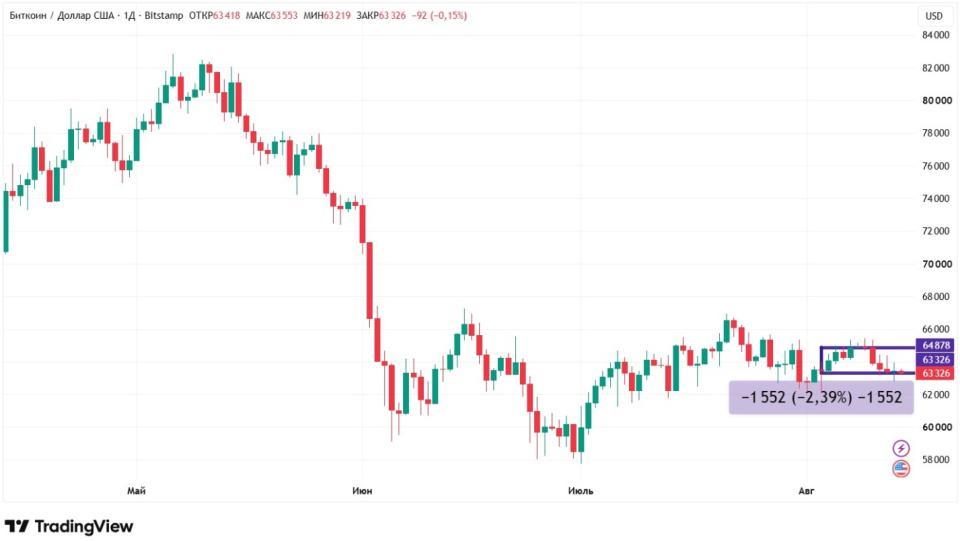
Between August 7 and 14, 2026, Bitcoin's price fell by 2.39%. Most of the week, five out of seven trading sessions, closed in negative territory. However, volatility remains low. The daily price change of $BTC did not exceed 1.5% on any day.
Source: tradingview.com

On August 12, U.S. authorities released inflation statistics for July. The Consumer Price Index (CPI) was 3.4%, matching the consensus forecast. Compared to June, it decreased by 0.1%. Core inflation, which excludes volatile items like food and energy, stood at 2.5%. This indicator also matched the consensus forecast and decreased by 0.1% relative to June. Despite generally positive data, price growth remains above the Federal Reserve's target (2%).

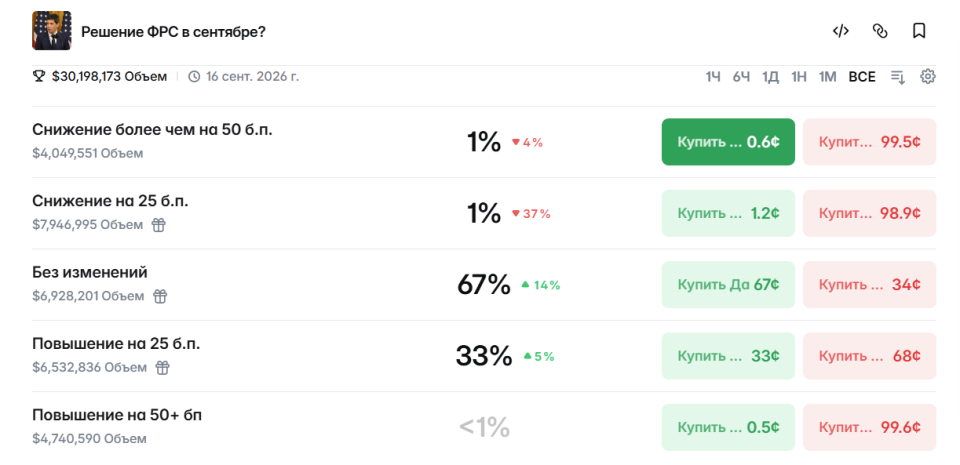
Therefore, the likelihood of a key interest rate cut at the regulator's upcoming meeting in September is extremely low. On the Polymarket portal, the most popular scenario, rated at 67%, is keeping the rate unchanged. Another 33% believe in a 25 basis point increase. This trend is unfavorable for Bitcoin, as loans will not become cheaper, meaning investor risk appetite is unlikely to increase.
Source: polymarket.com

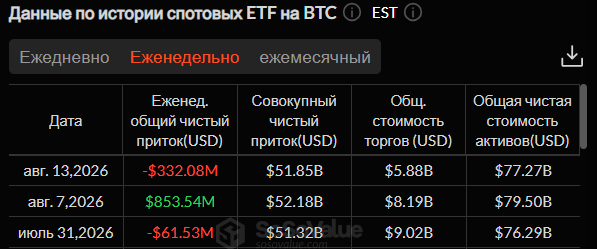
Spot Bitcoin ETFs recorded a weekly outflow of $332.08 million. The largest amount, $146.4 million, was withdrawn by investors from Fidelity's fund, the Fidelity Wise Origin Bitcoin Fund (FBTC).
Source: sosovalue.com

Bitcoin is not rising also because major players prefer to sell the asset in mid-year. The company with the largest $BTC reserve, Strategy (formerly MicroStrategy), has been offloading cryptocurrency for four consecutive weeks. The latest transaction resulted in the sale of 1,637 $BTC (approximately $103 million).

Formerly a mining company, now reoriented towards artificial intelligence, HUT 8 sold 493 $BTC (over $31 million). Another player in the same market segment, Riot Platforms, according to its second-quarter financial report, sold 4,300 coins (over $271 million).

These sell-offs have explainable reasons. Strategy needs to meet its debt obligations to investors, and American miners are facing unfavorable market conditions for $BTC mining.

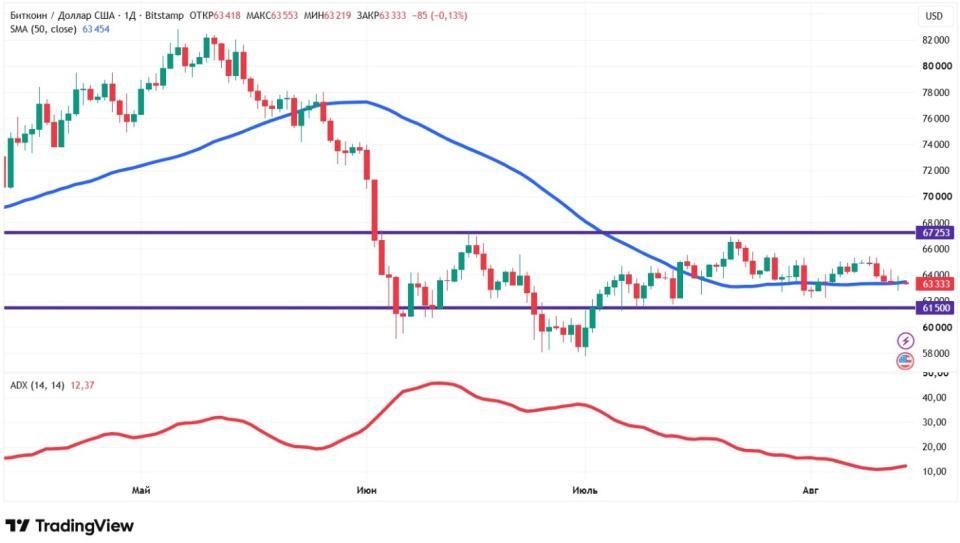
From a technical analysis perspective, Bitcoin remains in a sideways trend. The absence of a clear trend is confirmed by the low value of the ADX indicator – 12.37. Moreover, the price fluctuates above and below the 50-day moving average (marked in blue), which is characteristic of consolidation zones. The nearest support and resistance levels on the daily chart remain unchanged from last week: $61,650 and $67,253.
Source: tradingview.com

The Fear and Greed Index value remained unchanged from last week at 29. This level indicates that fear continues to dominate crypto investor sentiment.

Ethereum

Ether's price decreased by 1.71% from August 7 to 14. $ETH continues to hover around $1,900. Similar to Bitcoin, Ethereum's volatility remains low. Last week, the daily change in the cost of $ETH did not exceed 2% at the end of any trading session.
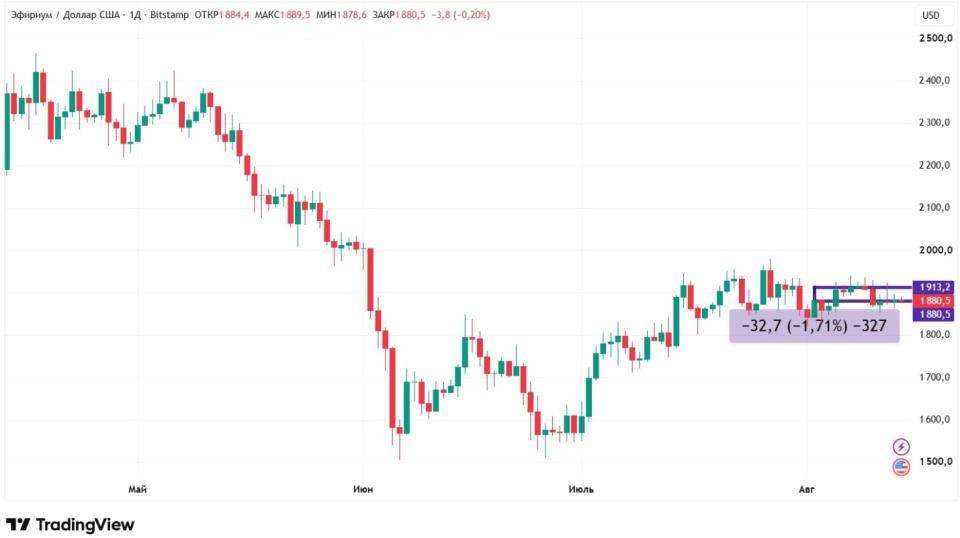
Source: tradingview.com

Despite the drop in $ETH's price, user engagement in the Ethereum network is slowly recovering. According to the analytical platform Santiment, on one day last week, the number of active addresses reached 989,500. This is the best daily indicator since March. Growth in user activity indicates sustained interest in the Ethereum ecosystem.

Spot Ethereum ETFs, after five consecutive weeks of inflows, recorded an outflow of $2.26 million. The largest amount, $16.39 million, was withdrawn by investors from BlackRock's fund, the iShares Ethereum Trust (ETHA).
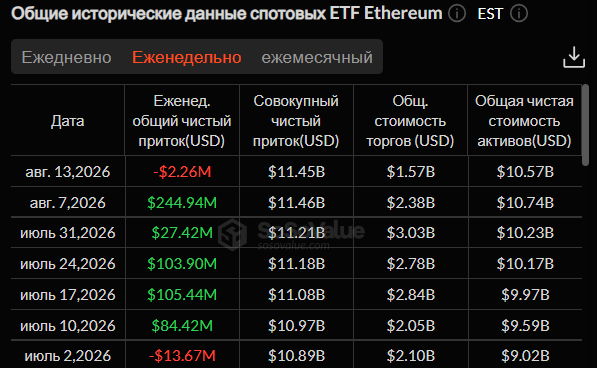
Source: sosovalue.com

It's also worth noting that Ethereum remains an inflationary cryptocurrency. Its issuance exceeds the amount of $ETH burned. Although the inflation rate is small—only 0.856%—the supply is constantly increasing, putting some pressure on the price.
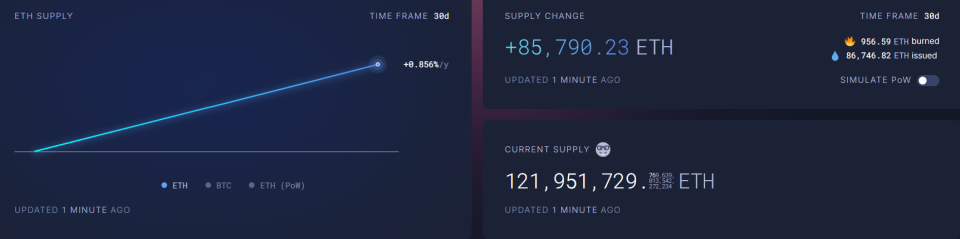
Source: ultrasound.money

From a technical analysis perspective, Ethereum has been in a sideways range between the $1,800 support and $1,980 resistance levels since mid-July. Indicators point to a slight advantage for buyers (bulls) over sellers (bears). The price is above the 50-day moving average (marked in blue), and the RSI value is slightly above 50.
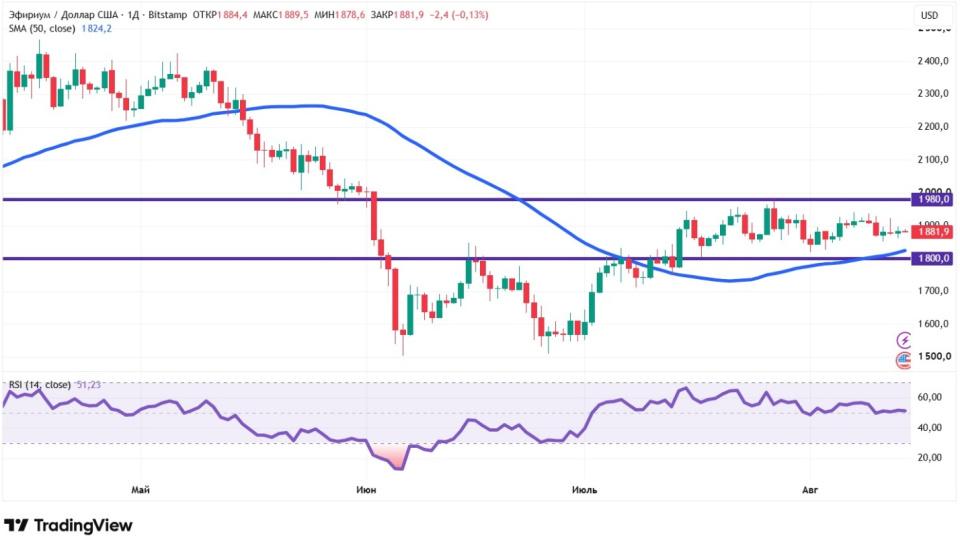
Source: tradingview.com

Ripple

As a result of the hack of the Coreum cross-chain bridge on August 9, 200,000 $XRP were stolen. The attackers' operation lasted 97 minutes. The criminals exploited a vulnerability in the bridge related to deposit verification. The XRPL blockchain itself was not compromised.

Spot ETFs on $XRP have recorded capital inflows for the fifth consecutive week. This time, the inflow amounted to $2.25 million. All of this sum went to the fund by Bitwise, the Bitwise $XRP ETF ($XRP).
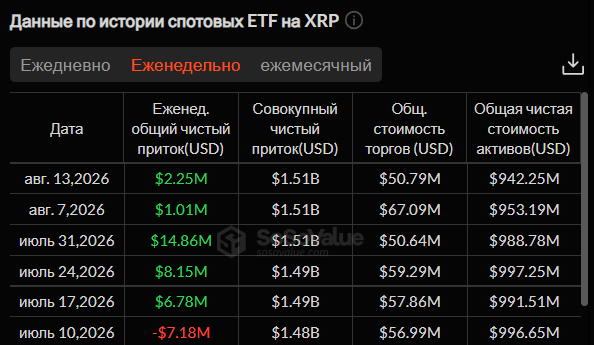
Source: sosovalue.com

The negativity from the Coreum bridge hack slightly outweighed the positivity associated with spot $XRP ETFs. By the end of the week, the price of the Ripple cryptocurrency had fallen by 1.7%. Moreover, at one point it dropped below $1, a level not seen for twenty months.
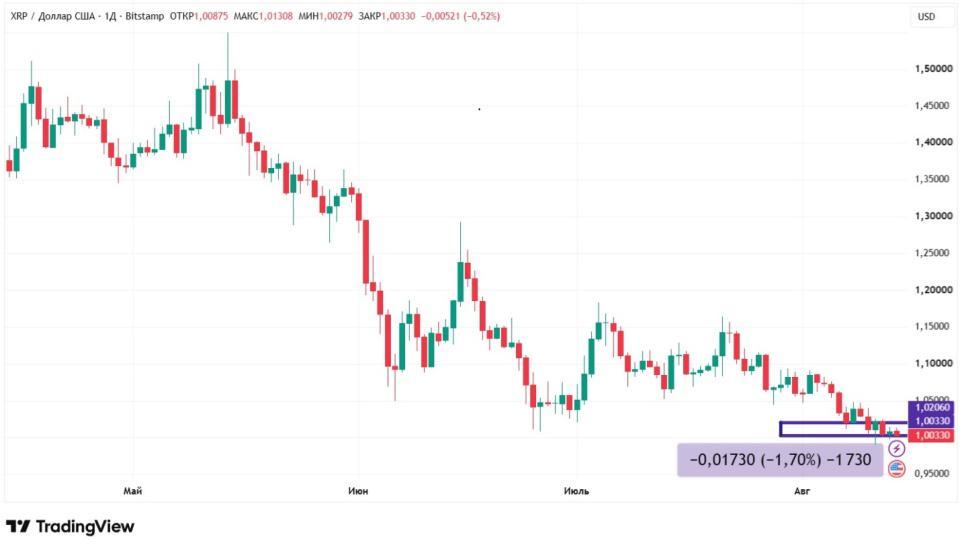
Source: tradingview.com

Cardano

On August 7, Grayscale withdrew its application to the Securities and Exchange Commission (SEC) for a Cardano Trust ETF — an exchange-traded fund for $ADA. Interestingly, this event occurred two days before the six-month anniversary of Cardano futures trading on the Chicago Mercantile Exchange (CME). Six months of derivatives trading for a cryptocurrency is one of the criteria for ETF approval, though not a guarantee. In addition to withdrawing the ETF application, Grayscale gave up its plans for similar products tied to the price of Hedera and Polkadot.

The news had a negative impact on $ADA. For the week of August 7-14, the coin's price fell by 9.53%. All seven trading sessions ended in negative territory.
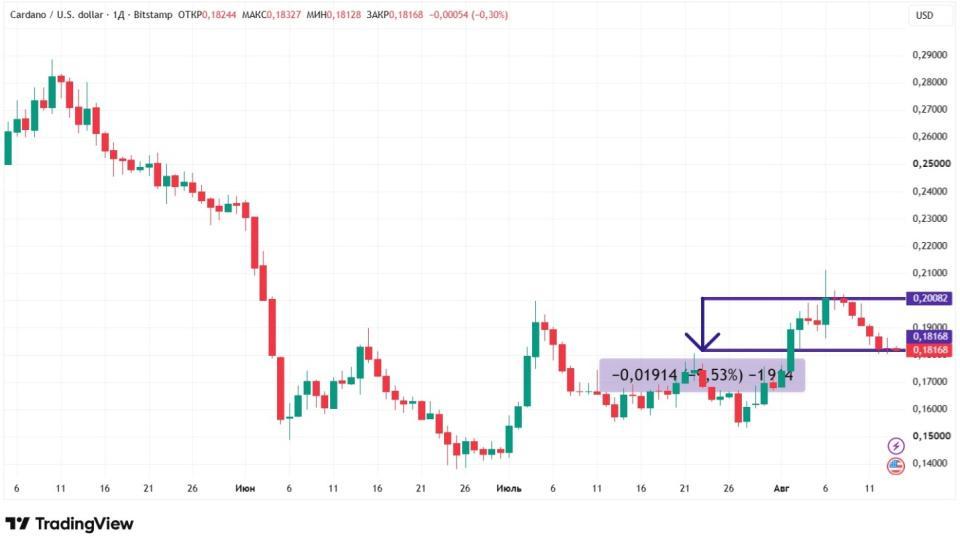
Source: tradingview.com

Monero

From August 7 to 14, there was a significant surge in activity in the derivatives market related to the private cryptocurrency Monero ($XLM). Over the week, the open interest indicator rose from $139.27 million to $178.7 million, adding over 28% and reaching its highest level since January.
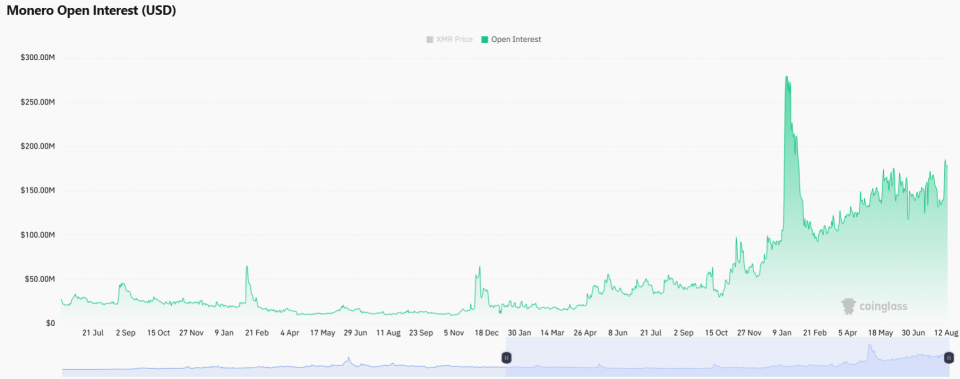
Source: coinglass.com

Against this backdrop, $XLM showed positive dynamics. The gain over seven days was 5.32%. On the August 9 trading session, Monero even surpassed the $400 mark for the first time in two months, but later corrected slightly.
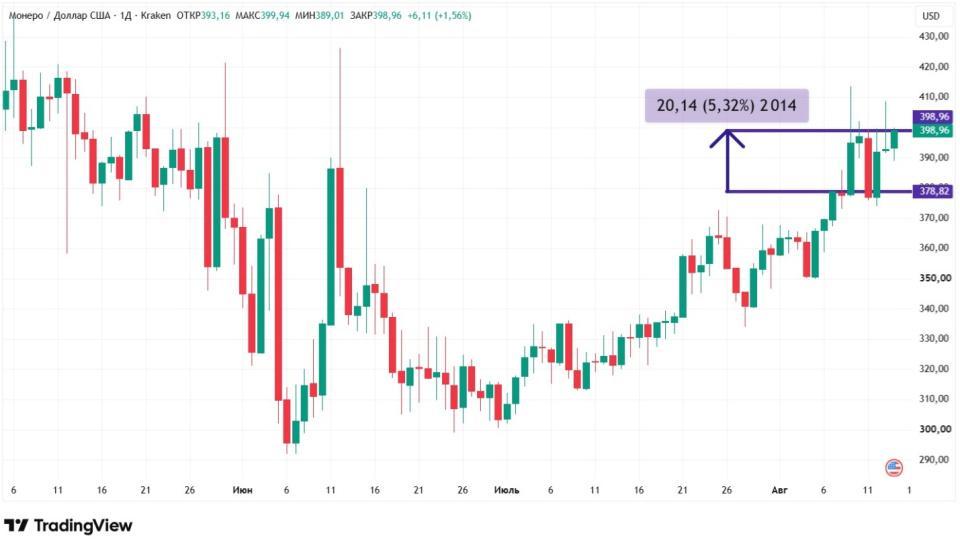
Source: tradingview.com

Conclusion

The second week of August concluded with declines for most cryptocurrencies. The main catalyst for the negative dynamics of digital assets is inflation in the United States. Although the dollar has stopped depreciating, prices remain above the Fed's target levels.

This material and the information herein do not constitute individual or any other form of recommendation. The opinion of the editorial board may not coincide with the opinions of analytical portals and experts.



end-content

Preguntas relacionadas

QAccording to the article, why did the cryptocurrency market decline in the week of August 7-14, 2026?

AThe main catalyst for the negative trend in the cryptocurrency market was the inflation data from the United States. While US inflation slowed by 0.1% in July, the Consumer Price Index (3.4%) and Core Inflation (2.5%) remained above the Federal Reserve's 2% target. This significantly reduced the likelihood of a key interest rate cut, which is unfavorable for risk assets like Bitcoin.

QWhat was the specific weekly price change for Bitcoin ($BTC) and what factors contributed to its lack of growth?

ABitcoin's price decreased by 2.39% from August 7 to 14, 2026. Factors contributing to its lack of growth included: sustained high US inflation reducing chances for a Fed rate cut (keeping borrowing costs high), net outflows of $332.08 million from spot Bitcoin ETFs, and major players like Strategy (formerly MicroStrategy), HUT 8, and Riot Platforms selling significant amounts of Bitcoin due to debt obligations and unfavorable mining conditions.

QHow did the price of Ethereum ($ETH) perform and what were the contrasting trends observed in its network activity and ETF flows?

AEthereum's price decreased by 1.71% during the week, struggling to move significantly away from the $1900 level. Despite the price drop, user engagement on the Ethereum network showed recovery, with active addresses reaching 989,500 in a single day—the best daily figure since March. Conversely, spot Ethereum ETFs, after five consecutive weeks of inflows, recorded a net outflow of $2.26 million.

QWhich cryptocurrency saw a significant surge in derivatives market activity, and what was its price performance?

AMonero ($XMR) saw a significant surge in derivatives market activity. Its Open Interest increased by over 28% from $139.27 million to $178.7 million, reaching a high not seen since January. On this backdrop, Monero's price increased by 5.32% for the week, even briefly surpassing $400 for the first time in two months on August 9th.

QWhat negative news impacted Ripple ($XRP) and Cardano ($ADA) prices during the reported week?

ARipple ($XRP) was negatively impacted by the hack of the Coreum cross-chain bridge on August 9th, which resulted in the theft of 200,000 XRP. Cardano ($ADA) was negatively impacted by the news that Grayscale withdrew its application with the SEC for a Cardano Trust ETF on August 7th. Consequently, $XRP fell 1.7% and $ADA fell 9.53% for the week.

Lecturas Relacionadas

IPO Imminent, OpenAI Faces Major Personnel Upheaval

OpenAI, preparing for a potential IPO, is experiencing significant leadership turmoil. In mid-August 2026, longtime "GPU geek" Scott Gray quietly left, and within three days, Chief Operating Officer Brad Lightcap (8-year veteran) and Chief Revenue Officer Denise Dresser (8-month tenure) departed. This follows a broader exodus of at least 10 senior executives in 2026, including heads of product, safety, and ethics. Analysts view this as a strategic "surgery" to transform from a research lab into a sales-driven enterprise company before going public. Revenue now tilts toward enterprise clients, surpassing consumer income sooner than expected, with annualized revenue reaching $40 billion. The new CRO, Dali Rajic, is a veteran enterprise sales leader. Concurrently, OpenAI has disbanded independent safety teams like "Preparedness," which assessed catastrophic risks, integrating their functions into core research. Critics warn this removes dedicated "brakes" on AI development. The leadership vacuum raises questions about who is the clear second-in-command after former apps CEO Fidji Simo moved to an advisory role. Co-founder Greg Brockman appears to be consolidating power. As OpenAI races against rival Anthropic ($47B annualized revenue), it faces the dual challenge of commercial execution while managing the departure of foundational technical talent and ensuring responsible AI development remains a priority.

marsbitHace 1 hora(s)

IPO Imminent, OpenAI Faces Major Personnel Upheaval

marsbitHace 1 hora(s)

AI Can 'Have Moods Too'! New Research from USTC: Confusion and Anxiety Make AI Work Better

The article discusses research from the University of Science and Technology of China and Oxford, revealing that allowing AI to recognize and act upon simulated "internal emotions" can significantly improve its performance. The study demonstrates a coherent pairing between specific emotional states in AI agents and their subsequent skill choices. For instance, an agent feeling curious and desirous will search for products, while one feeling confused and tense will rephrase queries. This mirrors human decision-making influenced by emotions. Statistical validation showed a 76.5% semantic consistency in these pairings. Crucially, the research challenges the traditional view of AI errors as flaws to be eliminated. It found that "bad" emotions like confusion, tension, or frustration serve as useful metacognitive signals, indicating a mismatch between the current strategy and the environment. By responding to these signals, AI can proactively adjust before a failure occurs. This is particularly effective in complex tasks prone to failure. For example, in tasks like "heating an item" and "picking up two items," success rates surged from 9.6% to 56.9% and 4.4% to 31.3%, respectively, when using the emotion-driven skill selection method (EMOTION2SKILL). The AI's "nervous" state about a closed microwave, for instance, prompted it to check and open it first, preventing failure. The article also mentions related work from Tianjin University, which embeds emotional prediction into world models (Large Emotional World Model, LEWM), significantly improving prediction accuracy in human-centric environments. Removing emotional data was found to degrade performance even in unrelated logical reasoning tasks. These studies build on earlier findings, like those from Anthropic, that identifiable emotional representations exist within large language models (LLMs). The focus is shifting from philosophical debate about AI emotion to practically harnessing these internal states as functional signals to enhance AI robustness and capability.

marsbitHace 2 hora(s)

AI Can 'Have Moods Too'! New Research from USTC: Confusion and Anxiety Make AI Work Better

marsbitHace 2 hora(s)

Trading

Spot
活动图片