Crypto market bottom in? Why Goldman Sachs sees ‘attractive entry point’

ambcryptoPublicado a 2026-03-27Actualizado a 2026-03-27

Resumen

Goldman Sachs suggests the cryptocurrency market may have bottomed, presenting an attractive entry point for select crypto-related stocks. Analyst James Yaro noted the market decline has reached approximately the historical peak-to-trough average, with the current cycle at 95% and 90% relative to historical price and volume declines. The firm highlighted Robinhood (HOOD), Figure Technologies (FIGR), and Coinbase (COIN) as key stocks, lowering COIN's price target to $235 (still implying over 35% upside) and HOOD's to $91 (30% potential upside). Both stocks are down about 55% from October 2025 highs. While Goldman joins other firms like Fidelity in calling a market bottom, research from Ecoinometrics cautions that Bitcoin's recovery could take around 10 months based on current drawdowns.

The crypto market may have established its bottom, offering an ‘attractive entry point’ for a few related stocks, according to investment bank Goldman Sachs.

On the 26th of March, in a note to investors, Goldman analyst James Yaro wrote,

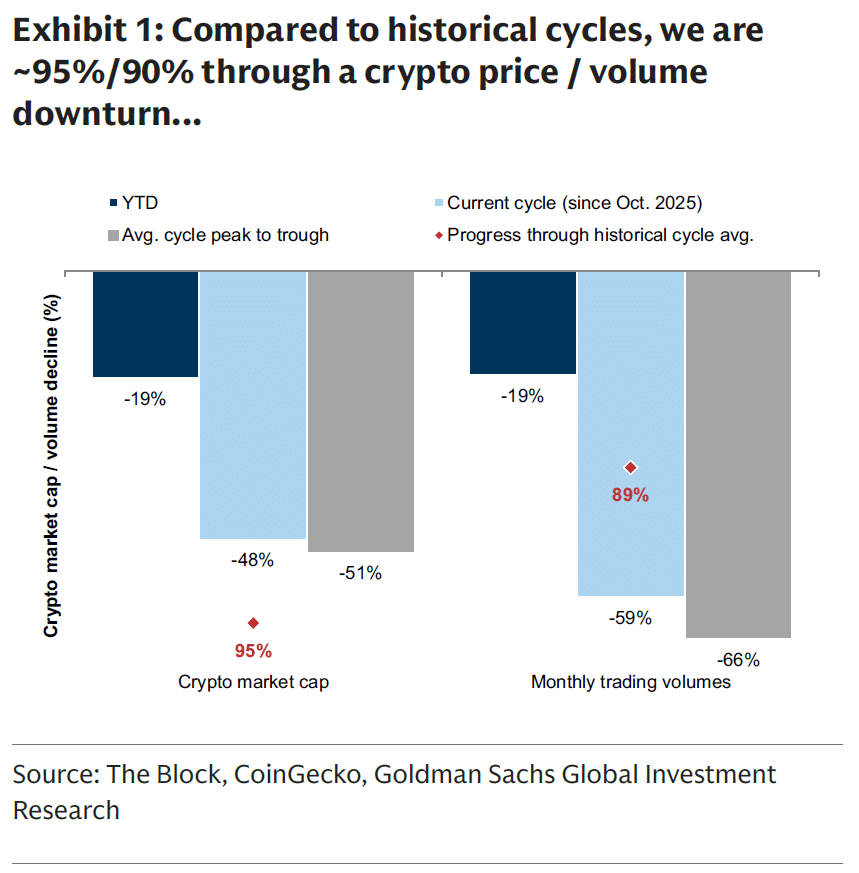
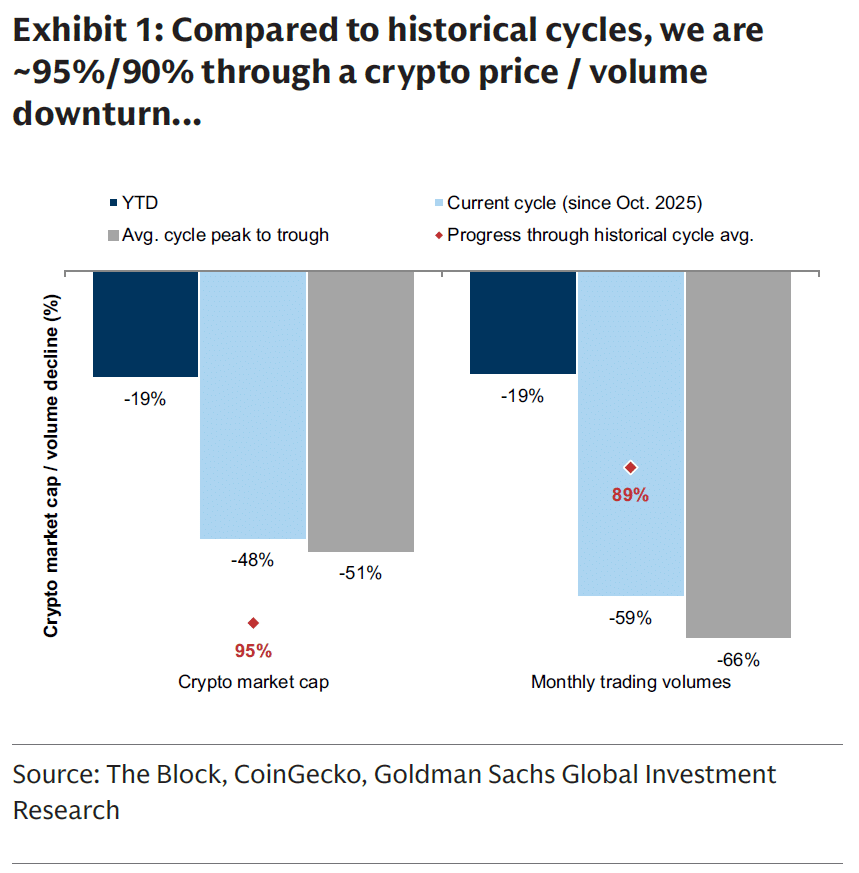
The crypto market price decline has approximately reached the historical peak-to-trough average.
Source: Goldman Sachs

The investment research side of the firm referenced historical crypto price and volume downturns. According to the attached chart, the current cycle was at 95% and 90% relative to historical price/volume decline.

Yaro added,

All in, we see an increasingly attractive entry point to our digital-asset sensitive coverage, albeit selectively, across the group. Valuation is becoming more attractive, especially in names that are less exposed directly to crypto prices.

Crypto stocks vs. Bitcoin

The investment firm singled out Robinhood (Nasdaq: HOOD), Figure Technologies (Nasdaq: FIGR), and Coinbase (Nasdaq: COIN) as key crypto-related stocks of interest as the market stabilizes.

It lowered the Coinbase price target from $270 to $235. Still, this implied over 35% upside from its current COIN price of $173. Similarly, it downgraded its HOOD’s target from $102 to $91, implying a 30% upside potential from the press time value of $70.35.
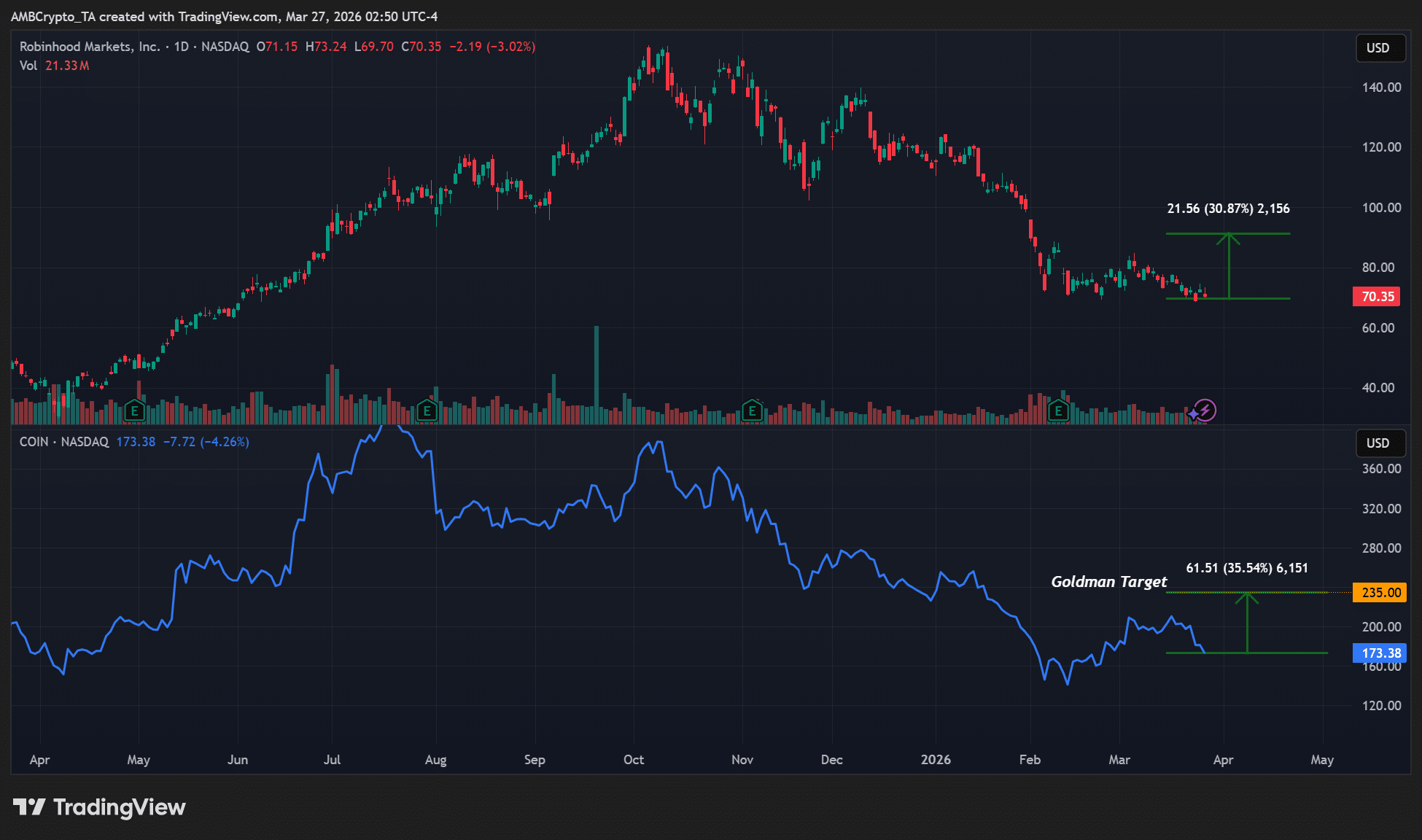
Source: HOOD vs. COIN price performance

Both crypto stocks were down about 55% from their October 2025 highs. Hence, this could be a discounted window if the crypto market rebounds strongly from here.

Goldman is the latest to make a crypto market bottom call, following Fidelity, Bitwise, and others who made similar projections after Bitcoin slipped to $60K in February.

In fact, from a price chart perspective, the 200-Weekly Moving Average (WMA) was at $59K as of writing, reinforcing the above projections. The past bear markets bottomed around this support.
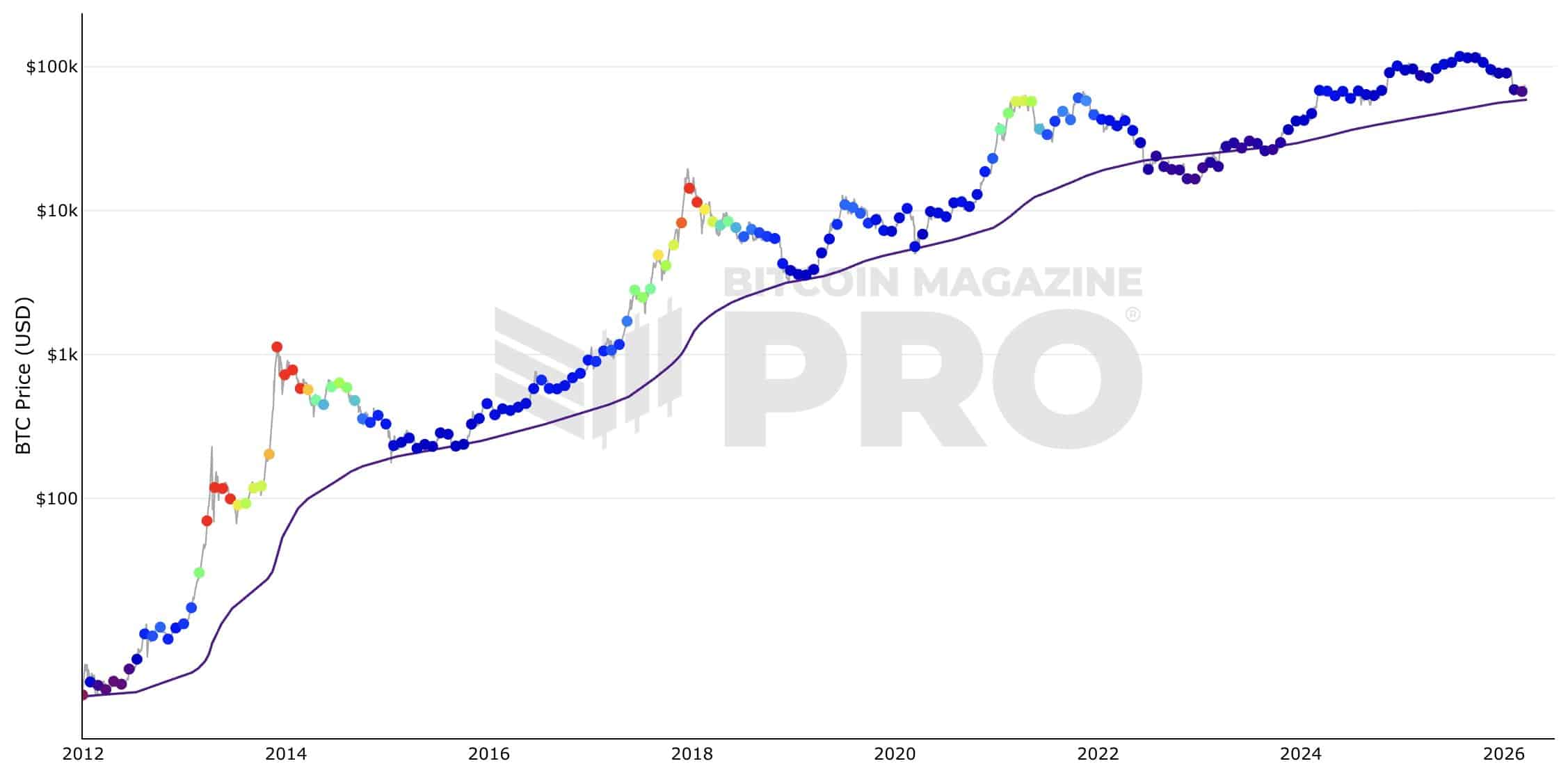
Source: BM Pro

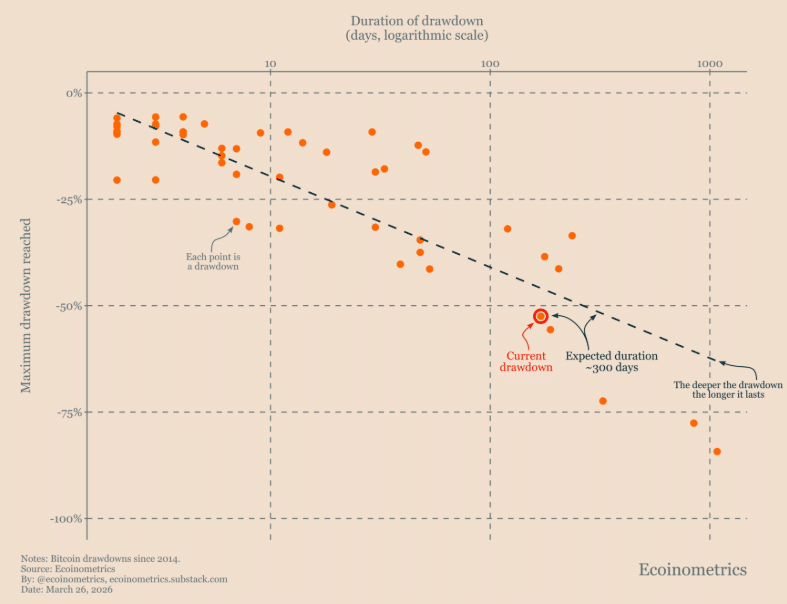
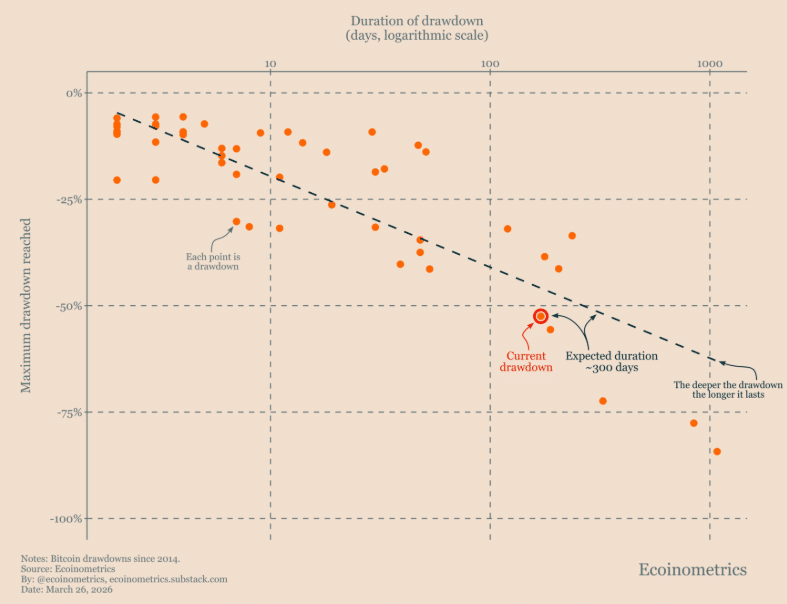
Still, it could take way longer for Bitcoin to rebound than most people anticipate. According to crypto research firm Ecoinometrics, the “deeper Bitcoin falls, the longer it takes to recover.” The firm noted that for every 10% drop, it takes about 80 days for the asset to bounce back.

At the current drawdown, which implied 300 days (about 10 months) for BTC to fully recover, the firm cautioned.
Source: Ecoinometrics

Final Summary

  • Goldman Sachs projected that the crypto market bottom may be near, as progress hit over 90% based on historical price and volume downturns.
  • However, Ecoinometrics cautioned that it could take an additional 10 months for a strong Bitcoin recovery.


Preguntas relacionadas

QAccording to Goldman Sachs, what percentage of the historical price and volume decline has the current crypto market cycle reached?

AThe current cycle has reached 95% of the historical price decline and 90% of the historical volume decline.

QWhich three crypto-related stocks did Goldman Sachs single out as key stocks of interest?

AGoldman Sachs singled out Robinhood (HOOD), Figure Technologies (FIGR), and Coinbase (COIN).

QWhat is Goldman Sachs' new price target for Coinbase (COIN) and what upside potential does it imply from the current price?

AGoldman Sachs lowered the Coinbase price target from $270 to $235, which implies over 35% upside from its current price of $173.

QWhat key technical indicator, mentioned in the article, reinforces the projection that the crypto market may have bottomed?

AThe 200-Weekly Moving Average (WMA) for Bitcoin, which was at $59K, reinforces the projection as past bear markets have bottomed around this support level.

QAccording to Ecoinometrics, how long does it take for Bitcoin to recover for every 10% drop in price, and what is the estimated total recovery time at the current drawdown?

AAccording to Ecoinometrics, for every 10% drop, it takes about 80 days for Bitcoin to recover. At the current drawdown, it is estimated to take 300 days (about 10 months) for a full recovery.

Lecturas Relacionadas

CPU Makes a Comeback to the Table, A $170 Billion "Power Seizure" Drama Begins

A new era is dawning for the server CPU (Central Processing Unit), driven by the shift from AI model training to large-scale reasoning and the rise of Agentic AI. This article explores how the CPU is reclaiming a central role in the AI data center. For years, the focus has been on the GPU (Graphics Processing Unit) for AI training. However, as AI moves to the inference and Agent phase—where tasks involve complex, multi-step reasoning, tool calls, and data management—the workload balance is flipping. Studies show CPUs now handle over 70% of the workload in Agentic AI, up from 10-30% in training. This is because Agent tasks generate massive intermediate data (KV Cache) that exceeds GPU memory, forcing it to be offloaded to the CPU's larger, more scalable memory pools. This increased importance is translating into market changes. Major players are taking note: NVIDIA launched its first standalone CPU line, Vera, based on ARM architecture and optimized for Agent performance. AMD doubled its server CPU market forecast to over $1200 billion by 2030. Analyst reports project the total server CPU market could reach $1700 billion by 2030, with AI-driven demand being a primary driver. Furthermore, the classic ratio of CPUs to GPUs in AI servers is rapidly changing, converging from 1:8 toward 1:1 for Agent deployments. This surge in demand has led to a rare industry-wide price increase of 10-15% for server CPUs from Intel and AMD, breaking a decade-long trend of "more performance for the same price." Demand is bifurcating into high-core-count CPUs for in-rack GPU support and moderate-core CPUs for standalone Agent task orchestration. In China, this global trend presents an opportunity for domestic CPU manufacturers like Hygon (海光信息) and Huawei Kunpeng, who are bolstered by both growing AI infrastructure needs and national policies promoting technological self-reliance ("xin chuang"). The maturity of their software ecosystems is also accelerating, evidenced by faster adaptation to new AI models. In conclusion, the narrative is shifting from a GPU-centric view to one where CPU-GPU synergy is critical. The CPU is no longer a peripheral component but a performance-defining bottleneck and a key growth driver in the AI hardware stack, opening a massive new market estimated in the hundreds of billions of dollars.

marsbitHace 1 hora(s)

CPU Makes a Comeback to the Table, A $170 Billion "Power Seizure" Drama Begins

marsbitHace 1 hora(s)

TechFlow Intelligence: AMD AI Director Publicly Criticizes Claude Code for "Becoming Dumber and Lazier", Trump Claims Full Ceasefire in Hormuz But Strait Still Has 80 Unexploded Mines

TechFlow Intelligence Report: This daily digest covers key developments in AI, crypto, hardware, and geopolitics. In AI, SK Telecom faces US export control scrutiny over its partnership with Anthropic, while a Gemini user reports being misled in a scam scenario, sparking safety debates. China's Z.AI launches the GLM-5.2 model, rivaling Claude Opus without NVIDIA chips. In crypto, Bithumb lists ReProtocol, and Upbit delists KernelDAO. On the hardware front, MIT researchers build a custom OS to study chips, ASML denies US claims its advanced lithography machines are in China, and Amazon considers selling its in-house AI chips. Apple's future A21 Pro chip may use TSMC's latest N2P process. Major tech issues include 10,000 GitHub repositories distributing malware and Apple patching a critical eavesdropping flaw in Beats earbuds. US stocks rise, led by semiconductors, with Intel surging 10.6%, while SpaceX falls 3.5%. Geopolitically, despite a US-Iran deal, the Strait of Hormuz remains risky with ~80 uncleared mines, stalling 80M barrels of oil on standby tankers. Iran postpones Switzerland talks, and Trump calls the agreement an "unconditional surrender." The report highlights a contrast: temporary geopolitical calm versus the ongoing, fundamental restructuring of tech supply chains and chip independence.

marsbitHace 1 hora(s)

TechFlow Intelligence: AMD AI Director Publicly Criticizes Claude Code for "Becoming Dumber and Lazier", Trump Claims Full Ceasefire in Hormuz But Strait Still Has 80 Unexploded Mines

marsbitHace 1 hora(s)

Trading

Spot
Futuros
活动图片