Crypto Investors Cheer As South Korea Scraps Punishing Tax Plan

bitcoinistPublicado a 2026-03-20Actualizado a 2026-03-20

Resumen

South Korea's main opposition party, the People Power Party, has proposed a bill to abolish the planned 20% tax on cryptocurrency gains, which was scheduled to take effect in 2027. The tax had been repeatedly delayed due to political debates and concerns over fairness, as it imposed a lower threshold compared to stock gains. The proposal aims to integrate crypto income into a unified financial investment tax framework instead of maintaining a separate regime. While this offers short-term relief for investors, the country continues to advance broader crypto regulations, including user protection laws and AI-powered tracking systems, indicating that a more comprehensive and integrated tax environment may still emerge in the future.

South Korean right-wing lawmakers have proposed a bill to abolish the taxation of crypto assets scheduled to take effect on January 1, 2027.

A Long Chain Of Regulation Delays

According to Korean outlet Digital Asset, Korea’s main opposition party the People Power Party is advancing a plan that would effectively abolish the dedicated 20% “crypto tax” by merging virtual‐asset income into a unified financial investment tax framework, instead of enforcing a separate regime just for digital assets.

The proposal comes after multiple postponements. Ruling and opposition parties alternated between promising delays and demanding quick implementation, repeatedly using crypto tax timelines as an election wedge with youth voters. The original 20% tax on gains over roughly ₩2.5 million was pushed from 2022 to 2023, then to 2025, and then again toward 2027 amid political infighting and concerns over investor protection.

The core issue has lays in parity. Crypto gains were set to be taxed at 20% above a very low threshold, while stock gains only paid similar rates above ₩50 million, fueling claims that young, retail‐heavy crypto traders were being unfairly targeted. Song Eon-seok, floor leader of the party and the responsible for introducing the bill, explained:

Given that the financial investment income tax has been abolished for the development of the capital market and the protection of investors, imposing a separate income tax on digital assets raises issues regarding equity and consistency in the tax system.

Kim Han-gyu, senior deputy floor leader for policy of the Democratic Party, responded to the proposal saying that they ruling party will discuss the bill now that it’s been introduced, although “there is no serious discussion or consensus within the party”, local media reported.

South Korea In The Forefront Of Crypto Regulation

South Korea has already rolled out the Virtual Asset User Protection Act and is still fighting over a second‐phase “Virtual Asset Law” covering stablecoins and more comprehensive oversight, underscoring that taxation is only one piece of a much tougher framework.

While many jurisdictions are tightening tax enforcement on digital assets, South Korea is prioritizing regulatory safeguards and market structure first. It’s worth noting, however, that South Korea’s National Tax Service is also moving ahead with a strong AI Crypto Tracking System, as reported by Bitcoinist on March 12.

A more balanced tax design could reduce incentives for Korean traders to move volume offshore or into grey‐area platforms, potentially supporting onshore liquidity and institutional participation. The apparent end of a standalone crypto tax is a short‐term relief, but once the unified financial investment tax kicks in, sophisticated reporting and on‐chain tracing tools mean evasion risks will climb. Active traders should prepare for stricter KYC, better record‐keeping, and the possibility that today’s relief turns into tomorrow’s more robust, integrated tax regime.
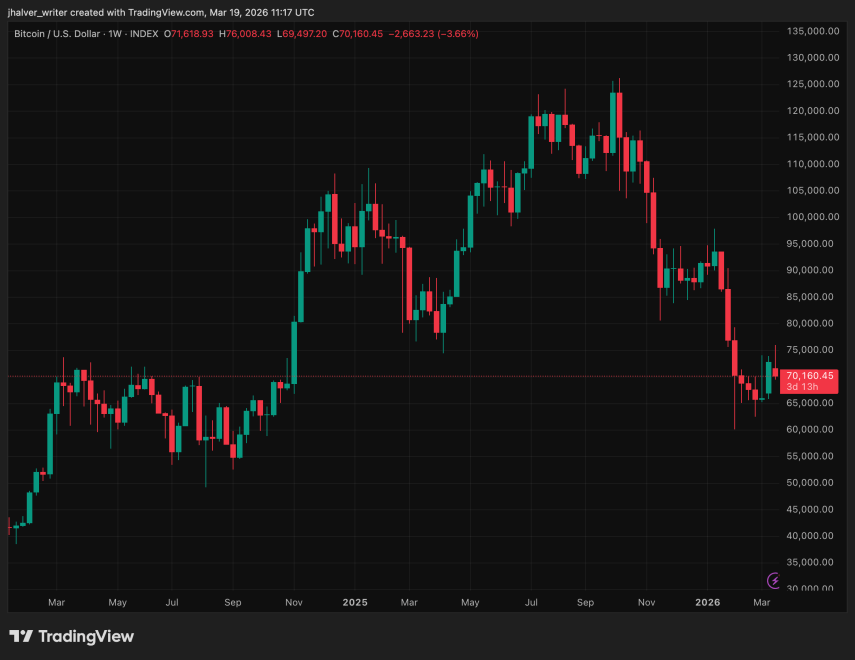
At the moment of writing, BTC’s trades for $70k on the daily chart. Source: BTCUSD on Tradingview

Cover image from Perplexity, BTCUSD chart from Tradingview

Preguntas relacionadas

QWhat is the main reason South Korean lawmakers are proposing to abolish the dedicated crypto tax?

AThey aim to address issues of equity and consistency in the tax system by merging virtual-asset income into a unified financial investment tax framework, rather than having a separate regime just for digital assets.

QHow many times has the implementation of South Korea's 20% crypto tax been postponed?

AThe tax has been postponed multiple times, originally from 2022 to 2023, then to 2025, and again to 2027.

QWhat was the key disparity between crypto and stock taxation that fueled claims of unfair targeting?

ACrypto gains were set to be taxed at 20% above a very low threshold (around ₩2.5 million), while stock gains only paid similar rates above a much higher threshold of ₩50 million.

QWhat broader regulatory framework is South Korea implementing alongside the tax discussion?

ASouth Korea has rolled out the Virtual Asset User Protection Act and is developing a second-phase 'Virtual Asset Law' covering stablecoins and more comprehensive oversight.

QWhat potential market impact could a more balanced tax design have according to the article?

AIt could reduce incentives for Korean traders to move volume offshore or into grey-area platforms, potentially supporting onshore liquidity and institutional participation.

Lecturas Relacionadas

380,000 Apps Exposed, 2,000+ Apps Leaked Secrets: AI Programming Turns 'Intranet' into Public Internet

Israeli cybersecurity firm RedAccess uncovered a severe data exposure trend linked to "vibe coding" or AI-powered software development tools. Their research found approximately 38,000 publicly accessible web applications built with platforms like Lovable, Base44, Netlify, and Replit. Of these, an estimated 2,000 apps exposed sensitive corporate and personal data, including medical records, financial information, internal strategic documents, and customer chat logs. In some cases, access even granted administrative privileges. The core issue stems from default privacy settings that make applications public by default, combined with a lack of built-in security controls (like authentication) in the AI-generated code. This allows employees without security expertise—"citizen developers"—to easily create and deploy applications that bypass standard corporate security reviews. The exposed apps, often indexed by search engines, are trivially discoverable. While some platform providers (Replit, Lovable, Wix/Base44) argue that security configuration is the user's responsibility and question the validity of some findings, security researchers confirm the widespread reality of such exposures. This pattern, also noted in prior studies, highlights a critical security gap as AI democratizes app creation, potentially leading to massive, unintentional data leaks.

marsbitHace 35 min(s)

380,000 Apps Exposed, 2,000+ Apps Leaked Secrets: AI Programming Turns 'Intranet' into Public Internet

marsbitHace 35 min(s)

Attracting Global Capital, Asia's New 'Super Cycle' Is Unfolding

Investors are turning to Asia as the next frontier for global equity growth, with a new "super cycle" unfolding across the region. Driven by the AI revolution, Asian markets, particularly South Korea, have seen significant rallies. According to Morgan Stanley analysis, the underlying drivers of Asia's industrial cycle are shifting from traditional sectors like real estate and manufacturing to massive investments in AI infrastructure, energy security and transition, and supply chain resilience. Fixed asset investment in Asia is projected to grow from around $11 trillion in 2025 to $16 trillion by 2030, with a 7% annual growth rate from 2026-2030. The AI wave is a primary catalyst, driving immense capital expenditure for chips, servers, data centers, and power systems. Asia is central to this hardware supply chain. In China, AI investment is focused on building a full-system domestic capability, with the local AI chip market potentially reaching $86 billion by 2030. Beyond AI, China's export story is expanding from EVs and batteries to robotics. The country already captures about half of new global industrial robot demand and over 90% of humanoid robot shipments. This growth phase mirrors the early stages of China's EV export boom. Simultaneously, energy security investments, spurred by AI's massive power needs, are rising, with China benefiting from its leadership in solar, batteries, and EVs. Regional defense spending is also increasing structurally, supporting demand for advanced manufacturing. The main beneficiaries are China, South Korea, and Japan, positioned in core supply chain areas. However, risks remain, including potential overcapacity, profit margin pressures from competition, persistent technological restrictions, geopolitical friction, and workforce displacement due to AI-driven automation. Market volatility is also expected to increase as investor expectations diverge on the realization of these capital investment and export themes.

marsbitHace 35 min(s)

Attracting Global Capital, Asia's New 'Super Cycle' Is Unfolding

marsbitHace 35 min(s)

Funding Weekly Report | 14 Public Funding Events, Kalshi Completes $10B New Funding Round at $220B Valuation Led by Coatue Management

Weekly Funding Roundup: 14 Deals and $10.49B+ in Total Funding, Led by Kalshi's $1B Round Last week (5.4-5.10) saw 14 notable funding events in the global blockchain ecosystem, raising over $10.49 billion in total. Key highlights include Kalshi, a prediction market platform, securing a $1 billion round led by Coatue Management, reaching a $22 billion valuation. The platform now boasts ~2 million MAUs and $178B in annualized trading volume. In DeFi, regulated on-chain reinsurer OnRe raised $5 million in Series A funding, and Bitcoin-backed credit protocol Saturn Credit completed a $2 million seed round. For Infrastructure & Tools, OpenTrade raised $17 million to expand its stablecoin yield infrastructure, and RWA platform Balcony secured $12.7 million to deploy its property settlement service in the US. Centralized Finance saw one deal: AI-driven trading platform Stockcoin.ai completed a seed round led by Amber Group. In the prediction market sector alongside Kalshi, AI-powered platform Elastics raised $2 million. Other notable deals include SC Ventures' strategic investment in crypto market maker GSR and Centrifuge securing a "seven-figure" investment from Coinbase to become a core RWA partner for Base. On the investor side, Haun Ventures raised a new $1 billion fund targeting crypto and AI, and Multi Investment raised ~$616 million to focus on blockchain and Web3 investments.

marsbitHace 1 hora(s)

Funding Weekly Report | 14 Public Funding Events, Kalshi Completes $10B New Funding Round at $220B Valuation Led by Coatue Management

marsbitHace 1 hora(s)

Trading

Spot
Futuros
活动图片





