Crypto Industry Watches As Poland Advances Long-Delayed Regulatory Bill

bitcoinistPublicado a 2026-05-16Actualizado a 2026-05-16

Resumen

Poland's parliament has passed a long-delayed cryptocurrency regulatory bill, driven by urgency following a fraud scandal at a local exchange. Prime Minister Donald Tusk cited the Zondacrypto case, where users lost access to funds and which had alleged Russian ties, as proof of the need for investor protections. The approved bill grants Poland's Financial Supervision Authority (KNF) broad powers to oversee the market, impose penalties, and block accounts or transactions. However, the legislation faces potential rejection, as it retains contentious account-blocking provisions that led President Karol Nawrocki to veto two prior versions. Critics argue it lacks sufficient judicial oversight. A third veto would prolong regulatory uncertainty as Poland races to align with the EU's MiCA framework by a July deadline. The bill prevailed over three other competing proposals in a parliamentary vote.

Poland’s prime minister has tied the country’s repeated failure to pass crypto rules to a high-profile fraud case — a charge that added urgency to a parliamentary vote that had already failed twice before.

A Scandal Shapes The Debate

Prime Minister Donald Tusk pointed to Zondacrypto, a Polish crypto exchange now under a prosecutor’s fraud probe, as evidence of what happens when investor protections are not in place.

Thousands of the exchange’s users reportedly could not access their funds, and Tusk alleged the platform had ties to Russian capital and influence dating to its early years.

He argued that Poland’s inability to finalize a regulatory framework had slowed any official response to the crisis.

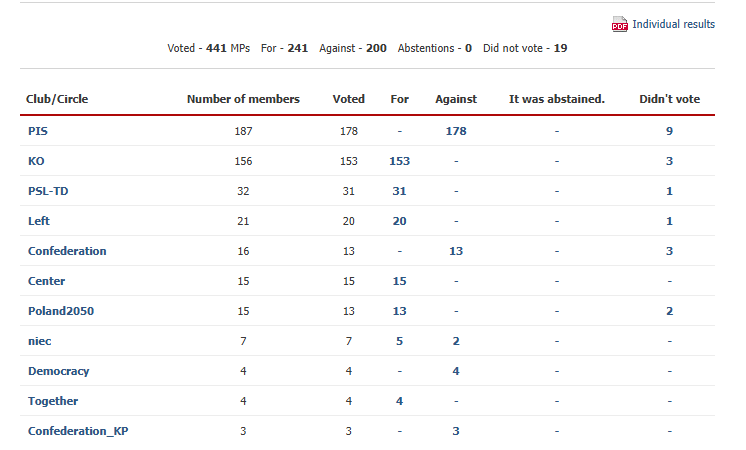
The exchange scandal cast a long shadow over this week’s sitting of the Sejm, Poland’s lower house of parliament, where lawmakers debated four separate crypto bills simultaneously.
Source: SEJM

On Friday, they approved the government-backed bill — numbered 2529 and supported by the Ministry of Finance — by a vote of 241 to 200. It was the third time the government had pushed this kind of legislation through parliament after President Karol Nawrocki vetoed two earlier versions.

The approved bill hands broad authority to Poland’s Financial Supervision Authority, known as the KNF, to monitor crypto market participants, impose administrative penalties, and block accounts and transactions when deemed necessary.

Critics Point To Unchanged Provisions

Not everyone in the crypto community welcomed the outcome. Market participants and commentators noted that the account and transaction blocking provisions — the same ones that prompted Nawrocki’s previous vetoes — remained largely intact in the final text. Proposed changes such as stronger judicial oversight of enforcement actions were not included.

BTCUSD trading at $79,182 on the 24-hour chart: TradingView

With those concerns unresolved, many observers expect the president to veto the bill again. That prospect worries industry players, since a third rejection would deepen regulatory uncertainty at a particularly inconvenient time.

Poland is required to bring its rules in line with the European Union’s Markets in Crypto-Assets Regulation, known as MiCA, with implementation deadlines approaching in July.

Four Bills, One Outcome

The vote came after lawmakers reviewed competing proposals from four separate sources: the government, the president, the Confederation party, and a parliamentary group. A committee merged the texts before the final vote, and the government version ultimately prevailed.

Featured image from Hotels.com, chart from TradingView

Preguntas relacionadas

QWhat event did Poland's Prime Minister Donald Tusk link to the need for cryptocurrency regulation?

APrime Minister Donald Tusk linked the need for cryptocurrency regulation to the scandal surrounding the Zondacrypto exchange, which is under a fraud probe, where thousands of users reportedly could not access their funds.

QWhat is the main regulatory body granted authority under the newly passed Polish crypto bill, and what powers does it have?

AUnder the newly passed bill, Poland's Financial Supervision Authority (KNF) is granted broad authority to monitor crypto market participants, impose administrative penalties, and temporarily block accounts and transactions when deemed necessary.

QWhy do critics expect the Polish President to veto the recently passed cryptocurrency bill?

ACritics expect the President to veto the bill because it retains controversial provisions, such as the power to block accounts and transactions without the stronger judicial oversight that was proposed but not included, which were the same reasons for his previous vetoes.

QWhat is the external regulatory deadline that Poland is facing regarding cryptocurrency legislation?

APoland is facing a deadline to align its national rules with the European Union's Markets in Crypto-Assets Regulation (MiCA), with implementation deadlines approaching in July.

QHow many different cryptocurrency bills were debated in the Sejm, and which one was ultimately approved?

ALawmakers debated four separate cryptocurrency bills from different sources: the government, the president, the Confederation party, and a parliamentary group. The government-backed bill (number 2529) was the one ultimately approved after a committee merged the texts for a final vote.

Lecturas Relacionadas

Agents Take Over Traffic Distribution Power: What Are Tencent, ByteDance, and Alibaba Competing For?

In the race to dominate the AI era's entry point, China's tech giants—Tencent, ByteDance, and Alibaba—are aggressively deploying AI Agents to control the future of traffic distribution. Alibaba is pursuing a dual-track "closed loop + openness" strategy. Its Qianwen app is evolving into a super-Agent integrated across its ecosystem (Taobao, Alipay, etc.) to handle complex tasks like travel planning. Concurrently, it is opening its platform to external brands (Luckin Coffee, KFC) and has launched a B2B Agent platform, "Wukong," targeting enterprise automation. Its other flagship, Quark, aims to be an "AI super search box" for information and tasks. ByteDance is executing an omnipresent "sprawl strategy." Its Doubao app boasts over 300 million monthly active users and is evolving into a default AI entry point for daily life, with plans for paid versions and e-commerce integration. Its core weapon is the Kouzi platform, a visual "AI assembly factory" for developers to build custom Agents. ByteDance is also pushing hardware integration, collaborating on AI phones and developing smart glasses to embed Doubao everywhere. Tencent is playing its long-held "ultimate card" by quietly embedding an AI Agent directly into WeChat. This Agent, accessible via a swipe, can understand user commands and automatically execute tasks by calling upon WeChat's millions of mini-programs (e.g., finding and ordering coffee). This leverages WeChat's unparalleled 1.4-billion-user ecosystem to position the app as an AI-powered "service operating system," a move that could dramatically reshape the competitive landscape. The core battleground is shifting from competing for "user screen time" to competing to be the "default execution layer" for user intent. The business model is evolving from an "attention economy" to an "intent economy," where the Agent that can most efficiently fulfill a user's need gains control over service access and token flow. This represents a fundamental change in how users connect with digital services, making the fight for the Agent入口 (entry point) a pivotal moment for redefining industry leadership in the AI age.

marsbitHace 36 min(s)

Agents Take Over Traffic Distribution Power: What Are Tencent, ByteDance, and Alibaba Competing For?

marsbitHace 36 min(s)

From Banning Doubao to Embracing Honor: Why Did WeChat Suddenly 'Change Its Face'?

The article explores the sudden shift in WeChat's strategy towards AI assistants from mobile phone manufacturers, transitioning from strict opposition to active collaboration. For over a year, WeChat fiercely resisted attempts by phone AI assistants (like ByteDance's Doubao in late 2025) to control its features via GUI automation ("simulated clicking"), citing security and data control concerns. This stance created a significant barrier for system-level AI integration. Now, Tencent has initiated A2A (Agent-to-Agent) partnerships with major phone brands like Honor, Xiaomi, OPPO, and vivo. This model allows a phone's system AI (e.g., Honor's YOYO) to parse a user's voice command and send a structured request directly to WeChat's own internal AI agent via secure APIs. WeChat then executes the action (e.g., sending a message) and returns the result. The article attributes Tencent's "change of face" to strategic pressure. While leading in social app usage, Tencent trails rivals like ByteDance and Alibaba in standalone AI app popularity. WeChat, with its vast mini-program ecosystem, is Tencent's key asset for an AI comeback. The upcoming WeChat AI agent aims to handle tasks like booking and payments within the app. However, phone system assistants remain the primary AI entry point for most users. The A2A collaboration allows Tencent to extend WeChat's AI reach to this crucial system layer while maintaining control over its core functions and data. For phone manufacturers, embracing A2A is a pragmatic move. The GUI route proved unviable due to WeChat's blocks. A2A offers a compliant path to integrate a vital service, enhancing their AI assistants' usefulness. It allows them to focus on developing their own AI ecosystems for other services while cooperating on WeChat access. The collaboration is framed as a mutual, strategic necessity: Tencent gains a distribution channel, and manufacturers gain a key functionality. The partnership relies on a "dual authorization" mechanism for security, requiring both user and app consent for each action. While questions about long-term data privacy practices remain, experts note A2A is more secure and compliant than GUI automation. Ultimately, this cooperation is seen as a tentative, calculated truce. Tencent's long-term goal is to make WeChat an AI-powered "service OS." Phone manufacturers aim to make their system AI the central user interface. Their paths may converge or clash in the future, but for now, the A2A deal represents the opening chapter in the battle for the AI-era user入口, driven by necessity and strategic calculus on both sides.

marsbitHace 2 hora(s)

From Banning Doubao to Embracing Honor: Why Did WeChat Suddenly 'Change Its Face'?

marsbitHace 2 hora(s)

Trading

Spot
Futuros

Artículos destacados

Cómo comprar BILL

¡Bienvenido a HTX.com! Hemos hecho que comprar Billions Network (BILL) sea simple y conveniente. Sigue nuestra guía paso a paso para iniciar tu viaje de criptos.Paso 1: crea tu cuenta HTXUtiliza tu correo electrónico o número de teléfono para registrarte y obtener una cuenta gratuita en HTX. Experimenta un proceso de registro sin complicaciones y desbloquea todas las funciones.Obtener mi cuentaPaso 2: ve a Comprar cripto y elige tu método de pagoTarjeta de crédito/débito: usa tu Visa o Mastercard para comprar Billions Network (BILL) al instante.Saldo: utiliza fondos del saldo de tu cuenta HTX para tradear sin problemas.Terceros: hemos agregado métodos de pago populares como Google Pay y Apple Pay para mejorar la comodidad.P2P: tradear directamente con otros usuarios en HTX.Over-the-Counter (OTC): ofrecemos servicios personalizados y tipos de cambio competitivos para los traders.Paso 3: guarda tu Billions Network (BILL)Después de comprar tu Billions Network (BILL), guárdalo en tu cuenta HTX. Alternativamente, puedes enviarlo a otro lugar mediante transferencia blockchain o utilizarlo para tradear otras criptomonedas.Paso 4: tradear Billions Network (BILL)Tradear fácilmente con Billions Network (BILL) en HTX's mercado spot. Simplemente accede a tu cuenta, selecciona tu par de trading, ejecuta tus trades y monitorea en tiempo real. Ofrecemos una experiencia fácil de usar tanto para principiantes como para traders experimentados.

233 Vistas totalesPublicado en 2026.05.07Actualizado en 2026.06.02

Cómo comprar BILL

Discusiones

Bienvenido a la comunidad de HTX. Aquí puedes mantenerte informado sobre los últimos desarrollos de la plataforma y acceder a análisis profesionales del mercado. A continuación se presentan las opiniones de los usuarios sobre el precio de BILL (BILL).

活动图片













