Crypto Industry Bands Together To Demand Clear Betting Market Laws

bitcoinistPublicado a 2026-02-18Actualizado a 2026-02-18

Resumen

A new advocacy effort led by The Digital Chamber’s Prediction Markets Working Group is pushing for clearer federal regulation of crypto prediction markets in the U.S. The group supports the CFTC’s stance that such markets should fall under federal oversight rather than state-level enforcement. Recent legal actions highlight the tension: state regulators, like in Nevada, are treating these platforms as unlicensed gambling operations, while companies like Polymarket and Kalshi argue they offer derivative-like contracts under federal jurisdiction. The conflict is moving through courts, with both sides preparing legal arguments, and future regulatory proposals may shape the outcome.

A new, organized push is under way to shape how crypto prediction markets are treated in the US. A blockchain advocacy group has launched a unit aimed at guiding policy, pressing regulators, and backing industry players through legal fights and public research.

Industry Sets Legal Strategy

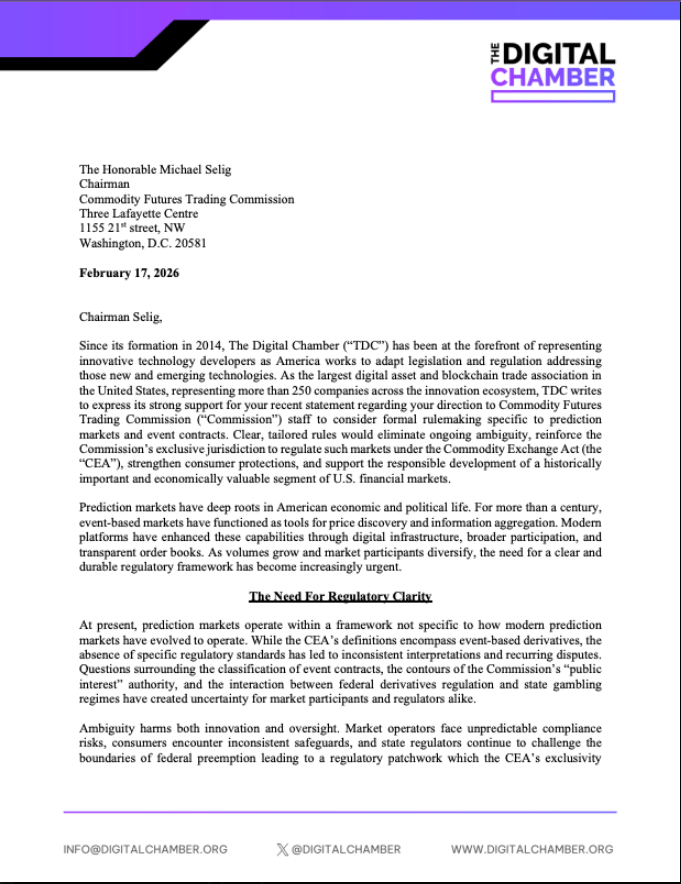
According to the group’s announcement, the first move was a letter praising the Commodity Futures Trading Commission and its chair for arguing that federal oversight should cover many event contracts.

The Prediction Markets Working Group, created by the blockchain advocacy group, The Digital Chamber, called for clearer rules and an end to what it described as enforcement-first regulation.

The group plans to meet with regulators, file policy ideas, publish studies and join court fights through friend-of-the-court briefs to press its view that a single federal regulator should be the lead voice on these crypto markets.

The regulator’s recent public comments were framed as support for that approach. CFTC Chairman Mike Selig has said the agency has overseen similar contracts for many years, and industry backers see that as a foundation for wider federal authority.

Tests On The Ground

Reports note that litigation and enforcement are already testing the theory. A major crypto US platform was hit with state action this week, accused of offering unlicensed wagering.

Kalshi faces a civil case brought by a state gaming regulator seeking to stop certain markets that the regulator calls gambling.

Rival platforms have felt the squeeze too; one has moved to federal court to try to head off state bans. Polymarket sued a state to argue federal oversight takes precedence.

The platforms argue their contracts behave like derivatives and should be treated as such, while state officials keep saying these products look a lot like bets.

As of today, the market cap of cryptocurrencies stood at $2.31 trillion. Chart: TradingView

States Push Back

That tension is clear along state lines. Nevada Gaming Control Board, which enforces strict gambling rules in its jurisdiction, has been among the most aggressive.

Reports say a governor in another state called these markets gambling that harms people, signaling political heat. Utah Governor Spencer Cox criticized federal arguments and framed the issue as one of public safety.

Meanwhile a platform chose to take its fight to the federal courts in a state that has been moving toward enforcement. Massachusetts figures into that legal push.

Image: Flowcarbon

What Comes Next

The next stretch will likely be shaped by filings and court rulings as much as by rulemaking. Industry lawyers are preparing to press federal primacy; state officials are planning to press their gambling statutes.

Legal briefs and amicus filings will try to persuade judges about what these crypto contracts really are. Regulators could also respond with formal rule proposals, and those would change the tone of the debate.

Featured image from The Center for Public Justice, chart from TradingView

Preguntas relacionadas

QWhat is the main goal of the newly formed Prediction Markets Working Group?

AThe main goal is to guide policy, press regulators, and back industry players through legal fights and public research to advocate for clearer rules and a single federal regulator for crypto prediction markets.

QWhich US regulatory body did the working group praise in its first move, and why?

AThe working group praised the Commodity Futures Trading Commission (CFTC) and its chair for arguing that federal oversight should cover many event contracts, seeing it as a foundation for wider federal authority.

QWhat legal action did the state of Nevada take against crypto prediction markets, according to the article?

AThe Nevada Gaming Control Board, which enforces strict gambling rules, has been among the most aggressive in taking action against these markets, with one major US platform facing a civil case from a state gaming regulator.

QHow are crypto prediction market platforms arguing their products should be classified and regulated?

AThe platforms argue that their contracts behave like derivatives and should be treated as such under federal oversight, rather than being classified as gambling and regulated by state laws.

QWhat is the current market capitalization of cryptocurrencies as mentioned in the article?

AAs of the date of the article, the market capitalization of cryptocurrencies stood at $2.31 trillion.

Lecturas Relacionadas

OpenAI Post-Training Engineer Weng Jiayi Proposes a New Paradigm Hypothesis for Agentic AI

OpenAI engineer Weng Jiayi's "Heuristic Learning" experiments propose a new paradigm for Agentic AI, suggesting that intelligent agents can improve not just by training neural networks, but also by autonomously writing and refining code based on environmental feedback. In the experiment, a coding agent (powered by Codex) was tasked with developing and maintaining a programmatic strategy for the Atari game Breakout. Starting from a basic prompt, the agent iteratively wrote code, ran the game, analyzed logs and video replays to identify failures, and then modified the code. Through this engineering loop of "code-run-debug-update," it evolved a pure Python heuristic strategy that achieved a perfect score of 864 in Breakout and performed competitively with deep reinforcement learning (RL) algorithms in MuJoCo control tasks like Ant and HalfCheetah. This approach, termed Heuristic Learning (HL), contrasts with Deep RL. In HL, experience is captured in readable, modifiable code, tests, logs, and configurations—a software system—rather than being encoded solely into opaque neural network weights. This offers potential advantages in explainability, auditability for safety-critical applications, easier integration of regression tests to combat catastrophic forgetting, and more efficient sample use in early learning stages, as demonstrated in broader tests on 57 Atari games. However, the blog acknowledges clear limitations. Programmatic strategies struggle with tasks requiring long-horizon planning or complex perception (e.g., Montezuma's Revenge), areas where neural networks excel. The future vision is a hybrid architecture: specialized neural networks for fast perception (System 1), HL systems for rules, safety, and local recovery (also System 1), and LLM agents providing high-level feedback and learning from the HL system's data (System 2). The core proposition is that in the era of capable coding agents, a significant portion of an AI's learned experience could be maintained as an auditable, evolving software system.

marsbitHace 57 min(s)

OpenAI Post-Training Engineer Weng Jiayi Proposes a New Paradigm Hypothesis for Agentic AI

marsbitHace 57 min(s)

Your Claude Will Dream Tonight, Don't Disturb It

This article explores the recent phenomenon of AI companies increasingly using anthropomorphic language—like "thinking," "memory," "hallucination," and now "dreaming"—to describe machine learning processes. Focusing on Anthropic's newly announced "Dreaming" feature for its Claude Agent platform, the piece explains that this function is essentially an automated, offline batch processing of an agent's operational logs. It analyzes past task sessions to identify patterns, optimize future actions, and consolidate learnings into a persistent memory system, akin to a form of reinforcement learning and self-correction. The article draws parallels to similar features in other AI agent systems like Hermes Agent and OpenClaw, which also implement mechanisms for reviewing historical data, extracting reusable "skills," and strengthening long-term memory. It notes a key difference from human dreaming: these AI "dreams" still consume computational resources and user tokens. Further context is provided by discussing the technical challenges of managing AI "memory" or context, highlighting the computational expense of large context windows and innovations like Subquadratic's new model claiming drastically longer contexts. The core critique argues that this strategic use of human-centric vocabulary does more than market products; it subtly reshapes user perception. By framing algorithms with terms associated with consciousness, companies blur the line between tool and autonomous entity. This linguistic shift can influence user expectations, tolerance for errors, and even perceptions of responsibility when systems fail, potentially diverting scrutiny from the companies and engineers behind the technology. The article concludes by speculating that terms like "daydreaming" for predictive task simulation might be next, continuing this trend of embedding the idea of an "inner life" into computational processes.

marsbitHace 59 min(s)

Your Claude Will Dream Tonight, Don't Disturb It

marsbitHace 59 min(s)

Trading

Spot
Futuros

Artículos destacados

Cómo comprar PUSH

¡Bienvenido a HTX.com! Hemos hecho que comprar Push Protocol (PUSH) sea simple y conveniente. Sigue nuestra guía paso a paso para iniciar tu viaje de criptos.Paso 1: crea tu cuenta HTXUtiliza tu correo electrónico o número de teléfono para registrarte y obtener una cuenta gratuita en HTX. Experimenta un proceso de registro sin complicaciones y desbloquea todas las funciones.Obtener mi cuentaPaso 2: ve a Comprar cripto y elige tu método de pagoTarjeta de crédito/débito: usa tu Visa o Mastercard para comprar Push Protocol (PUSH) al instante.Saldo: utiliza fondos del saldo de tu cuenta HTX para tradear sin problemas.Terceros: hemos agregado métodos de pago populares como Google Pay y Apple Pay para mejorar la comodidad.P2P: tradear directamente con otros usuarios en HTX.Over-the-Counter (OTC): ofrecemos servicios personalizados y tipos de cambio competitivos para los traders.Paso 3: guarda tu Push Protocol (PUSH)Después de comprar tu Push Protocol (PUSH), guárdalo en tu cuenta HTX. Alternativamente, puedes enviarlo a otro lugar mediante transferencia blockchain o utilizarlo para tradear otras criptomonedas.Paso 4: tradear Push Protocol (PUSH)Tradear fácilmente con Push Protocol (PUSH) en HTX's mercado spot. Simplemente accede a tu cuenta, selecciona tu par de trading, ejecuta tus trades y monitorea en tiempo real. Ofrecemos una experiencia fácil de usar tanto para principiantes como para traders experimentados.

197 Vistas totalesPublicado en 2024.12.13Actualizado en 2025.03.21

Cómo comprar PUSH

Discusiones

Bienvenido a la comunidad de HTX. Aquí puedes mantenerte informado sobre los últimos desarrollos de la plataforma y acceder a análisis profesionales del mercado. A continuación se presentan las opiniones de los usuarios sobre el precio de PUSH (PUSH).

活动图片