Crypto has everything needed for a bull market, so why is the market down?

cointelegraphPublicado a 2025-12-19Actualizado a 2025-12-19

Resumen

Despite numerous positive drivers such as increased liquidity, a pro-crypto U.S. government, ETF launches, and institutional buying, the crypto market is on track to end 2025 lower than it started. Analysts question why the market isn’t in a bull run, with some suggesting structural issues or excessive leverage are to blame. Selling pressure persists from long-term holders, technical traders, and cycle theorists. While some declare a bear market has already begun, others highlight strong fundamentals, including regulatory progress and institutional adoption, calling 2025 a foundational year for long-term growth.

Analysts and investors are questioning why crypto isn’t in a bull market, given the amount of positive drivers that have taken place this year.

“At some point, we need to admit that something is structurally broken in the crypto market,” CNBC crypto contributor Ran Neuner said on Tuesday.

He said that multiple favorable factors should be leading to crypto markets performing better, such as increased liquidity, a pro-crypto US government, various exchange-traded fund launches, major institutional and crypto treasury company buying, and strong performance in traditional markets such as gold, silver, and major stock indexes.

However, crypto markets are on track to end the year lower than when they began, with the total market capitalization falling more than 32% from its all-time high of $4.4 trillion in early October and almost 13% down from Jan. 1.
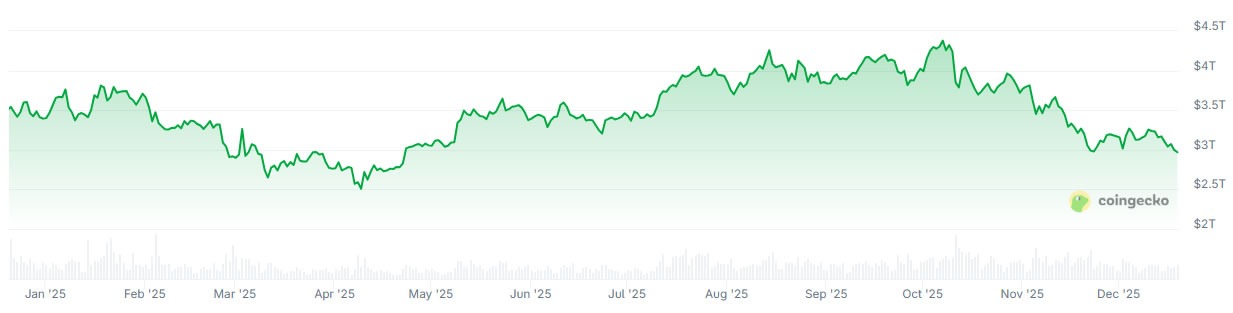
Crypto market cap is on track to end the year lower than it started. Source: CoinGecko

Two possible outcomes for crypto

Neuner said there were two possible outcomes for crypto: discovery of “what’s actually broken and who is selling” or the “mother of all catch-up trades because that’s how markets work.”

Economist Adam Kobeissi said that “one day, we will look back at the last 2 months of seemingly daily mass crypto liquidations and what’s happening will be crystal clear:”

“Crypto is experiencing a structural shift amid historic levels of leverage.”

Related: Most crypto sectors lagged Bitcoin over past 3 months: Glassnode

Analyst “PlanB” called it an “epic battle until sellers are out of ammo,” explaining that selling pressure is still coming from “OGs traumatized by 2021,” technical investors looking at relative strength index, and those who believe in the four-year cycle and that a bear market is due.

Crypto winter is already here

Meanwhile, some analysts are convinced that the bear market is already underway.

“Bitcoin entered a bear market in late October 2025, becoming the first major risk asset to price in a slowing economy,” 10x Research CEO Markus Thielen told Cointelegraph.

“Retail participation never meaningfully returned this cycle, and value creation remained narrowly concentrated in Bitcoin rather than broadening across risk assets. Winter isn’t approaching; it has already arrived.”

Things aren’t that bad, really

Despite the poor performance of spot markets, the industry’s fundamentals remain solid.

“While prices may have fallen short of expectations, this year delivered more structural progress than any in crypto’s history,” Erik Lowe, head of content at blockchain venture firm Pantera, said in a report on Tuesday.

Like Neuner, he listed several milestone achievements for the industry this year, including a shift in staff and stance at US financial regulators, the establishment of a US strategic Bitcoin reserve and digital asset stockpile, and increases in stablecoin supplies and onchain value of tokenized real-world assets.

“From that perspective, we believe there hasn’t been a more important year for the industry than 2025. This is the year we began laying the deep caissons to support durable, long-term growth.”

Magazine: Bitcoin’s critical level is $82.5K, Ethereum ‘not done yet’: Trade Secrets

Preguntas relacionadas

QAccording to the article, what are some of the positive factors that should have led to a crypto bull market in 2025?

AThe positive factors include increased liquidity, a pro-crypto US government, various exchange-traded fund (ETF) launches, major institutional and crypto treasury company buying, and strong performance in traditional markets like gold, silver, and major stock indexes.

QWhat does analyst Ran Neuner suggest are the two possible outcomes for the crypto market?

ARan Neuner suggests the two possible outcomes are the discovery of 'what's actually broken and who is selling' or the mother of all catch-up trades because that's how markets work.

QWhat reason does 10x Research CEO Markus Thielen give for stating that a crypto bear market is already underway?

AMarkus Thielen states that Bitcoin entered a bear market in late October 2025, becoming the first major risk asset to price in a slowing economy. He adds that retail participation never meaningfully returned this cycle and value creation remained narrowly concentrated in Bitcoin.

QDespite the poor market performance, what does Erik Lowe from Pantera highlight as a positive for the crypto industry in 2025?

AErik Lowe highlights that 2025 delivered more structural progress than any year in crypto's history, citing milestone achievements like a shift in US financial regulators' stance, the establishment of a US strategic Bitcoin reserve, and increases in stablecoin supplies and onchain value of tokenized real-world assets.

QWhat does economist Adam Kobeissi identify as the core reason for the current crypto market conditions?

AAdam Kobeissi states that 'Crypto is experiencing a structural shift amid historic levels of leverage,' implying that excessive leverage is a fundamental cause of the current market downturn and liquidations.

Lecturas Relacionadas

After Marvell's 32% Surge, the Chinese Chip Family Behind It Emerges

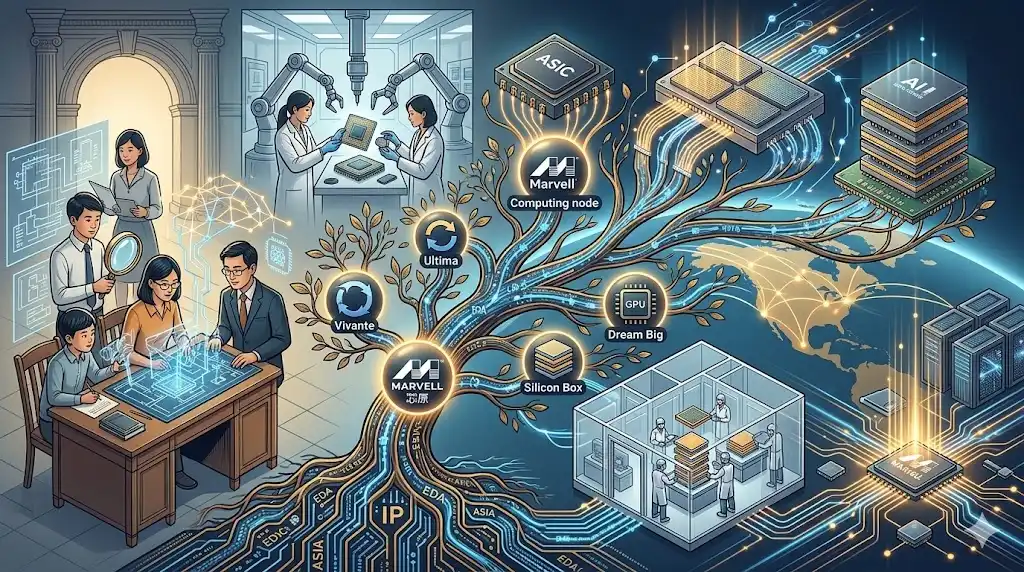
The stock price of Marvell Technology surged 32.5% on June 2nd, driven by NVIDIA CEO Jensen Huang highlighting its custom ASICs and optical interconnects as core to AI data center architecture. This event brought attention to the Chinese semiconductor family behind Marvell: the Dai siblings. The story centers on three siblings, all UC Berkeley graduates, whose three-decade entrepreneurial journey aligns with major semiconductor industry shifts. In 1995, youngest sister Dai Wei Li co-founded Marvell with her husband Sehat Sutardja and his brother, focusing on storage controllers. Eldest brother Dai Wei Min founded EDA company Ultima, later sold to Cadence, and later founded VeriSilicon (芯原) in China, becoming a leading semiconductor IP provider. Second brother Dai Wei Jin co-founded EDA firm Silicon Perspective (sold to Cadence) and GPU IP company Vivante, later acquired by VeriSilicon. The combined "Dai-Sutardja" family network extends beyond Marvell. Their ventures and investments form a comprehensive ecosystem for the post-Moore's Law, chiplet era. Key holdings include: Dream Big Semiconductor (AI SuperNICs, acquired by Arm), Alphawave (high-speed SerDes IP, acquired by Qualcomm), and Silicon Box (a chiplet advanced packaging foundry). VeriSilicon itself thrives on the AI ASIC and IP boom in China. Collectively, the family's AI infrastructure-related portfolio is estimated at over $22 billion. Their strategy represents a distinct path: building critical components for open standards and key manufacturing capacity in the chiplet era, rather than pursuing standalone AI chip dominance. While this path may not create the next NVIDIA, it has enabled repeated successful exits and sustained influence within the global semiconductor industry.

marsbitHace 1 hora(s)

After Marvell's 32% Surge, the Chinese Chip Family Behind It Emerges

marsbitHace 1 hora(s)

Microsoft is Afraid of Being Marginalized by AI Giants

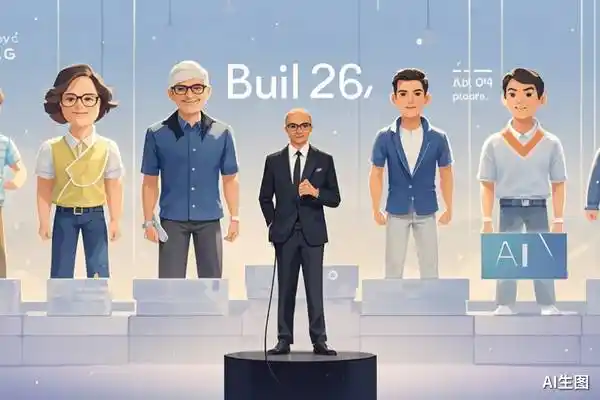
Microsoft, once the defining force of the PC era, now faces a familiar challenge in the AI age: the risk of being relegated to a profitable but invisible infrastructure provider. This anxiety was laid bare at Build 2026, where CEO Satya Nadella unveiled a major strategic pivot. The catalyst was a quiet April agreement that dissolved Microsoft's exclusive licensing and cloud-hosting deal with OpenAI, its once-vital partner. This erased Microsoft's key AI moat. With OpenAI and Anthropic defining AI applications and gaining enterprise traction—even within Microsoft's own ranks—Nadella had to answer: without exclusivity, what is Microsoft's role? The answer was a suite of seven in-house AI models, a developer-focused AI workstation (Surface RTX Spark Dev Box), and, most crucially, the Agent 365 platform for enterprise AI governance. The models, notably targeting Anthropic's strengths in coding and enterprise, signal a defensive move. However, the broader strategy is to make the models themselves less decisive. Financially, Microsoft's AI revenue is strong, driven largely by Azure running others' models. Yet its user-facing products like Copilot show weak penetration and engagement. Microsoft earns infrastructure money but lacks direct user mindshare. Nadella's core fear is being "hollowed out." As OpenAI and Anthropic prepare for IPOs and gain financial independence, they may build their own infrastructure, threatening Azure's lucrative AI revenue stream. Microsoft's window is to entrench itself deeper: not as the model creator, but as the indispensable platform for securely deploying, managing, and governing all AI models within the enterprise through Agent 365. Build 2026 revealed Microsoft's bet: in the AI era, the ultimate power lies not in any single model, but in the enterprise "operating system" that controls them. Nadella is determined to ensure Microsoft is the driver of this new era, not just a passenger.

marsbitHace 1 hora(s)

Microsoft is Afraid of Being Marginalized by AI Giants

marsbitHace 1 hora(s)

CPU, Quietly Returning to the Center of the AI Computing Power Stage

Over the past three years, AI computing power narratives have been dominated by GPUs. However, starting in 2026, this story began to shift. While training large models remains GPU-intensive, the rapid growth of inference and AI agent workloads, which require high levels of task orchestration, concurrency, and data flow management, has highlighted a renewed critical role for CPUs. These are tasks GPUs are not designed to handle. Intel's recent launch of the Xeon 6+ processor, built on its Intel 18A process and featuring up to 288 efficiency cores (E-cores), exemplifies this strategic pivot. It is positioned not as a mere companion to GPUs but as the essential "control plane" for AI infrastructure, optimized for high-density, energy-efficient, and high-throughput workloads characteristic of AI agents and inference. This "CPU resurgence" is not about CPUs outperforming GPUs in raw computation. It reflects a systemic bottleneck: as AI scales from training single models to deploying countless intelligent agents, the demand for coordination and data handling surges. Major cloud providers are also developing their own high-density ARM-based server CPUs for similar workloads. However, Intel's success with this strategy faces significant challenges. Competition includes NVIDIA's integrated CPU-GPU solutions, the expanding adoption of cloud vendors' in-house ARM CPUs, and the crucial market test of Intel's 18A manufacturing process against rivals like TSMC's N2. In conclusion, CPUs are indeed reclaiming a central, though redefined, role in AI compute—managing the complex orchestration that enables massive-scale AI deployment. While the trend is clear, which company will ultimately lead this CPU resurgence remains an open question to be decided in the data centers of 2027 and beyond.

marsbitHace 1 hora(s)

CPU, Quietly Returning to the Center of the AI Computing Power Stage

marsbitHace 1 hora(s)

Trading

Spot
Futuros

Artículos destacados

Cómo comprar BILL

¡Bienvenido a HTX.com! Hemos hecho que comprar Billions Network (BILL) sea simple y conveniente. Sigue nuestra guía paso a paso para iniciar tu viaje de criptos.Paso 1: crea tu cuenta HTXUtiliza tu correo electrónico o número de teléfono para registrarte y obtener una cuenta gratuita en HTX. Experimenta un proceso de registro sin complicaciones y desbloquea todas las funciones.Obtener mi cuentaPaso 2: ve a Comprar cripto y elige tu método de pagoTarjeta de crédito/débito: usa tu Visa o Mastercard para comprar Billions Network (BILL) al instante.Saldo: utiliza fondos del saldo de tu cuenta HTX para tradear sin problemas.Terceros: hemos agregado métodos de pago populares como Google Pay y Apple Pay para mejorar la comodidad.P2P: tradear directamente con otros usuarios en HTX.Over-the-Counter (OTC): ofrecemos servicios personalizados y tipos de cambio competitivos para los traders.Paso 3: guarda tu Billions Network (BILL)Después de comprar tu Billions Network (BILL), guárdalo en tu cuenta HTX. Alternativamente, puedes enviarlo a otro lugar mediante transferencia blockchain o utilizarlo para tradear otras criptomonedas.Paso 4: tradear Billions Network (BILL)Tradear fácilmente con Billions Network (BILL) en HTX's mercado spot. Simplemente accede a tu cuenta, selecciona tu par de trading, ejecuta tus trades y monitorea en tiempo real. Ofrecemos una experiencia fácil de usar tanto para principiantes como para traders experimentados.

169 Vistas totalesPublicado en 2026.05.07Actualizado en 2026.06.02

Cómo comprar BILL

Qué es ATWO

I. Introducción al ProyectoArena Two es una plataforma interactiva descentralizada que permite a los fanáticos jugar un papel activo y tokenizado en los resultados de eventos en tiempo real. A diferencia de los modelos de transmisión tradicionales que reducen a los fanáticos a espectadores pasivos, Arena Two aprovecha la tecnología blockchain para permitir que los fanáticos voten directamente en tiempo real e influyan en los resultados en el campo.II. Información del TokenNombre del token: ATWO (Arena Two)III. Enlaces RelacionadosSitio web: https://arenatwo.com/Exploradores: https://basescan.org/token/0x499D35eBE6cEe9B2Ac35Fd003fcBbeeB9CFc7B32Twitter: https://x.com/arenatwoXNota: La introducción del proyecto proviene de los materiales publicados o proporcionados por el equipo oficial del proyecto, que es solo para referencia y no constituye asesoramiento de inversión. HTX no se hace responsable de ninguna pérdida directa o indirecta resultante.

54 Vistas totalesPublicado en 2026.05.18Actualizado en 2026.06.02

Qué es ATWO

Cómo comprar ATWO

¡Bienvenido a HTX.com! Hemos hecho que comprar Arena Two (ATWO) sea simple y conveniente. Sigue nuestra guía paso a paso para iniciar tu viaje de criptos.Paso 1: crea tu cuenta HTXUtiliza tu correo electrónico o número de teléfono para registrarte y obtener una cuenta gratuita en HTX. Experimenta un proceso de registro sin complicaciones y desbloquea todas las funciones.Obtener mi cuentaPaso 2: ve a Comprar cripto y elige tu método de pagoTarjeta de crédito/débito: usa tu Visa o Mastercard para comprar Arena Two (ATWO) al instante.Saldo: utiliza fondos del saldo de tu cuenta HTX para tradear sin problemas.Terceros: hemos agregado métodos de pago populares como Google Pay y Apple Pay para mejorar la comodidad.P2P: tradear directamente con otros usuarios en HTX.Over-the-Counter (OTC): ofrecemos servicios personalizados y tipos de cambio competitivos para los traders.Paso 3: guarda tu Arena Two (ATWO)Después de comprar tu Arena Two (ATWO), guárdalo en tu cuenta HTX. Alternativamente, puedes enviarlo a otro lugar mediante transferencia blockchain o utilizarlo para tradear otras criptomonedas.Paso 4: tradear Arena Two (ATWO)Tradear fácilmente con Arena Two (ATWO) en HTX's mercado spot. Simplemente accede a tu cuenta, selecciona tu par de trading, ejecuta tus trades y monitorea en tiempo real. Ofrecemos una experiencia fácil de usar tanto para principiantes como para traders experimentados.

117 Vistas totalesPublicado en 2026.05.18Actualizado en 2026.06.02

Cómo comprar ATWO

Discusiones

Bienvenido a la comunidad de HTX. Aquí puedes mantenerte informado sobre los últimos desarrollos de la plataforma y acceder a análisis profesionales del mercado. A continuación se presentan las opiniones de los usuarios sobre el precio de A (A).

活动图片