Crypto Goes Davos: Ripple And Hedera Step Into WEF Week

bitcoinistPublicado a 2026-01-15Actualizado a 2026-01-15

Resumen

Ripple CEO Brad Garlinghouse will participate in a World Economic Forum (WEF) panel titled "Is Tokenization the Future?" during Davos 2026, alongside leaders from Coinbase, Standard Chartered, and the ECB. The discussion will focus on tokenization's transition from pilots to mainstream financial infrastructure. Ripple is also a sponsor of the privately organized USA House venue. Hedera is an official sponsor of USA House and will contribute to high-level discussions on digital assets, AI, and central banking. It is also sponsoring the Global Blockchain Business Council’s "Blockchain Central Davos." Additionally, Hedera's carbon-market initiative, EcoGuard Global, will launch at Davos, offering end-to-end digital infrastructure for high-integrity carbon markets, built on the Hedera network.

Ripple CEO Brad Garlinghouse is slated to appear on a World Economic Forum (WEF) panel on tokenization during Davos 2026, while Hedera says it will sponsor and participate in a slate of senior-level events running alongside the annual gathering. The WEF Annual Meeting 2026 is scheduled for Jan. 19–23 in Davos-Klosters.

Ripple Joins WEF Davos Tokenization Panel

Garlinghouse is once again listed among the public speakers for a WEF session titled “Is Tokenization the Future?” set for Jan. 21 (10:15–11:00 CET). The panel also lists Coinbase CEO Brian Armstrong, Standard Chartered CEO Bill Winters, ECB Governor François Villeroy de Galhau, Eurazeo CEO Valérie Urbain, and moderator Karen Tso.

The session framing is explicitly market-structure oriented, positioning tokenization as something moving beyond pilots and into mainstream financial rails. In the WEF description, organizers write: “Asset tokenization is accelerating quickly, moving from early experiments to full deployment across major asset classes. As adoption expands, it promises new ways for individuals to invest while presenting traditional firms and emerging innovators with complex new dynamics.”

A separate thread of Ripple’s Davos presence may run through “USA House,” a privately organized venue that typically operates in parallel with the official WEF perimeter. Venue materials list Ripple among sponsors of USA House for Davos 2026.

Hedera Brings EcoGuard Global To Davos

Hedera, for its part, is leaning into Davos week as a convening calendar rather than a single stage appearance. In a statement via X, Hedera announced: “Hedera is proud to be an official sponsor of the USA House during the WEF Annual Meeting in Davos, and will contribute to senior-level discussions on digital assets, AI, central banking, and G20 coordination.”

Hedera is also sponsoring Global Blockchain Business Council’s “Blockchain Central Davos,” which runs Jan. 19–22 alongside the WEF meeting, according to Hedera and GBBC materials.

Separately, a Hedera-built carbon-market initiative called EcoGuard Global is scheduled to officially launch in Davos on Jan. 20 at Turmhotel Victoria (3:00–6:00 PM), per EcoGuard’s announcement.

The EcoGuard description pitches an end-to-end infrastructure play around integrity and lifecycle accounting:

“EcoGuard Global is a full carbon lifecycle company building and operating digital infrastructure and managed marketplaces—while actively participating in carbon markets as a developer, investor, and market enabler for high-integrity climate projects... Built on the Hedera network by The Hashgraph Group, EcoGuard Global combines trusted digital infrastructure with market operations, capital, and partnerships to support credible, investable, and scalable carbon markets.”

At press time, HBAR traded at $0.12134.
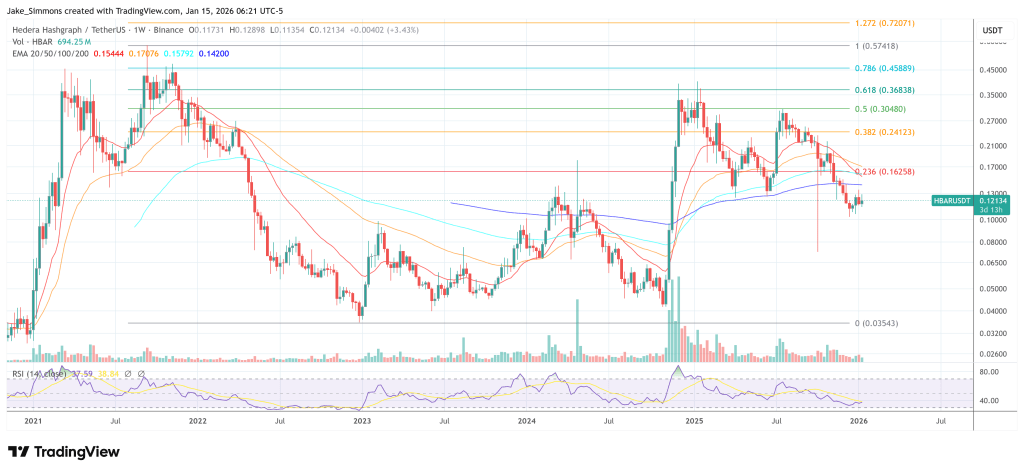
HBAR remains below the 200-week EMA, 1-week chart | Source: HBARUSDT on TradingView.com

Lecturas Relacionadas

Dan Koe: The Counterintuitive Truth—You Don't Need to Remember Everything You Read

Dan Koe: The Counterintuitive Truth — You Don't Need to Remember Everything You Read The central idea is that deliberately trying to remember information is often misguided. True learning isn't about memorizing facts but about having important knowledge surface naturally when needed through use. Most forgetting is normal, not a failure. The article reframes learning using a control theory framework—a four-step feedback loop: having a clear Goal, accurately Sensing your current state, Comparing the gap, and Acting to close it. Most learning stalls because people only do step 2 (blind input) without a goal to create the necessary "error signal" for focused action. The most effective method is to start with output, not input. Begin a meaningful personal project first, and learn only what's necessary to complete it. This project-driven, "just-in-time" learning ensures knowledge is contextual and retained. The concept of a "Second Brain" often fails because it becomes a digital graveyard—over-collected and under-utilized. The goal should be building a "Second Subconscious"—a dynamic system that proactively surfaces relevant ideas during creation, not a static storage vault. Tools like Obsidian+Claude or Eden can help by automating organization and enabling semantic search, but their value depends on linking knowledge to active projects. Ultimately, what matters is not what you store, but what you filter and internalize. Focus on ideas that shape your worldview, use projects as filters, and transform collected material through writing and sharing. AI should be used to reduce friction in research and editing, not to formulate your core views. In conclusion, remembering is a byproduct, not the goal. Knowledge that sticks comes from pursuing personal goals, applying it in real projects, and digesting it through creation. The tools are merely aids; the crucial step is to start doing meaningful work and let the necessary knowledge find you.

marsbitHace 47 min(s)

Dan Koe: The Counterintuitive Truth—You Don't Need to Remember Everything You Read

marsbitHace 47 min(s)

A New Era: The Fundamental Transformation of China's Entrepreneurs

A profound generational shift is underway among Chinese entrepreneurs. The wealth and influence once dominated by real estate and internet giants is now being claimed by a new wave of founders driving breakthroughs in AI, semiconductors, and robotics. This change is vividly reflected in 2026's wealth rankings. Figures like Zhang Yiming (ByteDance), Liang Wenfeng (DeepSeek), Chen Tianshi (Cambricon), and Wang Xingxing (Unitree Robotics) are ascending. Their wealth stems not from traditional business models but from market expectations for future technological competitiveness, with AI, chips, and smart hardware becoming the primary engines of wealth creation. Their common trait is a foundational focus on technology, often starting from the laboratory rather than a business plan. Examples include Chen Tianshi's decade-long push in AI chips, Liang Wenfeng's core algorithmic innovations at DeepSeek with a compact team, and Zhu Yiming's "no salary until profitable" 9-year journey to build Changxin Memory into a global DRAM player. This transition marks a fundamental shift in China's economic imperative: from commercial expansion and learning to indigenous innovation and deep industrial capability. While the previous generation built the foundational market and infrastructure, this new cohort is tasked with achieving global leadership in core technologies, moving China from "keeping pace" to pioneering original, breakthrough innovations that are industrialized at scale. The baton is being passed to those competing on the world stage through technological originality.

marsbitHace 47 min(s)

A New Era: The Fundamental Transformation of China's Entrepreneurs

marsbitHace 47 min(s)

Once-Popular Web3 Enters Wave of Layoffs

The once-hot Web3 industry is experiencing a severe wave of layoffs. While many companies attribute job cuts to AI-driven restructuring, the primary reason is often financial pressure. The Web3 sector, at the intersection of tech and finance, has been hit particularly hard. Employees at major cryptocurrency exchanges report sudden, impersonal layoffs—often with system access revoked overnight—and minimal or no severance. Common tactics include setting impossible performance targets or terminating employees for minor policy violations. The working atmosphere has become toxic, marked by intense monitoring, excessive meetings, and management obsessed with control and internal politics rather than product innovation. The industry's core business model is collapsing. Exchange revenue from trading fees and listing charges has plummeted due to a decline in quality projects and retail investor exodus. Events like the massive forced liquidation on October 10th further shattered confidence. Competition from on-chain derivatives platforms and prediction markets is intensifying the downturn. As layoffs continue, displaced workers struggle to find new opportunities. Many transition to the AI sector, but face significant bias from traditional finance and even some AI firms, which view crypto industry experience with suspicion. The current downturn appears more structural than cyclical, driven by unsustainable practices, internal strife, and a failure to innovate, raising questions about the industry's future trajectory.

marsbitHace 1 hora(s)

Once-Popular Web3 Enters Wave of Layoffs

marsbitHace 1 hora(s)

Trading

Spot
活动图片