Global crypto funds attracted a remarkable $1 billion in inflows last week, marking their third consecutive week of positive net flows and best performance in two months, while underscoring resilience amid geopolitical challenges.
Crypto Funds’ Positive Streak Extends
According to the latest CoinShares data, crypto funds drew $1.06 billion in inflows last week, continuing their positive net flows run for the third consecutive week and extending their best performance since the year started.
Notably, crypto Exchange-Traded Products (ETPs) had a five-week run of negative net flows from January 19 to February 20 amid market weakness and broader negative sentiment. The investment products had cumulative outflows of $4 billion, registering their worst performance since the October 10 crash.
The US market experienced most of the negative net flows during this period, while Bitcoin-based ETPs saw the weakest performance among major cryptocurrencies, with over $3.80 billion in outflows.
However, US investors’ renewed demand for digital asset investment products since the end of February, particularly Bitcoin Exchange-Traded Funds (ETFs), has reduced the prior one-month outflows streak, bringing the three-week run of inflows to $2.62 billion.
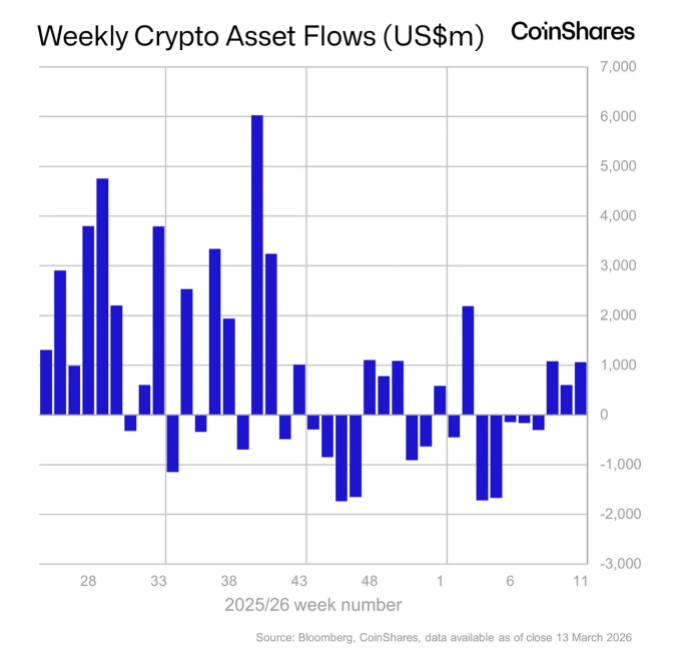
Crypto funds attract massive inflows for the third consecutive week. Source: CoinShares
Regionally, 96% of the inflows originated from the US, with Canada and Switzerland following with $19.4 million and $10.4 million, respectively. Hong Kong also attracted $23.1 million in inflows, marking the best performance since August 2025. In contrast, Germany recorded outflows of $17.1 million, its first negative net flows in 2026, according to CoinShares’ data.
Funds based on the flagship cryptocurrency showed the strongest performance this week, with $793 million in inflows. This accounts for 75% of total inflows, bringing BTC’s three-week inflows to $2.2 billion.
The report noted that short Bitcoin investment products also attracted $8.1 million in inflows last week, highlighting that market opinion remains somewhat polarized.
Meanwhile, Ethereum funds also saw meaningful inflows worth $315 million, partially driven by BlackRock’s debut of its staked Ether ETF in the US. This brings the category’s year-to-date (YTD) flows, which are on a net outflow position, near a net-neutral position.
Digital Assets, Bitcoin’s ‘Safe Haven’ Narrative Reinforced
James Butterfill, head of research at CoinShares, highlighted crypto funds’ strong performance despite the increasing Middle East tensions, explaining that “significant geopolitical disruption has reinforced digital assets, particularly Bitcoin, as a relative safe haven compared with other asset classes.”
Since the beginning of the Iran crisis, total assets under management (AuM) in crypto ETPs have risen by 9.4% to $140 billion, Butterfill noted on Monday. Notably, Nate Geraci, co-founder of the ETF Institute, recently affirmed that ETF investors have “largely displayed diamond hands” since the October correction began.
The expert emphasized that 50% drawdowns “are a walk in the park for long-time BTC investors,” but observed that newer ETF investors also appear unfazed by the recent market volatility.
Bloomberg Intelligence Senior ETF Analyst Eric Balchunas also shared a similar perspective on the performance of spot Bitcoin ETFs, calling the investment products’ resilience “absurd” amid the market conditions.
The latest QCP Market Colour highlighted that crypto is rallying and institutional liquidity is also returning, while equities and gold remain under pressure. According to the Monday analysis, recent price actions suggest a resurgence of Bitcoin’s narrative as a “digital safe haven” or “geopolitical hedge,” with “markets stress-testing that thesis in real time.”
“If this pattern persists, it would be a late-quarter plot twist, given crypto’s underdog status and its familiar habit of correlating with traditional assets mostly on the way down,” the report stated.
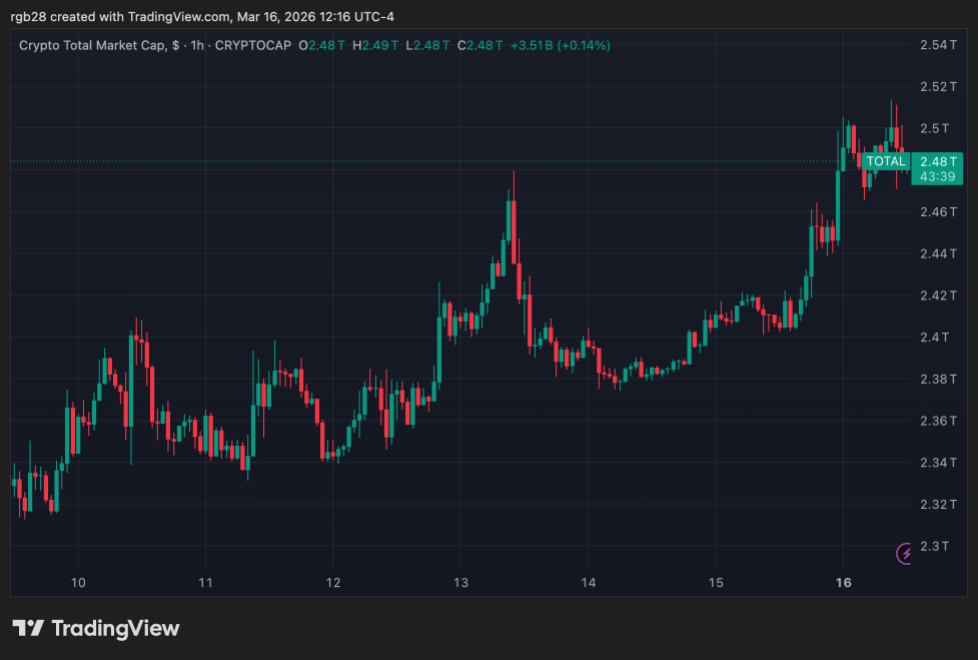
The total crypto market capitalization is at $2.48 trillion on the one-week chart. Source: TOTAL on TradingView






