Crypto Enters Extreme Fear Zone as Global Trade Tensions and Policy Shifts Weigh on Prices

bitcoinistPublicado a 2026-02-24Actualizado a 2026-02-24

Resumen

Cryptocurrency markets plunged into extreme fear, with BTC briefly falling below $65,000, erasing weekend gains. The sell-off was driven by heightened geopolitical risks, new U.S. tariff policies, and concerns over persistent inflation and slower global growth. Total market cap dropped 3–5%, approaching $2.2 trillion. Over $460 million in leveraged positions were liquidated, with long traders bearing the brunt. Rising whale selling and thin liquidity exacerbated the decline. Investors are now closely watching upcoming economic data and Fed policy decisions for direction, though short-term volatility is expected to persist amid macroeconomic uncertainty.

The market tumbled sharply on Monday, with BTC briefly slipping below $65,000, as traders reacted to a mix of U.S. trade policy shifts, geopolitical risks, and looming economic data. The sudden losses erased weekend gains and pushed the market deeper into extreme fear, currently at 5.

Total crypto market capitalization fell roughly 3–5% within a day, sliding toward the $2.2 trillion mark. The downturn coincided with rising geopolitical risks and sweeping tariff measures announced by U.S. President Donald Trump, which unsettled broader financial markets and reduced appetite for risk assets.
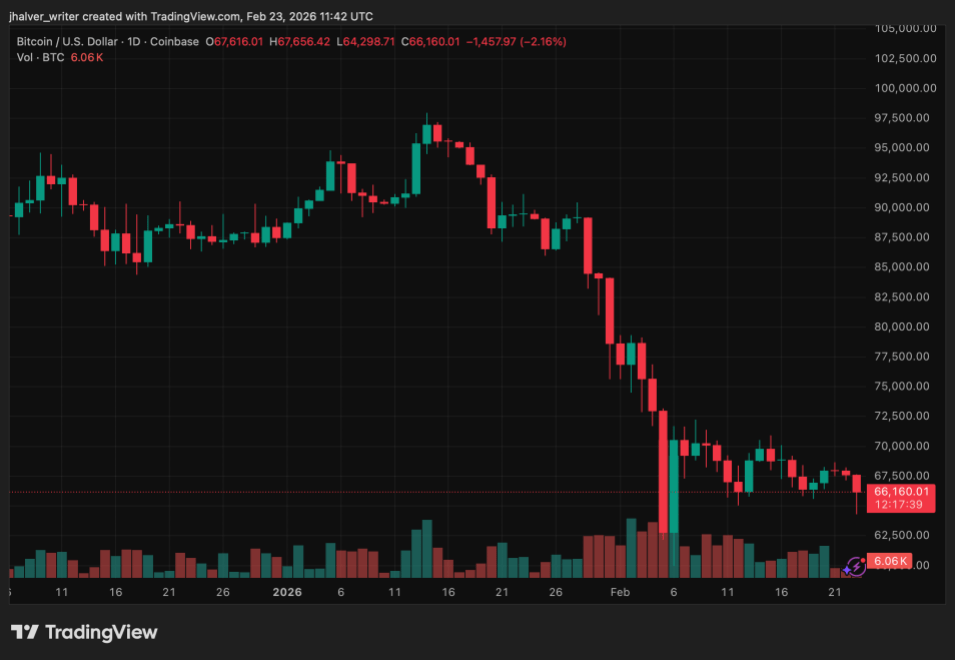
BTC's price trends to the downside on the daily chart. Source: BTCUSD on Tradingview

Trade Tensions and Macro Risks Drive Sell-Off

Market volatility intensified after the Supreme Court of the United States ruled that parts of earlier tariff programs exceeded presidential authority. Shortly after, Trump introduced new global tariffs of up to 15% under separate trade powers, raising concerns about slower global growth and persistent inflation.

Escalating tensions between the United States and Iran added another layer of uncertainty, pushing investors toward traditional safe-haven assets such as gold. Crypto assets, which had previously benefited from a “digital gold” narrative, instead behaved more like high-risk investments during the latest market stress.

Large-holder selling also contributed to downside pressure, with increased transfers from whale wallets to exchanges signaling potential liquidation activity. Analysts noted that thin liquidity and weak conviction among buyers amplified price swings.

Economic Data And Policy Decisions in Focus

Investors are now watching upcoming economic indicators closely. Consumer confidence data, jobless claims, and producer price inflation figures are expected to shape expectations around interest rates. Recent inflation readings above forecasts have reduced hopes for near-term monetary easing by the Federal Reserve.

Meanwhile, the central bank is scheduled to inject roughly $14.6 billion into financial markets, a move some analysts believe could provide temporary support for speculative assets, though not equivalent to full stimulus measures.

Technology earnings are also on the radar, particularly results from Nvidia, whose performance often influences sentiment across both tech equities and crypto markets.

Liquidations Rise as Fear Dominates Sentiment

Market data shows more than $460 million in leveraged positions were wiped out during the latest decline, with long traders accounting for the majority of losses. Institutional flows have weakened as well, with exchange-traded crypto funds recording notable outflows.

Additional supply pressure emerged after mining firm Bitdeer sold its entire weekly production, while public commentary from industry figures, including Michael Saylor, suggested long-term optimism remains despite short-term weakness.

The Crypto Fear and Greed Index has dropped into extreme fear territory, reflecting cautious positioning across the market. Until macroeconomic clarity improves, analysts expect volatility to remain elevated as traders weigh policy risks against longer-term adoption trends.

Cover image from ChatGPT, BTCUSD chart from Tradingview

Preguntas relacionadas

QWhat caused the crypto market to tumble sharply on Monday, pushing it into extreme fear?

AThe market decline was driven by a combination of U.S. trade policy shifts, including new global tariffs announced by former President Trump, rising geopolitical risks such as tensions with Iran, and looming economic data that reduced risk appetite.

QHow much did the total crypto market capitalization fall within a day, and what level did it approaching?

ATotal crypto market capitalization fell roughly 3–5% within a day, sliding toward the $2.2 trillion mark.

QWhat role did large-holder selling play in the market downturn?

ALarge-holder selling contributed to downside pressure, with increased transfers from whale wallets to exchanges signaling potential liquidation activity, which amplified price swings due to thin liquidity and weak buyer conviction.

QWhich upcoming economic indicators are investors closely watching to shape interest rate expectations?

AInvestors are closely watching consumer confidence data, jobless claims, and producer price inflation figures to shape expectations around interest rates.

QHow much in leveraged positions were wiped out during the market decline, and what was the primary type of trader affected?

AMore than $460 million in leveraged positions were wiped out, with long traders accounting for the majority of the losses.

Lecturas Relacionadas

2026 New Policy Interpretation: The "Mutual Pursuit" of Intelligent Agents and AI Terminals, and the Three Major Value Reconstructions in the AIoT Industry

In May 2026, China's national ministries released two pivotal policy documents that jointly establish a strategic "dual-track" framework for the AIoT industry. The "Intelligent Agent Standardized Application and Innovation Development Implementation Opinions" defines the "soul"—positioning intelligent agents as core AI products. The "Artificial Intelligence Terminal Intelligence Grading" national standard defines the "body"—establishing a four-tier capability ladder (L1 to L4) for AI hardware. This synchronized policy approach is globally unique, moving beyond market-led (US) or risk-focused (EU) models. It frames AIoT as a new type of "intelligent infrastructure," comparable to electricity or the internet in historical significance. The core analysis identifies a value evolution from IoT 1.0 (connection) to AIoT 4.0 (collaboration, represented by the forward-looking L4 level). This "L4" signifies a paradigm shift: from users operating tools to delegating tasks to agent-like devices ("Intelligent Action of All Things"). The article outlines three strategic paths for companies: becoming Standard Definers, Scenario Integrators (focusing on 19 specified application areas), or Infrastructure Builders. A critical 18-24 month window is identified for strategic positioning. A "Four Levers" strategy is proposed: leveraging Standards (L-level certification), leveraging Scenarios (deep vertical focus), leveraging Open Source (for cost reduction and ecosystem influence), and leveraging Momentum (engaging in global protocol ecosystems). In conclusion, these policies are a starting gun for a decade-long industrial transformation, shifting the industry narrative from "Intelligent Connection of All Things" to "Intelligent Action of All Things," with companies needing to choose their赛道and execution strategy decisively.

marsbitHace 44 min(s)

2026 New Policy Interpretation: The "Mutual Pursuit" of Intelligent Agents and AI Terminals, and the Three Major Value Reconstructions in the AIoT Industry

marsbitHace 44 min(s)

Splashing Out 27 Billion Yuan, OpenAI Establishes New Company to Accelerate AI Deployment

On May 11th, OpenAI announced the formation of a new company, "OpenAI Deployment Company," with an initial investment of over $4 billion (approximately 27.2 billion RMB). This venture aims to help businesses build and deploy AI solutions. OpenAI is also acquiring the AI consulting firm Toromo to rapidly scale the deployment company's capabilities. This new entity, majority-owned by OpenAI, brings together 19 investment, consulting, and system integration partners, led by TPG with co-lead founding partners including Advent International, Bain Capital, and Brookfield. OpenAI's Chief Revenue Officer, Denise Dresser, stated that while AI is becoming increasingly capable, the current challenge lies in integrating these systems into core business infrastructure and workflows. The deployment company is designed to bridge this gap and translate AI capabilities into operational impact. This move comes as OpenAI emphasizes the next competitive phase will depend on the efficiency of deploying AI in real business scenarios. The company reports over 1 million businesses already use its products and APIs. OpenAI is significantly increasing its investments in computing power, with co-founder Greg Brockman stating the company expects to spend $50 billion on compute this year, a dramatic increase from $3 million in 2017. The announcement follows OpenAI's recent completion of a record $122 billion funding round in late March, led by Amazon, Nvidia, and SoftBank, valuing the company at $852 billion post-money. Major strategic investors committed $110 billion as a base for this round. Concurrently, OpenAI is advancing its core model development. It has shifted focus from its Sora video generator to developing advanced robotics and AI models that interact with the physical world. It has also begun allowing select users access to a new model specialized in identifying software vulnerabilities and is reportedly preparing to launch an enhanced image generation model in the coming weeks. According to reports citing founder Sam Altman, OpenAI is considering an IPO as early as 2027, with a potential valuation around $1 trillion.

marsbitHace 1 hora(s)

Splashing Out 27 Billion Yuan, OpenAI Establishes New Company to Accelerate AI Deployment

marsbitHace 1 hora(s)

Trading

Spot
Futuros
活动图片





