Crypto drops alongside equities as risk-off sentiment spreads across markets

ambcryptoPublicado a 2026-03-26Actualizado a 2026-03-26

Resumen

Cryptocurrencies experienced a broad sell-off alongside U.S. equities, signaling a market-wide shift toward risk-off sentiment rather than crypto-specific weakness. Major digital assets declined, with Ethereum falling 4.1% and Solana dropping over 5%, while Bitcoin saw a more modest 2.1% decrease. Losses extended across altcoins and large-cap tokens like BNB and XRP, with stablecoins remaining stable as investors sought safety. Similarly, tech stocks such as Meta and Nvidia fell sharply, highlighting a retreat from high-risk assets. The synchronized decline underscores continued correlation between crypto and equities during periods of market stress, reflecting their increased sensitivity to macro sentiment and institutional flows.

A broad sell-off across digital assets mirrored declines in U.S. equities, signaling a coordinated pullback in risk assets rather than an isolated crypto move.

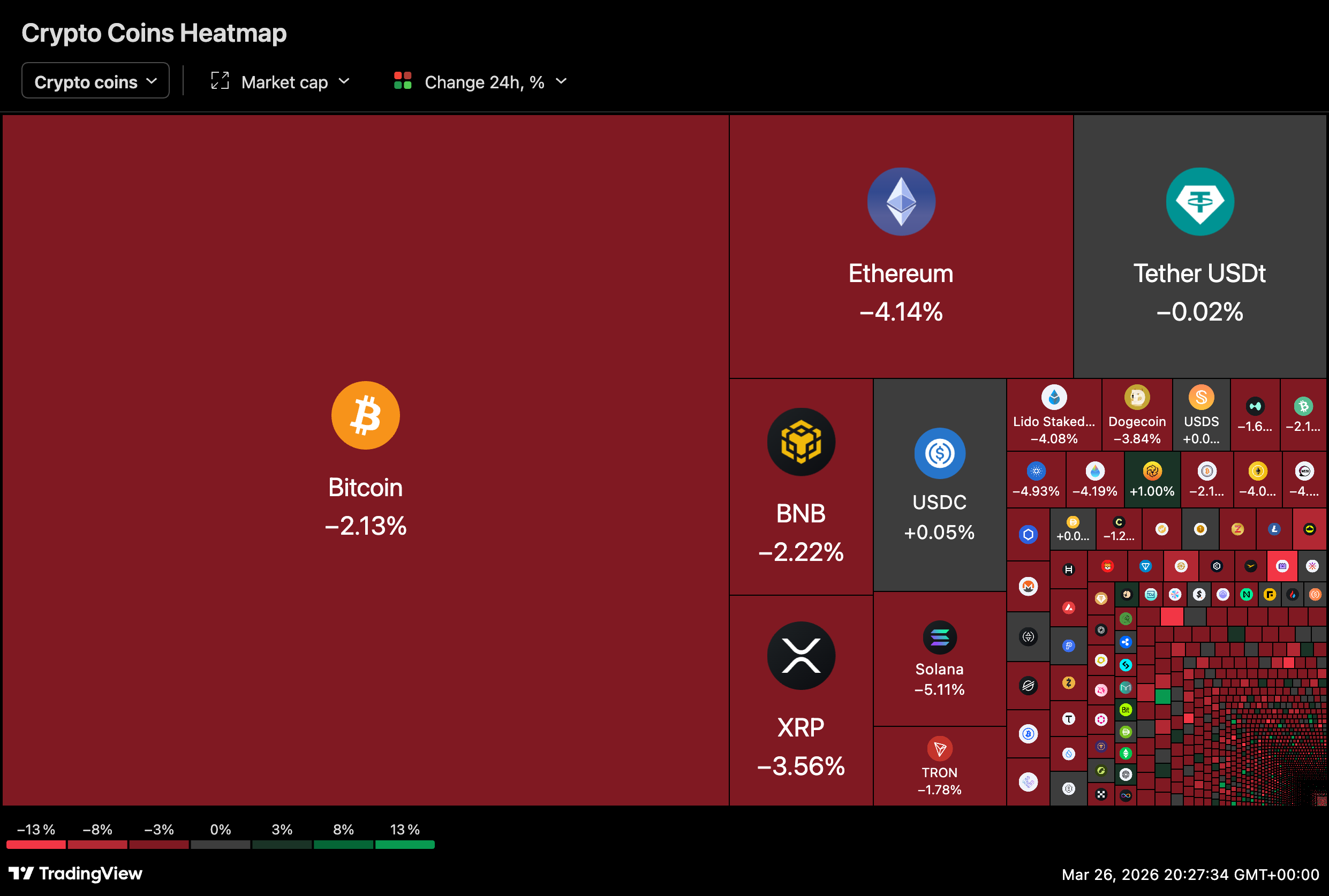
Market heatmaps showed widespread losses across major cryptocurrencies, with Ethereum down 4.1% and Solana falling over 5%. Bitcoin, the largest asset by market cap, posted a more modest 2.1% decline but remained firmly in negative territory.

The weakness extended across altcoins, with few sectors showing resilience, pointing to a broad-based shift in sentiment rather than token-specific developments.

Crypto market sees broad sell-off led by ETH and SOL

The decline was led by higher-beta assets, a common pattern during periods of market stress. Ethereum and Solana both underperformed Bitcoin, suggesting reduced risk appetite among traders.

Large-cap tokens, including BNB and XRP, also moved lower, reinforcing the market-wide nature of the sell-off. Stablecoins such as USDC and Tether remained largely unchanged, reflecting a shift toward capital preservation.
Source: TradingView

The absence of a clear catalyst suggests the move may be tied to broader macro positioning rather than crypto-specific developments.

Equities mirror the move with tech stocks under pressure

A similar pattern was visible in equity markets, particularly within the technology sector.

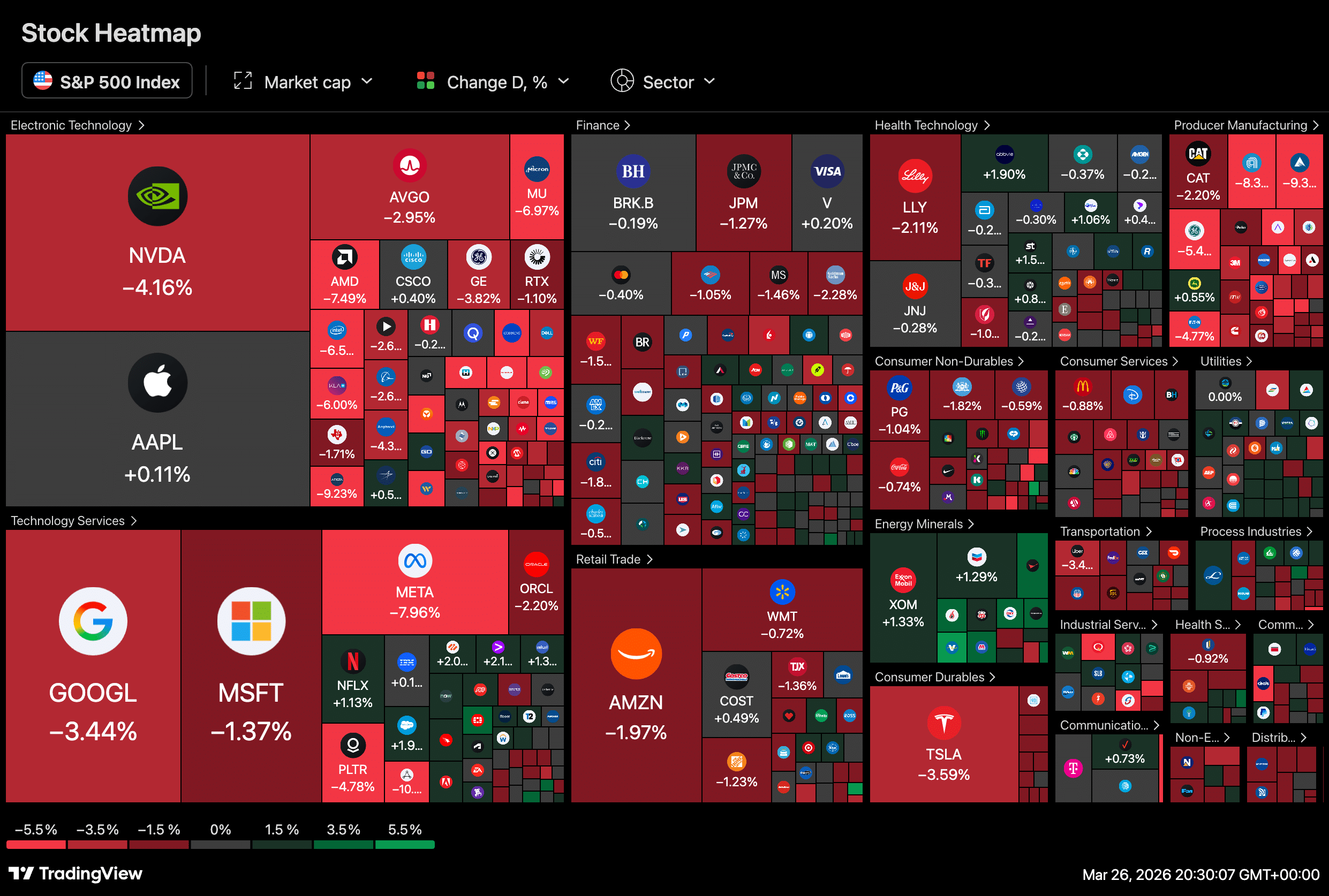
Major stocks such as NVIDIA and Meta Platforms fell sharply, with Meta dropping nearly 8% and Nvidia declining over 4%. Alphabet Inc. and Amazon also posted losses, contributing to a broader decline across the S&P 500.
Source: TradingView

The concentration of losses in growth and tech names highlights a retreat from higher-risk segments of the market.

Correlation highlights risk-off sentiment across markets

The synchronized decline across crypto and equities points to a continued correlation between the two asset classes, particularly during periods of uncertainty.

Rather than acting as a hedge, crypto is trading in line with broader risk sentiment, moving alongside equities when investors reduce exposure to volatile assets.

This alignment has become more pronounced in recent years as institutional participation in digital assets has increased, linking crypto performance more closely to macro-driven market flows.


Final Summary

  • Crypto and equities declined simultaneously, reflecting a broader risk-off move rather than isolated weakness.
  • Continued correlation suggests digital assets remain tied to macro sentiment, especially during periods of market stress.


Preguntas relacionadas

QWhat was the main reason for the simultaneous decline in both cryptocurrency and equity markets according to the article?

AThe decline was due to a broad risk-off sentiment spreading across markets, rather than isolated crypto-specific factors, indicating a coordinated pullback in risk assets.

QWhich two major cryptocurrencies led the sell-off in the crypto market and by how much did they decline?

AEthereum led with a 4.1% decline, and Solana fell over 5%.

QHow did Bitcoin's performance compare to other major cryptocurrencies during this market downturn?

ABitcoin posted a more modest decline of 2.1%, underperforming compared to Ethereum and Solana but still in negative territory.

QWhich technology stocks were mentioned as declining sharply in the equity market, and what were their approximate losses?

AMeta Platforms dropped nearly 8%, and Nvidia declined over 4%. Alphabet and Amazon also posted losses.

QWhat does the synchronized decline between crypto and equities suggest about their correlation according to the article?

AIt suggests that crypto is trading in line with broader risk sentiment and moving alongside equities during periods of uncertainty, rather than acting as a hedge, due to increased institutional participation linking crypto to macro-driven market flows.

Lecturas Relacionadas

How Many Tokens Away Is Yang Zhilin from the 'Moon Chasing the Light'?

The article explores the intense competition between two leading Chinese AI companies, DeepSeek and Kimi (Moon Dark Side), and the mounting pressure on Yang Zhilin, the founder of Kimi. While DeepSeek re-emerged after 15 months of silence with its powerful V4 model—boasting 1.6 trillion parameters and low-cost, long-context capabilities—Kimi has been focusing on long-context processing and multi-agent systems with its K2.6 model. Yang faces a threefold challenge: technological rivalry, commercialization pressure, and investor expectations. Despite Kimi’s high valuation (reaching $18 billion), its revenue heavily relies on a single product with low paid conversion rates, while DeepSeek’s strategic silence and open-source influence have strengthened its market position and valuation prospects, now targeting over $20 billion. Both companies reflect broader trends in China’s AI ecosystem: Kimi aims for global influence through open-source contributions and agent-based advancements, while DeepSeek prioritizes foundational innovation and hardware independence, notably shifting to Huawei’s chips. Their competition is seen as vital for China’s AI progress, with the gap between top Chinese and U.S. models narrowing to just 2.7% on the Elo rating scale. Ultimately, the article argues that this rivalry, though anxiety-inducing for leaders like Zhilin, is essential for driving innovation and solidifying China’s role in the global AI landscape.

marsbitHace 4 hora(s)

How Many Tokens Away Is Yang Zhilin from the 'Moon Chasing the Light'?

marsbitHace 4 hora(s)

TechFlow Intelligence Bureau: ChatGPT Helps Amateur Mathematician Crack 60-Year-Old Problem, CFTC Sues New York Regulator Over Coinbase and Gemini

An amateur mathematician, with the assistance of ChatGPT, has solved a combinatorial mathematics puzzle originally proposed by Hungarian mathematician Paul Erdős in the 1960s. This marks another milestone in AI-aided mathematical research, demonstrating the evolving capabilities of large language models in formal reasoning. In other AI developments, OpenAI introduced a new privacy filter tool for enterprise API usage, automatically screening sensitive data. Meanwhile, the Qwen3.6-27B model achieved 100 tokens per second on a single RTX 5090 GPU using quantization, significantly lowering the cost barrier for local AI deployment. In crypto and Web3, the U.S. CFTC sued New York’s financial regulator, challenging its oversight of Coinbase and Gemini—a first-of-its-kind federal-state regulatory clash. Following a vulnerability, KelpDAO and major DeFi protocols established a recovery fund. Tether froze $344 million in assets linked to Iran’s central bank upon U.S. Treasury request, highlighting the centralized control risks in stablecoins. Separately, Litecoin underwent a 3-hour chain reorganization to undo a privacy-layer exploit. In the U.S., former President Trump invoked the Defense Production Act to address power grid bottlenecks affecting AI data centers and dismissed the entire National Science Board, raising concerns over research independence. A retail trader gained 250% on a $600k Intel options bet amid AI-related speculation. Xiaomi announced its first performance electric vehicle, targeting rivals like Tesla. Meanwhile, iPhone users reported devices automatically reinstalling a hidden app daily, suspected to be MDM-related. A Chinese securities report noted that A-share institutional crowding has reached its second-longest streak since 2007, signaling high valuations and potential style rotation. The day’s developments reflect a dual narrative: AI is enabling unprecedented individual breakthroughs, while centralized power structures—whether governmental or corporate—are becoming more assertive, underscoring that decentralization is as much a political-economic challenge as a technical one.

marsbitHace 4 hora(s)

TechFlow Intelligence Bureau: ChatGPT Helps Amateur Mathematician Crack 60-Year-Old Problem, CFTC Sues New York Regulator Over Coinbase and Gemini

marsbitHace 4 hora(s)

Trading

Spot
Futuros
活动图片




