Crypto Donations Branded ‘Dangerous’? UK Security Panel Urges Immediate Ban

bitcoinistPublicado a 2026-03-18Actualizado a 2026-03-18

Resumen

A UK National Security Panel has called for an immediate ban on political donations made with cryptocurrency, labeling them an "unnecessary and unacceptably high risk" to the integrity of the political finance system. The cross-party committee warns that crypto donations create a "gaping hole" in national security defenses, making it difficult to verify donors due to pseudonymous wallets, mixers, and foreign payment processors. The report urges stricter donor-identity checks, wealth-source verification, and a single-agency lead for enforcement to prevent foreign interference and illicit finance. Proposed rules would require donations to go through FCA-registered platforms, prohibit mixed coins, and mandate conversion to pounds within 48 hours. This is framed as a national security measure, not a blanket attack on crypto.

UK National Security Panel has deemed donations made with crypto assets as an “unnecessary and unacceptably high risk” and it is asking the government for an immediate ban.

Too High Of A Crypto-Risk

The Joint Committee on the National Security Strategy has called today for a moratorium on crypto political donations (an official temporary ban), alongside new donor‐verification rules, to tackle illicit finance and foreign interference in UK politics. The latest report of the Joint Committee warns that crypto donations to UK political parties are a high‐risk channel for illicit and foreign money. Crypto donations pose an “unnecessary and unacceptably high risk to the integrity of the political finance system”, the report reads.

The Government must immediately ban political donations made through cryptocurrency until firm rules can be developed, in order to keep UK politics safe from illicit finance, a cross-party Committee has found.

This decision follows a letter issued on February 24 by Committee Chair of the House of Commons Matt Western to Housing Secretary Steve Reed, urging the government to act before the next general election, warning that hostile states may exploit opaque crypto flows, as reported by Bitcoinist.

Inside The Warning Report

The main concerns expressed by the parliamentary include pseudonymous wallets, mixers and foreign‐based payment processors make it hard to verify who is really bankrolling UK parties, creating a “gaping hole” in national‐security defenses. In order to tackle this, the committee is asking for stricter donor‐identity checks and wealth‐source verification, plus a clear single‐agency lead over political finance enforcement to avoid the current fragmentation across multiple bodies.

Responsibility for policing risks of foreign influence in political finance is dispersed across several services, including the Electoral Commission, Metropolitan Police, Counter Terrorism Policing, MI5, the National Crime Agency and other police services. The Committee argues that accountability and governance are “inadequate”, and notes that a clearer set up with a single national lead would help address low public trust in enforcement of the rules.

What Happens Next?

Under the specific conditions proposed for any future digital assets donations after the moratorium, parties would only be allowed to accept coins that move through fully FCA‐registered platforms, closing off the offshore exchanges and bespoke portals currently used to route funds into Westminster. Any crypto that has passed through mixers or tumblers would be flat‐out prohibited and, on top of that, parties would have to convert donated tokens into pounds within roughly 48 hours, sharply limiting the time funds remain on‐chain and making it easier for regulators and watchdogs to audit who is really paying for UK politics.

The UK is trying to position itself as a “global hub” for digital assets in trading and custody, even as its national‐security apparatus moves aggressively to regulate crypto assets.

The committee frames this as a national‐security and anti‐corruption issue, not a blanket attack on crypto markets, but the political narrative still feeds into a broader crackdown theme investors cannot ignore. While spot crypto trading in the UK remains unaffected in the short term, headlines about “illicit money” and “foreign interference” can sap risk appetite, weigh on politically exposed tokens, and add another layer of regulatory overhang for any UK‐facing exchanges or payment rails.
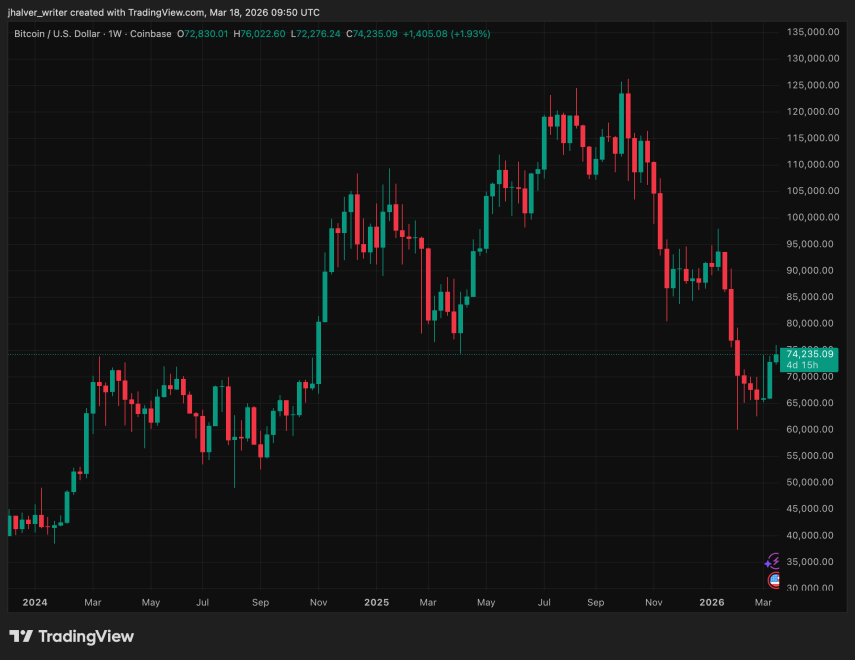
At the time of writing, BTC’s price stays on the $74k. Source: BTCUSD on Tradingview

Cover image from Perplexity, BTCUSD chart from Tradingview

Preguntas relacionadas

QWhat is the main recommendation of the UK National Security Panel regarding crypto political donations?

AThe UK National Security Panel has recommended an immediate ban (moratorium) on political donations made through cryptocurrency to protect the integrity of the political finance system from illicit finance and foreign interference.

QWhat specific risks did the committee identify with crypto donations?

AThe committee identified risks including pseudonymous wallets, mixers, and foreign-based payment processors that make it difficult to verify the true source of donations, creating a 'gaping hole' in national security defenses.

QWhat conditions are proposed for allowing crypto donations after the moratorium?

AAfter the moratorium, parties would only be allowed to accept crypto that moves through fully FCA-registered platforms, must convert donated tokens to pounds within 48 hours, and any crypto that has passed through mixers or tumblers would be prohibited.

QWhich UK agencies are currently responsible for policing risks of foreign influence in political finance?

AResponsibility is dispersed across several services including the Electoral Commission, Metropolitan Police, Counter Terrorism Policing, MI5, the National Crime Agency, and other police services.

QHow does the committee frame this issue in relation to the UK's broader crypto ambitions?

AThe committee frames this as a national security and anti-corruption issue, not a blanket attack on crypto markets, even as the UK tries to position itself as a 'global hub' for digital assets in trading and custody.

Lecturas Relacionadas

How Many Tokens Away Is Yang Zhilin from the 'Moon Chasing the Light'?

The article explores the intense competition between two leading Chinese AI companies, DeepSeek and Kimi (Moon Dark Side), and the mounting pressure on Yang Zhilin, the founder of Kimi. While DeepSeek re-emerged after 15 months of silence with its powerful V4 model—boasting 1.6 trillion parameters and low-cost, long-context capabilities—Kimi has been focusing on long-context processing and multi-agent systems with its K2.6 model. Yang faces a threefold challenge: technological rivalry, commercialization pressure, and investor expectations. Despite Kimi’s high valuation (reaching $18 billion), its revenue heavily relies on a single product with low paid conversion rates, while DeepSeek’s strategic silence and open-source influence have strengthened its market position and valuation prospects, now targeting over $20 billion. Both companies reflect broader trends in China’s AI ecosystem: Kimi aims for global influence through open-source contributions and agent-based advancements, while DeepSeek prioritizes foundational innovation and hardware independence, notably shifting to Huawei’s chips. Their competition is seen as vital for China’s AI progress, with the gap between top Chinese and U.S. models narrowing to just 2.7% on the Elo rating scale. Ultimately, the article argues that this rivalry, though anxiety-inducing for leaders like Zhilin, is essential for driving innovation and solidifying China’s role in the global AI landscape.

marsbitHace 3 hora(s)

How Many Tokens Away Is Yang Zhilin from the 'Moon Chasing the Light'?

marsbitHace 3 hora(s)

TechFlow Intelligence Bureau: ChatGPT Helps Amateur Mathematician Crack 60-Year-Old Problem, CFTC Sues New York Regulator Over Coinbase and Gemini

An amateur mathematician, with the assistance of ChatGPT, has solved a combinatorial mathematics puzzle originally proposed by Hungarian mathematician Paul Erdős in the 1960s. This marks another milestone in AI-aided mathematical research, demonstrating the evolving capabilities of large language models in formal reasoning. In other AI developments, OpenAI introduced a new privacy filter tool for enterprise API usage, automatically screening sensitive data. Meanwhile, the Qwen3.6-27B model achieved 100 tokens per second on a single RTX 5090 GPU using quantization, significantly lowering the cost barrier for local AI deployment. In crypto and Web3, the U.S. CFTC sued New York’s financial regulator, challenging its oversight of Coinbase and Gemini—a first-of-its-kind federal-state regulatory clash. Following a vulnerability, KelpDAO and major DeFi protocols established a recovery fund. Tether froze $344 million in assets linked to Iran’s central bank upon U.S. Treasury request, highlighting the centralized control risks in stablecoins. Separately, Litecoin underwent a 3-hour chain reorganization to undo a privacy-layer exploit. In the U.S., former President Trump invoked the Defense Production Act to address power grid bottlenecks affecting AI data centers and dismissed the entire National Science Board, raising concerns over research independence. A retail trader gained 250% on a $600k Intel options bet amid AI-related speculation. Xiaomi announced its first performance electric vehicle, targeting rivals like Tesla. Meanwhile, iPhone users reported devices automatically reinstalling a hidden app daily, suspected to be MDM-related. A Chinese securities report noted that A-share institutional crowding has reached its second-longest streak since 2007, signaling high valuations and potential style rotation. The day’s developments reflect a dual narrative: AI is enabling unprecedented individual breakthroughs, while centralized power structures—whether governmental or corporate—are becoming more assertive, underscoring that decentralization is as much a political-economic challenge as a technical one.

marsbitHace 4 hora(s)

TechFlow Intelligence Bureau: ChatGPT Helps Amateur Mathematician Crack 60-Year-Old Problem, CFTC Sues New York Regulator Over Coinbase and Gemini

marsbitHace 4 hora(s)

Trading

Spot
Futuros

Artículos destacados

Cómo comprar BAN

¡Bienvenido a HTX.com! Hemos hecho que comprar Comedian (BAN) sea simple y conveniente. Sigue nuestra guía paso a paso para iniciar tu viaje de criptos.Paso 1: crea tu cuenta HTXUtiliza tu correo electrónico o número de teléfono para registrarte y obtener una cuenta gratuita en HTX. Experimenta un proceso de registro sin complicaciones y desbloquea todas las funciones.Obtener mi cuentaPaso 2: ve a Comprar cripto y elige tu método de pagoTarjeta de crédito/débito: usa tu Visa o Mastercard para comprar Comedian (BAN) al instante.Saldo: utiliza fondos del saldo de tu cuenta HTX para tradear sin problemas.Terceros: hemos agregado métodos de pago populares como Google Pay y Apple Pay para mejorar la comodidad.P2P: tradear directamente con otros usuarios en HTX.Over-the-Counter (OTC): ofrecemos servicios personalizados y tipos de cambio competitivos para los traders.Paso 3: guarda tu Comedian (BAN)Después de comprar tu Comedian (BAN), guárdalo en tu cuenta HTX. Alternativamente, puedes enviarlo a otro lugar mediante transferencia blockchain o utilizarlo para tradear otras criptomonedas.Paso 4: tradear Comedian (BAN)Tradear fácilmente con Comedian (BAN) en HTX's mercado spot. Simplemente accede a tu cuenta, selecciona tu par de trading, ejecuta tus trades y monitorea en tiempo real. Ofrecemos una experiencia fácil de usar tanto para principiantes como para traders experimentados.

536 Vistas totalesPublicado en 2024.12.11Actualizado en 2025.03.21

Cómo comprar BAN

Discusiones

Bienvenido a la comunidad de HTX. Aquí puedes mantenerte informado sobre los últimos desarrollos de la plataforma y acceder a análisis profesionales del mercado. A continuación se presentan las opiniones de los usuarios sobre el precio de BAN (BAN).

活动图片