Crypto Credit Crisis Deepens As BlockFills Files For Bankruptcy

bitcoinistPublicado a 2026-03-16Actualizado a 2026-03-16

Resumen

Crypto lender BlockFills and three related entities under parent firm Reliz LTD have filed for Chapter 11 bankruptcy protection. The filing comes after the company halted customer withdrawals last month, citing a sharp Bitcoin selloff as the reason. Prior to the bankruptcy, a Delaware court had already ordered 71 Bitcoin frozen due to a customer fund dispute. Chapter 11 allows the company to continue operating while it restructures its finances and negotiates a repayment plan with creditors. Customers with balances on the platform are considered unsecured creditors, meaning they will be last in line for repayment. The amount and timing of any recovery depend on the company's assets and may take months or years to resolve. This situation mirrors previous crypto lending failures, such as Celsius and Voyager, where customers faced long waits for partial repayments. BlockFills has not disclosed its total liabilities or the number of affected customers.

A Delaware court had already ordered 71 Bitcoin frozen over a customer fund dispute before crypto lender BlockFills formally declared it could no longer operate.

That freeze — tied to a legal battle with creditors over how client money was handled — cast a shadow over the company well before it filed for Chapter 11 protection this week.

Customers Locked Out As Withdrawals Halt

BlockFills stopped letting customers move their money last month. The company pointed to a sharp Bitcoin selloff — the coin dropped from above $97,000 to below $64,000 between mid-January and early February — as the reason it needed to protect both itself and its clients.

Deposits and withdrawals went dark. No timeline for restoration was given.

Now the company and three related entities, all operating under parent firm Reliz LTD, have taken their case to federal bankruptcy court in Delaware.

The filing seeks a Chapter 11 restructuring, which allows a company to keep running while it works out a repayment plan with the people it owes money to.
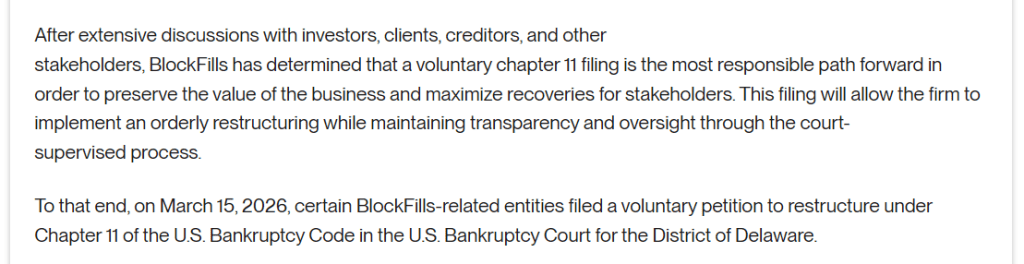
BlockFills' statement on company updates and Chapter 11 bankruptcy filing.

In a statement, BlockFills said the decision came after talks with investors, clients, and creditors. The company said it believes the court process will give it the time and structure needed to stabilize operations, find additional sources of cash, and look at possible deals with outside parties.

Officials said the goal is a consensual restructuring — meaning one that creditors agree to rather than one forced on them by a judge.

What Chapter 11 Means For Those Owed Money

Chapter 11 is not a wind-down. It is a legal system that provides a company with a moratorium to restructure its finances during which an automatic stay prevents creditors from collecting their debts.

BTCUSD now trading at $73,450. Chart: TradingView

As for customers who have balances on the platform, the situation is not so straightforward. They would be considered unsecured creditors in a bankruptcy case, which means they would be last in line after secured creditors and expenses approved by the court.

The amount they will get back and when that will happen is dependent on what assets BlockFills actually owns. That process can take months or, in complex cases, years.

BTCUSD trading at $73,240 on the 24-hour chart: TradingView

Bankruptcy Filing Caps A Difficult Period For The Firm

BlockFills has been under pressure from multiple directions. The frozen Bitcoin order involving Dominion Capital pointed to deeper disputes over whether customer funds were properly segregated — a question that goes beyond market timing.

Reports indicate the company had been in talks with stakeholders for an extended period before concluding that a court-supervised restructuring was the only viable path forward.

The collapse follows a pattern seen in earlier crypto lending failures. Companies including Celsius, Voyager, and BlockFi all suspended withdrawals before filing for bankruptcy during the 2022 market downturn. In each case, customers waited — sometimes years — for partial repayment.

BlockFills has not disclosed total liabilities, the number of affected customers, or the full value of assets under its control. This is a developing situation, and more details are expected to emerge as court documents become public.

Featured image from Unsplash, chart from TradingView

Preguntas relacionadas

QWhat was the primary reason cited by BlockFills for halting customer withdrawals last month?

ABlockFills cited a sharp Bitcoin selloff, where the coin dropped from above $97,000 to below $64,000 between mid-January and early February, as the reason it needed to protect both itself and its clients.

QWhat type of bankruptcy protection did BlockFills and its related entities file for?

ABlockFills and three related entities filed for Chapter 11 bankruptcy protection, which allows a company to continue operating while it works out a repayment plan with its creditors.

QHow are customers with balances on the BlockFills platform classified in the bankruptcy case?

ACustomers with balances on the platform are considered unsecured creditors, meaning they are last in line for repayment after secured creditors and court-approved expenses.

QWhat significant event involving customer funds occurred before the formal bankruptcy filing?

AA Delaware court had already ordered 71 Bitcoin to be frozen due to a customer fund dispute, which was tied to a legal battle with creditors over how client money was handled.

QWhich other crypto companies does the article mention as having followed a similar pattern of suspending withdrawals before filing for bankruptcy in 2022?

AThe article mentions Celsius, Voyager, and BlockFi as companies that suspended withdrawals before filing for bankruptcy during the 2022 market downturn.

Lecturas Relacionadas

Has the 'Digital Gold' Narrative for BTC Failed?

**Title: Has the "Digital Gold" Narrative for Bitcoin Failed?** The article argues that Bitcoin's "digital gold" narrative remains valid despite a recent sharp price decline (from a peak near $126k in Oct 2025 to briefly under $61k in Feb 2026). It presents a long-term investment framework based on three core points: **1. Viewing Bitcoin as an Asset:** Bitcoin is presented as a superior potential store of value compared to gold. Key arguments are its absolute scarcity (21 million cap), superior portability, and transparent auditability via its public ledger. While acknowledging its current use in early, volatile stages (~3-4% global adoption), the author draws parallels to the early, disruptive phases of the internet and e-commerce. **2. Understanding the Recent Downturn:** The current ~50% correction is framed as a predictable, consensus-driven cycle following its post-halving peak (the 2024 halving preceded the Oct 2025 high). A crucial factor is a historic "changing of hands": the influx of new institutional buyers via ETFs allowed early, low-cost holders (miners, OG believers) to take profits. The author notes that while severe, Bitcoin's historical drawdowns (e.g., 93% in 2011, 77% in 2021-22) have been progressively smaller, suggesting maturing holder structure and decreasing volatility over time. **3. The Long-Term Perspective:** The long-term thesis hinges on Bitcoin capturing a portion of gold's market value. With Bitcoin's market cap at ~$1.4 trillion (at $70k) versus gold's ~$20 trillion, significant upside potential exists if the "digital gold" narrative is partially realized. However, the author strongly cautions that short-term risks remain, the bottom is unpredictable, and high volatility is inherent. The real risk is not Bitcoin failing but poor personal position management (over-leverage, wrong capital) and a lack of deep understanding, which can force investors out during severe downturns. The conclusion uses Amazon's 95% crash post-2000 dot-com bubble and subsequent 42x recovery as an analogy. The ultimate question is not if Bitcoin's price will rise, but if an investor's strategy and conviction can withstand the volatility to see the long-term play out. The recent divergence (gold up, Bitcoin down) is posed not as a narrative failure, but as potential evidence of this ongoing, painful transition from a speculative asset to a mainstream allocation.

marsbitHace 10 hora(s)

Has the 'Digital Gold' Narrative for BTC Failed?

marsbitHace 10 hora(s)

Has BTC's 'Digital Gold' Narrative Failed?

The article discusses Bitcoin's "digital gold" narrative, its recent price drop, and long-term outlook through the perspective of "Jason". It argues the narrative is not a failure but that Bitcoin represents a superior, new asset class due to its fixed supply (21 million), portability, and auditability. The piece compares its current ~3-4% global adoption rate to early internet/e-commerce, suggesting significant growth potential. Regarding the 2025-2026 price decline (from ~$126k to briefly under $61k), the author views it as a predictable, consensus-driven sell-off within Bitcoin's ~4-year cycle post-halving, exacerbated by a major "handover" from early, low-cost holders to new institutional buyers via ETFs. A key observation is that historical peak-to-trough drawdowns have lessened over time (e.g., 93% in 2011 to ~50% in 2026), indicating maturing volatility as holder structure changes. For the long term, the author uses a simple framework: Bitcoin's total market cap (~$1.4T at $70k) is only about 7% of gold's (~$20T). Even capturing 30-50% of gold's value would imply substantial upside. However, the article strongly cautions against viewing this as investment advice, emphasizing extreme volatility and the critical importance of risk management, position sizing, and deep fundamental understanding to survive severe drawdowns. It concludes by drawing a parallel to Amazon's 95% crash in 2000 and subsequent 42x recovery, stressing that the key is surviving market cycles to realize long-term potential.

链捕手Hace 10 hora(s)

Has BTC's 'Digital Gold' Narrative Failed?

链捕手Hace 10 hora(s)

From Code to Cognition: A Ten-Thousand-Word Guide to the Evolution of the Robot Brain

"From Code to Cognition: The Evolution of Robot Brains" The journey of robotic intelligence has shifted dramatically from manually coded systems to AI-driven brains. For decades, robots relied on layered software stacks—perception, state estimation, planning, control—each handcrafted. While predictable, they lacked adaptability. The 2010s saw deep learning revolutionize perception (e.g., object detection) and control (via reinforcement learning), but learned skills remained narrow. The arrival of Large Language Models (LLMs) marked a turning point. LLMs acted as high-level planners, interpreting natural language instructions and generating sequences of actions for traditional robotic systems to execute. However, true integration came with Visual-Language-Action (VLA) models, which fused vision, language, and motion prediction into a single network. Pioneered by models like RT-2 and open-source projects like OpenVLA, VLAs enable robots to reason and act directly from visual input and commands. The most advanced humanoid robots now employ a "dual-brain" architecture: a slow-thinking, large VLA (System 2) for reasoning and planning, and a fast-reacting, small network (System 1) for high-frequency motion control, sometimes with an even lower-level System 0 for balance. This split balances cognition with the physics of real-time movement. Computation is split between onboard hardware (e.g., NVIDIA Jetson) for safety-critical control loops and cloud/edge servers for non-critical tasks like learning and interfaces. A crucial driver is the open-source ecosystem—models like GR00T and OpenVLA allow startups to build upon pre-trained brains and fine-tune them with their own data, accelerating development. Despite progress, current systems struggle with recovery from errors, sample inefficiency, and long-horizon tasks. This has spurred the rise of **World Models**—neural networks that predict the consequences of actions. By simulating possible futures before acting (like NVIDIA Cosmos or Meta V-JEPA), robots can plan, recover, and generalize better. This represents the next frontier: shifting intelligence from learned reactions to an internal model of physics and cause-and-effect. The field is rapidly evolving. While not yet at its "ChatGPT moment," the convergence of cheaper hardware, scalable simulation, and world models points toward robots that are increasingly capable, adaptive, and useful. The question is shifting from "what can robots do?" to "what *should* they do?"

marsbitHace 10 hora(s)

From Code to Cognition: A Ten-Thousand-Word Guide to the Evolution of the Robot Brain

marsbitHace 10 hora(s)

Trading

Spot
Futuros
活动图片