Crypto community ‘very sorry’ over Senator Lummis' reelection decision

cointelegraphPublicado a 2025-12-21Actualizado a 2025-12-21

Resumen

US Senator Cynthia Lummis, a prominent advocate for cryptocurrency and Bitcoin, announced she will not seek reelection in 2026, prompting widespread support and regret from the crypto community. Industry leaders credited her significant role in advancing pro-crypto policies, criticizing the SEC's enforcement-heavy approach and championing key legislative efforts like the Responsible Financial Innovation Act and the US Clarity Act. Despite her departure, figures like a16z's Collin McCune and Multicoin's Kyle Samani emphasized that regulatory work continues, with hopes high for passing major crypto legislation in 2026. White House crypto czar David Sacks called her a "great ally" and expressed disappointment at her exit.

The crypto industry has rallied in support of pro-crypto US Senator Cynthia Lummis after she announced she will not seek reelection in 2026.

Lummis, who is a vocal advocate for digital assets and Bitcoin (BTC) adoption, played a significant role in crypto policy discussions in the US over the past few years and earned widespread respect across the crypto industry.

Venture capital firm a16z head of government affairs, Collin McCune, said in an X post on Friday that “crypto would not be where it is today without her fight in the Congress.”

Lummis was a “great ally on crypto,” says David Sacks

Echoing a similar sentiment, crypto investment firm Multicoin general partner, Greg Xethalis, said, “Her priorities have advanced so far because sometimes it takes a cattle rancher like Sen Lummis to drive good policy.”
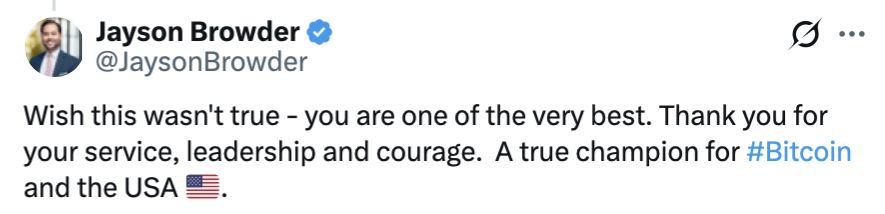
Source: Jayson Browder

Lummis was a vocal critic of former SEC Chair Gary Gensler’s regulation-by-enforcement approach to crypto during the Joe Biden administration and was a major advocate for the proposals of the Responsible Financial Innovation Act and the ongoing US Clarity Act, both aimed at providing greater regulatory clarity for digital assets.

Source: Cynthia Lummis

In her announcement on Friday, which has amassed almost 1 million views on X, Lummis said she does not have “six more years” in her. “I am a devout legislator, but I feel like a sprinter in a marathon. The energy required doesn’t match up,” she said.

Support for Lummis also came from within the White House. White House AI and crypto czar, David Sacks, described Lummis as “a great ally on crypto,” adding that he was “very sorry to see her go.”
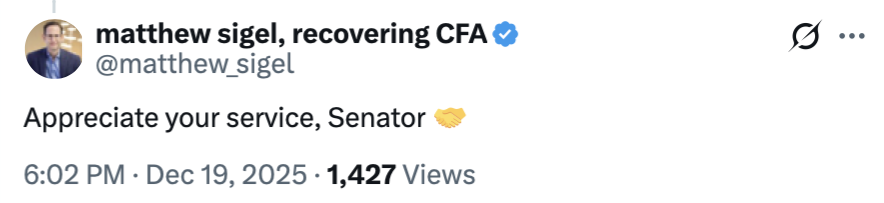
Source: Matthew Sigel

Bitcoin advocate and Coin Stories host Natalie Brunell also paid tribute, thanking Lummis for her “service and for helping move the Bitcoin cause forward.” “Wishing you a wonderful next chapter,” Brunnell said.

Crypto VC says “jobs not done” after Lummis’ announcement

Despite Lummis’ decision to step down, industry participants say policy efforts are far from over. Multicoin managing partner Kyle Samani said, “Jobs not done. We have legislation to pass in 2026.”

Related: US Senate confirms pro-crypto Selig to lead CFTC, Hill to head FDIC

Lummis’ announcement came a day after Sacks said the US Congress could move as early as January on the highly-anticipated US Clarity Act.

”We are closer than ever to passing the landmark crypto market structure legislation that President Trump has called for,” Sacks said on Thursday.

Magazine: Bitcoin’s critical level is $82.5K, Ethereum ‘not done yet’: Trade Secrets

Criptos en tendencia

Preguntas relacionadas

QWhy is the crypto community expressing support and regret over Senator Cynthia Lummis' decision?

ABecause she is a vocal advocate for digital assets and Bitcoin adoption, played a significant role in crypto policy discussions, and was a key supporter of legislation like the Responsible Financial Innovation Act and the US Clarity Act.

QWhat role did Senator Lummis play in criticizing the SEC's approach to crypto regulation?

AShe was a vocal critic of former SEC Chair Gary Gensler’s regulation-by-enforcement approach during the Biden administration.

QHow did David Sacks describe Senator Lummis following her announcement?

AHe described her as 'a great ally on crypto' and said he was 'very sorry to see her go'.

QWhat did Multicoin managing partner Kyle Samani say about the future of crypto legislation after Lummis' decision?

AHe stated, 'Jobs not done. We have legislation to pass in 2026,' indicating that policy efforts are far from over.

QWhat reason did Senator Lummis give for not seeking reelection in 2026?

AShe said she does not have 'six more years' in her, feeling like 'a sprinter in a marathon' where the energy required doesn't match up.

Lecturas Relacionadas

Analyzing the Impact of AI on Economic Growth and Productivity

**Title: Analyzing AI's Impact on Economic Growth and Productivity** This article examines three contrasting views on AI's influence on economic growth and productivity. **The Optimistic View** posits that AI, especially through automating R&D ("recursive self-improvement"), could dramatically accelerate growth, even triggering a technological "singularity" with explosive, potentially infinite, economic expansion. **The Moderate/Mainstream View** acknowledges AI's productivity benefits but emphasizes significant real-world constraints that could limit its impact. These include: limited cost savings per task, structural ceilings on which jobs and industries are "exposed" to AI, adoption bottlenecks (e.g., compute, energy, regulatory hurdles), and the "weak link" effect where non-automatable tasks cap overall gains. Consequently, the realized AI dividend may be far lower than optimistic projections, with estimates typically ranging from 0.1% to 1.3% annual productivity growth. **The Pessimistic View** stems from two strands. The first aligns with the moderate view but applies extremely conservative assumptions about task exposure and efficiency gains, yielding minimal projected impact. The second introduces a demand-side critique: if AI primarily replaces rather than augments labor, it could depress labor's share of income, weaken consumer demand, and create a "demand trap" that ultimately stifles growth, unless offset by redistribution policies. **The authors' assessment** is nuanced: * **Short-term (1-2 years):** AI will support growth primarily through investment spending, not significant productivity gains. * **Medium-term (3-5 years):** Three potential paths emerge based on AI demand and bottleneck severity: 1. **"Optimistic Path":** High demand, few bottlenecks. Rapid productivity gains but risk of major job displacement and social conflict without redistribution. 2. **"Moderate Path" (most likely):** High demand but significant, surmountable bottlenecks. Leads to moderate productivity gains, financial market volatility (K-shaped returns), and sectoral job losses. 3. **"Pessimistic Path":** Low demand or severe bottlenecks. Minimal productivity and growth impact, triggering financial market corrections but allowing a smoother societal transition with less labor disruption. * **Long-term:** AI holds potential for a major productivity revolution and prosperity. The conclusion stresses that no path is smooth. Technologically "optimistic" outcomes could be socially detrimental, while "pessimistic" technological diffusion might be more socially stable. Policymakers must monitor developments and prepare balanced responses to manage economic, financial, and social sustainability.

marsbitHace 27 min(s)

Analyzing the Impact of AI on Economic Growth and Productivity

marsbitHace 27 min(s)

The New Cold War is a Tech Stock War

The New Cold War is a Tech Stock War The article argues that the contemporary geopolitical and economic rivalry between the US and China represents a "New Cold War," but one fundamentally fought through technology and financial markets, not physical barriers or conventional trade. Historically, US dominance was secured through financial systems. The Soviet Union, reliant on the rigid "Transferable Ruble," was ultimately undermined by its dependency on the US dollar for oil trade. Later, Japan's semiconductor challenge was countered not just by tariffs (e.g., Plaza Accord, 301 investigations) but by binding it to US Treasury bonds. China presents a more complex, "embedded" challenger. While it holds vast dollar reserves and US debt like Japan, its industrial base is stronger and more diversified than the Soviet Union's. Surviving the initial 2018 trade war phase, the conflict has evolved into a "tech-financial war." The core battlefield is now the stock market. US tech stocks (AI, semiconductors) are treated as sovereign assets, buoyed by bipartisan national will. China is pushing to strengthen its own financial markets to convert industrial strength into financial power and fund its tech ambitions. Companies like ChangXin (semiconductors), Moonshot AI, and DJI compete not just for market share but as financial proxies for their respective systems. The new paradigm is moving from globally efficient monopolies (Apple, Google) towards companies that achieve monopolistic profits within their respective geopolitical spheres. This competition over "pricing power" and financial valuation in segmented markets defines the current era, making the stock market the primary arena for this tech-centric struggle.

marsbitHace 36 min(s)

The New Cold War is a Tech Stock War

marsbitHace 36 min(s)

Trading

Spot

Artículos destacados

Cómo comprar US

¡Bienvenido a HTX.com! Hemos hecho que comprar Talus Network (US) sea simple y conveniente. Sigue nuestra guía paso a paso para iniciar tu viaje de criptos.Paso 1: crea tu cuenta HTXUtiliza tu correo electrónico o número de teléfono para registrarte y obtener una cuenta gratuita en HTX. Experimenta un proceso de registro sin complicaciones y desbloquea todas las funciones.Obtener mi cuentaPaso 2: ve a Comprar cripto y elige tu método de pagoTarjeta de crédito/débito: usa tu Visa o Mastercard para comprar Talus Network (US) al instante.Saldo: utiliza fondos del saldo de tu cuenta HTX para tradear sin problemas.Terceros: hemos agregado métodos de pago populares como Google Pay y Apple Pay para mejorar la comodidad.P2P: tradear directamente con otros usuarios en HTX.Over-the-Counter (OTC): ofrecemos servicios personalizados y tipos de cambio competitivos para los traders.Paso 3: guarda tu Talus Network (US)Después de comprar tu Talus Network (US), guárdalo en tu cuenta HTX. Alternativamente, puedes enviarlo a otro lugar mediante transferencia blockchain o utilizarlo para tradear otras criptomonedas.Paso 4: tradear Talus Network (US)Tradear fácilmente con Talus Network (US) en HTX's mercado spot. Simplemente accede a tu cuenta, selecciona tu par de trading, ejecuta tus trades y monitorea en tiempo real. Ofrecemos una experiencia fácil de usar tanto para principiantes como para traders experimentados.

602 Vistas totalesPublicado en 2025.12.11Actualizado en 2026.06.02

Cómo comprar US

Discusiones

Bienvenido a la comunidad de HTX. Aquí puedes mantenerte informado sobre los últimos desarrollos de la plataforma y acceder a análisis profesionales del mercado. A continuación se presentan las opiniones de los usuarios sobre el precio de US (US).

活动图片