Crypto Bear Market Startup Guide Part 1: Pre-Market Price Spread Market for Tokenized Stocks

marsbitPublicado a 2026-03-16Actualizado a 2026-03-16

Resumen

"Encrypted Bear Market Startup Guide Part 1: Pre-IPO Stock Price Arbitrage Market" Despite the challenges of a crypto bear market, over 80% of startups that raised seed rounds in 2022 are still building. This period can foster focus on product development and survival skills. This series explores potential business opportunities, starting with the pre-IPO stock price arbitrage market. This market bridges crypto and traditional finance, with major stock exchanges and crypto platforms participating. The upcoming 2026 "IPO boom," featuring companies like OpenAI, Anthropic, SpaceX(xAI), and crypto exchanges, is driving demand for pre-IPO trading. Platforms like PreStocks, Jarsy, and Tessera have emerged, offering more flexible trading than traditional venues like Hiive. Significant price discrepancies exist for the same stock across different pre-IPO platforms. For example: - Kalshi shows a $148 (37%) difference between PreStocks ($397) and Jarsy ($545). - Polymarket has a $94 (50.5%) spread between PreStocks ($186) and Jarsy ($280). - SpaceX(xAI) has a $75 (12.7%) gap between PreStocks ($666) and Tessera ($591). This creates an opportunity for a new platform to act as an arbitrage marketplace for these price differences. The potential business model could include trading fees, LP fees, and profiting from the platform's own arbitrage positions, though current market liquidity remains in the millions.

Original|Odaily Planet Daily (@OdailyChina)

Author|Wenser(@wenser 2010)

Not long ago, Mysten Labs CEO evan.sui shared his views on the "bear market." He mentioned that he does not agree with the notion that "the bear market is great, just keep building." In fact, the bear market is not "great"; packaging it as good for everyone overlooks the real costs (such as discouraging builders and users). Many retail investors and excellent teams face cash flow problems and are forced to exit, ultimately harming the long-term development of the crypto industry.

However, data evidence does not align with this view. A report released by Lattice VC in October 2024 showed that over 80% of crypto startups that announced seed round funding during the 2022 bear market were still building at that time. In other words, if project teams can ensure relatively stable personnel and funding, the bear market is more conducive to project development and growth. The reasons might be that during a bear market, project teams focus more on product development and experience optimization; or perhaps the bear market hones the project teams' abilities to survive through various means. In any case, being in a crypto bear market, determined startup teams might find opportunities in adversity and carve out their own path to development.

In light of this, we will use a series of articles titled "Crypto Bear Market Startup Guide" to explore potential entrepreneurial tracks and project directions with our readers. If any crypto projects emerge and grow rapidly as a result in the future, Odaily Planet Daily also welcomes project teams to discuss cooperation.

Today, let's first discuss one of the hottest potential entrepreneurial directions besides prediction markets—the pre-market price spread market for tokenized stocks.

The Real Demand for Tokenized Stock Pre-Market: Platform Differentiation and Liquidity Bridge

As an intermediate bridge connecting the crypto market with traditional financial markets, tokenized stock trading platforms have not only attracted high attention and active participation from crypto project teams but have also seen involvement from global leading securities platforms including Nasdaq and the New York Stock Exchange, aiming to capture incremental markets while further activating liquidity in traditional financial markets.

Furthermore, not only have listed cryptocurrency concept stocks undergone tokenization and on-chain contract transformation, but many pre-IPO hot concept stocks have also garnered enthusiasm from both crypto and traditional financial markets, giving rise to several pre-market stock tokenization trading platforms.

Considering that the capital market is about to welcome a wave of U.S. stock listings this year, including OpenAI, Anthropic, SpaceX (xAI), Kalshi, Polymarket, OKX, Kraken, and a series of AI model companies, commercial aerospace companies, prediction market platforms, and crypto exchanges, there is no doubt that 2026 is destined to be a "big year for IPOs."

Against the backdrop of a fluctuating and occasionally rebounding crypto market and a consistently rising stock market, the热度 of the pre-market stock trading further supports the above view—there is strong demand from both crypto and traditional financial markets for pre-market trading of hot concept stocks.

This is the main reason for the emergence of pre-market stock trading platforms such as PreStocks, Jarsy, Tessera, and others. Additionally, compared to traditional financial market pre-market trading platforms like Hiive and Nasdaq Private Market, crypto pre-market trading platforms offer more flexible trading methods, purchase limits, and entry barriers, with relatively higher premiums, which attracts many users to participate enthusiastically.

However, just as the same token can have different prices on different exchanges, before mechanisms like oracles are introduced into the pre-market stock market, regardless of the reason, we can clearly see that different platforms have certain price differences for the same underlying stock.

Based on the above information, we can somewhat boldly conclude—the crypto market still lacks one or more "bridge platforms between pre-market stock trading platforms."

This might be a necessary step in advancing the tokenization of stocks and the tokenization of pre-market stock markets—a unified comprehensive platform covering pre-market trading in traditional financial markets and pre-market trading in crypto markets.

Below, we will use the two leading prediction market platforms, Kalshi and Polymarket, which are seeking $20 billion in funding, and SpaceX (xAI), valued at $1.25 trillion, as examples to explore the feasibility and real demand of this "entrepreneurial direction."

Comparing Pre-Market Price Spreads on PreStocks, Jarsy, Tessera: Maximum Spread Rate Exceeds 50%, Price Difference Up to Nearly $150

Kalshi Pre-Market Spread: Up to $148, Spread Rate Around 37%

Taking the Kalshi pre-market as an example, its prices on different platforms are as follows—

PreStocks platform, the pre-market price of the stock token is around $397; (compared to the $369 we mentioned one month ago in the article "Kalshi Trading Volume Continues to Hit New Highs, What Is a Reasonable Pre-IPO Stock Price?", it has increased by nearly $30, a rise of 7.6%)
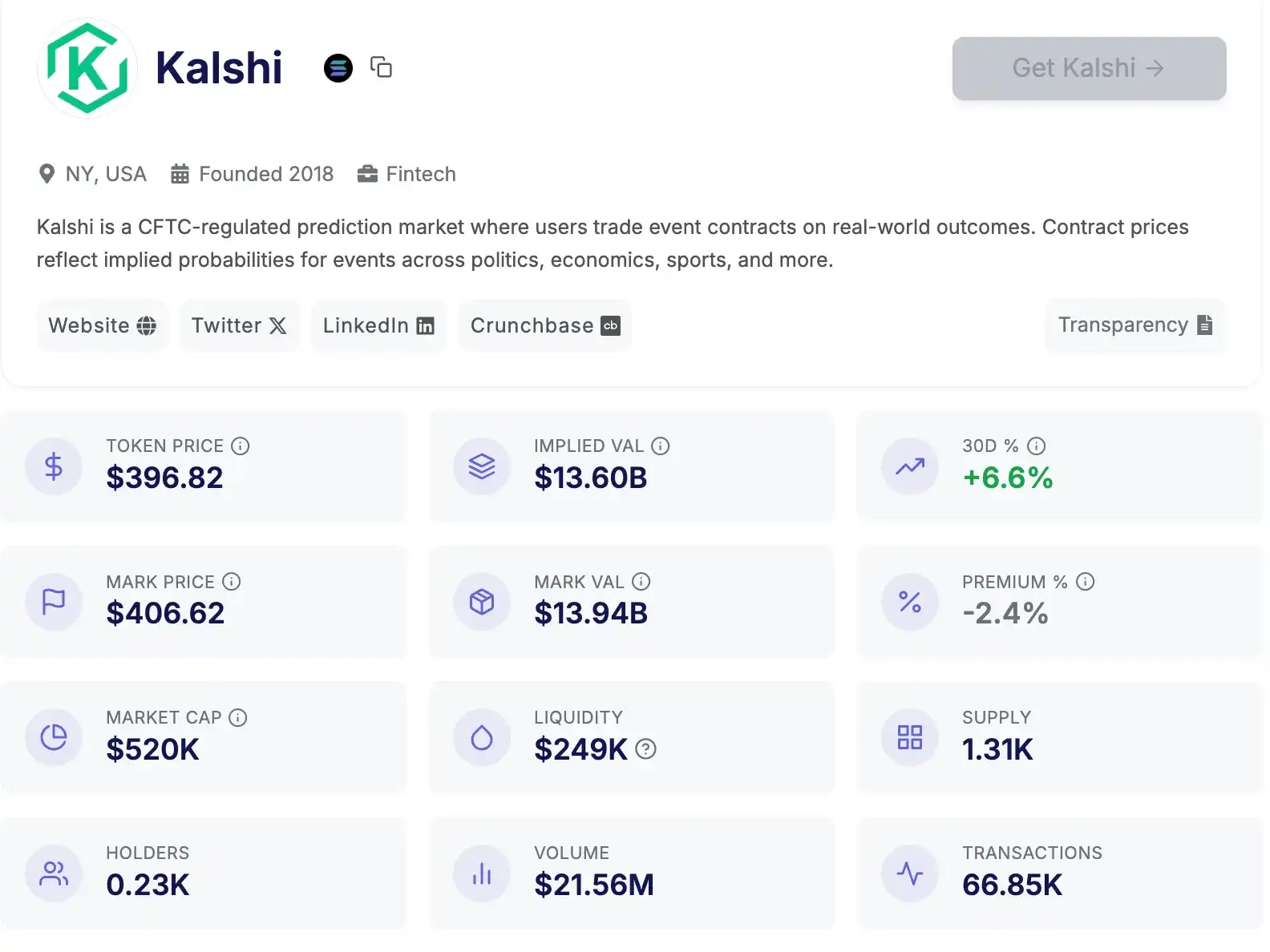
Jarsy platform, the pre-market price is quoted at around $545. (compared to the $504 we mentioned one month ago in the article "Kalshi Trading Volume Continues to Hit New Highs, What Is a Reasonable Pre-IPO Stock Price?", it has increased by over $40, a rise of 8.1%)

In other words, the price difference for Kalshi's pre-market stock on the two major trading platforms is as high as $148 (Odaily Planet Daily Note: Considering that the two platforms use order book trading mechanisms and on-chain liquidity token trading mechanisms respectively, we are only making an abstract comparison here, temporarily not involving specific asset settlement forms, same below). If calculated based on the $360 price on the traditional financial market pre-market trading platform Hiive, the pre-market price difference even reaches $185.

Polymarket Pre-Market Spread: Up to $94, Spread Rate Over 50%

Taking the Polymarket pre-market as an example, its prices on different platforms are as follows—

PreStocks platform, the pre-market price of the stock token is around $186 (Odaily Planet Daily Note: up 23% in the past 30 days);
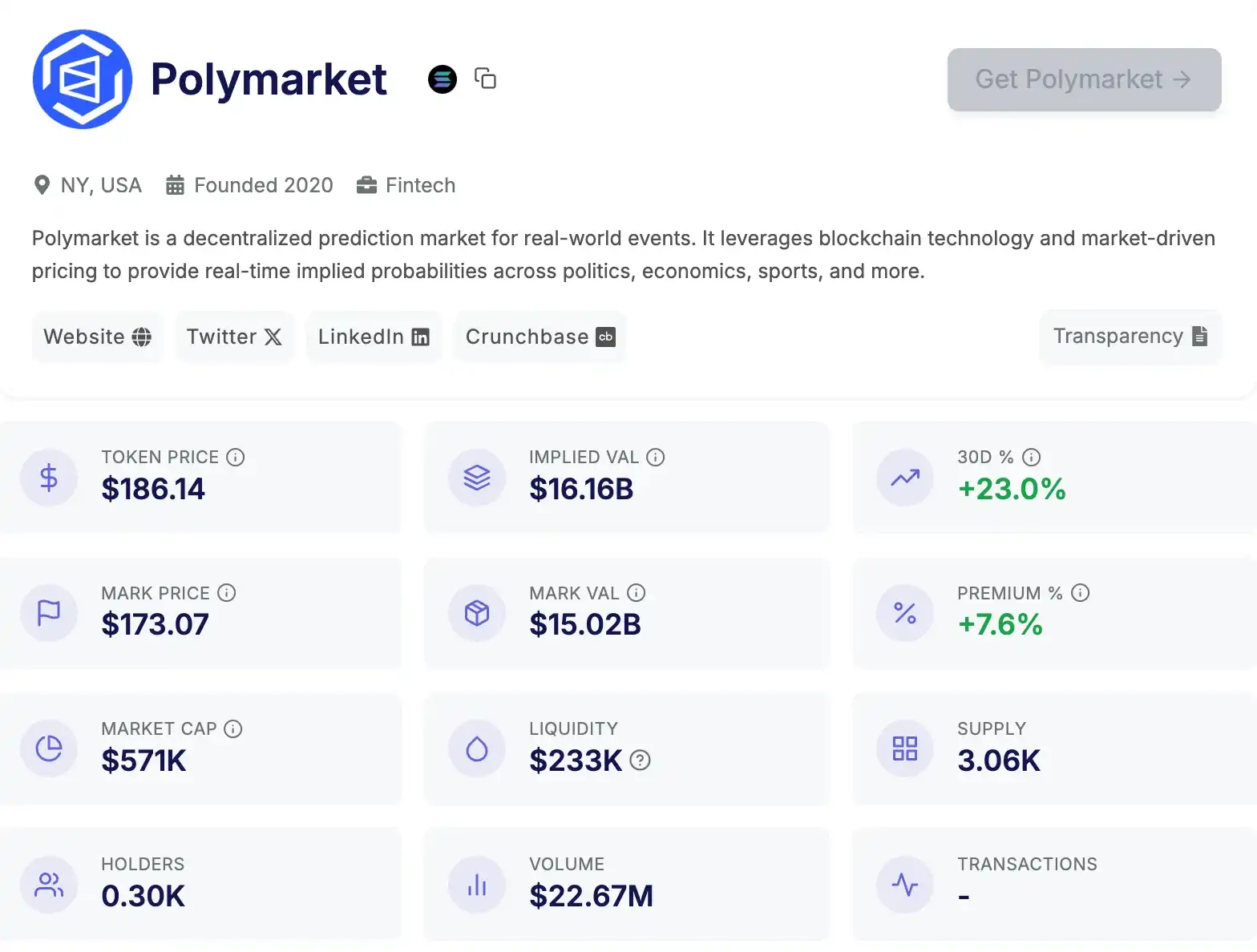
Jarsy platform, the pre-market price is quoted at around $280.

In other words, the price difference for Polymarket's pre-market stock on the two major platforms is about $94, with a spread rate of approximately 50.5%.

SpaceX(xAI) Pre-Market Spread: About $75, Spread Rate 12.7%

Taking SpaceX(xAI) as an example, its prices on different platforms are as follows—

PreStocks platform, the pre-market price of the stock token is around $666 (Odaily Planet Daily Note: up 4.1% in the past 30 days);
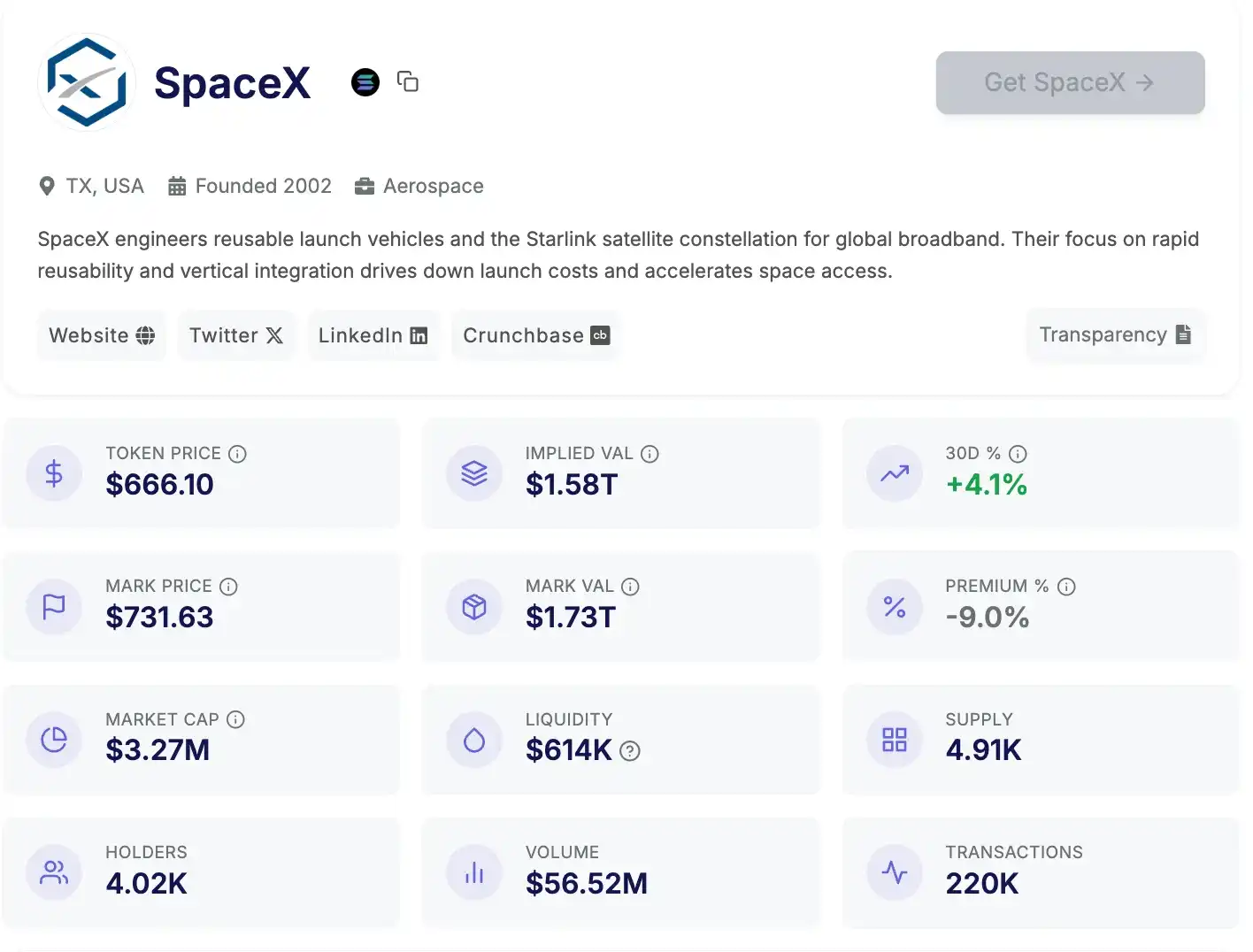
Tessera platform, the pre-market price of the stock token is temporarily reported at around $591 (Odaily Planet Daily Note: up about 14.5% in the past 30 days).
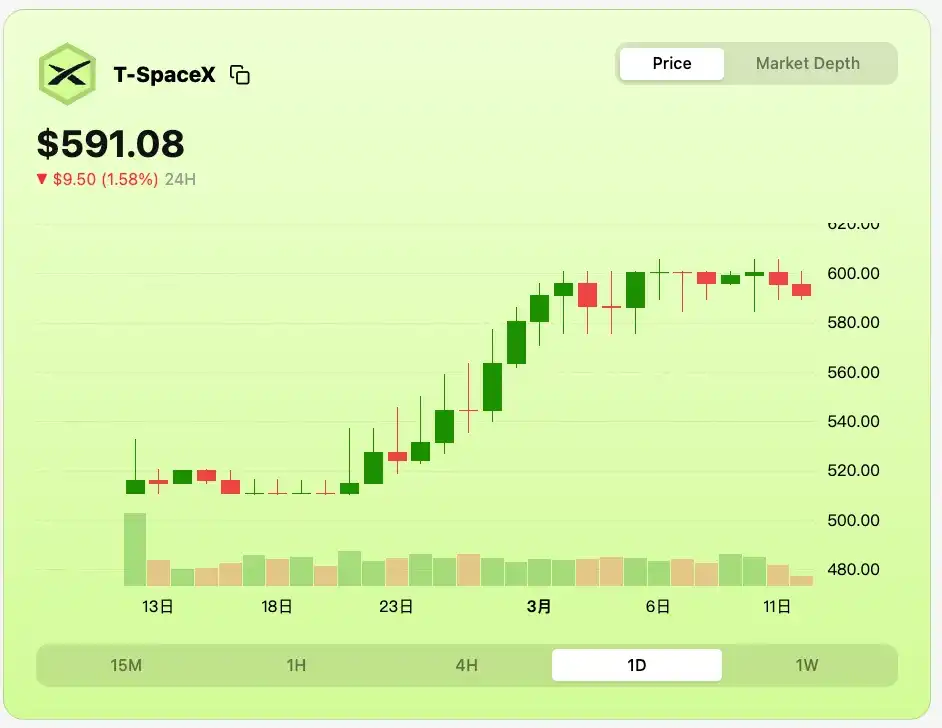
In other words, the price difference for SpaceX's pre-market stock on the two major platforms is about $75, with a spread rate of approximately 12.7%.

In summary, based on existing pre-market trading platforms, it might be possible to build a pre-market price spread market for tokenized stocks to meet market trading and speculation demands after securing sufficient pre-market tokens or pre-market equity capital.

Of course, considering that the current market liquidity remains within the million-dollar range, the main business model of this platform might focus on transaction fees, LP fees, and realizing price differences from the platform's own investment quotas, among other aspects.


Preguntas relacionadas

QWhat is the main argument presented by Mysten Labs CEO evan.sui regarding the crypto bear market?

AMysten Labs CEO evan.sui argues that the bear market is not 'great' and that the narrative that it is good for everyone ignores the real costs, such as driving away builders and users, causing cash flow problems for retail investors and excellent teams, and ultimately harming the long-term development of the crypto industry.

QAccording to the Lattice VC report from October 2024, what percentage of crypto startups that announced seed funding during the 2022 bear market are still building?

AAccording to the Lattice VC report, over 80% of crypto startups that announced seed funding during the 2022 bear market are still building.

QWhat is the proposed new entrepreneurial direction discussed in the article, besides prediction markets?

AThe proposed new entrepreneurial direction is the pre-market price difference market for tokenized stocks (币股盘前价差市场), which aims to act as a bridge between different pre-market trading platforms to capitalize on pricing discrepancies.

QWhat was the approximate price difference (in USD) and the difference rate for Kalshi's pre-market stock tokens between the PreStocks and Jarsy platforms?

AThe price difference for Kalshi's pre-market stock tokens between PreStocks ($397) and Jarsy ($545) was approximately $148, with a difference rate of about 37%.

QWhat potential business models are suggested for a platform that capitalizes on pre-market price differences?

AThe potential business models suggested are transaction fees, liquidity provider (LP) fees, and profiting from the price differences of the platform's own investment allocations.

Lecturas Relacionadas

From South Korea to the United States: Blue-Collar Jobs Are Becoming Increasingly Popular, Thanks to AI

AI is reshaping the labor market's value proposition. The traditional four-year college degree is losing its appeal as a guaranteed career path, while skilled blue-collar trades like electricians, welders, and plumbers are experiencing historic demand and wage premiums. This shift is driven by dual pressures: AI's displacement of certain white-collar roles and a booming need for physical infrastructure and data center construction. Data confirms the trend. In the U.S., vocational school revenue surged, and a significant portion of recent layoffs are AI-related. Surveys show a majority of Gen Z adults plan to pursue blue-collar work, citing better job security against AI automation. Vocational education interest has exploded recently. Experts cite a psychological shift as younger generations seek tangible, AI-resistant careers and avoid high student debt. In many cases, salaries for skilled trades now match or exceed those requiring a bachelor's degree. In South Korea, semiconductor vocational high schools boast near-total employment, with graduates securing high-paying roles at companies like Samsung. The shortage is structural, exacerbated by a retiring baby boomer workforce and massive infrastructure projects. Companies like JPMorgan Chase, Meta, and Lowe's are investing heavily in training programs. However, overcoming historical stigma and a "perception gap" around trade careers remains a key challenge to closing the talent gap.

marsbitHace 23 min(s)

From South Korea to the United States: Blue-Collar Jobs Are Becoming Increasingly Popular, Thanks to AI

marsbitHace 23 min(s)

Qualcomm: AI Hype Subsides, When Will Smartphones Emerge from the Gloom?

Qualcomm reported its Q3 FY2026 results (ending June 2026), with revenue of $9.95B, down 4% YoY but above expectations. Gross margin declined to 53.1%, pressured by rising costs across manufacturing and memory. Key business segments showed mixed performance: Handset revenue fell 19.6% YoY to $5.09B, dragged by an 11% decline in non-Apple Android shipments and weaker high-end mix. Conversely, Automotive revenue surged 61% to $1.59B, and IoT grew 9% to $1.83B. Core operating profit dropped 41% YoY due to margin compression and higher expenses. Management's Q4 FY2026 guidance projects revenue of $9.7B-$10.5B, in line with consensus, but Non-GAAP EPS guidance of $2.05-$2.25 fell short of expectations. Amidst persistent weakness in its core handset market, Qualcomm is pursuing growth in AI, focusing on Edge AI (smartphones, PCs, automotive) and Data Center AI. Its data center strategy includes four pillars: AI accelerators (e.g., AI200), commercial CPUs (Dragonfly C1000), custom silicon, and connectivity solutions. While these initiatives initially boosted its stock, concerns over AI capital expenditure sustainability have since erased those gains. The company targets $5B in data center revenue for FY2027 and $15B for FY2029. The report concludes that with the traditional handset business still under pressure, the data center opportunity is currently viewed as a longer-term option, and a more conservative valuation based on core operations may be warranted until AI contributions materialize.

marsbitHace 28 min(s)

Qualcomm: AI Hype Subsides, When Will Smartphones Emerge from the Gloom?

marsbitHace 28 min(s)

From TPU to Self-Evolving Agents: How Jeff Dean Predicts the Next Step in AI

At the 2026 YC Startup School, Jeff Dean outlined his vision for AI's next phase, shifting focus from simply scaling models to building intelligent, autonomous systems. He believes AI's progress is no longer just about creating smarter models, but about integrating them into systems capable of long-term, iterative work, automated experimentation, and continuous learning. This evolution moves the competition from "who has the bigger model" to "who can best organize intelligence." Dean suggests AI capabilities are now comparable to a junior engineer, enabling the automation of complex workflows. However, the true challenge and opportunity lie in managing these AI "workers" at scale. He emphasizes the importance of **context engineering**—structuring tools, memory, and feedback loops—over raw model power. For startups, this means building deep expertise in niche domains where general models currently fail (near 0-1% success rates), leveraging proprietary data, specialized tools, and domain-specific evaluators. A recurring theme is re-examining fundamental constraints. Dean's past work, like moving Google's search index to memory or creating the TPU, stemmed from questioning outdated assumptions about hardware and cost. He sees similar inflection points today, particularly in **specialized inference hardware** to drastically reduce latency and energy consumption for real-time Agent operation. Notably, he points out that in modern AI systems, the dominant cost is often not computation but **data movement**. Reliable, long-running Agents require robust system design, borrowing concepts from distributed computing like checkpointing, state management, and parallel exploration to handle failures and maintain progress over days or weeks. As AI automates execution, the scarcest human skills will shift to **defining clear specifications**, **judging what problems are worth solving** (taste), and designing effective feedback loops. Ultimately, Dean's framework prioritizes understanding the problem deeply, identifying the true bottlenecks, and systematically building closed-loop systems where AI can not only perform tasks but also improve AI itself.

marsbitHace 28 min(s)

From TPU to Self-Evolving Agents: How Jeff Dean Predicts the Next Step in AI

marsbitHace 28 min(s)

Trading

Spot
活动图片




