Crypto Bear Market Startup Guide Part 1: Pre-Market Price Spread Market for Tokenized Stocks

marsbitPublicado a 2026-03-16Actualizado a 2026-03-16

Resumen

"Encrypted Bear Market Startup Guide Part 1: Pre-IPO Stock Price Arbitrage Market" Despite the challenges of a crypto bear market, over 80% of startups that raised seed rounds in 2022 are still building. This period can foster focus on product development and survival skills. This series explores potential business opportunities, starting with the pre-IPO stock price arbitrage market. This market bridges crypto and traditional finance, with major stock exchanges and crypto platforms participating. The upcoming 2026 "IPO boom," featuring companies like OpenAI, Anthropic, SpaceX(xAI), and crypto exchanges, is driving demand for pre-IPO trading. Platforms like PreStocks, Jarsy, and Tessera have emerged, offering more flexible trading than traditional venues like Hiive. Significant price discrepancies exist for the same stock across different pre-IPO platforms. For example: - Kalshi shows a $148 (37%) difference between PreStocks ($397) and Jarsy ($545). - Polymarket has a $94 (50.5%) spread between PreStocks ($186) and Jarsy ($280). - SpaceX(xAI) has a $75 (12.7%) gap between PreStocks ($666) and Tessera ($591). This creates an opportunity for a new platform to act as an arbitrage marketplace for these price differences. The potential business model could include trading fees, LP fees, and profiting from the platform's own arbitrage positions, though current market liquidity remains in the millions.

Original|Odaily Planet Daily (@OdailyChina)

Author|Wenser(@wenser 2010)

Not long ago, Mysten Labs CEO evan.sui shared his views on the "bear market." He mentioned that he does not agree with the notion that "the bear market is great, just keep building." In fact, the bear market is not "great"; packaging it as good for everyone overlooks the real costs (such as discouraging builders and users). Many retail investors and excellent teams face cash flow problems and are forced to exit, ultimately harming the long-term development of the crypto industry.

However, data evidence does not align with this view. A report released by Lattice VC in October 2024 showed that over 80% of crypto startups that announced seed round funding during the 2022 bear market were still building at that time. In other words, if project teams can ensure relatively stable personnel and funding, the bear market is more conducive to project development and growth. The reasons might be that during a bear market, project teams focus more on product development and experience optimization; or perhaps the bear market hones the project teams' abilities to survive through various means. In any case, being in a crypto bear market, determined startup teams might find opportunities in adversity and carve out their own path to development.

In light of this, we will use a series of articles titled "Crypto Bear Market Startup Guide" to explore potential entrepreneurial tracks and project directions with our readers. If any crypto projects emerge and grow rapidly as a result in the future, Odaily Planet Daily also welcomes project teams to discuss cooperation.

Today, let's first discuss one of the hottest potential entrepreneurial directions besides prediction markets—the pre-market price spread market for tokenized stocks.

The Real Demand for Tokenized Stock Pre-Market: Platform Differentiation and Liquidity Bridge

As an intermediate bridge connecting the crypto market with traditional financial markets, tokenized stock trading platforms have not only attracted high attention and active participation from crypto project teams but have also seen involvement from global leading securities platforms including Nasdaq and the New York Stock Exchange, aiming to capture incremental markets while further activating liquidity in traditional financial markets.

Furthermore, not only have listed cryptocurrency concept stocks undergone tokenization and on-chain contract transformation, but many pre-IPO hot concept stocks have also garnered enthusiasm from both crypto and traditional financial markets, giving rise to several pre-market stock tokenization trading platforms.

Considering that the capital market is about to welcome a wave of U.S. stock listings this year, including OpenAI, Anthropic, SpaceX (xAI), Kalshi, Polymarket, OKX, Kraken, and a series of AI model companies, commercial aerospace companies, prediction market platforms, and crypto exchanges, there is no doubt that 2026 is destined to be a "big year for IPOs."

Against the backdrop of a fluctuating and occasionally rebounding crypto market and a consistently rising stock market, the热度 of the pre-market stock trading further supports the above view—there is strong demand from both crypto and traditional financial markets for pre-market trading of hot concept stocks.

This is the main reason for the emergence of pre-market stock trading platforms such as PreStocks, Jarsy, Tessera, and others. Additionally, compared to traditional financial market pre-market trading platforms like Hiive and Nasdaq Private Market, crypto pre-market trading platforms offer more flexible trading methods, purchase limits, and entry barriers, with relatively higher premiums, which attracts many users to participate enthusiastically.

However, just as the same token can have different prices on different exchanges, before mechanisms like oracles are introduced into the pre-market stock market, regardless of the reason, we can clearly see that different platforms have certain price differences for the same underlying stock.

Based on the above information, we can somewhat boldly conclude—the crypto market still lacks one or more "bridge platforms between pre-market stock trading platforms."

This might be a necessary step in advancing the tokenization of stocks and the tokenization of pre-market stock markets—a unified comprehensive platform covering pre-market trading in traditional financial markets and pre-market trading in crypto markets.

Below, we will use the two leading prediction market platforms, Kalshi and Polymarket, which are seeking $20 billion in funding, and SpaceX (xAI), valued at $1.25 trillion, as examples to explore the feasibility and real demand of this "entrepreneurial direction."

Comparing Pre-Market Price Spreads on PreStocks, Jarsy, Tessera: Maximum Spread Rate Exceeds 50%, Price Difference Up to Nearly $150

Kalshi Pre-Market Spread: Up to $148, Spread Rate Around 37%

Taking the Kalshi pre-market as an example, its prices on different platforms are as follows—

PreStocks platform, the pre-market price of the stock token is around $397; (compared to the $369 we mentioned one month ago in the article "Kalshi Trading Volume Continues to Hit New Highs, What Is a Reasonable Pre-IPO Stock Price?", it has increased by nearly $30, a rise of 7.6%)
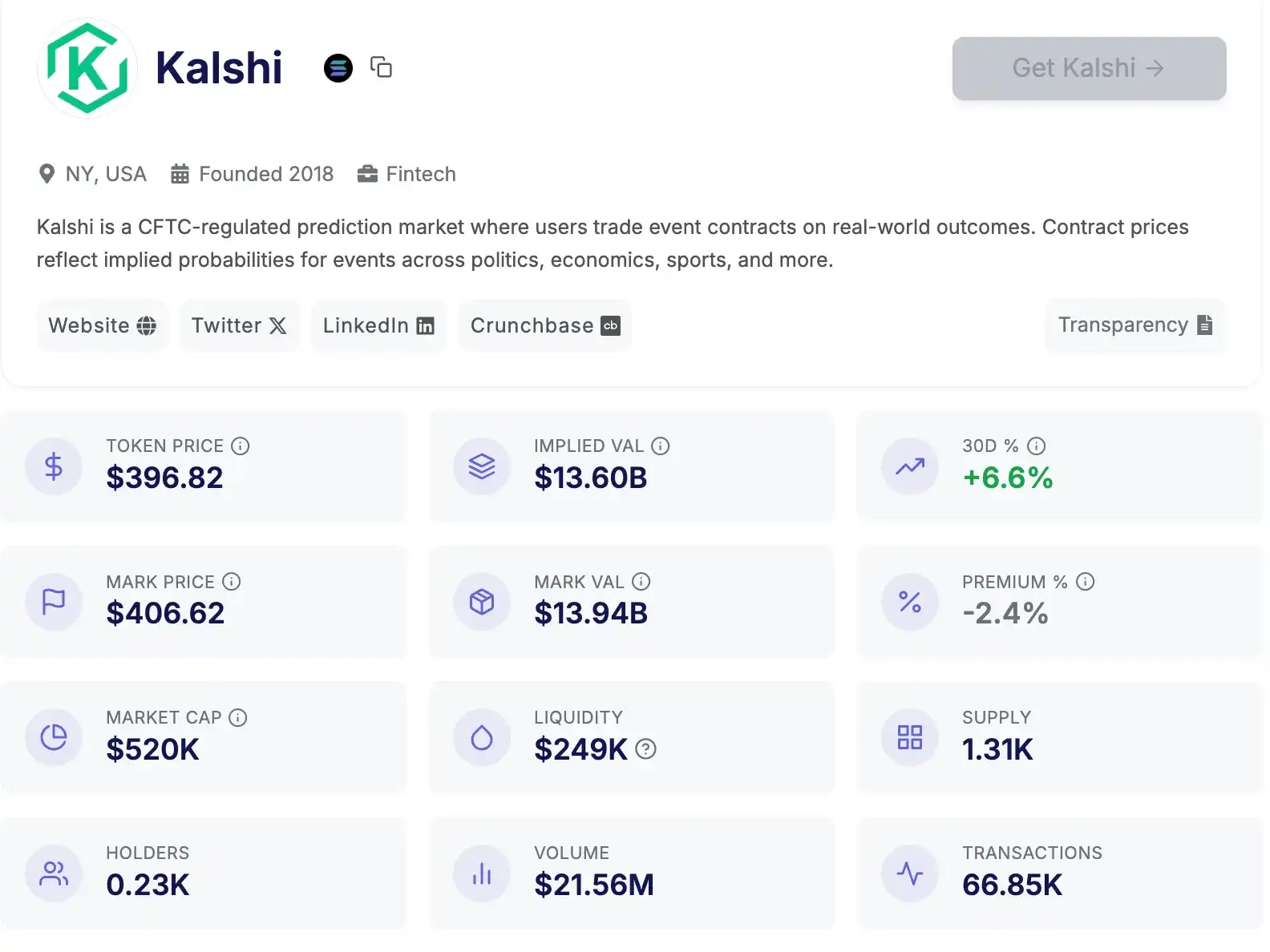
Jarsy platform, the pre-market price is quoted at around $545. (compared to the $504 we mentioned one month ago in the article "Kalshi Trading Volume Continues to Hit New Highs, What Is a Reasonable Pre-IPO Stock Price?", it has increased by over $40, a rise of 8.1%)

In other words, the price difference for Kalshi's pre-market stock on the two major trading platforms is as high as $148 (Odaily Planet Daily Note: Considering that the two platforms use order book trading mechanisms and on-chain liquidity token trading mechanisms respectively, we are only making an abstract comparison here, temporarily not involving specific asset settlement forms, same below). If calculated based on the $360 price on the traditional financial market pre-market trading platform Hiive, the pre-market price difference even reaches $185.

Polymarket Pre-Market Spread: Up to $94, Spread Rate Over 50%

Taking the Polymarket pre-market as an example, its prices on different platforms are as follows—

PreStocks platform, the pre-market price of the stock token is around $186 (Odaily Planet Daily Note: up 23% in the past 30 days);
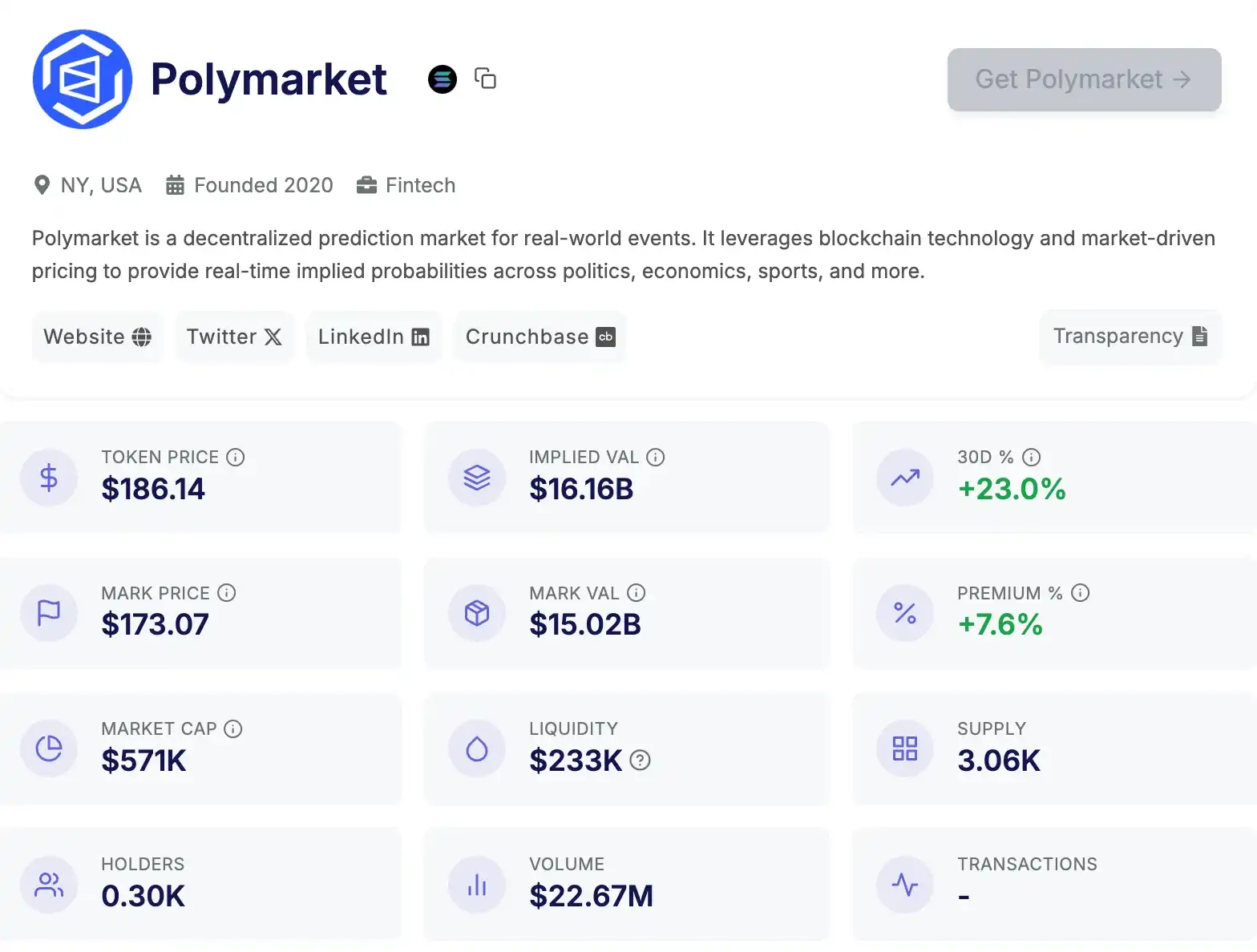
Jarsy platform, the pre-market price is quoted at around $280.

In other words, the price difference for Polymarket's pre-market stock on the two major platforms is about $94, with a spread rate of approximately 50.5%.

SpaceX(xAI) Pre-Market Spread: About $75, Spread Rate 12.7%

Taking SpaceX(xAI) as an example, its prices on different platforms are as follows—

PreStocks platform, the pre-market price of the stock token is around $666 (Odaily Planet Daily Note: up 4.1% in the past 30 days);
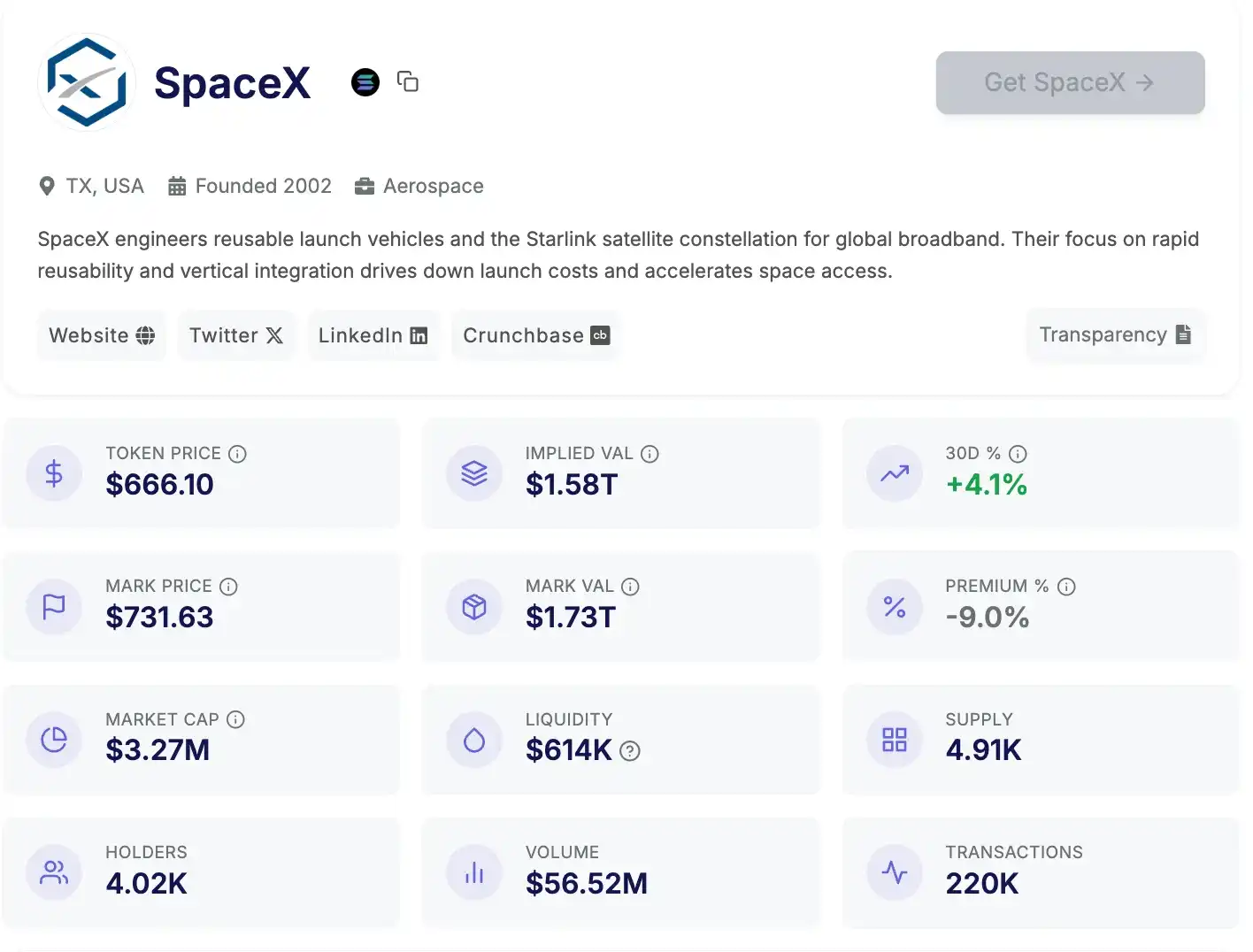
Tessera platform, the pre-market price of the stock token is temporarily reported at around $591 (Odaily Planet Daily Note: up about 14.5% in the past 30 days).
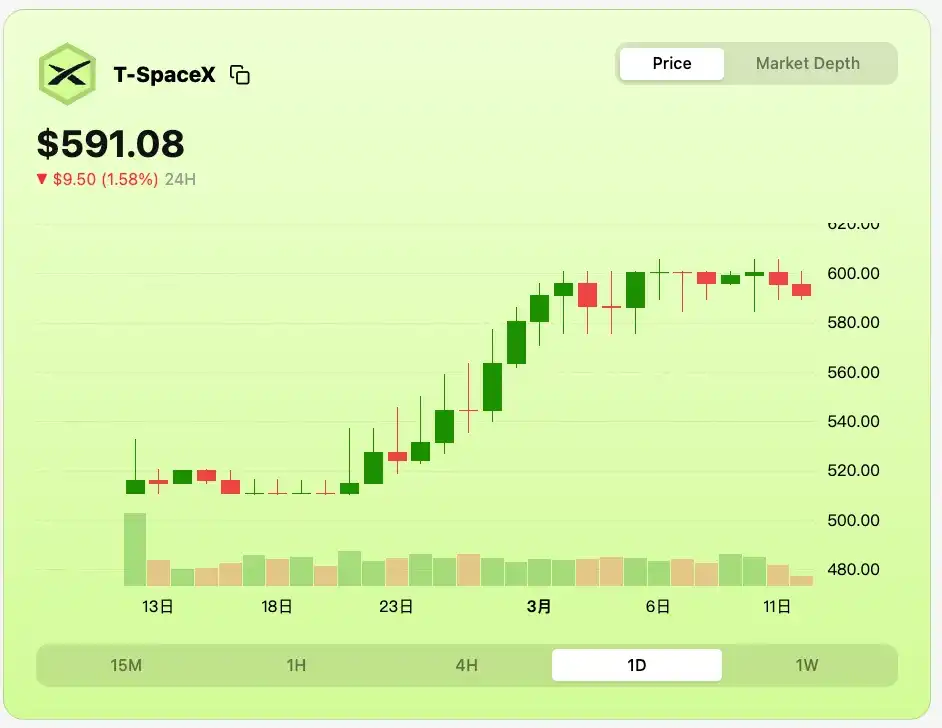
In other words, the price difference for SpaceX's pre-market stock on the two major platforms is about $75, with a spread rate of approximately 12.7%.

In summary, based on existing pre-market trading platforms, it might be possible to build a pre-market price spread market for tokenized stocks to meet market trading and speculation demands after securing sufficient pre-market tokens or pre-market equity capital.

Of course, considering that the current market liquidity remains within the million-dollar range, the main business model of this platform might focus on transaction fees, LP fees, and realizing price differences from the platform's own investment quotas, among other aspects.


Preguntas relacionadas

QWhat is the main argument presented by Mysten Labs CEO evan.sui regarding the crypto bear market?

AMysten Labs CEO evan.sui argues that the bear market is not 'great' and that the narrative that it is good for everyone ignores the real costs, such as driving away builders and users, causing cash flow problems for retail investors and excellent teams, and ultimately harming the long-term development of the crypto industry.

QAccording to the Lattice VC report from October 2024, what percentage of crypto startups that announced seed funding during the 2022 bear market are still building?

AAccording to the Lattice VC report, over 80% of crypto startups that announced seed funding during the 2022 bear market are still building.

QWhat is the proposed new entrepreneurial direction discussed in the article, besides prediction markets?

AThe proposed new entrepreneurial direction is the pre-market price difference market for tokenized stocks (币股盘前价差市场), which aims to act as a bridge between different pre-market trading platforms to capitalize on pricing discrepancies.

QWhat was the approximate price difference (in USD) and the difference rate for Kalshi's pre-market stock tokens between the PreStocks and Jarsy platforms?

AThe price difference for Kalshi's pre-market stock tokens between PreStocks ($397) and Jarsy ($545) was approximately $148, with a difference rate of about 37%.

QWhat potential business models are suggested for a platform that capitalizes on pre-market price differences?

AThe potential business models suggested are transaction fees, liquidity provider (LP) fees, and profiting from the price differences of the platform's own investment allocations.

Lecturas Relacionadas

Annual Salary of Millions Competing for Electricians, Meta Rushes to Open Its Own Technical School

The AI boom is facing an unexpected bottleneck: a severe shortage of skilled construction workers and electricians. As tech giants like Meta, OpenAI, and Alphabet race to build massive data centers—such as OpenAI's $16 billion "Stargate" project—they are hitting a critical labor wall. The U.S. needs an estimated 130,000 more electricians, 240,000 construction workers, and 150,000 supervisors by 2030 for AI infrastructure alone, but tens of thousands of electrician jobs go unfilled each year. While AI companies offer high premiums, with electricians earning up to $280,000 annually, worker scarcity still causes massive losses—delays on a single project can cost $14.2 million per month. The complexity of building AI data centers, which require immense power (equivalent to powering hundreds of thousands of homes), sophisticated electrical systems, and advanced liquid cooling solutions, demands highly skilled technicians who are in short supply. To combat this, companies are investing heavily in training. Meta has committed $115 million to a free training school offering tuition, housing, and stipends, targeting 5,000 new workers. OpenAI is partnering with unions to secure skilled labor. These efforts are paying off, with a significant rise in Gen Z interest in trade schools over college. However, the power demands are staggering. AI data centers are driving a rapid surge in electricity consumption, projected to account for up to 12% of U.S. power use by 2028 and raising costs for consumers. Furthermore, the construction boom is project-based, leading to a potential future glut of trained workers once building peaks, which could depress wages industry-wide. The race for AI supremacy now depends as much on skilled hands as on advanced chips.

marsbitHace 30 min(s)

Annual Salary of Millions Competing for Electricians, Meta Rushes to Open Its Own Technical School

marsbitHace 30 min(s)

OpenAI No Longer Sells Its Most Expensive Model for Profit

OpenAI is shifting its business strategy away from promoting its most expensive, flagship models for every task. Recent price cuts—80% for GPT-5.6 Luna and 20% for Terra—signal a deeper change: the company now actively advises users that many tasks don't require the most powerful model. Instead, OpenAI recommends a tiered approach: use the high-end GPT-5.6 Sol for complex planning and analysis, then delegate execution to cheaper models like Luna. This mirrors moves by Anthropic, which recently launched Claude Opus 5 at half the price of its top model, Fable 5. Both companies are de-emphasizing flagship models as primary revenue drivers, using them instead for brand prestige and technological showcases. The industry is entering a "mass-market" phase, similar to automotive, where high-volume, cost-effective models handle daily operations and drive scale. OpenAI's price reductions are partly enabled by AI models themselves optimizing underlying code and infrastructure, creating a self-reinforcing cycle of efficiency gains and cost reduction. Competition is shifting from "who is smartest" to "who offers the best value." The goal is no longer selling individual models but fostering widespread API adoption and ecosystem lock-in. By making AI calls cheap and ubiquitous, companies like OpenAI aim to become the indispensable, utility-like infrastructure powering automated workflows—the "water and electricity" of software, quietly embedded everywhere.

marsbitHace 30 min(s)

OpenAI No Longer Sells Its Most Expensive Model for Profit

marsbitHace 30 min(s)

Will the Fed Definitely Raise Interest Rates in September? How Will Crypto and U.S. Stocks Withstand the Pressure?

The market's expectation for a September Fed rate hike surged dramatically in early August, jumping from under 50% to over 80% within a week. This shift followed a contentious July FOMC meeting, where a 9-3 vote to hold rates revealed growing dissent from hawkish members advocating for an immediate hike to combat persistent inflation. The primary catalyst for this repricing is rising oil prices, driven by renewed geopolitical tensions around the Strait of Hormuz, which threaten global supply. Energy costs directly influence inflation metrics, making the upcoming July CPI report (due August 12th) a critical data point. If it shows inflation reaccelerating, the probability of a September hike will solidify. For Bitcoin and crypto assets, this is typically bearish news. Bitcoin continues to behave as a high-beta, liquidity-sensitive risk asset. A rate hike raises the opportunity cost of holding non-yielding assets and could drive capital toward money markets, pressuring crypto prices in the short term. However, historical patterns suggest that if a hike is perceived as the end of a tightening cycle rather than the start, any negative price impact may be brief. U.S. stocks, particularly crypto-linked equities like Coinbase and growth-oriented tech stocks, are also vulnerable. Higher rates increase discount rates in valuation models, putting pressure on high-multiple companies. This coincides with a pivotal tech earnings season where investor focus has shifted from massive AI capital expenditure to tangible revenue and cash flow generation. Companies with negative cash flow and weak growth narratives could face heightened volatility if borrowing costs rise in September. In summary, a September Fed hike has evolved into a mainstream market scenario. Key factors to watch are oil prices, the July CPI report, and Fed communications, which will determine the final decision and its impact on volatile crypto and equity markets.

marsbitHace 40 min(s)

Will the Fed Definitely Raise Interest Rates in September? How Will Crypto and U.S. Stocks Withstand the Pressure?

marsbitHace 40 min(s)

Trading

Spot
活动图片




