Crypto ATM Giant Bitcoin Depot Warns Of Possible Collapse

bitcoinistPublicado a 2026-05-16Actualizado a 2026-05-16

Resumen

Crypto ATM operator Bitcoin Depot has warned of potential collapse in an SEC filing, citing "substantial doubt" about its ability to continue. The company faces a severe crisis driven by a sharp $80 million revenue drop in Q1 2026, a $9.5 million net loss, and over $20 million in legal judgments. Intensifying regulatory pressure is a key factor, including a proposed nationwide ban on crypto ATMs in Canada and multiple lawsuits from U.S. states like Massachusetts and Iowa. These actions, alongside enhanced compliance controls, have drastically reduced customer transaction volume. The company's stock (BTM) plummeted over 40% in five days. In a leadership change, former MoneyGram CEO Alex Holmes replaced Scott Buchanan in March, bringing compliance expertise to navigate the challenging legal and regulatory landscape. The future of the business remains highly uncertain.

Bitcoin Depot had roughly 220 machines running in Canada when the Canadian government released its Spring Economic Update in April, proposing a nationwide ban on crypto ATMs to combat scammers and money launderers. The timing could not have been worse for the company.

A Company Running Out Of Room

The Atlanta-based crypto kiosk operator disclosed in a Form 10-Q filing with the US Securities and Exchange Commission on Tuesday that management has “substantial doubt” about whether the business can keep running.

Chief financial officer David Gray cited more than $20 million in legal judgments accrued in the fourth quarter of 2025, alongside a wave of lawsuits from state regulators and a sharp drop in transaction volume.

Revenue fell by $80 million in the first quarter of 2026 compared to the same period a year earlier. The company also posted a net loss of $9.5 million over those three months.

Officials pointed to tightening regulations and enhanced compliance controls as the main reasons customers are using the machines less.
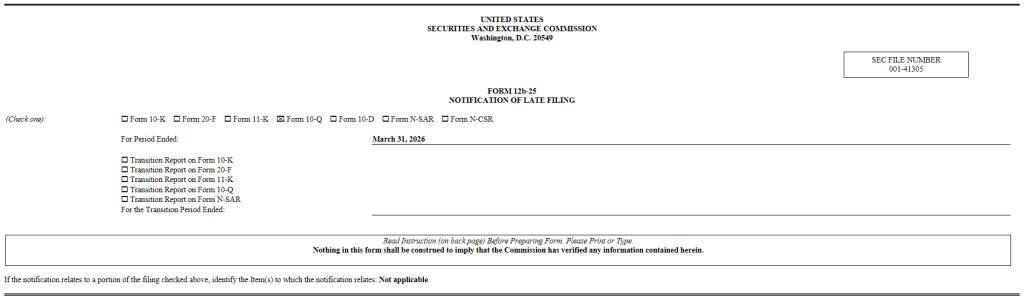
Source: SEC

States Are Closing The Door

The legal pressure started before the Canadian proposal. In January, Bitcoin Depot paid close to $2 million to Maine’s Consumer Credit Protection Bureau to settle a complaint.

Massachusetts, Iowa, and other states have since filed their own actions against the company. Individual cities and towns have also moved to restrict or ban crypto kiosks, with local officials citing concerns about residents falling victim to scams.

BTCUSD currently trading at $78,103. Chart: TradingView

Shares of Bitcoin Depot, which trade on the Nasdaq under the ticker BTM, dropped more than 40% over five trading days, sliding from $5 to $2.90.

In March, the company replaced CEO Scott Buchanan, who had held the position for just three months, with Alex Holmes.

Holmes ran MoneyGram from 2016 to 2024 and is known for his background in regulatory compliance — a skill set Bitcoin Depot clearly needs right now.

Leadership Shift, Uncertain Road

The company’s SEC filing described the revenue decline as being driven by a combination of regulatory impacts and enhanced compliance controls.

Reports indicate Bitcoin Depot is trying to manage existing legal exposure while adapting to a market that looks very different than it did a year ago.

Whether the new leadership can stabilize the business remains to be seen. The machines are still running. The lawsuits are not stopping. And the regulatory walls are getting closer on both sides of the border.

Featured image from ICIJ, chart from TradingView

Preguntas relacionadas

QWhat major event did the Canadian government announce in April that negatively impacted Bitcoin Depot?

AIn April, the Canadian government released its Spring Economic Update, proposing a nationwide ban on crypto ATMs to combat scammers and money launderers.

QAccording to its SEC filing, what are the main reasons cited for the decline in Bitcoin Depot's revenue?

AThe main reasons cited for the revenue decline are tightening regulations and enhanced compliance controls, which have led to customers using the machines less.

QWho is the new CEO of Bitcoin Depot as of March, and what is his relevant background?

AThe new CEO as of March is Alex Holmes, who previously ran MoneyGram from 2016 to 2024 and is known for his background in regulatory compliance.

QWhat significant financial challenges did Bitcoin Depot's CFO cite for the fourth quarter of 2025?

ACFO David Gray cited more than $20 million in legal judgments accrued in the fourth quarter of 2025, alongside a wave of lawsuits from state regulators and a sharp drop in transaction volume.

QHow did Bitcoin Depot's stock price (BTM) perform over five trading days following the news?

AShares of Bitcoin Depot (ticker BTM) dropped more than 40% over five trading days, sliding from $5 to $2.90.

Lecturas Relacionadas

Robots Begin to 'Consume Data': The Hidden Production Chain from Indian Data Factories to Billion-Dollar Humanoid Robots

Robots have started to 'consume data,' driving the formation of a new industrial supply chain focused on producing training data for embodied AI. Unlike large language models, which are trained on vast internet text corpora, embodied AI models face a 'data desert' in the physical world. This has created a massive demand for first-person perspective video data (Ego Data), captured by workers wearing cameras in places like Indian garment factories. Companies like Neocambrian AI are establishing 'data factories' where workers perform standardized tasks (e.g., sorting clothes, kitchen organization) to generate thousands of hours of video. Research, such as NVIDIA's EgoScale, demonstrates that scaling this human demonstration data predictably improves robot performance, particularly for dexterous manipulation. This has validated a training path combining large-scale human data for pre-training with smaller amounts of robot-specific data for fine-tuning. The value of different data types varies significantly, forming a 'data pyramid.' The base consists of low-cost, large-scale internet and Ego Data. Higher layers include more expensive motion-capture data (e.g., from data gloves), simulation/synthetic data, and the most costly and scarce layer: real robot teleoperation data. This demand has spawned a layered ecosystem of data suppliers: low-cost data factories, motion capture and alignment specialists, robot-native teleoperation service providers, simulation data companies, and platforms aiming for data standardization. Robot companies themselves are adopting a 'layered procurement' strategy: outsourcing generic Ego Data while building in-house capabilities for robot-specific adaptation data and the critical deployment/failure data generated in real-world applications. The industry is shifting focus from hardware and basic mobility to the data pipelines required for general-purpose capability. While parallels exist to data labeling companies like Scale AI in the LLM boom, the physical complexity of robot data—involving action success ambiguity and sim-to-real gaps—requires more integrated solutions for data collection, annotation, and a continuous feedback loop. The race is on to build the data engines that will teach robots to operate reliably in the unstructured real world.

marsbitHace 2 hora(s)

Robots Begin to 'Consume Data': The Hidden Production Chain from Indian Data Factories to Billion-Dollar Humanoid Robots

marsbitHace 2 hora(s)

Spicy Commentary | Michael Saylor's 'Player Talk'; 60-Year-Old Aunt Liquidated After 'Scamming a Young Man'

**"Spicy Commentary": Three Tales of Crypto's Wild Week** This week's "Spicy Commentary" column highlights three dramatic stories from the cryptocurrency world. First, **MicroStrategy's Michael Saylor** addressed the controversy over his company potentially selling Bitcoin. At the BTC Prague event, he clarified, "I never said the company can't sell Bitcoin. I told *you* never to sell *your* Bitcoin." This "do as I say, not as I do" stance was criticized by netizens as peak linguistic gymnastics, noting a history of him previously stating the company would "never" sell. Second, a **bizarre fraud case** emerged from Beijing. A 60-year-old woman, obsessed with getting rich from crypto but unwilling to risk her own savings, posed online as the 20-something "god-daughter" of a high-ranking official. She catfished a young man, convincing him to give her over 200,000 yuan for fabricated emergencies. She then invested all the stolen money into cryptocurrency with 10x leverage, only to lose everything in a market crash. The woman was sentenced to four years in prison for fraud. Finally, a **sobering trader's tale** surfaced on Reddit. A user posted "Tale of a crypto trader," confessing their net worth had plummeted from a peak of $45 million to roughly $17,200, primarily due to holding meme coins too long. The post, described as a crypto "book of confessions," sparked reactions ranging from sympathy to critique about greed, poor risk management, and the perils of treating meme coins as long-term investments instead of taking profits. The column concludes that this week featured masterful rhetoric, elaborate scams, and extreme financial volatility, stitching together another chapter in crypto's unpredictable theater.

Foresight NewsHace 2 hora(s)

Spicy Commentary | Michael Saylor's 'Player Talk'; 60-Year-Old Aunt Liquidated After 'Scamming a Young Man'

Foresight NewsHace 2 hora(s)

Tremble Humans, AI Continues Its Accelerated Sprint

Trembling, Humans: AI Continues Its Accelerated Sprint Yes, AI is still rapidly accelerating. While deep learning seemed to stall quickly in its early years, large models after years of development show no sign of hitting their ceiling. At the Zhiyuan Conference 2026, the focus is on enabling AI to move from the digital world into the physical world. Scaling Law remains effective, continuing to drive advancements in both large language models and multimodal models. The industry is now entering a phase of pursuing World Models, though unresolved technical paths and data issues mean this exploration may take 3-5 more years. Concurrently, breakthroughs in Agents are accelerating AI's real-world application in fields like healthcare and meetings. Making Agents truly useful requires key hardware-software co-design, evident from the strong presence of chip vendors at the conference. We stand at a new historical threshold where AI is becoming a foundational force reshaping the world. The first day of the conference highlighted AI's evolution from "knowing how to chat" to "knowing how to work." Scaling Law persists, World Models are the next key battleground, and Agents are transitioning from usable to好用 (user-friendly). Scaling Law is not ending but diversifying. New models like Anthropic's Fable 5 demonstrate scaling through parameter size, synthetic data, and reinforcement learning. Advancements in AI Coding and Agent deployment are enabling a trend of AI self-evolution, potentially allowing AI to take over digital world iterations. World Models represent the next frontier for large models extending into the physical realm, but no current model is truly impressive at solving real-world problems. Technical consensus is lacking, with debates on data sources (video, simulation, real-world). Different approaches are emerging: language-centric, pixel-centric, 3D-structure-centric, and visual-representation-centric models. Zhiyuan Institute is exploring a fifth path: unified latent space modeling fusing language and visual representations, and introduced its own under-development World Model, Physis-v0.1. On the product side, Agents are key to bringing AI into daily life. Since 2025, the "Year of the Agent," products have become more proactive and capable of complex tasks. Zhiyuan showcased four vertical Agents for cardiac diagnosis, autonomous research, meeting summarization, and protein risk discovery. However, technical challenges remain, particularly in context engineering like memory and orchestration. "Harness" – the engineering framework around an Agent – is crucial for maximizing its capabilities by clarifying intent, designing workflows, and incorporating validation and feedback. In summary, AI's breakneck pace continues on multiple fronts: foundational model scaling, the ambitious pursuit of World Models for physical understanding, and the ongoing refinement of practical Agents. The journey from capable to truly reliable and useful AI systems is well underway.

marsbitHace 3 hora(s)

Tremble Humans, AI Continues Its Accelerated Sprint

marsbitHace 3 hora(s)

The Backside of Musk's Trillion-Dollar Fortune: 85% Can't Be Sold

Elon Musk becomes the world's first trillionaire, driven by SpaceX's IPO valuing the company at $1.77 trillion. However, his vast wealth is largely illiquid: he holds over 85% voting control, likely through super-voting shares that are subject to lock-ups and selling restrictions. While his net worth surpasses $1 trillion across SpaceX, Tesla, and private holdings, only a tiny fraction (potentially under 2% annually) could be converted to cash without jeopardizing control and market confidence. SpaceX's IPO also creates paper millionaires for roughly 4,400 employees, but their holdings face lock-up periods, exercise costs, and taxes, delaying and reducing actual cash proceeds. Only 4.2% of total shares are initially available for public trading, making the stock price highly sensitive to limited net buying or selling pressure. A major test will come when lock-ups expire for the remaining 96% of shares. The article contrasts SpaceX's wealth distribution with potential AI IPOs. Anthropic and OpenAI could generate employee wealth pools 20 times larger than SpaceX's in paper value, due to their higher valuations relative to revenue and potentially more distributed ownership. However, sustaining those high price-to-sales multiples post-IPO is uncertain. A key financial puzzle for SpaceX investors is its xAI unit. While it has locked in an estimated $26 billion in annual compute revenue from clients like Anthropic and Google, the unit reported a $6.4 billion loss in 2025. More critically, estimated annual capital expenditures of ~$30.8 billion exceed that revenue. The long-term viability of SpaceX's AI narrative hinges on whether this compute income can eventually cover the unit's massive ongoing investments and losses.

链捕手Hace 3 hora(s)

The Backside of Musk's Trillion-Dollar Fortune: 85% Can't Be Sold

链捕手Hace 3 hora(s)

Trading

Spot
Futuros

Artículos destacados

Cómo comprar ATM

¡Bienvenido a HTX.com! Hemos hecho que comprar Atletico De Madrid Fan Token (ATM) sea simple y conveniente. Sigue nuestra guía paso a paso para iniciar tu viaje de criptos.Paso 1: crea tu cuenta HTXUtiliza tu correo electrónico o número de teléfono para registrarte y obtener una cuenta gratuita en HTX. Experimenta un proceso de registro sin complicaciones y desbloquea todas las funciones.Obtener mi cuentaPaso 2: ve a Comprar cripto y elige tu método de pagoTarjeta de crédito/débito: usa tu Visa o Mastercard para comprar Atletico De Madrid Fan Token (ATM) al instante.Saldo: utiliza fondos del saldo de tu cuenta HTX para tradear sin problemas.Terceros: hemos agregado métodos de pago populares como Google Pay y Apple Pay para mejorar la comodidad.P2P: tradear directamente con otros usuarios en HTX.Over-the-Counter (OTC): ofrecemos servicios personalizados y tipos de cambio competitivos para los traders.Paso 3: guarda tu Atletico De Madrid Fan Token (ATM)Después de comprar tu Atletico De Madrid Fan Token (ATM), guárdalo en tu cuenta HTX. Alternativamente, puedes enviarlo a otro lugar mediante transferencia blockchain o utilizarlo para tradear otras criptomonedas.Paso 4: tradear Atletico De Madrid Fan Token (ATM)Tradear fácilmente con Atletico De Madrid Fan Token (ATM) en HTX's mercado spot. Simplemente accede a tu cuenta, selecciona tu par de trading, ejecuta tus trades y monitorea en tiempo real. Ofrecemos una experiencia fácil de usar tanto para principiantes como para traders experimentados.

125 Vistas totalesPublicado en 2024.12.11Actualizado en 2025.03.21

Cómo comprar ATM

Discusiones

Bienvenido a la comunidad de HTX. Aquí puedes mantenerte informado sobre los últimos desarrollos de la plataforma y acceder a análisis profesionales del mercado. A continuación se presentan las opiniones de los usuarios sobre el precio de ATM (ATM).

活动图片