Crypto and AI Need Female Executives

marsbitPublicado a 2026-01-21Actualizado a 2026-01-21

Resumen

Recent growing prominence in the AI industry is the rise of female executives in key operational and commercial roles. Recent examples include CZ Chen, COO of Manus (acquired by Meta for $2 billion), and MiniMax’s 31-year-old COO Yun Yeyi, now worth HK$4.8 billion. Similar trends were observed during crypto’s heyday with leaders like He Yi (Binance), Lisa Loud (BitMEX), and Cynthia Wu (Matrixport). Both AI and crypto share a dual nature: technically cutting-edge yet often led by technical founders who lack strong commercial, narrative, or public-facing skills. Female COOs and CMOs excel as bridges—translating complex technology into market-ready products and building trust through communication and empathy. Figures like Daniela Amodei (Anthropic) and Yun Yeyi have been instrumental in driving commercialization and mass adoption. The migration of such talent signals a sector’s maturation and commercial viability. As AI enters its productization phase, crypto’s failure to attract or retain similar talent may hinder its transition beyond niche technical circles toward mainstream relevance. Where skilled female leaders go, value follows; where they leave, stagnation often remains.

Author: Alice, Shenchao TechFlow

Recently, an interesting phenomenon has been observed in the AI circle: more and more female executives are stepping into the spotlight.

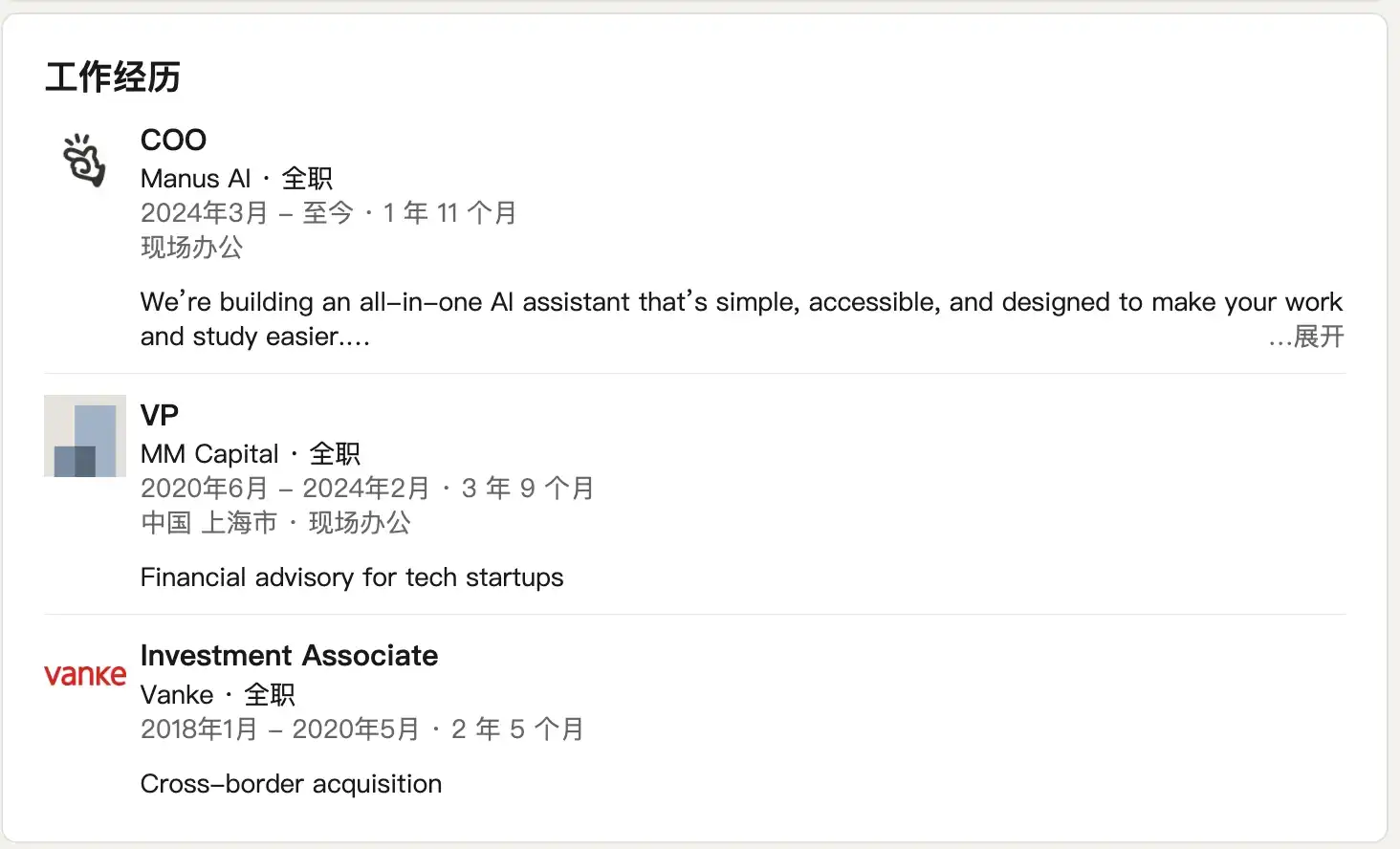
On December 30th, Meta announced it would acquire Manus for $2 billion, bringing 90s-born COO CZ Chen into the public eye. With an undergraduate degree from Shanghai University of Finance and Economics and a master's from Columbia, she started working in 2018, first at Vanke, then at an FA agency, and made her final career move to Manus in 2024, achieving financial freedom directly.
On January 9th, at MiniMax's bell-ringing ceremony, standing alongside the 36-year-old founder Yan Junjie was a woman born in 1994, Yun Yeyi.
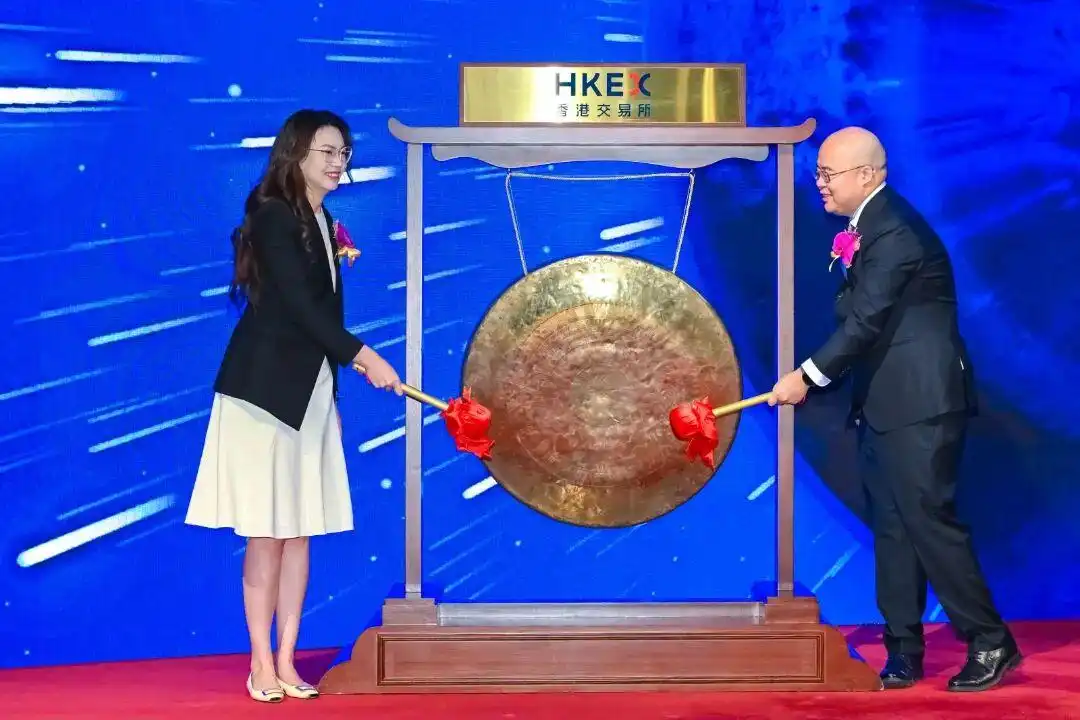
This 31-year-old COO now has a net worth of HKD 4.8 billion.

What is Yun Yeyi's background?

She studied electronic engineering at Johns Hopkins University, with minors in economics and mathematics. After graduating in 2017, she joined SenseTime, rising from financing manager to assistant to CEO Xu Li, and then to director of the innovation business department, experiencing SenseTime's journey from unicorn to listing on the Hong Kong stock exchange.

In 2022, when Yan Junjie decided to leave SenseTime to found MiniMax, Yun Yeyi followed almost without hesitation.

Her value goes beyond just following.

MiniMax's prospectus shows that Yun Yeyi handles almost everything outside of technical R&D: product, commercialization, board matters, operations, management... Her annual salary is $1.479 million, more than all other executive directors combined, a figure that speaks volumes.

It's not just in China; globally, the influence of women in the AI circle is undeniable.

Daniela Amodei, with a background in English literature, after working at Stripe and OpenAI, co-founded Anthropic with her brother Dario in 2021, serving as president, focusing on daily operations and commercialization, driving the marketization of Claude products.

Lila Ibrahim, former Intel executive, joined DeepMind in 2018 as its first COO, responsible for daily operations, partnerships, social impact, external affairs, and government relations.

Mira Murati, the Albanian-born former CTO of OpenAI, came to the U.S. on a scholarship at 16, moved from the Model X team at Tesla to OpenAI, and eventually left to found Thinking Machines Lab, valued at $9 billion...

This scene feels familiar.

From 2017 to 2021, during the golden age of crypto, a dazzling array of stars emerged, including a prominent presence of female CMOs and COOs.

The most well-known is undoubtedly Binance co-founder and CMO He Yi (now co-CEO). From Shanghai to Tokyo, then from Malta to Paris and Dubai, she was present at every strategic shift, helping the company become the world's largest cryptocurrency exchange.

Lisa Loud, from Apple engineer to PayPal's Canadian market head, jumped to BitMEX as CMO in 2017. Subsequently, BitMEX once became the world's largest crypto trading platform for derivatives.

Cynthia Wu, COO of Matrixport, former vice president of product development at HKEX, brought traditional finance experience to crypto financial services, helping the company become one of Asia's largest digital asset service platforms.

......

Back then, crypto was the world's asset focus, and the spotlight naturally fell on these female executives at the center of the stage.

But the tide receded, and the protagonists changed.

Now, AI is the focus of the spotlight, so we see Daniela Amodei on the Forbes rich list, and Yun Yeyi radiant at MiniMax's listing ceremony.

Fundamentally, Crypto and AI are strikingly similar: "both cutting-edge and rudimentary."

Cutting-edge is reflected in the technology itself: blockchain reconstructs trust mechanisms, AI reconstructs productivity—both are underlying technologies that can change the world.

Rudimentary is reflected in the founder profile: mostly technical backgrounds, fluent in code, but unfamiliar with marketing, especially government and public relations.

This is the value of female COOs/CMOs. They are the bridge between technical geniuses and the external world, capable of deep dialogue with technical teams and telling compelling stories to investors and users.

Daniela Amodei translated AI safety philosophy into executable business strategies, allowing Claude to break through in the shadow of ChatGPT; Yun Yeyi brought MiniMax from the lab to the C-end market; He Yi long served as the chief customer officer, personally answering user questions and building trust.

When a product moves beyond the pure technical stage and increasingly needs to face the C-end, the advantages of female executives become more apparent.

After all, PR and product require not a confrontational mindset, but empathy.

From another perspective, capable female executives vote with their feet. They go where they can utilize their talents and create value. If they start leaving an industry, it indicates the disappearance of commercial certainty in that industry.

The problem in the crypto industry is obvious now: a lack of talent who can translate technology into products accepted by the masses. Mass adoption and positive externalities remain empty talk. Observing any emerging industry reveals this pattern: when female executives with technical understanding, business acumen, and narrative skills begin to rise, the industry truly shifts from technology-driven to commercialization and mass adoption.

Their emergence marks the true maturity of an industry.

The AI circle has already undergone this transition. Female executives like Daniela Amodei and Yun Yeyi are driving productization, moving AI from lab algorithms into daily life and the business world.

As for the crypto industry, if it can't retain "elites who can speak human language," then it deserves to remain stuck in the mud of PVP.

The flow of talent is the风向标 (wind vane) of the industry.

Where they go, value is created; where they leave, bubbles often burst.

Preguntas relacionadas

QWhat is the trend observed in the AI industry regarding female executives, as mentioned in the article?

AThe article notes that more female executives are stepping into the spotlight in the AI industry, taking on key roles such as COO and CMO, and driving commercialization and productization of AI technologies.

QWho is Yun Yeyi, and what is her role and significance at MiniMax?

AYun Yeyi is the 31-year-old COO of MiniMax, with a background from Johns Hopkins University and experience at SenseTime. She handles almost all non-R&D aspects of the company, including product, commercialization, and operations, with an annual salary of $1.479 million, reflecting her critical role in the company's success.

QHow does the article compare the roles of female executives in Crypto and AI industries?

AThe article highlights that both Crypto and AI industries have seen prominent female COOs and CMOs who act as bridges between technical teams and the external world. They excel in marketing, government relations, and storytelling, which are essential for turning complex technologies into widely accepted products.

QWhat common characteristics do Crypto and AI share, according to the article?

ACrypto and AI are both described as 'cutting-edge yet rustic.' They are cutting-edge in terms of technology (blockchain redefining trust mechanisms and AI redefining productivity), but rustic in that founders are often technical experts who lack skills in marketing and external relations.

QWhat does the article suggest about the importance of female executives for industry maturity?

AThe article suggests that the rise of female executives with technical understanding, business acumen, and narrative ability marks an industry's transition from technology-driven to commercialization and mass adoption. Their presence indicates true industry maturity, while their departure may signal a decline in commercial certainty.

Lecturas Relacionadas

a16z: AI's 'Amnesia', Can Continuous Learning Cure It?

The article "a16z: AI's 'Amnesia' – Can Continual Learning Cure It?" explores the limitations of current large language models (LLMs), which, like the protagonist in the film *Memento*, are trapped in a perpetual present—unable to form new memories after training. While methods like in-context learning (ICL), retrieval-augmented generation (RAG), and external scaffolding (e.g., chat history, prompts) provide temporary solutions, they fail to enable true internalization of new knowledge. The authors argue that compression—the core of learning during training—is halted at deployment, preventing models from generalizing, discovering novel solutions (e.g., mathematical proofs), or handling adversarial scenarios. The piece introduces *continual learning* as a critical research direction to address this, categorizing approaches into three paths: 1. **Context**: Scaling external memory via longer context windows, multi-agent systems, and smarter retrieval. 2. **Modules**: Using pluggable adapters or external memory layers for specialization without full retraining. 3. **Weights**: Enabling parameter updates through sparse training, test-time training, meta-learning, distillation, and reinforcement learning from feedback. Challenges include catastrophic forgetting, safety risks, and auditability, but overcoming these could unlock models that learn iteratively from experience. The conclusion emphasizes that while context-based methods are effective, true breakthroughs require models to compress new information into weights post-deployment, moving from mere retrieval to genuine learning.

marsbitHace 2 hora(s)

a16z: AI's 'Amnesia', Can Continuous Learning Cure It?

marsbitHace 2 hora(s)

Can a Hair Dryer Earn $34,000? Deciphering the Reflexivity Paradox in Prediction Markets

An individual manipulated a weather sensor at Paris Charles de Gaulle Airport with a portable heat source, causing a Polymarket weather market to settle at 22°C and earning $34,000. This incident highlights a fundamental issue in prediction markets: when a market aims to reflect reality, it also incentivizes participants to influence that reality. Prediction markets operate on two layers: platform rules (what outcome counts as a win) and data sources (what actually happened). While most focus on rules, the real vulnerability lies in the data source. If reality is recorded through a specific source, influencing that source directly affects market settlement. The article categorizes markets by their vulnerability: 1. **Single-point physical data sources** (e.g., weather stations): Easily manipulated through physical interference. 2. **Insider information markets** (e.g., MrBeast video details): Insiders like team members use non-public information to trade. Kalshi fined a剪辑师 $20,000 for insider trading. 3. **Actor-manipulated markets** (e.g., Andrew Tate’s tweet counts): The subject of the market can control the outcome. Evidence suggests Tate’sociated accounts coordinated to profit. 4. **Individual-action markets** (e.g., WNBA disruptions): A single person can execute an event to profit from their pre-placed bets. Kalshi and Polymarket handle these issues differently. Kalshi enforces strict KYC, publicly penalizes insider trading, and reports to regulators. Polymarket, with its anonymous wallet-based system, has historically been more permissive, arguing that insider information improves market accuracy. However, it cooperated with authorities in the "Van Dyke case," where a user traded on classified government information. The core paradox is reflexivity: prediction markets are designed to discover truth, but their financial incentives can distort reality. The more valuable a prediction becomes, the more likely participants are to influence the event itself. The market ceases to be a mirror of reality and instead shapes it.

marsbitHace 3 hora(s)

Can a Hair Dryer Earn $34,000? Deciphering the Reflexivity Paradox in Prediction Markets

marsbitHace 3 hora(s)

Trading

Spot
Futuros

Artículos destacados

Cómo comprar ALICE

¡Bienvenido a HTX.com! Hemos hecho que comprar My Neighbor Alice (ALICE) sea simple y conveniente. Sigue nuestra guía paso a paso para iniciar tu viaje de criptos.Paso 1: crea tu cuenta HTXUtiliza tu correo electrónico o número de teléfono para registrarte y obtener una cuenta gratuita en HTX. Experimenta un proceso de registro sin complicaciones y desbloquea todas las funciones.Obtener mi cuentaPaso 2: ve a Comprar cripto y elige tu método de pagoTarjeta de crédito/débito: usa tu Visa o Mastercard para comprar My Neighbor Alice (ALICE) al instante.Saldo: utiliza fondos del saldo de tu cuenta HTX para tradear sin problemas.Terceros: hemos agregado métodos de pago populares como Google Pay y Apple Pay para mejorar la comodidad.P2P: tradear directamente con otros usuarios en HTX.Over-the-Counter (OTC): ofrecemos servicios personalizados y tipos de cambio competitivos para los traders.Paso 3: guarda tu My Neighbor Alice (ALICE)Después de comprar tu My Neighbor Alice (ALICE), guárdalo en tu cuenta HTX. Alternativamente, puedes enviarlo a otro lugar mediante transferencia blockchain o utilizarlo para tradear otras criptomonedas.Paso 4: tradear My Neighbor Alice (ALICE)Tradear fácilmente con My Neighbor Alice (ALICE) en HTX's mercado spot. Simplemente accede a tu cuenta, selecciona tu par de trading, ejecuta tus trades y monitorea en tiempo real. Ofrecemos una experiencia fácil de usar tanto para principiantes como para traders experimentados.

120 Vistas totalesPublicado en 2024.12.11Actualizado en 2025.03.21

Cómo comprar ALICE

Discusiones

Bienvenido a la comunidad de HTX. Aquí puedes mantenerte informado sobre los últimos desarrollos de la plataforma y acceder a análisis profesionales del mercado. A continuación se presentan las opiniones de los usuarios sobre el precio de ALICE (ALICE).

活动图片













