Crypto Adoption Set To Accelerate In 2026 As ETFs, Stablecoins, Tokenization Gain Ground

bitcoinistPublicado a 2026-01-01Actualizado a 2026-01-01

Resumen

Coinbase's head of research, David Duong, forecasts accelerated crypto adoption in 2026, driven by ETF approvals, stablecoins, tokenization, and clearer regulations. He notes that regulatory progress in the U.S. and Europe, such as the GENIUS Act and MiCA, is enabling institutional adoption and product development. Crypto demand is now broader and more stable, supported by corporate treasuries and long-term investors rather than short-term speculation. From 2023 to 2025, crypto ETPs raised over $48 billion, with significant growth in stablecoins ($300B market cap) and emerging tokenization ($1.2B+). Practical uses in lending, settlement, and collateral are expanding, positioning crypto for a more central role in finance.

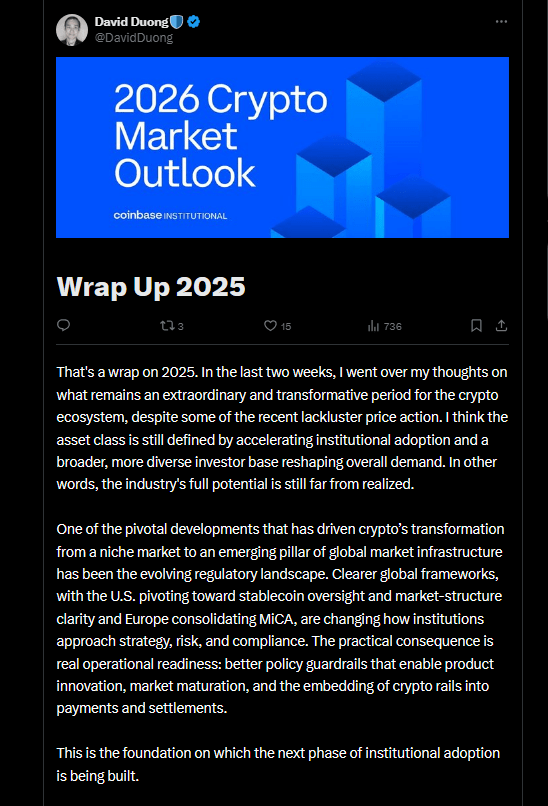
Coinbase’s head of investment research, David Duong, said momentum from crypto exchange-traded funds, stablecoins, tokenization, and clearer rules is likely to build through 2026 and speed up wider use of digital assets.

“We expect these forces to compound in 2026 as ETF approval timelines compress,” he said. According to Duong, last year laid important groundwork by giving more regulated paths for investors and by pushing crypto tools closer to normal finance.

Regulatory Steps Spur Institutional Moves

Duong pointed out that clearer rulebooks in the US and Europe are changing how big institutions handle crypto. The US has moved toward stablecoin oversight with the GENIUS Act, and Europe has pushed forward with MiCA.

Those moves are being used by firms to make operations ready for new products and to link crypto rails to payments and settlements. He said that better guardrails let firms design products that can be used by a broader set of clients.
Investor Base Shifts Away From Single Narratives

Based on reports, crypto demand is no longer driven by a lone story or by only early adopters. Adoption figures have held steady, at 10% in Q1 2023 and close to 10% in Q1 2025, showing broad, steady interest across markets.

That mix of allocators and end users now includes corporate treasuries and long-term investors, which may reduce the rapid churn tied to short-term speculation. Some capital looks more strategic and may stay in place for longer.

Markets Respond With Capital

Meanwhile, reports indicate that global investment funds raised more than $48 billion through exchange-traded products (ETPs) related to digital currencies from January 2023 until December 2025—this is an increase from 2024.

Total crypto market cap currently at $2.94 trillion. Chart: TradingView

Investment funds focused on Ethereum had almost three times the inflow during this time frame as compared to 2024.

The growth of stablecoins continues to be significant; their market capitalization is approximately $300 billion, but stablecoins still process trillions of dollars through full trading venues and DeFi.

Tokenized assets are smaller by comparison, with a market value above $1.2 billion, but analysts expect growth as institutions test blockchain-based ownership and fractional investing.

Tokenization And Corporate Use

Corporations have started to experiment with digital asset treasuries and tokenized collateral. Those are being tested for use in lending, settlement, and as part of corporate balance sheets.

Based on Duong’s view, tokenized collateral could be more widely accepted in traditional deals, and stablecoins might be used more in delivery-vs-payment setups. These practical uses are being watched closely by banks and custodians.

Outlook For 2026

Duong summed up his view by stressing three things: clear policy, operational readiness, and useful products. According to him, when regulators set clearer rules, institutions build safer systems, and companies design products people can actually use, crypto can move from a niche market toward a more central role in finance.

Featured image from Chainalysis, chart from TradingView

Criptos en tendencia

Preguntas relacionadas

QAccording to David Duong, what four key factors are likely to build momentum and accelerate wider crypto adoption through 2026?

ACrypto exchange-traded funds (ETFs), stablecoins, tokenization, and clearer regulatory rules.

QWhat two major regulatory developments in the US and Europe did Duong highlight as changing how big institutions handle crypto?

AThe US moving toward stablecoin oversight with the GENIUS Act, and Europe pushing forward with the Markets in Crypto-Assets (MiCA) regulation.

QWhat does the steady crypto adoption rate of around 10% in both Q1 2023 and Q1 2025 indicate about the market?

AIt shows broad, steady interest across markets, indicating that demand is no longer driven by a single narrative or only early adopters, but includes a wider base like corporate treasuries and long-term investors.

QHow much did global investment funds raise through crypto-related exchange-traded products (ETPs) from January 2023 to December 2025?

AGlobal investment funds raised more than $48 billion through crypto-related ETPs during that period.

QWhat three key elements did David Duong stress are necessary for crypto to move from a niche market to a central role in finance?

AClear policy from regulators, operational readiness from institutions building safer systems, and useful products that people can actually use.

Lecturas Relacionadas

Rented Faith: How Much of the Bitcoin ETF Inflows Is Real Money?

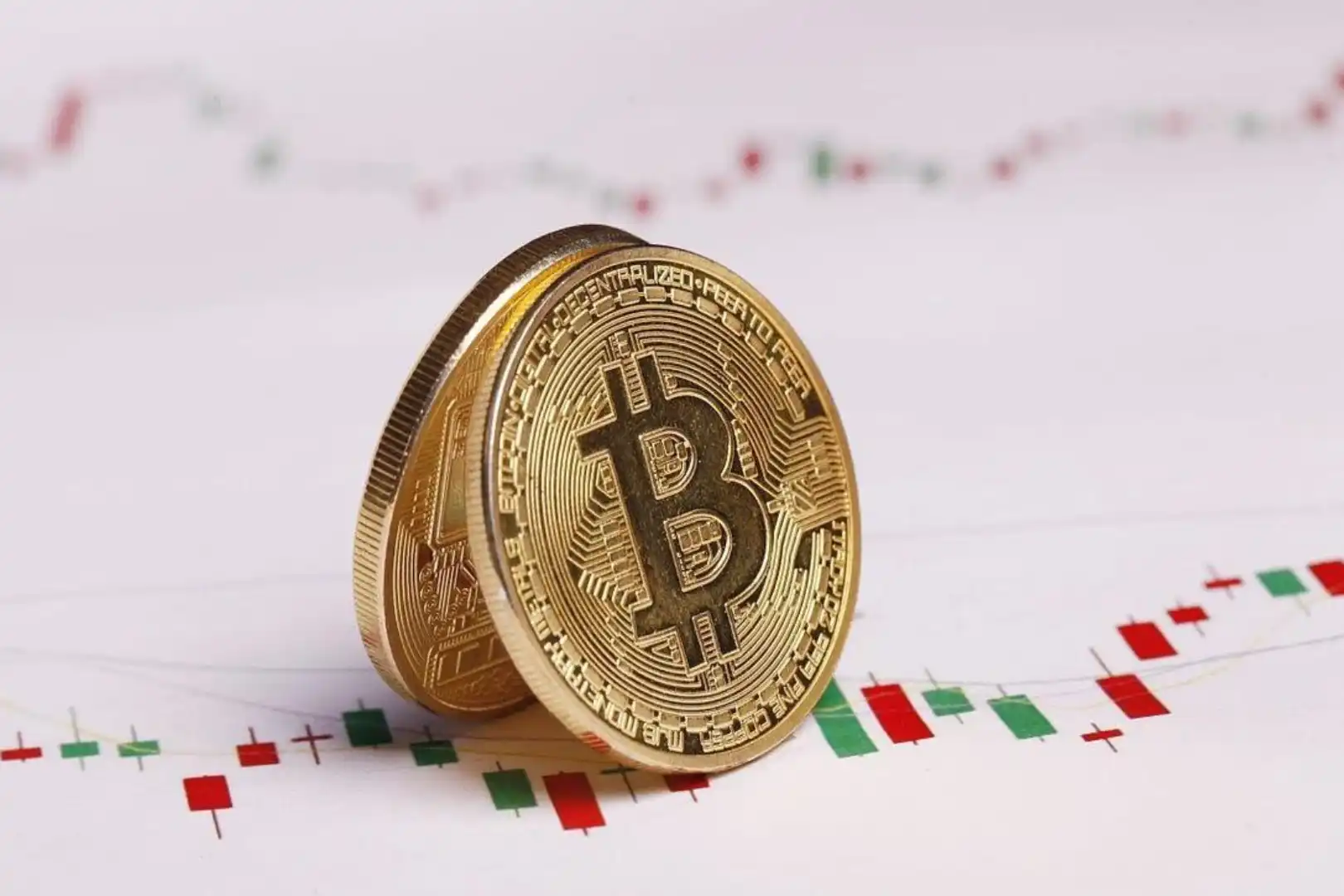
"Rented Conviction: How Much of Bitcoin ETF Flows Is Real Money" The weekly inflows into Bitcoin ETFs are often interpreted as a gauge of institutional belief. However, a significant portion of this activity is driven by a hidden arbitrage trade, not directional conviction. The core mechanism is a cash-and-carry arbitrage: traders buy spot Bitcoin (often via ETFs) while simultaneously shorting CME futures to lock in the price difference, or "basis." This delta-neutral trade is essentially an interest rate play. In weekly data, about half the fluctuation in ETF flows can be explained by new short positions added by leveraged funds (hedge funds), with a correlation of 0.70. Bitcoin's price movement in a given week shows no statistical power in predicting these flows. While this arbitrage trade drives weekly *volatility*, it is not the main component of the cumulative *stock*. Of the total ~$55 billion in net ETF inflows, the current net arbitrage position is only about $1 billion. The remainder is steady, directional buying averaging ~$400 million per week, which constitutes the vast majority of the accumulated "mountain" over two years. Thus, ETF flow data overstates the *volatility* of conviction, not its *level*. This arbitrage trade has been unwinding for nearly two years. Leveraged fund short positions peaked at ~$14 billion in late 2024 and have since declined to ~$4.5 billion. When the basis compresses to unprofitable levels, ETF inflows and short positions retreat together. Recent outflows should not be mistaken for a loss of faith but rather the routine unwinding of this rate trade. For Ethereum ETFs, the pattern is weaker. Accounting for staking yield makes the basis often negative, so neither strong conviction buying nor robust arbitrage supports its flows. To interpret ETF flows correctly, monitor the CME basis versus T-bill rates and leveraged fund net shorts. They reveal how much of the next "demand" headline is real. The real, patient buy-and-hold demand is what constitutes the enduring bulk of ETF assets.

marsbitHace 43 min(s)

Rented Faith: How Much of the Bitcoin ETF Inflows Is Real Money?

marsbitHace 43 min(s)

Soaring Over Tenfold Within the Year: The Frenzy Over SK Hynix Leveraged Products

South China Morning Post The leveraged ETF tracking SK Hynix has surged over tenfold year-to-date, fueled by intense market speculation on the memory chip sector. By June 22, the value of the 'South Korea 2x Long SK Hynix ETF' listed in Hong Kong had skyrocketed by more than 1,061% since the start of the year, while its asset size exploded over twenty times from the end of last year. The rally is driven by AI-driven demand for high-bandwidth memory (HBM), with SK Hynix recently sampling its next-generation HBM4E product. However, industry professionals warn of significant risks. Leveraged ETFs magnify both gains and losses. During a recent market correction, while the underlying SK Hynix stock fell 19.1%, its double-leveraged ETF dropped nearly 38%. Korean regulators noted that such products could theoretically lose 60% in a single day. Additionally, these ETFs face risks like time decay in volatile markets, liquidity spirals during mass redemptions, and extreme price dislocations from market-making failures, as seen in early June when an ETF moved opposite to its underlying stock. The trading is predominantly driven by retail investors, with institutional capital largely absent due to the products' high volatility. Analysts caution that with the semiconductor sector at elevated valuations and facing geopolitical and supply chain uncertainties, leveraged ETFs pose a substantial threat of amplified losses for uninformed investors.

marsbitHace 1 hora(s)

Soaring Over Tenfold Within the Year: The Frenzy Over SK Hynix Leveraged Products

marsbitHace 1 hora(s)

18 Months, Over 50x Surge: KIOXIA's Epic Comeback

KIOXIA, a NAND flash memory giant, staged a dramatic comeback driven by AI demand. After a period of significant losses, a failed merger, and missed HBM opportunities, its 2024 IPO began modestly. However, fueled by explosive demand for AI data storage, its stock price skyrocketed over 50 times within 18 months, making it Japan's most valuable company, surpassing Toyota. Its Q1 FY2026 profit guidance soared 30-fold year-over-year, with 2026 NAND capacity already sold out. Key to its success is its 3D NAND technology, BiCS FLASH. As the inventor of NAND, KIOXIA advanced its technology through generations, reaching over 200 layers by 2023. Key innovations include CBA (CMOS directly Bonded to Array), which separately manufactures control circuits and memory arrays for better performance, and OPS (On Pitch Select Gate) to increase density. The company is now developing high-capacity packages like an 8TB solution stacking 32 dies. Looking beyond NAND, KIOXIA is exploring 3D DRAM with its OCTRAM technology, using oxide semiconductor transistors for ultra-low leakage to reduce power consumption. This fundamental research differs from HBM and represents a long-term bet to extend its 3D expertise from NAND into future DRAM architectures. KIOXIA's story highlights how technological assets and shifting market cycles can rapidly transform a company's fortunes. While questions remain about sustaining growth beyond the current AI boom, its resurgence demonstrates that in semiconductors, being down does not necessarily mean being out.

marsbitHace 1 hora(s)

18 Months, Over 50x Surge: KIOXIA's Epic Comeback

marsbitHace 1 hora(s)

Market Trends in U.S. Stocks (June 23): Peak at Listing? SpaceX Loses Over $800 Billion in Three Days, Tech Stocks Experience Severe Internal Divergence

Stock Market Trends (June 23): Did SpaceX Peak at IPO? The company loses over $800 billion in market value in three days as a sharp divergence unfolds within the tech sector. SpaceX's post-IPO decline of over 20%, falling below its first-day close, reflects a swift market repricing. The catalyst is a clear shift in narrative from "AI platform potential" to concerns over rising capital costs, as its $8.57 billion IPO and subsequent $20 billion debt offering are earmarked for acquisitions and refinancing existing bridge loans rather than de-leveraging. While high-valuation tech stocks like Google, Meta, Amazon, and Microsoft faced pressure, Micron surged nearly 7% to a record high following a strategic supply deal with Anthropic for HBM and memory, highlighting robust, tangible demand in AI infrastructure. The broader market saw funds rotate into more defensive industrial and financial names. Macro factors included a dip in oil prices to a three-month low on news of a US-Iran framework deal, though logistical hurdles for resuming full Strait of Hormuz shipments remain. Key events ahead include Nvidia's shareholder meeting, Micron's earnings, and the May PCE inflation data. The latter will be crucial in determining whether the sell-off in high-valuation growth stocks, which appears to have just begun, will persist.

marsbitHace 2 hora(s)

Market Trends in U.S. Stocks (June 23): Peak at Listing? SpaceX Loses Over $800 Billion in Three Days, Tech Stocks Experience Severe Internal Divergence

marsbitHace 2 hora(s)

Trading

Spot
Futuros

Artículos destacados

Cómo comprar GAIN

¡Bienvenido a HTX.com! Hemos hecho que comprar GriffinAI (GAIN) sea simple y conveniente. Sigue nuestra guía paso a paso para iniciar tu viaje de criptos.Paso 1: crea tu cuenta HTXUtiliza tu correo electrónico o número de teléfono para registrarte y obtener una cuenta gratuita en HTX. Experimenta un proceso de registro sin complicaciones y desbloquea todas las funciones.Obtener mi cuentaPaso 2: ve a Comprar cripto y elige tu método de pagoTarjeta de crédito/débito: usa tu Visa o Mastercard para comprar GriffinAI (GAIN) al instante.Saldo: utiliza fondos del saldo de tu cuenta HTX para tradear sin problemas.Terceros: hemos agregado métodos de pago populares como Google Pay y Apple Pay para mejorar la comodidad.P2P: tradear directamente con otros usuarios en HTX.Over-the-Counter (OTC): ofrecemos servicios personalizados y tipos de cambio competitivos para los traders.Paso 3: guarda tu GriffinAI (GAIN)Después de comprar tu GriffinAI (GAIN), guárdalo en tu cuenta HTX. Alternativamente, puedes enviarlo a otro lugar mediante transferencia blockchain o utilizarlo para tradear otras criptomonedas.Paso 4: tradear GriffinAI (GAIN)Tradear fácilmente con GriffinAI (GAIN) en HTX's mercado spot. Simplemente accede a tu cuenta, selecciona tu par de trading, ejecuta tus trades y monitorea en tiempo real. Ofrecemos una experiencia fácil de usar tanto para principiantes como para traders experimentados.

376 Vistas totalesPublicado en 2025.09.24Actualizado en 2026.06.02

Cómo comprar GAIN

Discusiones

Bienvenido a la comunidad de HTX. Aquí puedes mantenerte informado sobre los últimos desarrollos de la plataforma y acceder a análisis profesionales del mercado. A continuación se presentan las opiniones de los usuarios sobre el precio de GAIN (GAIN).

活动图片