Crypto Adoption Set To Accelerate In 2026 As ETFs, Stablecoins, Tokenization Gain Ground

bitcoinistPublicado a 2026-01-01Actualizado a 2026-01-01

Resumen

Coinbase's head of research, David Duong, forecasts accelerated crypto adoption in 2026, driven by ETF approvals, stablecoins, tokenization, and clearer regulations. He notes that regulatory progress in the U.S. and Europe, such as the GENIUS Act and MiCA, is enabling institutional adoption and product development. Crypto demand is now broader and more stable, supported by corporate treasuries and long-term investors rather than short-term speculation. From 2023 to 2025, crypto ETPs raised over $48 billion, with significant growth in stablecoins ($300B market cap) and emerging tokenization ($1.2B+). Practical uses in lending, settlement, and collateral are expanding, positioning crypto for a more central role in finance.

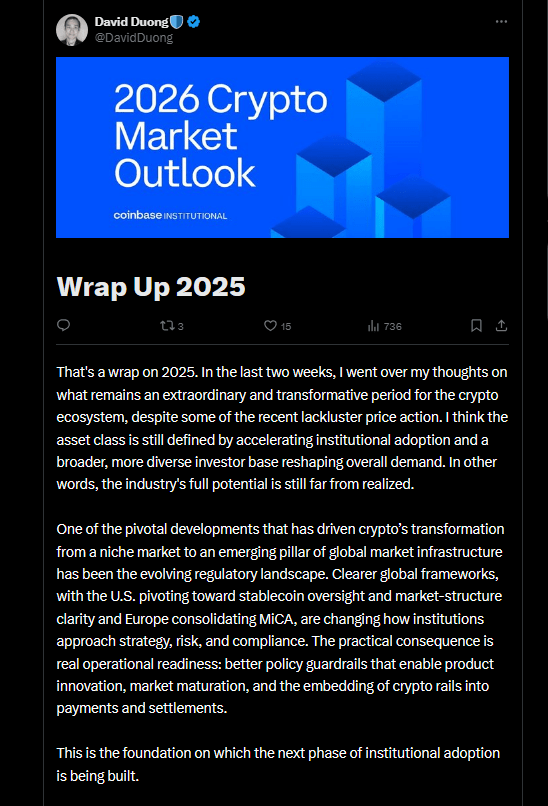
Coinbase’s head of investment research, David Duong, said momentum from crypto exchange-traded funds, stablecoins, tokenization, and clearer rules is likely to build through 2026 and speed up wider use of digital assets.

“We expect these forces to compound in 2026 as ETF approval timelines compress,” he said. According to Duong, last year laid important groundwork by giving more regulated paths for investors and by pushing crypto tools closer to normal finance.

Regulatory Steps Spur Institutional Moves

Duong pointed out that clearer rulebooks in the US and Europe are changing how big institutions handle crypto. The US has moved toward stablecoin oversight with the GENIUS Act, and Europe has pushed forward with MiCA.

Those moves are being used by firms to make operations ready for new products and to link crypto rails to payments and settlements. He said that better guardrails let firms design products that can be used by a broader set of clients.
Investor Base Shifts Away From Single Narratives

Based on reports, crypto demand is no longer driven by a lone story or by only early adopters. Adoption figures have held steady, at 10% in Q1 2023 and close to 10% in Q1 2025, showing broad, steady interest across markets.

That mix of allocators and end users now includes corporate treasuries and long-term investors, which may reduce the rapid churn tied to short-term speculation. Some capital looks more strategic and may stay in place for longer.

Markets Respond With Capital

Meanwhile, reports indicate that global investment funds raised more than $48 billion through exchange-traded products (ETPs) related to digital currencies from January 2023 until December 2025—this is an increase from 2024.

Total crypto market cap currently at $2.94 trillion. Chart: TradingView

Investment funds focused on Ethereum had almost three times the inflow during this time frame as compared to 2024.

The growth of stablecoins continues to be significant; their market capitalization is approximately $300 billion, but stablecoins still process trillions of dollars through full trading venues and DeFi.

Tokenized assets are smaller by comparison, with a market value above $1.2 billion, but analysts expect growth as institutions test blockchain-based ownership and fractional investing.

Tokenization And Corporate Use

Corporations have started to experiment with digital asset treasuries and tokenized collateral. Those are being tested for use in lending, settlement, and as part of corporate balance sheets.

Based on Duong’s view, tokenized collateral could be more widely accepted in traditional deals, and stablecoins might be used more in delivery-vs-payment setups. These practical uses are being watched closely by banks and custodians.

Outlook For 2026

Duong summed up his view by stressing three things: clear policy, operational readiness, and useful products. According to him, when regulators set clearer rules, institutions build safer systems, and companies design products people can actually use, crypto can move from a niche market toward a more central role in finance.

Featured image from Chainalysis, chart from TradingView

Criptos en tendencia

Preguntas relacionadas

QAccording to David Duong, what four key factors are likely to build momentum and accelerate wider crypto adoption through 2026?

ACrypto exchange-traded funds (ETFs), stablecoins, tokenization, and clearer regulatory rules.

QWhat two major regulatory developments in the US and Europe did Duong highlight as changing how big institutions handle crypto?

AThe US moving toward stablecoin oversight with the GENIUS Act, and Europe pushing forward with the Markets in Crypto-Assets (MiCA) regulation.

QWhat does the steady crypto adoption rate of around 10% in both Q1 2023 and Q1 2025 indicate about the market?

AIt shows broad, steady interest across markets, indicating that demand is no longer driven by a single narrative or only early adopters, but includes a wider base like corporate treasuries and long-term investors.

QHow much did global investment funds raise through crypto-related exchange-traded products (ETPs) from January 2023 to December 2025?

AGlobal investment funds raised more than $48 billion through crypto-related ETPs during that period.

QWhat three key elements did David Duong stress are necessary for crypto to move from a niche market to a central role in finance?

AClear policy from regulators, operational readiness from institutions building safer systems, and useful products that people can actually use.

Lecturas Relacionadas

From South Korea to the United States: Blue-Collar Jobs Are Becoming Increasingly Popular, Thanks to AI

AI is reshaping the labor market's value proposition. The traditional four-year college degree is losing its appeal as a guaranteed career path, while skilled blue-collar trades like electricians, welders, and plumbers are experiencing historic demand and wage premiums. This shift is driven by dual pressures: AI's displacement of certain white-collar roles and a booming need for physical infrastructure and data center construction. Data confirms the trend. In the U.S., vocational school revenue surged, and a significant portion of recent layoffs are AI-related. Surveys show a majority of Gen Z adults plan to pursue blue-collar work, citing better job security against AI automation. Vocational education interest has exploded recently. Experts cite a psychological shift as younger generations seek tangible, AI-resistant careers and avoid high student debt. In many cases, salaries for skilled trades now match or exceed those requiring a bachelor's degree. In South Korea, semiconductor vocational high schools boast near-total employment, with graduates securing high-paying roles at companies like Samsung. The shortage is structural, exacerbated by a retiring baby boomer workforce and massive infrastructure projects. Companies like JPMorgan Chase, Meta, and Lowe's are investing heavily in training programs. However, overcoming historical stigma and a "perception gap" around trade careers remains a key challenge to closing the talent gap.

marsbitHace 47 min(s)

From South Korea to the United States: Blue-Collar Jobs Are Becoming Increasingly Popular, Thanks to AI

marsbitHace 47 min(s)

Qualcomm: AI Hype Subsides, When Will Smartphones Emerge from the Gloom?

Qualcomm reported its Q3 FY2026 results (ending June 2026), with revenue of $9.95B, down 4% YoY but above expectations. Gross margin declined to 53.1%, pressured by rising costs across manufacturing and memory. Key business segments showed mixed performance: Handset revenue fell 19.6% YoY to $5.09B, dragged by an 11% decline in non-Apple Android shipments and weaker high-end mix. Conversely, Automotive revenue surged 61% to $1.59B, and IoT grew 9% to $1.83B. Core operating profit dropped 41% YoY due to margin compression and higher expenses. Management's Q4 FY2026 guidance projects revenue of $9.7B-$10.5B, in line with consensus, but Non-GAAP EPS guidance of $2.05-$2.25 fell short of expectations. Amidst persistent weakness in its core handset market, Qualcomm is pursuing growth in AI, focusing on Edge AI (smartphones, PCs, automotive) and Data Center AI. Its data center strategy includes four pillars: AI accelerators (e.g., AI200), commercial CPUs (Dragonfly C1000), custom silicon, and connectivity solutions. While these initiatives initially boosted its stock, concerns over AI capital expenditure sustainability have since erased those gains. The company targets $5B in data center revenue for FY2027 and $15B for FY2029. The report concludes that with the traditional handset business still under pressure, the data center opportunity is currently viewed as a longer-term option, and a more conservative valuation based on core operations may be warranted until AI contributions materialize.

marsbitHace 52 min(s)

Qualcomm: AI Hype Subsides, When Will Smartphones Emerge from the Gloom?

marsbitHace 52 min(s)

From TPU to Self-Evolving Agents: How Jeff Dean Predicts the Next Step in AI

At the 2026 YC Startup School, Jeff Dean outlined his vision for AI's next phase, shifting focus from simply scaling models to building intelligent, autonomous systems. He believes AI's progress is no longer just about creating smarter models, but about integrating them into systems capable of long-term, iterative work, automated experimentation, and continuous learning. This evolution moves the competition from "who has the bigger model" to "who can best organize intelligence." Dean suggests AI capabilities are now comparable to a junior engineer, enabling the automation of complex workflows. However, the true challenge and opportunity lie in managing these AI "workers" at scale. He emphasizes the importance of **context engineering**—structuring tools, memory, and feedback loops—over raw model power. For startups, this means building deep expertise in niche domains where general models currently fail (near 0-1% success rates), leveraging proprietary data, specialized tools, and domain-specific evaluators. A recurring theme is re-examining fundamental constraints. Dean's past work, like moving Google's search index to memory or creating the TPU, stemmed from questioning outdated assumptions about hardware and cost. He sees similar inflection points today, particularly in **specialized inference hardware** to drastically reduce latency and energy consumption for real-time Agent operation. Notably, he points out that in modern AI systems, the dominant cost is often not computation but **data movement**. Reliable, long-running Agents require robust system design, borrowing concepts from distributed computing like checkpointing, state management, and parallel exploration to handle failures and maintain progress over days or weeks. As AI automates execution, the scarcest human skills will shift to **defining clear specifications**, **judging what problems are worth solving** (taste), and designing effective feedback loops. Ultimately, Dean's framework prioritizes understanding the problem deeply, identifying the true bottlenecks, and systematically building closed-loop systems where AI can not only perform tasks but also improve AI itself.

marsbitHace 52 min(s)

From TPU to Self-Evolving Agents: How Jeff Dean Predicts the Next Step in AI

marsbitHace 52 min(s)

Trading

Spot

Artículos destacados

Cómo comprar GAIN

¡Bienvenido a HTX.com! Hemos hecho que comprar GriffinAI (GAIN) sea simple y conveniente. Sigue nuestra guía paso a paso para iniciar tu viaje de criptos.Paso 1: crea tu cuenta HTXUtiliza tu correo electrónico o número de teléfono para registrarte y obtener una cuenta gratuita en HTX. Experimenta un proceso de registro sin complicaciones y desbloquea todas las funciones.Obtener mi cuentaPaso 2: ve a Comprar cripto y elige tu método de pagoTarjeta de crédito/débito: usa tu Visa o Mastercard para comprar GriffinAI (GAIN) al instante.Saldo: utiliza fondos del saldo de tu cuenta HTX para tradear sin problemas.Terceros: hemos agregado métodos de pago populares como Google Pay y Apple Pay para mejorar la comodidad.P2P: tradear directamente con otros usuarios en HTX.Over-the-Counter (OTC): ofrecemos servicios personalizados y tipos de cambio competitivos para los traders.Paso 3: guarda tu GriffinAI (GAIN)Después de comprar tu GriffinAI (GAIN), guárdalo en tu cuenta HTX. Alternativamente, puedes enviarlo a otro lugar mediante transferencia blockchain o utilizarlo para tradear otras criptomonedas.Paso 4: tradear GriffinAI (GAIN)Tradear fácilmente con GriffinAI (GAIN) en HTX's mercado spot. Simplemente accede a tu cuenta, selecciona tu par de trading, ejecuta tus trades y monitorea en tiempo real. Ofrecemos una experiencia fácil de usar tanto para principiantes como para traders experimentados.

416 Vistas totalesPublicado en 2025.09.24Actualizado en 2026.06.02

Cómo comprar GAIN

Discusiones

Bienvenido a la comunidad de HTX. Aquí puedes mantenerte informado sobre los últimos desarrollos de la plataforma y acceder a análisis profesionales del mercado. A continuación se presentan las opiniones de los usuarios sobre el precio de GAIN (GAIN).

活动图片













