Crossing Boundaries, Embracing Integration for Renewal|Agenda for the February 12 Crypto Finance Forum Released

比推Publicado a 2026-02-09Actualizado a 2026-02-09

Resumen

A major Crypto Finance Forum, co-hosted by WLFI, Bakkt, HKU Business School's Executive Education, and ME Group, will be held at the University of Hong Kong on February 12, 2026. Under the vision of "Decoding Crypto, Reshaping the Future of Finance," the event aims to serve as a top-tier dialogue hub connecting East and West, academia and business, and traditional finance with the crypto industry. The forum will bring together global regulators, traditional finance executives, founders of crypto-native companies, and leading academics to explore institutional opportunities and new technological paradigms within regulatory frameworks. Key topics include stablecoin ecosystems, the institutional path forward for bridging traditional finance and digital assets, and the next evolution of Web3 infrastructure. Featured speakers include executives from Bakkt, WLFI, the University of Hong Kong, Solana Foundation, Tencent Cloud, HashKey Group, and Nano Labs, among others. The agenda includes keynote speeches, in-depth panel discussions, and debates on critical issues such as regulated entities versus permissionless DeFi and the value wave of asset tokenization. This high-density intellectual gathering is designed to provide deep insights and forward-looking perspectives, helping participants navigate the complex, rapidly evolving landscape of crypto finance and capture macro opportunities in the new era of digital assets.

Article Author/Source: ME News

Co-hosted by WLFI, Bakkt, HKU Business School Executive Education, and ME Group, the Crypto Finance Forum will grandly commence on February 12, 2026, on Hong Kong Island. As a top-tier dialogue hub connecting East and West, academia and business, traditional finance and the crypto industry, this forum, with the vision of "Decoding Crypto, Reshaping the Future of Finance," brings together global regulatory bodies, traditional finance executives, crypto-native enterprise founders, and top academic experts to jointly explore institutional opportunities and new technological paradigms within compliance frameworks.

Event Information

Event Theme: Crypto Finance Forum

Event Time: February 12, 2026, 9:30 AM – 12:00 PM (HKT)

Event Location: The University of Hong Kong

Organizers: WLFI, Bakkt, HKU Business School Executive Education, ME Group

Strategic Partners: Nano Labs Ltd (Nasdaq: NA), CoinFound, Tencent Cloud, OneAsset

Media Partners: Foresight News, Odaily, Jinse Finance, PANews, Bitpush, Financial Highlights
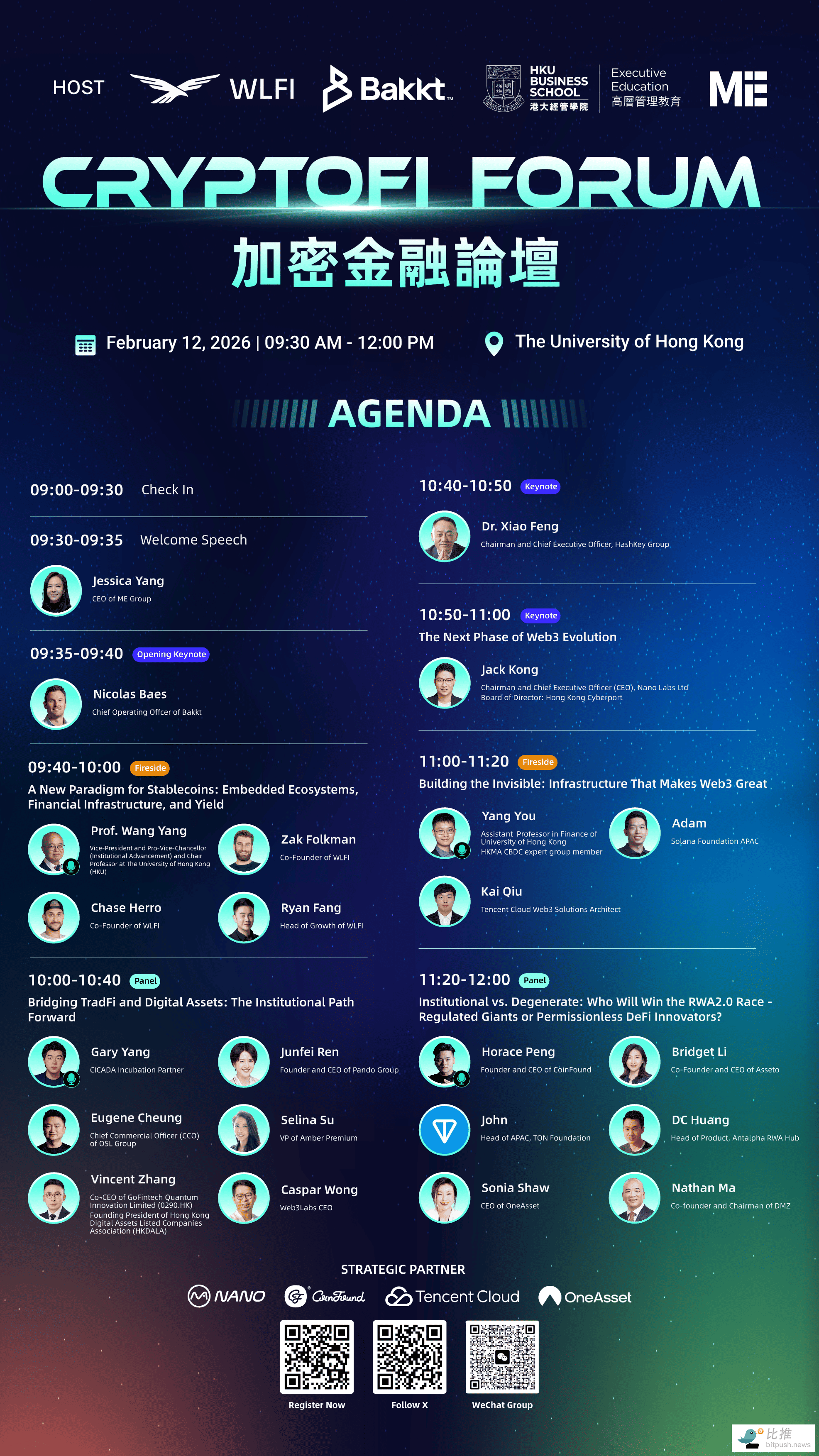
Core Agenda: A High-Density Feast of Crypto Finance Ideas

This forum will officially commence at 9:30 AM on February 12, 2026, at The University of Hong Kong. ME Group CEO Jessica Yang and Bakkt COO Nicolas Baes will deliver the opening remarks, setting the macro stage for this East-West financial dialogue. The opening dialogue, personally hosted by Professor Wang Yang, Vice President of The University of Hong Kong, will feature WLFI Co-founders Zak Folkman, Chase Herro, and Growth Lead Ryan Fang, delving into the embedded ecosystem of stablecoins and new paradigms for financial infrastructure.

The mid-section of the agenda will focus on the core proposition of "Bridging TradFi and Digital Assets: The Institutional Path Forward." Gary Yang, Partner at CICADA, will serve as the academic moderator, leading an in-depth discussion on the path forward for institutions. Senior executives from Pando Group, OSL Group, Amber Premium, Guofu Quantum, Web3 Labs, and others will gather for a 45-minute roundtable dialogue. They will jointly deconstruct how traditional financial institutions can bridge the cognitive and technological gaps to build a robust path to the digital asset world under an increasingly mature compliance framework, demonstrating a deep integration from academic theory to market practice. Following this, Kong Jianping, Director of Hong Kong Cyberport and Chairman of Nano Labs, and Dr. Xiao Feng, Chairman of HashKey Group, will deliver heavyweight keynote speeches. From the next stage of Web3 evolution to a panoramic industry outlook, they will provide attendees with forward-looking insights from a commanding height.

The finale of the forum will turn its focus to the hot topic of Web3 infrastructure for an in-depth exploration. Hosted by You Yang, Assistant Professor of Finance at The University of Hong Kong and HKMA CBDC Expert Member, the session will feature a dialogue with Adam, Head of APAC at Solana Foundation, and Qiu Kai, Tencent Cloud Web3 Solutions Architect, to discuss what constitutes "great infrastructure" amidst the Web3 wave. Subsequently, the event moves into a highly speculative roundtable forum. Guided by CoinFound Founder Horace Peng, industry leaders from Asseto, TON Foundation, Antalpha RWA Hub, OneAsset, and DMZ will debate the competition and cooperation between regulated entities and permissionless DeFi, exploring who will lead the next wave of value in on-chain assets. The entire event aims, through this series of high-density intellectual exchanges, to provide a clear and profound annotation for the direction of crypto finance evolution in 2026.

Core Highlights: A Premier Venue for Reshaping Understanding at an Inflection Point of Change

At this historic inflection point where the digital asset industry is accelerating towards institutionalization and compliance, the Crypto Finance Forum aims to present attendees with a top-tier Asian dialogue combining academic rigor and commercial practical value. We go beyond superficial trend discussions, striving to deeply analyze the current panoramic landscape of the crypto world. From new paradigms of stablecoins reconstructing financial infrastructure to the博弈 (game/competition) between traditional giants and native innovation in the RWA 2.0 track, we help you precisely capture the key pulses and macro opportunities of industry evolution amidst complex market noise.

This is even more a feast of ideas that crosses cognitive limits, bringing together authoritative insights from HKU academic experts to Web3 industry leaders. By listening to the deep碰撞 (collision/exchange) between academia and industry, you will gain first-hand knowledge of the latest institutional practice strategies under compliance frameworks and deeply explore leading application cases in the on-chain world. The event is committed to significantly shortening the distance between cutting-edge academic research and real-world institutional implementation, helping attendees reshape decision-making logic through multi-dimensional perspectives and seize future opportunities amidst rapidly changing financial transformations.

Conclusion

On February 12, 2026, let us meet at The University of Hong Kong and join this top-tier gathering that redefines the boundaries of crypto finance. Co-hosted by the powerful alliance of WLFI, Bakkt, HKU Business School Executive Education, and ME Group, this forum is not only a cross-border dialogue connecting Eastern and Western capital and academic wisdom but also a deep restructuring of the Web3 industry landscape in the new era of compliance. From the underlying logic of stablecoins to the ultimate博弈 (game/contest) of RWA 2.0, we look forward to joining you in decoding the next golden decade of digital assets amidst the waves of change.



Original link:https://www.bitpush.news/articles/7610219

Preguntas relacionadas

QWhat is the main theme and vision of the Crypto Finance Forum scheduled for February 12, 2026?

AThe main theme is 'Crypto Finance Forum' with a vision of 'Decoding Crypto, Reshaping the Future of Finance'. It aims to explore institutional opportunities and new technological paradigms within compliance frameworks, connecting the East and West, academia and business, and traditional finance with the crypto industry.

QWho are the main organizers and some of the strategic partners of the Crypto Finance Forum?

AThe forum is jointly organized by WLFI, Bakkt, HKU Business School's Executive Education, and ME Group. Strategic partners include Nano Labs Ltd (Nasdaq: NA), CoinFound, Tencent Cloud, and OneAsset.

QWhat are the key agenda highlights for the forum, particularly the opening and a major panel discussion?

AThe forum opens with remarks from ME Group CEO Jessica Yang and Bakkt COO Nicolas Baes. A major panel discussion, 'Bridging TradFi and Digital Assets: The Institutional Path Forward', will be academically chaired by CICADA partner Gary Yang, featuring executives from Pando Group, OSL Group, Amber Premium, and others to discuss how traditional financial firms can bridge the gap to digital assets.

QWhich academic institution is hosting the event, and which notable academic figures are participating?

AThe event is hosted at The University of Hong Kong. Notable academic participants include Professor Wang Yang, Vice President of HKU, who will host the opening dialogue, and Assistant Professor You Yang from HKU's Finance Department, who is also an HKMA CBDC expert member and will host a discussion on Web3 infrastructure.

QWhat is the stated purpose of the forum in the context of the current digital asset industry?

AThe forum aims to present a top-tier Asian dialogue with both academic rigor and commercial practical value at a historic inflection point where the digital asset industry is accelerating towards institutionalization and compliance. It seeks to provide insights to help participants reshape their decision-making logic and seize future opportunities amidst rapid financial transformation.

Lecturas Relacionadas

Apple Also Has to Pay Rent Now

Apple Pays Rent Too: The Two-Way Flow of "Traffic Tax" and "AI Capability Rent" Between Tech Giants For over two decades, Google has paid Apple an estimated $20 billion annually to remain the default search engine on Safari, a "traffic tax" for a critical user entry point. However, in 2026, the direction of this cash flow partially reversed. Apple agreed to pay Google roughly $1 billion per year to license its Gemini AI models, as Apple's own models reportedly struggled with complex tasks. This creates a unique dynamic: Apple acts as the "landlord" in the established search ecosystem, collecting rent from Google for access. Simultaneously, in the emerging AI arena, Apple becomes the "tenant," paying Google for access to cutting-edge AI capabilities it cannot currently match internally. While Apple claims its new models are "distilled" from Gemini outputs and contain "not a drop" of Google's original code, core dependencies remain. Its knowledge base is refined using Gemini's outputs, and its most powerful cloud model runs on Google's infrastructure. Apple has structured the deal as non-exclusive, allowing it to theoretically switch AI suppliers—a hedge against over-reliance. The future hinges on whether advanced AI models become a commodity (cheap and abundant) or remain a concentrated, scarce resource (expensive and controlled by few). Apple is betting on the former, leveraging its massive device ecosystem to be a powerful, choosy customer. If the latter proves true, its bargaining power could erode. This power dynamic is extending to developers. Apple, Google, and WeChat are all pushing for apps to expose their core functions as standardized "actions" or "intents" that their respective AI assistants (Siri, Gemini, WeChat AI) can directly call. The new scarce resource is no longer just app store visibility, but "being selected by the AI." The currency of "rent" has changed from a 30% revenue share to ceding control over how users interact with an app's functions.

marsbitHace 12 min(s)

Apple Also Has to Pay Rent Now

marsbitHace 12 min(s)

Missed the SpaceX IPO? WEEX's "First Trade Protection" Lets You Experience US Stock Trading Risk-Free.

With the excitement around SpaceX's recent public listing reigniting interest in the US stock market, Chinese investors face significant challenges accessing compliant and convenient trading channels following regulatory actions against major online brokers. This article explores the available options, highlighting their risks and limitations. Traditional paths for US stock investments remain problematic. Qualified Domestic Institutional Investor (QDII) and Listed Open-Ended Fund (LOF) products, while compliant, suffer from high fees, significant purchase premiums, and a very limited selection of assets. Small, unregulated offshore brokers pose substantial risks, including potential insolvency. While secure, VIP accounts at banks in Hong Kong or Singapore require high minimum deposits (often 1-2 million RMB) and in-person visits, placing them out of reach for most retail investors. The article positions cryptocurrency exchanges, specifically their TradFi (traditional finance on-chain) offerings, as a compelling alternative. Platforms like WEEX are noted for providing access to a wide range of US stocks and ETFs, including SpaceX (SPCXON), through tokenized assets. This method offers advantages such as a single account for both crypto and traditional assets, USDT-based settlement avoiding fiat complexities, flexible leverage, and robust risk management. To attract users, WEEX is promoting a "First Trade Guarantee" campaign. Running from June 15 to July 8 (UTC+8), it features a $30,000 prize pool. Users who trade $500 worth of US stock contracts can qualify for a guarantee on their first eligible trade: 100% loss coverage up to $30 or a 20% bonus on profits up to $30. The campaign is presented as a low-risk opportunity for both crypto natives and traditional investors to experience US stock trading.

marsbitHace 13 min(s)

Missed the SpaceX IPO? WEEX's "First Trade Protection" Lets You Experience US Stock Trading Risk-Free.

marsbitHace 13 min(s)

How Difficult is Chip Making? A Division Error Costs 475 Million Dollars

How Hard Is It to Make a Chip? A Division Error Cost $475 Million Chip expert Shi Kan, a researcher at the Chinese Academy of Sciences and a popular tech creator, explains the immense challenges of chip development. Chips are foundational to modern technology, but their creation is extraordinarily difficult. The journey from sand to a functional chip involves complex design and manufacturing, but a critical bottleneck is verification—ensuring the design works flawlessly before costly production. A single, undetected bug can have catastrophic consequences, as illustrated by the infamous 1994 Intel Pentium FDIV bug. A flaw in the floating-point division unit forced a recall costing $475 million. Unlike software, chips cannot be easily patched after manufacture, making "first-time success" paramount. However, industry surveys show only 24% of chip projects achieve this; over three-quarters require at least one costly re-spin due to design flaws. Verification has thus become the dominant phase, consuming up to 70% of the design cycle. The core challenge is a "verification impossible triangle" between high performance, good debuggability, and low cost. Exhaustively verifying a modern CPU core could take 15,000 years with software simulation, or 30 years with advanced hardware emulation—timeframes utterly impractical for development. Despite being essential, verification is often seen as unglamorous "dirty work," receiving less academic attention than fields like AI. Shi and his team are tackling this by developing an agile verification research framework called ENCORE, based on FPGA technology, to improve verification efficiency and debug capability. Beyond research, Shi engages in public science communication through long-form video content, aiming to demystify chip technology, AI, and computer science. He argues for the value of pursuing "hard and long-term" endeavors, whether in the meticulous world of chip verification or in creating substantive educational content, believing such sustained effort is likely the right path forward.

marsbitHace 23 min(s)

How Difficult is Chip Making? A Division Error Costs 475 Million Dollars

marsbitHace 23 min(s)

Blockchain Has Finally Started to Sail into the Mainstream After 18 Years

Blockchain Finds Its True Path After 18 Years: Becoming the Financial Backbone for AI Agents and Autonomy This analysis explores a pivotal shift in the blockchain and crypto investment landscape, driven by the dominance of AI. Major venture capital firms, including Variant, Paradigm, Haun Ventures, and YZi Labs, are moving beyond pure "crypto" investment theses. They are expanding their focus to AI, robotics, and frontier tech, signaling that blockchain is no longer seen as a standalone sector but as an underlying infrastructure layer. The core argument is that blockchain's killer application may not be user-facing apps, but rather providing the economic rails for the coming wave of AI agents, autonomous robots, and automated systems. Key capabilities like self-custody wallets, programmable stablecoins for micropayments, on-chain identity, and verifiable smart contracts are positioned as essential for a future where machines conduct economic activity. The recent $1.4 billion investment by Tether (via its venture arm) in German robotics company NEURA Robotics exemplifies this, aiming to embed Tether's wallet tools directly into robots for autonomous transactions. While many "AI + Crypto" projects remain superficial, the article concludes that true value lies where crypto is a necessary component—enabling machine-to-machine payments, agent autonomy, verifiable data provenance, and open financial settlement for the AI era. For crypto venture capital, this convergence with AI represents both an adaptation to shifting capital flows and a potential path to unlocking the large-scale, non-speculative utility the industry has long sought.

marsbitHace 43 min(s)

Blockchain Has Finally Started to Sail into the Mainstream After 18 Years

marsbitHace 43 min(s)

Trading

Spot
Futuros

Artículos destacados

Cómo comprar WLFI

¡Bienvenido a HTX.com! Hemos hecho que comprar Official World Liberty Financial (WLFI) sea simple y conveniente. Sigue nuestra guía paso a paso para iniciar tu viaje de criptos.Paso 1: crea tu cuenta HTXUtiliza tu correo electrónico o número de teléfono para registrarte y obtener una cuenta gratuita en HTX. Experimenta un proceso de registro sin complicaciones y desbloquea todas las funciones.Obtener mi cuentaPaso 2: ve a Comprar cripto y elige tu método de pagoTarjeta de crédito/débito: usa tu Visa o Mastercard para comprar Official World Liberty Financial (WLFI) al instante.Saldo: utiliza fondos del saldo de tu cuenta HTX para tradear sin problemas.Terceros: hemos agregado métodos de pago populares como Google Pay y Apple Pay para mejorar la comodidad.P2P: tradear directamente con otros usuarios en HTX.Over-the-Counter (OTC): ofrecemos servicios personalizados y tipos de cambio competitivos para los traders.Paso 3: guarda tu Official World Liberty Financial (WLFI)Después de comprar tu Official World Liberty Financial (WLFI), guárdalo en tu cuenta HTX. Alternativamente, puedes enviarlo a otro lugar mediante transferencia blockchain o utilizarlo para tradear otras criptomonedas.Paso 4: tradear Official World Liberty Financial (WLFI)Tradear fácilmente con Official World Liberty Financial (WLFI) en HTX's mercado spot. Simplemente accede a tu cuenta, selecciona tu par de trading, ejecuta tus trades y monitorea en tiempo real. Ofrecemos una experiencia fácil de usar tanto para principiantes como para traders experimentados.

576 Vistas totalesPublicado en 2025.09.01Actualizado en 2026.06.02

Cómo comprar WLFI

Discusiones

Bienvenido a la comunidad de HTX. Aquí puedes mantenerte informado sobre los últimos desarrollos de la plataforma y acceder a análisis profesionales del mercado. A continuación se presentan las opiniones de los usuarios sobre el precio de WLFI (WLFI).

活动图片











