Could A Bitcoin Price Crash Below $10,000 Wipe Out Strategy? Saylor Shares What To Expect

bitcoinistPublicado a 2026-02-18Actualizado a 2026-02-18

Resumen

MicroStrategy, now operating as Strategy, has become a major corporate holder of Bitcoin, though its current BTC investments are in the red. Concerns have been raised about the company's ability to survive a severe market downturn. In response, Michael Saylor shared that the company could withstand a Bitcoin price drop to as low as $8,000—an 88% decline—and still fully cover its $6.0 billion net debt. The firm holds 714,644 BTC, valued at nearly $49 billion at current prices. Even if BTC fell to $8,000, its holdings would still be worth approximately $6.0 billion, matching its debt obligations. Strategy’s that its debt consists of low-interest convertible notes with maturities between 2027 and 2032, not margin loans subject to liquidation calls. This structure allows the company to avoid forced selling during price drops. Despite recent market volatility, Strategy continues to buy Bitcoin, with a recent purchase of 1,142 BTC for $90 million in early February. Saylor reiterated the company’s plan to continue accumulating BTC regularly. While a crash to $10,000 would severely impact equity value, Strategy claims it has structured its finances to endure extreme scenarios.

MicroStrategy, now operating as Strategy, has become synonymous with corporate Bitcoin accumulation. However, the company’s returns on BTC are currently negative, and there are concerns about how it would fare in a more severe downturn and when its Bitcoin position would be finally wiped out.

Michael Saylor has now responded directly, reposting a statement from Strategy claiming the company can withstand a drop in BTC to $8,000 and still fully cover its debt.

Strategy Says It Can Survive An 88% Bitcoin Crash

Michael Saylor is still bullish on Bitcoin, and according to him, Strategy could continue meeting its obligations even if BTC’s price dropped to $8,000, with the plan being to equitize convertible debt over the next 3 to 6 years.

At the time of writing, Strategy is holding 714,644 BTC in its Bitcoin reserve. Based on the current Bitcoin price of around $69,000, those holdings are valued just under $49 billion. According to recent details shared by Strategy, the firm reports around $6.0 billion in net debt, giving it an 8.3x BTC asset coverage ratio under present conditions.
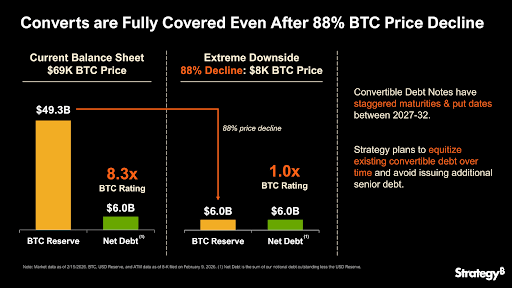
Source: Chart from Michael Saylor on X

The interesting part of the disclosure is the downside scenario. The company modeled an 88% price decline in Bitcoin, which would push BTC down to around $8,000. Under that assumption, its Bitcoin reserve would fall to roughly $6.0 billion. That figure still matches or slightly exceeds its net debt position, resulting in a 1.0x coverage ratio.

This means that even if BTC’s price were to suffer an 88% collapse from current levels, Strategy’s Bitcoin holdings would theoretically still be sufficient to cover its outstanding debt obligations on paper.

No Immediate Liquidation Risks For Strategy

Strategy’s borrowings are primarily low-interest convertible notes with staggered maturities and put dates stretching between 2027 and 2032. These are not margin loans secured by BTC that trigger automatic liquidations if BTC falls.

Since there are no margin calls associated directly with BTC price fluctuations, Strategy would not be forced to sell its BTC holdings in a sudden downturn. Instead, the company noted that it plans to equitize existing convertible debt over time. That means converting debt into company shares and avoiding issuing new senior secured debt.

Strategy is still in the business of purchasing huge amounts of Bitcoin, despite the recent price crash below $70,000. The most recent purchase was an additional 1,142 BTC for approximately $90 million in early February. Saylor even recently reiterated that Strategy plans to continue buying Bitcoin on a regular basis.

A BTC collapse to $10,000 would represent an extreme crash of 85% to 90% from recent levels. Although Strategy’s model suggests it could technically cover its net debt at $8,000 per BTC, such a scenario would dramatically shrink the value of its equity from $48.5 billion to less than $6 billion.

BTC trading at $67,856 on the 1D chart | Source: BTCUSDT on Tradingview.com

Preguntas relacionadas

QAccording to the article, what is the lowest Bitcoin price that Strategy (formerly MicroStrategy) claims it can withstand and still cover its debt?

AStrategy claims it can withstand a Bitcoin price drop to $8,000 and still fully cover its net debt obligations.

QWhat type of debt does Strategy hold, and why does this structure protect it from immediate liquidation in a Bitcoin price crash?

AStrategy's borrowings are primarily low-interest convertible notes with staggered maturities. They are not margin loans secured by BTC, so there are no automatic liquidation triggers or margin calls associated directly with BTC price fluctuations.

QWhat is the current BTC asset coverage ratio for Strategy, as mentioned in the article?

AUnder present conditions, with a Bitcoin price of around $69,000, Strategy has an 8.3x BTC asset coverage ratio.

QWhat is Michael Saylor's and Strategy's stated plan for their existing convertible debt?

AThe plan is to equitize the convertible debt over the next 3 to 6 years, which involves converting the debt into company shares and avoiding issuing new senior secured debt.

QDespite recent market conditions, what has Strategy continued to do regarding Bitcoin?

AStrategy has continued to purchase huge amounts of Bitcoin on a regular basis, with its most recent purchase being an additional 1,142 BTC for approximately $90 million in early February.

Lecturas Relacionadas

a16z: AI's 'Amnesia', Can Continuous Learning Cure It?

The article "a16z: AI's 'Amnesia' – Can Continual Learning Cure It?" explores the limitations of current large language models (LLMs), which, like the protagonist in the film *Memento*, are trapped in a perpetual present—unable to form new memories after training. While methods like in-context learning (ICL), retrieval-augmented generation (RAG), and external scaffolding (e.g., chat history, prompts) provide temporary solutions, they fail to enable true internalization of new knowledge. The authors argue that compression—the core of learning during training—is halted at deployment, preventing models from generalizing, discovering novel solutions (e.g., mathematical proofs), or handling adversarial scenarios. The piece introduces *continual learning* as a critical research direction to address this, categorizing approaches into three paths: 1. **Context**: Scaling external memory via longer context windows, multi-agent systems, and smarter retrieval. 2. **Modules**: Using pluggable adapters or external memory layers for specialization without full retraining. 3. **Weights**: Enabling parameter updates through sparse training, test-time training, meta-learning, distillation, and reinforcement learning from feedback. Challenges include catastrophic forgetting, safety risks, and auditability, but overcoming these could unlock models that learn iteratively from experience. The conclusion emphasizes that while context-based methods are effective, true breakthroughs require models to compress new information into weights post-deployment, moving from mere retrieval to genuine learning.

marsbitHace 2 hora(s)

a16z: AI's 'Amnesia', Can Continuous Learning Cure It?

marsbitHace 2 hora(s)

Can a Hair Dryer Earn $34,000? Deciphering the Reflexivity Paradox in Prediction Markets

An individual manipulated a weather sensor at Paris Charles de Gaulle Airport with a portable heat source, causing a Polymarket weather market to settle at 22°C and earning $34,000. This incident highlights a fundamental issue in prediction markets: when a market aims to reflect reality, it also incentivizes participants to influence that reality. Prediction markets operate on two layers: platform rules (what outcome counts as a win) and data sources (what actually happened). While most focus on rules, the real vulnerability lies in the data source. If reality is recorded through a specific source, influencing that source directly affects market settlement. The article categorizes markets by their vulnerability: 1. **Single-point physical data sources** (e.g., weather stations): Easily manipulated through physical interference. 2. **Insider information markets** (e.g., MrBeast video details): Insiders like team members use non-public information to trade. Kalshi fined a剪辑师 $20,000 for insider trading. 3. **Actor-manipulated markets** (e.g., Andrew Tate’s tweet counts): The subject of the market can control the outcome. Evidence suggests Tate’sociated accounts coordinated to profit. 4. **Individual-action markets** (e.g., WNBA disruptions): A single person can execute an event to profit from their pre-placed bets. Kalshi and Polymarket handle these issues differently. Kalshi enforces strict KYC, publicly penalizes insider trading, and reports to regulators. Polymarket, with its anonymous wallet-based system, has historically been more permissive, arguing that insider information improves market accuracy. However, it cooperated with authorities in the "Van Dyke case," where a user traded on classified government information. The core paradox is reflexivity: prediction markets are designed to discover truth, but their financial incentives can distort reality. The more valuable a prediction becomes, the more likely participants are to influence the event itself. The market ceases to be a mirror of reality and instead shapes it.

marsbitHace 3 hora(s)

Can a Hair Dryer Earn $34,000? Deciphering the Reflexivity Paradox in Prediction Markets

marsbitHace 3 hora(s)

Trading

Spot
Futuros
活动图片





