CoreWeave plans $2B note offering to scale AI business while managing dilution

cointelegraphPublished on 2025-12-08Last updated on 2025-12-08

Abstract

CoreWeave plans to raise $2 billion through a private offering of convertible notes due 2031, with an option for an additional $300 million. Proceeds will be used for general corporate purposes and capped-call transactions to reduce potential shareholder dilution. The notes can be settled in cash, shares, or a combination. Founded as a crypto miner in 2017, the company pivoted to AI infrastructure in 2019 and now operates over 33 data centers. The stock fell 9.2% on the news. Separately, CoreWeave's recent $9 billion bid to acquire Bitcoin miner Core Scientific failed after shareholders rejected it. The company stated the acquisition was primarily aimed at securing power capacity for future AI expansion, not a return to crypto.

AI infrastructure provider CoreWeave (CRWV) plans to raise $2 billion through a private offering of convertible senior notes due 2031, with proceeds earmarked for general corporate purposes and for capped-call transactions that could reduce potential future shareholder dilution.

The notes include an option for purchasers to buy an additional $300 million, the company said Monday. They can be settled in cash, shares or a combination of both at CoreWeave’s discretion.

To limit dilution if the notes are ultimately converted into equity, CoreWeave is entering into capped-call transactions. This hedge increases the effective conversion price and provides a degree of protection for existing shareholders while preserving financial flexibility.

CoreWeave was founded in 2017 as Atlantic Crypto, a company that used GPUs to mine Ether (ETH). As the crypto market weakened, it pivoted in 2019 into cloud and high-performance computing services, eventually refocusing its GPU infrastructure on AI workloads.

The company now operates a network of data centers built specifically for AI, and as of this year, reported running more than 33 facilities. It has not said whether proceeds from its latest fundraising will go toward further expanding that footprint.
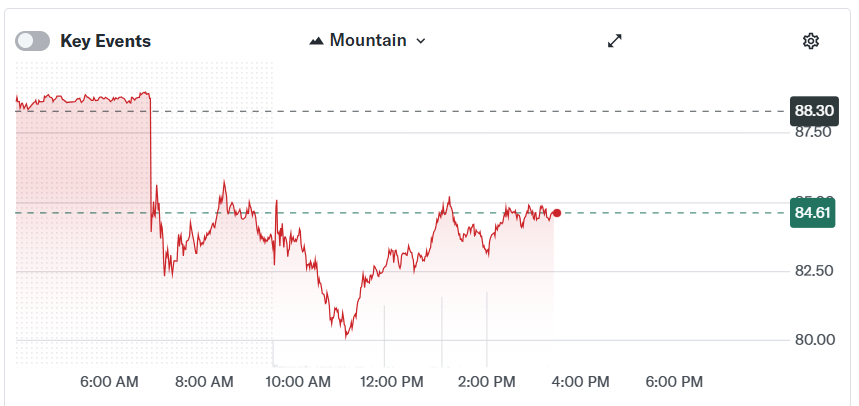
CoreWeave stock reacted negatively to the private note offering, falling as much as 9.2% on Monday. Source: Yahoo Finance

Related: TeraWulf looks to raise $500M as it bets big that AI is new Bitcoin

CoreWeave’s failed takeover bid of Core Scientific

Despite shifting its focus away from digital asset mining as its primary business, CoreWeave recently pursued a $9 billion acquisition of Core Scientific, one of the largest Bitcoin (BTC) mining operators. However, the deal fell through after Core Scientific’s shareholders voted against the proposal.

The attempted takeover fueled speculation about a return to crypto, but CoreWeave has characterized the effort differently.

The company stated that the acquisition aimed to secure access to approximately 1.3 gigawatts of power capacity across Core Scientific’s sites, which could be leveraged for future expansion in AI, cloud computing or other GPU-intensive workloads.

CoreWeave had spent more than a year pursuing Core Scientific, beginning with an initial offer in June 2024 that the miner rejected. As Core Scientific’s stock rose, the price needed to secure a deal also increased, ultimately contributing to the failure of the final proposal when shareholders voted it down.

Related: Crypto Biz: Mining weakness tests Bitcoin’s market cycle

Related Reads

Digital Asset Vaults Lose Their Luster: Twenty One's Stock Plunges 20% on First Trading Day

Twenty One Capital, a Bitcoin-focused treasury company backed by Tether and SoftBank, saw its shares plunge approximately 20% on its first day of trading on the New York Stock Exchange. The sharp decline reflects investor skepticism toward the valuation and business model of Bitcoin treasury companies amid a significant cryptocurrency market downturn. The company, led by 31-year-old CEO Jack Mallers, holds around 43,500 BTC. However, Bitcoin holdings have fallen over 25% since October’s all-time high near $126,000, putting pressure on the "digital asset treasury" (DAT) model. Despite its large Bitcoin reserve and strong backers, investors remain cautious due to unclear revenue paths and heavy reliance on Bitcoin’s volatile price. Twenty One went public via a merger with SPAC Cantor Equity. Unlike traditional companies, its valuation is almost entirely tied to its Bitcoin holdings, using metrics like "Bitcoin per Share" (BPS). Yet, the firm has not detailed how it will generate sustainable profits beyond holding Bitcoin. The sell-off reflects broader pressures on crypto-linked stocks. Other Bitcoin-heavy companies like Metaplanet, Trump Media, and Empery Digital also face millions in unrealized losses and falling share prices as Bitcoin corrects. The debut underscores high volatility and valuation risks in crypto investing. Despite innovation and institutional support, long-term viability requires transparent business models and clear profitability strategies—lessons even high-profile crypto firms must heed.

cointelegraph_中文Hace 34 min(s)

Digital Asset Vaults Lose Their Luster: Twenty One's Stock Plunges 20% on First Trading Day

cointelegraph_中文Hace 34 min(s)

Trading

Spot
Futures
活动图片