Core 'Key Contributors' Depart One After Another, Has Aave's DAO Dream Shattered?

比推Publicado a 2026-03-03Actualizado a 2026-03-03

Resumen

Recent weeks have seen major internal turbulence within Aave, one of DeFi’s most successful DAOs. The Aave Chan Initiative (ACI), a core governance team, announced it would cease operations and exit the ecosystem on March 3, following the departure of BGD Labs, the development team behind Aave V3, just two weeks earlier. The crisis stems from governance disputes that began in December, when Aave Labs unilaterally switched the protocol’s front-end aggregator from ParaSwap to CoW Swap, redirecting fee revenue from the DAO treasury to Aave Labs. In response, Aave Labs proposed the bundled “Aave Will Win” proposal in February, requesting $51M in funding for V4 development in exchange for routing all future product revenue to the DAO and phasing out V3. ACI strongly criticized the proposal, alleging that a significant portion of supporting votes came from addresses linked to Aave Labs, raising concerns about self-dealing and lack of transparency. Despite ACI’s attempts to introduce stricter accountability measures, their proposals were not adopted. The departures of both BGD Labs and ACI—key contributors responsible for technical development and governance—raise serious questions about Aave’s future, including technical risks associated with transitioning to V4 and the centralization of decision-making power. The situation highlights broader challenges in DAO governance, where power often remains concentrated among founders, developers despite the ideal of decentralized token-h...

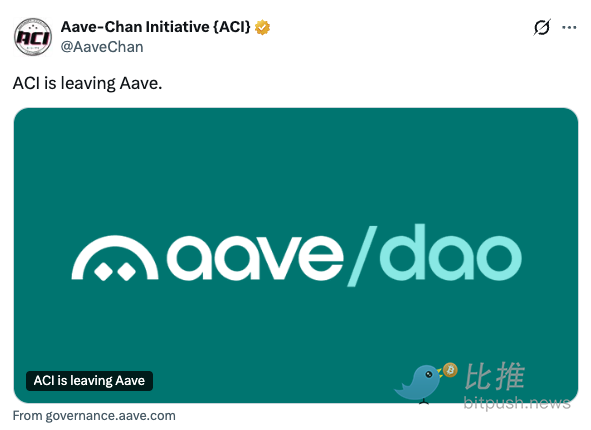
On March 3rd, the Aave protocol's core governance team, Aave Chan Initiative (ACI), announced it would cease operations and exit AAVE.

This is the second major contributor to leave within two weeks—previously, on February 20th, the development team behind the Aave V3 codebase, BGD Labs, announced its departure.
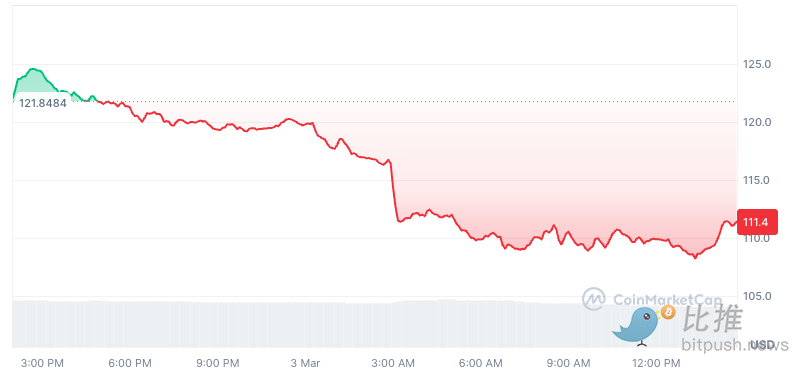
Following the announcement, the price of the AAVE token fell by more than 11%.

As one of the most successful DAOs (Decentralized Autonomous Organizations) in DeFi history, this DeFi leader with nearly $27 billion in TVL (Total Value Locked) is undergoing profound internal turmoil.
From Revenue Attribution Dispute to Bundled Voting

The seeds of this crisis were sown as early as last December.

At that time, Aave Labs replaced the front-end transaction aggregator from ParaSwap to CoW Swap without prior governance discussion. The fees that originally flowed to the DAO treasury instead went into Aave Labs' accounts.

Facing质疑 (query/doubt), Aave founder Stani Kulechov responded: the front-end interface was built by Labs, so the revenue naturally belongs to Labs; the smart contracts and liquidity pools belong to the DAO. This explanation was legally sound but caused discontent within the community.

To quell the controversy, Aave Labs proposed a plan called "Aave Will Win" in February. The proposal主要内容 (main content) included: requesting DAO approval for approximately $51 million in funding for V4 development; in exchange, all future revenue from Aave-branded products would be assigned to the DAO, and Aave V4 would be established as the sole technical foundation, gradually phasing out V3.

The problem was that these three matters were bundled together. Support revenue going to the DAO but think the funding amount is too large? No choice. Believe V3 still has value and shouldn't be sidelined?同样没得选 (Similarly, no choice). Either accept the entire package or reject it entirely.

ACI's Grievance: Opaque Voting

In its exit statement, ACI's core accusation was: a significant portion of the votes supporting the proposal came from addresses associated with Aave Labs. A temperature check vote passed by a narrow margin of 52.58%, and ACI believes the result might have been different without these "self-votes".
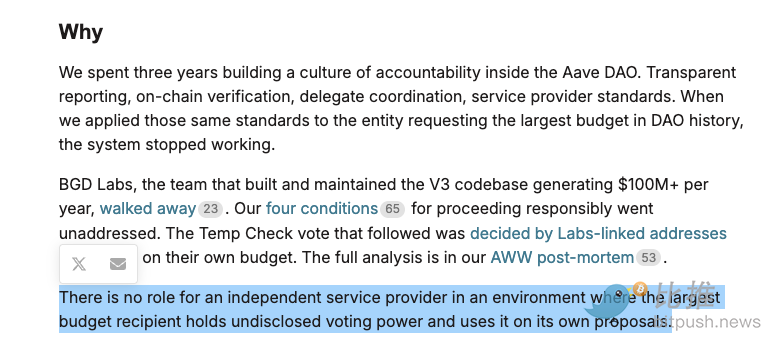
ACI founder Marc Zeller wrote: "If a major budget recipient can use its undisclosed voting power to force through its own proposals, then independent service providers lose their raison d'être within the DAO."

ACI did try to resolve the issue. Before the vote, it proposed four conditions, including stricter on-chain milestone tracking and restrictions on self-voting by budget recipients, but none were adopted.

This conflict reflects structural problems in DAO governance.

Aave Labs controls the codebase, brand domains, social media, and development discourse. BGD Labs maintains the main version V3—it contributes over 75% of the protocol's revenue and 97% of the total deposits. ACI is responsible for governance coordination and business development, claiming to have driven 61% of governance actions over the past three years, helping Aave's DeFi market share rise from less than 50% to over 65%.

These three teams were supposed to check and balance each other. But with BGD and ACI leaving one after another, the remaining power center, no matter how it表态 (states its position), is difficult to be fully trusted.

Stani Kulechov responded after ACI announced its exit: "Thank you Marc for years of contribution, the protocol will continue to operate normally."
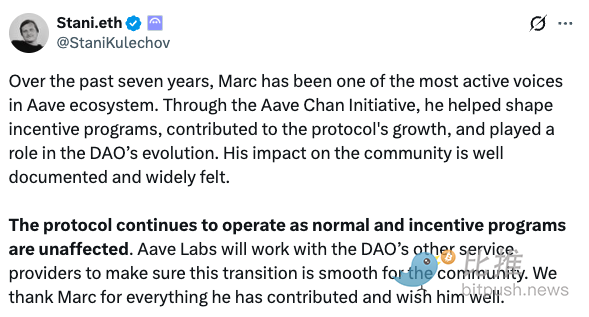
But this response did not address the core issue: when the people most capable of assessing the technical risks of V3 have left, how can the DAO feel confident betting its future on the untested V4?

Another noteworthy detail is that institutional investor Blockchain Capital stated afterwards that they were unable to participate in the snapshot vote with their held AAVE because their custody platform did not support it. This reveals another reality of DAO governance: nominally based on collective decision-making by token holders, voting power is often concentrated in the hands of a few.

DAO's Governance Dilemma

ACI stated that during the four-month transition period, it will transfer or open-source tools and responsibilities such as the governance dashboard, incentive framework, and committee roles. But some things are difficult to transfer: three years of accumulated governance experience, familiarity with protocol details, and the interpersonal network for coordinating different stakeholders.

Data shows that ACI spent $4.6 million from the DAO over the past three years, helping the GHO stablecoin grow from $35 million to $527 million. Who will take over these tasks in the future remains unknown.

This turmoil at Aave is essentially a microcosm of the DAO governance dilemma.

In theory, a DAO is a community of token holders. But in practice, governance is often dominated by the founding team, early investors, and core developers. These roles are both rule-makers, rule-enforcers, and sometimes budget recipients. When conflicts of interest arise, whether "procedural justice" is sufficient becomes the焦点 (focus) of controversy.

A DeFi practitioner commented: "This is not a question of who is right or wrong, but rather that the existing governance mechanisms do not provide an effective way to resolve conflicts when interests and positions diverge."

What Happens Next?

The ARFC (Request for Comments) stage revisions to the "Aave Will Win" proposal will be the first window to observe the direction of events. If the "structural improvements" promised by Kulechov can be implemented, such as unbundling the proposal and clarifying the boundaries of voting behavior, it might draw a line under this turmoil.

If consensus cannot be reached, the most extreme possibility is that BGD and ACI start anew, forking a new protocol. Although liquidity barriers are high, it's not impossible—the simultaneous departure of core developers and the governance team provides both the technical foundation and community basis for a fork.

For Aave, the immediate problem is how to fill the void left by the departure of the two core teams. The longer-term problem is how to find a more sustainable balance between the founder's vision, the interests of core developers, and the will of the community. If the paradox of "power concentration" cannot be resolved, even the strongest protocol may lose its first-mover advantage in endless internal friction.

Author: Bootly


Twitter:https://twitter.com/BitpushNewsCN

Bitpush TG Discussion Group:https://t.me/BitPushCommunity

Bitpush TG Subscription: https://t.me/bitpush

Original link:https://www.bitpush.news/articles/7616451

Preguntas relacionadas

QWhat was the immediate market reaction to the announcement of Aave Chan Initiative (ACI) shutting down operations?

AThe AAVE token price dropped by over 11%.

QWhat was the core accusation made by ACI in their exit statement regarding the 'Aave Will Win' proposal vote?

AACI alleged that a significant portion of the votes supporting the proposal came from addresses associated with Aave Labs, and that the vote might have failed without this 'self-voting'.

QWhat three main things were bundled together in the controversial 'Aave Will Win' proposal from Aave Labs?

AThe proposal bundled a request for ~$51M in funding for V4 development, the future redirection of all Aave brand product revenue to the DAO, and the establishment of Aave V4 as the sole technical base while phasing out V3.

QAccording to the article, what fundamental problem does Aave's crisis expose about DAO governance?

AIt exposes the structural problem where governance is often dominated by the founding team, early investors, and core developers, who are rule-makers, executors, and budget recipients, creating conflicts of interest that existing mechanisms struggle to resolve.

QWhat is one potential extreme outcome mentioned if a consensus cannot be reached after the departure of BGD Labs and ACI?

AThe most extreme possibility is that BGD and ACI could fork the protocol to create a new one, as their departure provides both the technical foundation and community basis for a fork.

Lecturas Relacionadas

KOL's Perspective: Why Is SOL Set to Rise from This Point?

**Summary: Why SOL is Positioned for Growth at This Level** The article argues that SOL is poised for an upward move from its current price point, citing several key factors. Primarily, SOL has just broken out of a 4-month consolidation phase. This breakout signals a return of risk appetite to the broader crypto market, as SOL is seen as a key indicator of overall crypto health. The token's ownership has reportedly shifted from short-term traders and tourists to long-term accumulators, leading to low volume. Any meaningful increase in trading activity could thus trigger significant upward momentum. Fundamental strengths include strong institutional adoption, integration with DeFi and RWAs (Real-World Assets), and the potential benefits from the Clarity Act. Despite its high volatility—having dropped 70% from its all-time high but still up 12x from its bear market low—SOL is highlighted as one of the few tokens from the last cycle to reach new highs. It boasts a robust ecosystem of applications, users, and protocols. Future catalysts include the expected influx of AI developers following the Miami Accelerate conference, which focused on AI on Solana. Furthermore, Solana is positioned as the premier chain for memecoin activity, a trend expected to continue and drive network usage and fees. The article concludes that recent price action reflects a healthy transfer to long-term holders, setting the stage for growth.

marsbitHace 28 min(s)

KOL's Perspective: Why Is SOL Set to Rise from This Point?

marsbitHace 28 min(s)

Those Pre-Bitcoin PoW Protocols Have Recently Been Reimplemented

This article details a recent surge in replicating pre-Bitcoin Proof-of-Work (PoW) protocols, specifically focusing on Hal Finney's 2004 RPOW (Reusable Proofs of Work). Within five days in May 2026, multiple independent builders in the Bitcoin/cypherpunk community launched projects inspired by this early electronic cash proposal. The initiative began with Fred Krueger's `rpow2.com`, a centralized but auditable system that replaced RPOW's original IBM 4758 hardware with Ed25519 signatures. Initially a faithful replica, it later adopted Bitcoin-like features (21M supply cap, difficulty adjustment) and a controversial 5.24% founder allocation. This sparked rapid forks, including `rpow4.com` which incorporated full Bitcoin parameters, a prediction market (`rpowmarket.com`), and a DEX (`rpow2swap.com`). Concurrently, Mike In Space created a prototype of Wei Dai's 1998 b-money proposal (`b-money.replit.app`), pushing the historical exploration even further back. The article contrasts these centralized, server-dependent experiments with Bitcoin's core innovation of decentralized, trustless consensus. It also highlights a parallel development: the `HASH` project on Ethereum, which uses smart contract hooks to enable a purely fair-launch, browser-mineable PoW token with 0% allocations to team or VCs. The collective activity is framed as a meme-driven, educational exploration of cypherpunk history rather than a serious financial movement, with all projects heavily disclaiming any investment value.

marsbitHace 33 min(s)

Those Pre-Bitcoin PoW Protocols Have Recently Been Reimplemented

marsbitHace 33 min(s)

South Korean Exchanges 'Battle' Regulators, Challenging the Boundaries of Enforcement and Legislation

South Korea's cryptocurrency industry is engaged in a rare, direct confrontation with regulators. The Financial Intelligence Unit (FIU), the primary anti-money laundering (AML) watchdog, has recently imposed heavy penalties on major exchanges like Upbit and Bithumb for alleged violations involving unregistered overseas VASPs and AML procedures. However, exchanges are now actively challenging these actions in court and through industry associations. In a significant shift, the Seoul Administrative Court ruled in favor of Upbit's operator, Dunamu, overturning part of an FIU-ordered business suspension. The court found the FIU's penalty criteria and justification insufficiently clear. Similarly, the court suspended the enforcement of a six-month business suspension against Bithumb pending a final ruling, citing potential irreversible harm to the exchange. Beyond legal battles, the industry is contesting proposed legislative amendments. The Digital Asset eXchange Alliance (DAXA) strongly opposes a draft rule that would mandate Suspicious Transaction Reports (STRs) for all crypto transfers over 10 million KRW (~$6,800). DAXA argues this "poison pill" clause violates legal principles and would overwhelm the STR system, increasing reports from 63,000 to an estimated 5.45 million annually for major exchanges, thereby crippling effective AML monitoring. This conflict highlights a structural tension in South Korea's crypto governance: comprehensive digital asset laws are still developing, while regulators rely heavily on AML enforcement. The industry's move from passive compliance to active legal and legislative challenges signifies a new phase, pressing for clearer rules and more proportionate enforcement. While short-term disputes may intensify, this clash could ultimately lead to a more mature and sustainable regulatory framework for South Korea's vibrant crypto market.

marsbitHace 1 hora(s)

South Korean Exchanges 'Battle' Regulators, Challenging the Boundaries of Enforcement and Legislation

marsbitHace 1 hora(s)

After 50x Storage Surge, Justin Sun Always Looks to the Next Decade

Sun Yuchen, known for his controversial stunts like a $30 million lunch with Warren Buffett (canceled due to a kidney stone) and eating a $6.2 million duct-taped banana, is often overshadowed by a significant fact: his decade-long track record of spotting major investment trends. In 2016, he famously advised young people to invest in Bitcoin, Nvidia, Tesla, and Tencent instead of buying property. A hypothetical $20,000 investment in Nvidia and Tesla from that list would now be worth over 50 million RMB. His latest major call was on November 6, 2025, predicting a "50x storage opportunity" tied to the AI boom, which materialized with Sandisk's stock surging nearly 50-fold by 2026. Looking ahead, Sun now focuses on the next frontier: Physical AI. He identifies four key areas: 1. **Embodied AI/Robotics**: He sees this reaching its "iPhone moment," with companies like UBTech and Galaxy General leading in commercialization. 2. **Drones**: Viewed as the first commercially viable form of Physical AI, revolutionizing sectors from warfare (e.g., AeroVironment's Switchblade) to logistics. 3. **Spatial Computing**: Beyond VR, it's about AI understanding physical space, a foundational technology for robotics and autonomous systems, exemplified by Apple's Vision Pro. 4. **Space Exploration**: After a 2025 suborbital flight with Blue Origin, Sun advocates for space as the ultimate frontier, discussing blockchain's potential role in space asset management and data transactions. His investment philosophy involves betting on entire, inevitable trends rather than single companies. For robotics, he sees Tesla (the body/manufacturer) and Nvidia (the brain/AI platform) as complementary plays. In defense drones, he highlights companies making tanks obsolete (AeroVironment) and those augmenting fighter jets (Kratos). For space, he participated in Blue Origin's flight and anticipates SpaceX's potential IPO to redefine the sector's valuation. Sun Yuchen's vision frames the next two decades not as a revolution in information flow (like the internet), but in the fundamental operation of the physical world through AI-powered robots, autonomous systems, and spatial intelligence, ultimately extending human and AI activity into space. While many still focus on conventional assets, he continues to look toward the next technological horizon.

marsbitHace 2 hora(s)

After 50x Storage Surge, Justin Sun Always Looks to the Next Decade

marsbitHace 2 hora(s)

Trading

Spot
Futuros

Artículos destacados

Cómo comprar ONE

¡Bienvenido a HTX.com! Hemos hecho que comprar Harmony (ONE) sea simple y conveniente. Sigue nuestra guía paso a paso para iniciar tu viaje de criptos.Paso 1: crea tu cuenta HTXUtiliza tu correo electrónico o número de teléfono para registrarte y obtener una cuenta gratuita en HTX. Experimenta un proceso de registro sin complicaciones y desbloquea todas las funciones.Obtener mi cuentaPaso 2: ve a Comprar cripto y elige tu método de pagoTarjeta de crédito/débito: usa tu Visa o Mastercard para comprar Harmony (ONE) al instante.Saldo: utiliza fondos del saldo de tu cuenta HTX para tradear sin problemas.Terceros: hemos agregado métodos de pago populares como Google Pay y Apple Pay para mejorar la comodidad.P2P: tradear directamente con otros usuarios en HTX.Over-the-Counter (OTC): ofrecemos servicios personalizados y tipos de cambio competitivos para los traders.Paso 3: guarda tu Harmony (ONE)Después de comprar tu Harmony (ONE), guárdalo en tu cuenta HTX. Alternativamente, puedes enviarlo a otro lugar mediante transferencia blockchain o utilizarlo para tradear otras criptomonedas.Paso 4: tradear Harmony (ONE)Tradear fácilmente con Harmony (ONE) en HTX's mercado spot. Simplemente accede a tu cuenta, selecciona tu par de trading, ejecuta tus trades y monitorea en tiempo real. Ofrecemos una experiencia fácil de usar tanto para principiantes como para traders experimentados.

230 Vistas totalesPublicado en 2024.12.12Actualizado en 2025.03.21

Cómo comprar ONE

Discusiones

Bienvenido a la comunidad de HTX. Aquí puedes mantenerte informado sobre los últimos desarrollos de la plataforma y acceder a análisis profesionales del mercado. A continuación se presentan las opiniones de los usuarios sobre el precio de ONE (ONE).

活动图片













