Consumer Technology Association Urges Senate to Vote for CLARITY Act Bill

cryptonews.ruPublicado a 2026-07-31Actualizado a 2026-07-31

Resumen

The Consumer Technology Association (CTA), representing over 1,300 tech companies, is urging the U.S. Senate to pass the CLARITY Act to establish clear federal rules for digital assets. CTA argues regulatory certainty will spur investment, enhance consumer protection, and bolster U.S. leadership in blockchain innovation. The House already approved the bill with bipartisan support in 2025. In the Senate, negotiations are ongoing, with debates centered on ethics rules and market oversight. Senator Cynthia Lummis released an updated bill text, but critics like Senator Elizabeth Warren warn it leaves conflicts of interest unresolved. Political pressure is mounting ahead of a potential vote, with former officials expressing confidence in its eventual passage. A key final debate involves stablecoins, as banking executives warn against allowing payment stablecoins to function like interest-bearing accounts, fearing deposit losses could impact community lending. Advocacy groups are also pledging to score senators' votes on the bill, increasing election-year pressure.

The Consumer Technology Association (CTA), representing over 1,300 technology companies, is urging the Senate to advance the CLARITY Act bill and establish clear federal rules for digital assets. This influential industry association is celebrating its 100th anniversary in 2024.

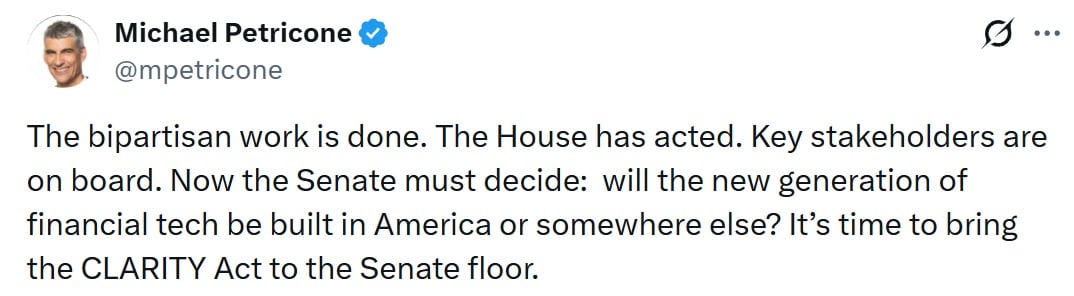
Michael Petricone, Senior Vice President of Global Public Affairs at CTA, stated on July 28 on X that the House of Representatives has completed its work, industry stakeholders support the bill, and now the Senate must determine whether financial technology innovation will develop in the United States or abroad.

CTA emphasized that regulatory certainty will stimulate investment, enhance consumer protection, expand innovation, and strengthen U.S. leadership in blockchain technology. The organization also noted that businesses need clear federal rules governing digital assets before they invest long-term capital and develop new financial products.
This call is based on a June 17 letter from CTA in which the organization expressed support for the bill's passage by the Senate. In 2025, the House of Representatives approved the bill with broad bipartisan support, shifting responsibility for the next crucial step to the Senate.

Senate Negotiations Focus on Ethics Rules

U.S. Senator Cynthia Lummis (R-WY) has released an updated text of the CLARITY Act, merging the results of work from the Senate Banking and Agriculture Committees. The introduced amendments address market oversight, consumer protection, and the allocation of regulatory authority for digital assets.

The proposal still faces opposition on ethics and enforcement issues. U.S. Senator Elizabeth Warren (D-MA), a senior member of the Senate Banking Committee, stated that the revised wording leaves significant conflicts of interest unresolved.

These disagreements are currently determining the bill's path to a vote. Supporters view this measure as a solid foundation for investment and competition, while critics demand stronger safeguards before Congress establishes new rules for the cryptocurrency market.

Political Pressure Mounts Ahead of Senate Vote

The CLARITY Act remains stalled in the Senate as legislators negotiate unresolved provisions. A White House agreement on ethics was aimed at easing one point of contention, while former House Financial Services Committee Chairman Patrick McHenry described the bill's passage as a matter of not "if" but "when."

Securities and Exchange Commission (SEC) Chairman Paul Atkins also supported Congressional action, arguing that legislation would provide more durable rules than regulation led primarily by federal agencies.

Stablecoin Debate Defines Course of Final Debates

Advocacy groups have promised to score senators' votes on the CLARITY Act bill, intensifying political pressure ahead of the November midterm elections.

Banks are focused on a narrower dispute concerning stablecoin rewards. Over 130 bank executives have urged lawmakers not to allow payment stablecoins to function as interest-bearing accounts, warning that deposit losses could affect funding for mortgages, farms, small businesses, and local communities.


Criptos en tendencia

Preguntas relacionadas

QWhat is the Consumer Technology Association (CTA) urging the U.S. Senate to do, and what is the name of the bill?

AThe Consumer Technology Association (CTA) is urging the U.S. Senate to advance and vote for the CLARITY Act, a bill aimed at establishing clear federal regulations for digital assets.

QAccording to the CTA, what are the expected benefits of regulatory clarity for digital assets?

AAccording to the CTA, regulatory clarity for digital assets will drive investment, enhance consumer protection, foster innovation, and strengthen U.S. leadership in blockchain technology. It will also give businesses the certainty needed to invest long-term capital and develop new financial products.

QWhat is a major point of contention regarding the CLARITY Act in the Senate, as highlighted by Senator Elizabeth Warren?

AA major point of contention in the Senate regarding the CLARITY Act involves ethics and enforcement. Senator Elizabeth Warren has criticized the revised bill language, stating it leaves serious conflicts of interest unresolved.

QWhat specific concern have banks raised regarding stablecoins in the final debates over the CLARITY Act?

ABanks have raised concerns that payment stablecoins could function like interest-bearing accounts. They warn that allowing this could lead to deposit losses, which could negatively impact funding for mortgages, farms, small businesses, and local communities.

QWhat was the legislative status of the CLARITY Act in the House of Representatives, and what is the current status in the Senate?

AThe CLARITY Act was passed by the House of Representatives in 2025 with broad bipartisan support. Currently, the bill is stalled in the Senate as legislators negotiate unresolved provisions, primarily concerning ethics, enforcement, and stablecoin regulations.

Lecturas Relacionadas

Stocks Fell Even More Violently Than Crypto, Where Did the Money Go?

From June to late July 2026, global stock markets, particularly technology and semiconductor stocks, experienced severe declines, with South Korea's KOSPI index facing historic circuit breakers and shedding 40% from its June peak. Key catalysts included SK Hynix's earnings miss despite record profits and competitive pressures from China's CXMT IPO. A global forced deleveraging event unfolded, devastating highly leveraged instruments like the 2x leveraged SK Hynix ETF, which lost over 80% of its value. Surprisingly, Bitcoin showed relative stability during this period, rising roughly 15% from its July low. The article clarifies this wasn't due to an inflow of equity flight capital but because Bitcoin had already undergone a significant correction in May and June, with U.S. spot Bitcoin ETFs seeing record outflows. True safe-haven flows went to gold, severing Bitcoin's short-term "digital gold" narrative. The sell-off is characterized not as an AI story collapse but a liquidity-driven清算 of crowded leveraged positions, potentially halfway through according to some analysts. For substantial capital to return to Bitcoin, the article cites necessary conditions: eased global liquidity pressure, a soft-landing Fed rate cut, and regulatory clarity from the stalled U.S. CLARITY Act. The conclusion is that Bitcoin is not a current safe haven but a pre-cleared asset. Its decoupling from tech stocks highlights its potential future role as a non-correlated asset for institutional portfolios, positioning it favorably for when global capital reallocates post-crisis.

marsbitHace 1 hora(s)

Stocks Fell Even More Violently Than Crypto, Where Did the Money Go?

marsbitHace 1 hora(s)

Trading

Spot

Artículos destacados

Cómo comprar BILL

¡Bienvenido a HTX.com! Hemos hecho que comprar Billions Network (BILL) sea simple y conveniente. Sigue nuestra guía paso a paso para iniciar tu viaje de criptos.Paso 1: crea tu cuenta HTXUtiliza tu correo electrónico o número de teléfono para registrarte y obtener una cuenta gratuita en HTX. Experimenta un proceso de registro sin complicaciones y desbloquea todas las funciones.Obtener mi cuentaPaso 2: ve a Comprar cripto y elige tu método de pagoTarjeta de crédito/débito: usa tu Visa o Mastercard para comprar Billions Network (BILL) al instante.Saldo: utiliza fondos del saldo de tu cuenta HTX para tradear sin problemas.Terceros: hemos agregado métodos de pago populares como Google Pay y Apple Pay para mejorar la comodidad.P2P: tradear directamente con otros usuarios en HTX.Over-the-Counter (OTC): ofrecemos servicios personalizados y tipos de cambio competitivos para los traders.Paso 3: guarda tu Billions Network (BILL)Después de comprar tu Billions Network (BILL), guárdalo en tu cuenta HTX. Alternativamente, puedes enviarlo a otro lugar mediante transferencia blockchain o utilizarlo para tradear otras criptomonedas.Paso 4: tradear Billions Network (BILL)Tradear fácilmente con Billions Network (BILL) en HTX's mercado spot. Simplemente accede a tu cuenta, selecciona tu par de trading, ejecuta tus trades y monitorea en tiempo real. Ofrecemos una experiencia fácil de usar tanto para principiantes como para traders experimentados.

350 Vistas totalesPublicado en 2026.05.07Actualizado en 2026.06.02

Cómo comprar BILL

Discusiones

Bienvenido a la comunidad de HTX. Aquí puedes mantenerte informado sobre los últimos desarrollos de la plataforma y acceder a análisis profesionales del mercado. A continuación se presentan las opiniones de los usuarios sobre el precio de BILL (BILL).

活动图片