Consolidation and Jackson Hole: Trader Assesses Bitcoin and Ethereum Movement Scenarios

cryptonews.ruPublicado a 2026-08-17Actualizado a 2026-08-17

Resumen

**Analysis: Bitcoin and Ethereum Consolidation Ahead of Jackson Hole** Bitcoin (BTC) is consolidating near $63,513, with liquidity accumulating around the $62,484 support level. The primary resistance is an unfilled 4-hour Fair Value Gap (FVG) at $64,000-$65,000. Analysts outline three potential scenarios: A) a rejection from the FVG leading to a cascade down to $60,000-$61,000; B) a bullish breakout above the FVG targeting $65,373 and higher; C) (prioritized) a quick stop-loss hunt below $62,484 followed by a rapid reversal upward into the imbalance. Ethereum (ETH) is similarly stagnant, failing to test $2,000 and remaining within its own 4H FVG. Key resistance is at $1,931.50 (PWH). Scenarios include: A) a genuine breakout and hold above this level; B) a deep liquidity grab below $1,852 followed by a powerful reversal; C) a false breakout above resistance leading to a cascading dump towards $1,780-$1,800. Despite ETF inflows, ETH's price lacks momentum. The US Dollar Index (DXY) broke below key support at 99.475, opening a path toward lower FVGs near 99,000. This weakness, if sustained, could support crypto markets. Key triggers this week are FOMC meeting minutes and preliminary PMI data, with positioning ahead of the Jackson Hole symposium being crucial. The overall sentiment is cautiously positive, but the recommended strategy is to stay out of medium-term positions in major assets until a clear directional move occurs, favoring intraday trading on lower timeframes wi...

  • Bitcoin is stuck near $63,513 and is accumulating liquidity around $62,484.
  • Ethereum did not reach $2000 and remains inside the 4H FVG.
  • DXY broke through support at 99.475, opening the path to lower inefficiency zones.
  • FOMC minutes, PMI data, and positioning ahead of Jackson Hole will be the main triggers this week.

Disclaimer: This material is not financial advice or a call to action. The presented analysis is the private opinion of its author. Incrypted is not responsible for readers' investment decisions.

Market Analysis — Prolonged Consolidation, Liquidity Shortage, and Positioning Ahead of Jackson Hole

The past trading week did not bring the expected resolutions. Despite a busy macroeconomic backdrop and constant news injections regarding the Middle East, major crypto assets followed conservative sideways scenarios.

Inflation statistics predictably matched consensus forecasts and were completely ignored by market participants. We analyze the technical picture and development vectors for the main assets in detail.

Bitcoin — Pool Accumulation and Threat of Manipulation

The chart has stalled around $63,513, showing almost no movement over five days. The current structure creates extreme tension: below us, at the $62,484 level, a third series of equal lows (EQL) has formed, converging at the same point with the pWL. Liquidity continues to accumulate, and the longer the market maker leaves this pool untouched, the higher the risk of an aggressive sell-off.

Above, price dynamics are restrained by an unfilled 4H FVG ($64,000-$65,000) — it remains the main barrier of the week. Higher up are pWH ($65,373), pMH ($66,924), and the old target at $67,255. If the sideways movement breaks to the downside, price will meet pools in the 1H FVG zones ($60,000-$61,000), 4H FVG ($59,000-$60,000), and at pML ($57,758).

Current Scenarios

Scenario A — Retest of the Imbalance and Cascade Breakdown Downwards

Price enters the 4H FVG zone $64,000-$65,000, notes buyer weakness, and reverses. Then comes what the market has been expecting for several weeks: a break of the $62,484 mark without a return and a cascade drop to $60,000-$61,000 and below.

Under thin August market conditions, a fall unfolds significantly faster than a rise. Invalidation — an immediate buyback into the body of the range within one or two candles.
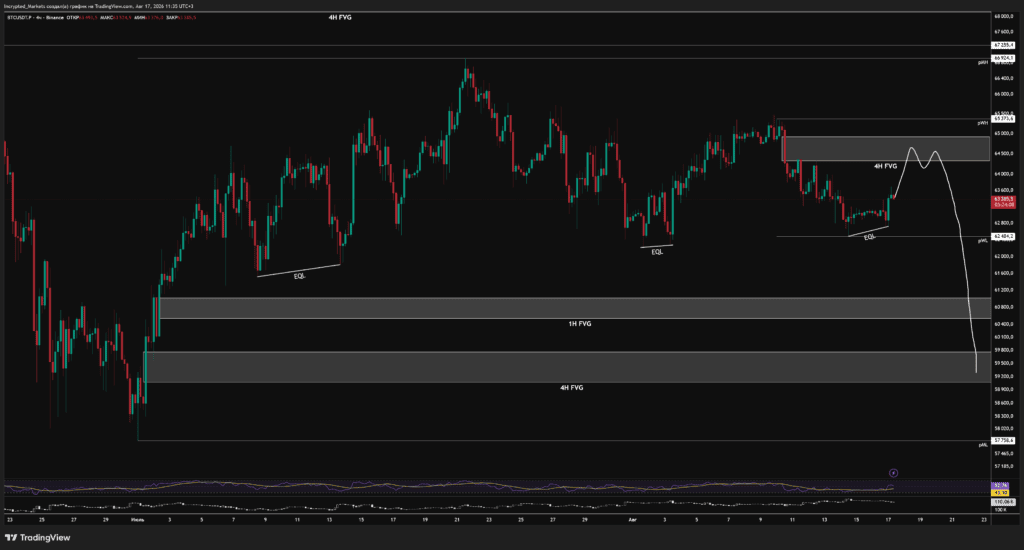
Four-hour chart of $BTC/$USDT.P. Data: TradingView.

Scenario B — Impulse Breakout and Assault on Resistances

The asset, on volume, slices through the 4H FVG, tests its upper boundary, and heads towards $65,373. Confirmed consolidation above PWH opens a direct path to $66,924 and $67,255.

The determining factor will be price behavior upon returning to the $64,000-$65,000 block — it should act as reliable support.
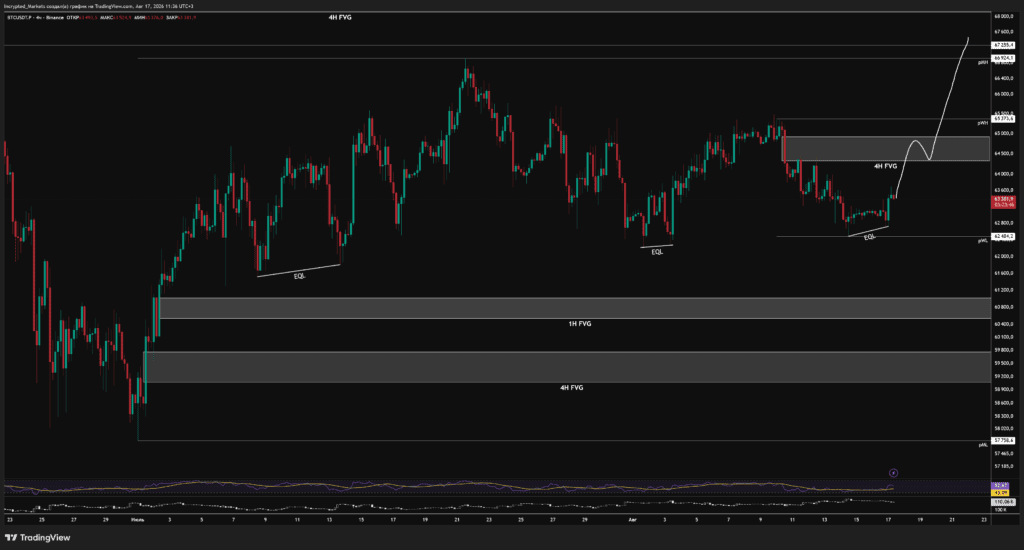
Four-hour chart of $BTC/$USDT.P. Data: TradingView.

Scenario C — Stop-Hunt and Reversal Upwards (Priority)

The most logical maneuver for large capital is a sharp break of $62,484 to take liquidity from early longs operating from the edge of the range, followed by a powerful impulse into the upper imbalance.

The key aspect is speed. A quick price return confirms buyer strength.
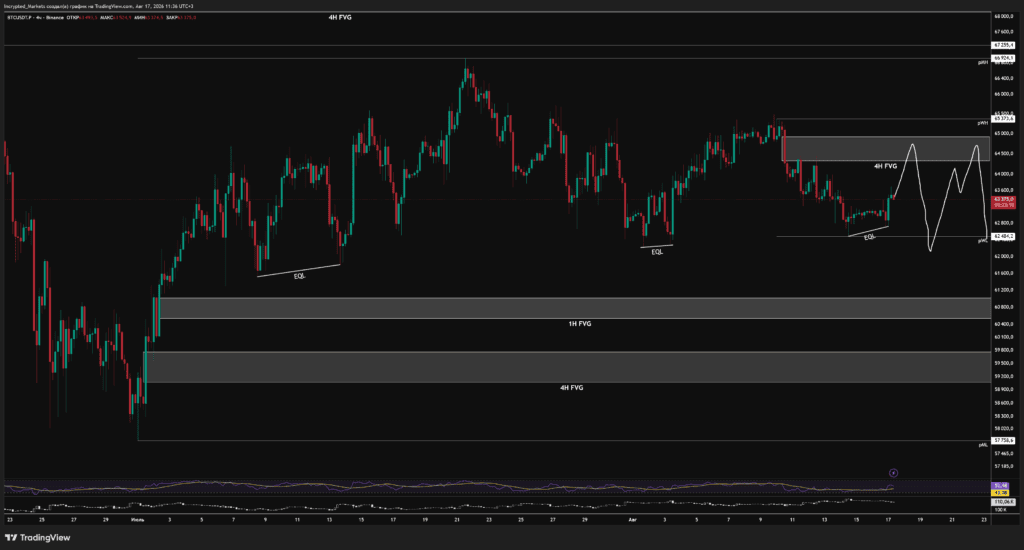
Four-hour chart of $BTC/$USDT.P. Data: TradingView.

Ethereum — Obstacle at $2000 and Divergence with ETF

The main altcoin spent the week in a similar stupor. The expected test of the round $2000 mark did not materialize. The market did not allow clean scenarios to play out: EQLs from below remained untouched, and the upward impulse choked at $1930.

The asset is literally stuck inside a 4H FVG, which currently acts as a zone of equilibrium. Pressure from above comes from resistance PWH $1931.50, behind which lies a dense cluster of liquidations 1925-1950, PMH $1982, and an hourly imbalance under $2000.

Support below is held by PWL $1852.22 and August EQLs. Below that lies a void down to the 4H FVG at $1802.46, a break of which opens the path to $1665-$1685.

Against the backdrop of chart stagnation, the relative strength of spot ETFs stands out: Ethereum funds have attracted capital for the fifth consecutive week, while Bitcoin recorded outflows of nearly $390 million last week. Meanwhile, the $ETH/$BTC pair is approaching 0.03.

However, without converting this strength into dollar value, the risk of a synchronous major dump remains.

Current Scenarios

Scenario A — Genuine Breakout and Consolidation

Accumulation within the current imbalance followed by a move through $1931.50 and entry into the short cluster $1925-$1950. The main goal is to consolidate above PWH.

Without holding this level upon retest, the move will be a false breakout.
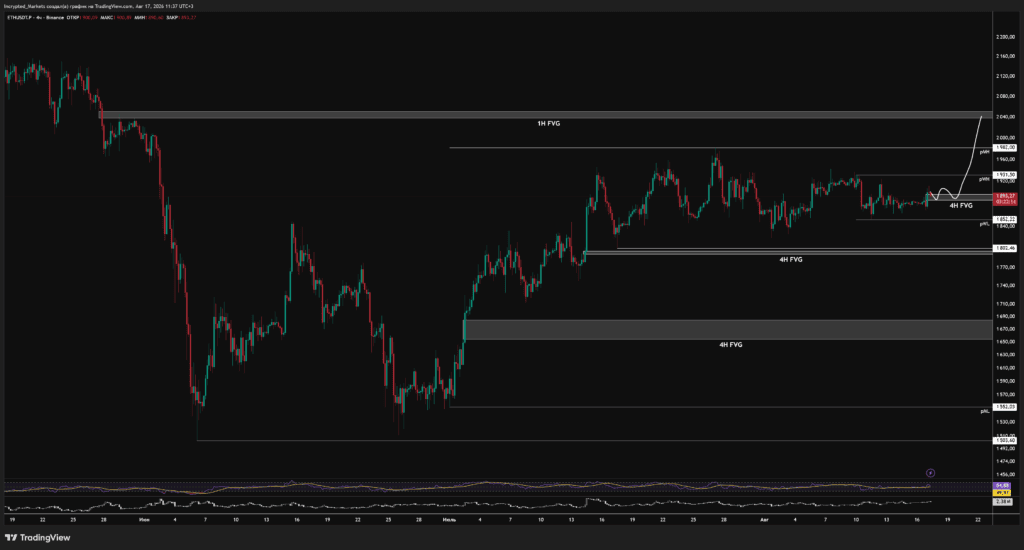
Four-hour chart of $ETH/$USDT.P. Data: TradingView.

Scenario B — Deep Liquidity Grab from Below

Break of support at $1852 and collection of equal lows along with "easy longs." A dip to $1802.46 is expected, followed by a powerful reversal upwards.

The validity of the scenario is confirmed only by a lightning-fast price return to the original range.
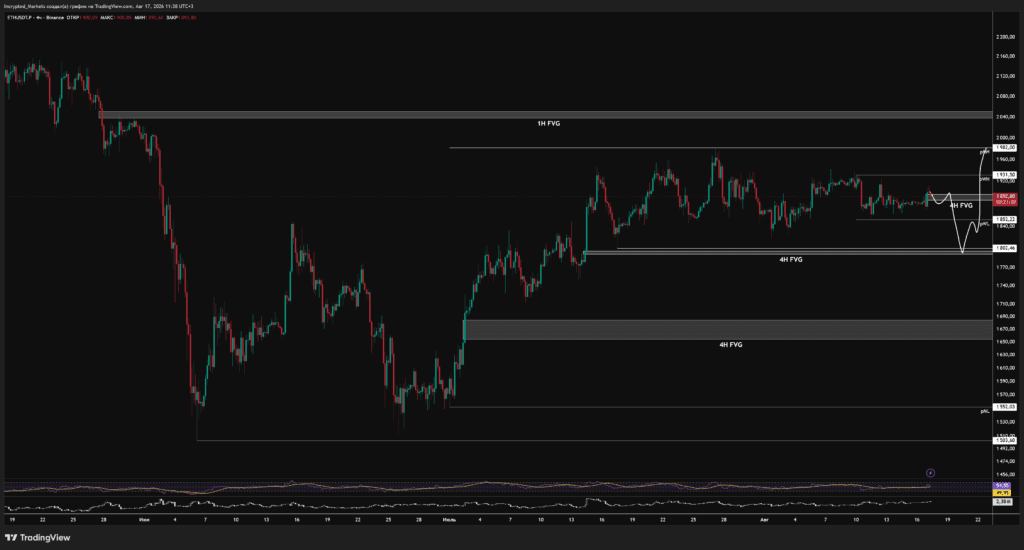
Four-hour chart of $ETH/$USDT.P. Data: TradingView.

Scenario C — False Breakout and Cascade Dump

The most painful option: the asset liquidates shorts in the $1931-$1950 zone, lures the crowd into breakout positions, then sharply reverses and cuts through the entire chart — through PWL and EQL straight to $1780-$1800.
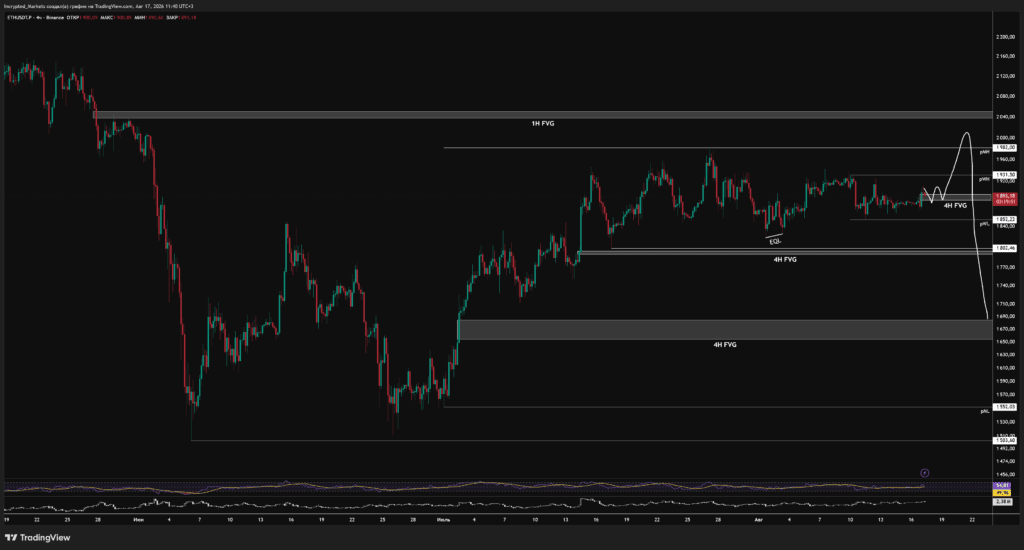
Four-hour chart of $ETH/$USDT.P. Data: TradingView.

Fundamental Triggers and Trading Plan

  • FOMC minutes on Thursday, August 20th. The document is retrospective, but any signs of a split within the committee could prompt a rapid reassessment of rate expectations;
  • Preliminary PMI indexes on Friday, August 21st. The focus is on employment and prices paid components — they will determine the balance of power at month-end;
  • Retail sector earnings season. Results from giants Home Depot, Target, Lowe’s, Walmart, and Reddit's inclusion in the S&P 500 act as an indirect channel of influence through correlation with stock indices;
  • Expectations for the Jackson Hole Symposium August 27-29. A half-empty calendar means movements will be driven not by statistics, but by capital positioning before Kevin Warsh's first speech as Fed Chair.

Summary

Paradoxically, the overall sentiment retains a positive tone. The current optimal strategy is staying out of the market for medium-term positions in heavy assets.

Under conditions where large capital is buying time, opening trades before a manipulative level break carries unjustified risk. Priority is given to intraday trading on lower timeframes in instruments with high volatility and strict risk control.

Dollar Index — Break of Key Supports, Movement Below 99.475, and Awaiting FOMC Minutes

Retrospective and Current Position

The past week dealt a serious technical blow to the positions of the American currency. While the release of expected inflation (CPI) data passed relatively calmly, the collapse in retail sales became the final trigger for sellers.

The Dollar Index (DXY) failed to hold the four-hour imbalance zone and impulsively broke through the previous support level.

Currently, DXY quotes have fallen to the 99.345 mark. The asset is trading below a key liquidity pool, opening the way to deeper inefficiency zones.

The market is transitioning into a positioning phase ahead of the Fed minutes publication and the approaching Jackson Hole symposium.

Technical Picture

The downward Order Flow received full confirmation after an aggressive consolidation below weekly lows. Key structural levels:

  • PWH 100.083 — the updated high of the past week, acting as local resistance;
  • PWL 99.475 — the previous weekly low, which was broken and now acts as the nearest mirror barrier;
  • 4H FVG zones: below, price is attracted by two large unfilled imbalances — the first with an upper boundary around 99.000, the second located deeper in the 98.700 zone.

Current Trading Scenarios

Scenario A — V-Shaped Buyback and Return Above PWL (Short Squeeze)

The index uses the current dip below 99.475 as a manipulation, i.e., a deviation, to collect liquidity. Price finds aggressive limit demand, forms a sharp reversal, and returns above the broken 99.475 level, heading to fill the imbalances above.
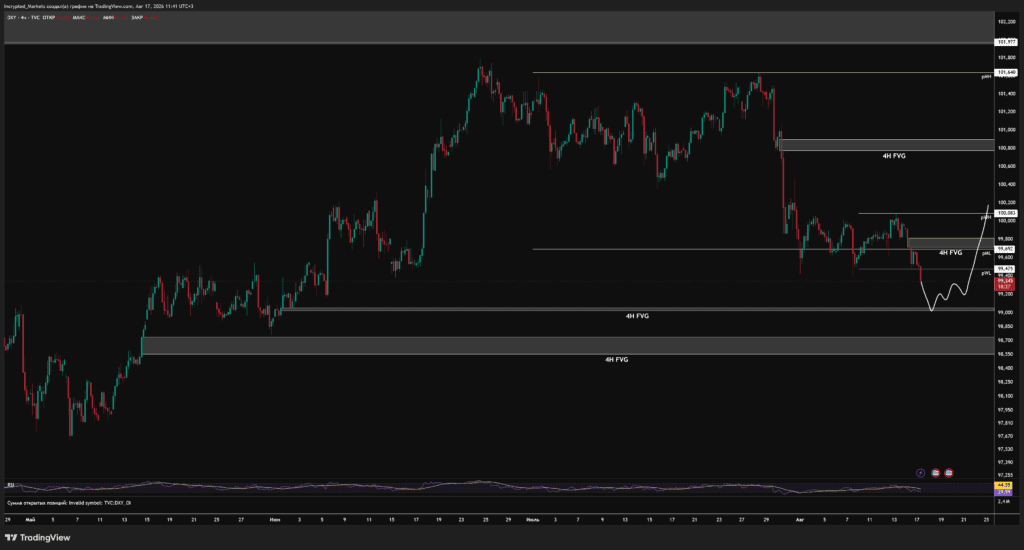
DXY index chart. Data: TradingView.

Scenario B — Pullback-Free Descent to Lower FVG (Priority Bearish)

Sellers maintain full control. The Dollar Index does not receive a bounce from current levels of 99.345 and continues a measured downward move straight to the 4H FVG zone with an upper boundary at the 99.000 level.

Further DXY weakening in this format would create ideal fundamental conditions for the crypto market to rise.
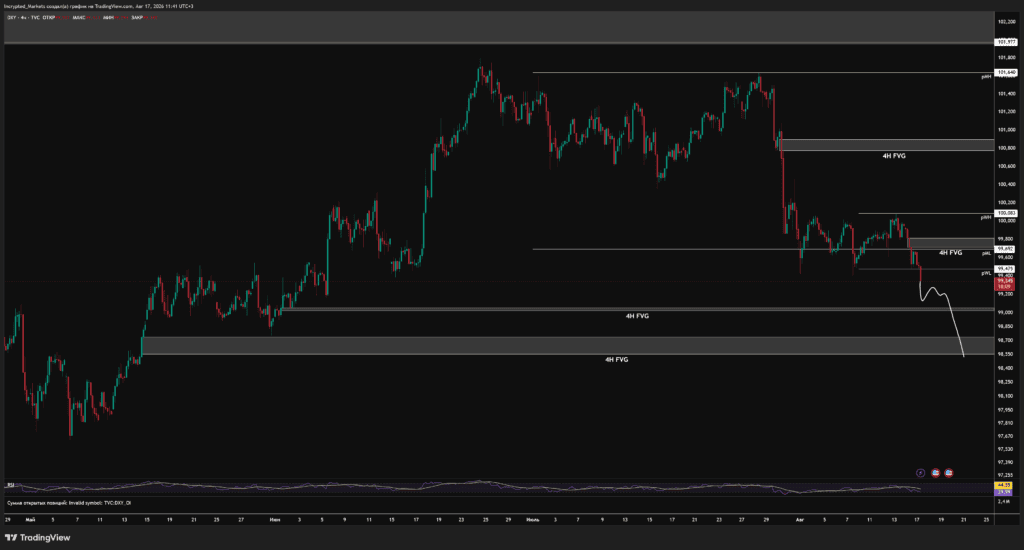
DXY index chart. Data: TradingView.

Scenario C — Retest of Resistance and Continued Decline

Price forms a local technical pullback, testing the zone of the broken PWL level 99.475 from below upwards.

Receiving a firm rejection from sellers in this area, the asset reverses and continues its decline towards the 99.000 block.
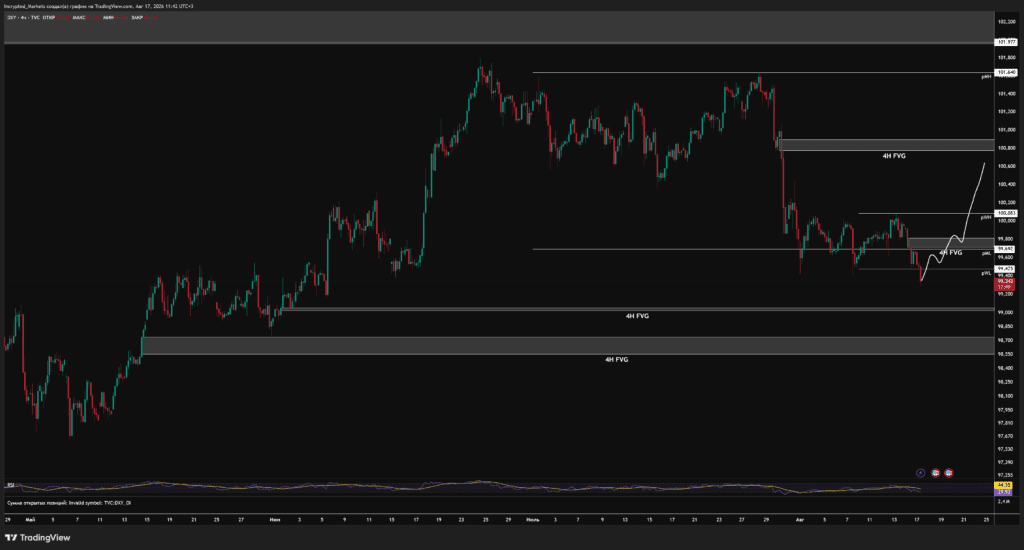
DXY index chart. Data: TradingView.

News Triggers of the Week

  • Wednesday, August 19, 17:30 — Crude oil inventories;
  • Wednesday, August 19, 21:00 — FOMC minutes release. The key event of the week, capable of providing insights into sentiments within the Fed before the September meeting;
  • Thursday, August 20, 15:30 — Philadelphia Fed Manufacturing Index for August;
  • Thursday, August 20, 15:30 — Initial jobless claims;
  • Friday, August 21, 15:30 — Preliminary Manufacturing PMI for August and Services PMI for August.

Sentiment and Tactics

The break of key support radically changes the medium-term balance of power. The market will carefully assess the details of the FOMC's backroom discussions on Wednesday evening.

Until then, chaotic manipulative movements on the thin August order book are possible.

Action plan: maintain focus on lower timeframes. For making trading decisions on crypto assets, it is critically important to see DXY's reaction — either an aggressive return above 99.475, which would be negative for risk assets, or a confident move towards pools at 99.000, which would fuel long positions.

Work systematically and control risks strictly.

Criptos en tendencia

Preguntas relacionadas

QWhat are the three main scenarios for Bitcoin's price movement according to the article, and which one is considered the priority?

AThe three scenarios are: A) Retest of the imbalance and a cascade breakdown downwards; B) Impulsive breakout and assault on resistances; C) Stop-loss hunt and reversal upwards. Scenario C (stop-loss hunt and reversal upwards) is considered the priority (the most logical maneuver for large capital).

QWhat key event and upcoming symposium are highlighted as major triggers for the market this week?

AThe publication of the FOMC meeting minutes and positioning ahead of the Jackson Hole symposium (scheduled for August 27-29) are highlighted as the major triggers for the market this week.

QWhat is the current technical situation for Ethereum, and what potential risk exists despite relative strength in its spot ETFs?

AEthereum is stuck within a 4H FVG (Fair Value Gap) and failed to test the $2000 level. Despite spot ETFs attracting capital for five consecutive weeks (unlike Bitcoin), the risk remains of a synchronous dump of major assets if this relative strength is not converted into dollar-denominated price appreciation.

QWhat happened to the US Dollar Index (DXY) last week, and what is the priority bearish scenario for its next move?

ALast week, the DXY impulsively broke below the previous support level at 99.475. The priority bearish scenario (Scenario B) is a non-rebounding descent directly towards the lower 4H FVG zone, with an upper boundary around 99.000.

QWhat is the recommended overall trading strategy according to the article's summary?

AThe recommended strategy is to stay out of the market for medium-term positions in heavy assets (like Bitcoin and Ethereum). The priority is given to intraday trading on lower timeframes in instruments with high volatility, coupled with strict risk control, until a manipulative level break occurs.

Lecturas Relacionadas

Report on the State of the Crypto Industry by 2026, Featuring Sumsub Vice President for North America, Danielle LaBarbera

The cryptocurrency industry is entering an era of regulated maturity, driven by frameworks like the CLARITY Act and the $GENIUS Act in the US. These provide clearer rules but also raise operational standards, requiring platforms to effectively demonstrate compliance. Simultaneously, fraud is evolving into sophisticated, AI-powered, lifecycle-based attacks, moving beyond simple onboarding scams. According to Daniel LaBarbera, VP of Sumsub for North America, companies must shift from one-time KYC checks to continuous, risk-based verification. This involves integrating identity, behavioral, device, and transaction data into a unified risk view. The 2026 State of Crypto Industry report highlights that while 55% of crypto firms faced fraud last year, effective strategies now combine AI-driven detection, continuous monitoring, and behavioral analytics. Key compliance challenges persist, particularly with the Travel Rule. Only 23% of companies are fully compliant, with high implementation costs, data security concerns, and regulatory fragmentation being major hurdles. Meanwhile, stablecoins are gaining traction, accounting for 36% of all crypto transactions in 2025, and evolving from trading tools into financial infrastructure for payments and settlements. The path forward lies in risk-based approaches that balance security, speed, and user experience. This includes adopting documentless verification, reusable KYC, and breaking down silos between compliance functions to create a holistic, lifecycle view of customer risk and trust.

cryptonews.ruHace 11 min(s)

Report on the State of the Crypto Industry by 2026, Featuring Sumsub Vice President for North America, Danielle LaBarbera

cryptonews.ruHace 11 min(s)

U.S. National Debt Approaches $40 Trillion in 5 Months, Bitcoin Debate Gains Momentum

The US national debt has surged to nearly $40 trillion in just five months, the fastest trillion-dollar increase on record. The debt's growth has accelerated dramatically over time, from taking 192 years to reach the first $1 trillion in 1981 to adding the latest $1 trillion in only five months. The federal budget deficit for the fiscal year is already over $1.8 trillion, exceeding last year's total, and net interest payments on the debt have surpassed $1 trillion, now exceeding defense or Medicare spending. This rapid debt accumulation is fueling arguments within the cryptocurrency industry that Bitcoin serves as a hedge against government-backed currencies and fiscal irresponsibility. Proponents, including some lawmakers and industry leaders, argue Bitcoin could act as a "hard currency" fiscal control mechanism. Legislation has even been proposed for the Treasury to acquire Bitcoin to help reduce the national debt. The International Monetary Fund has warned that global public debt could hit 100% of world GDP by 2029 if current trends continue, with the US and China as primary drivers. Some analyses suggest a sovereign debt crisis could drive capital into alternative assets like Bitcoin, similar to past regional banking crises. However, skeptics point out that both Bitcoin and gold have fallen in price at times during 2026 despite record debt, indicating the depreciation hedge theory may operate over a much longer timeframe than short-term price action.

cryptonews.ruHace 21 min(s)

U.S. National Debt Approaches $40 Trillion in 5 Months, Bitcoin Debate Gains Momentum

cryptonews.ruHace 21 min(s)

Technological Self-Reliance in China: A War from Lithography Machines to ABF Films

"China's Tech Independence: A Battle from Lithography Machines to ABF Film" In August 2026, Japan's Ajinomoto announced a 30% supply cut of ABF film to Chinese mainland clients, causing industry-wide shock and fears of price hikes and shortages in the semiconductor supply chain. That same year, Chinese company Lotus Holdings, known for its MSG business, acquired a small domestic ABF film startup for 103 million yuan, aiming to change this passive situation. ABF film is a core insulating material for advanced CPU, GPU, and AI chip packages. Ajinomoto, originally a food flavoring company, has monopolized over 95% of the global ABF film market for nearly 30 years, deriving its technology from byproducts of monosodium glutamate production. With AI chips consuming 5-10 times more ABF film than traditional chips, the supply-demand gap is widening. Ajinomoto's supply cut to China, where domestic ABF film production accounts for less than 5%, directly threatens the production of domestic high-end AI chips and their substrates. This incident highlights a crucial but often overlooked truth: the vulnerabilities in China's quest for technological self-reliance extend beyond headline areas like lithography machines to critical but seemingly minor components—insulating films, photoresists, electronic specialty gases, etc. The article frames China's tech independence as a multi-front war. While major breakthroughs have been achieved in chip design (e.g., Huawei's HiSilicon), foundry (e.g., SMIC), and memory chips (e.g., YMTC), countless smaller "Ajinomoto-style" chokepoints remain. Lotus Holdings' acquisition represents a significant shift: the battle is no longer fought only by tech giants but has become a collective, industry-wide effort involving companies from diverse backgrounds. Historically, external blockades have often spurred China's technological breakthroughs, as seen with Huawei's Kirin chips and YMTC's 3D NAND flash memory. Ajinomoto's supply cut, while a short-term challenge, may similarly catalyze domestic innovation in ABF film and other critical materials. The path to technological sovereignty is long and arduous, requiring sustained patience and investment to fill every gap in the complex supply chain. Lotus's move is not an immediate solution but a step towards that future, symbolizing a broader, relentless march toward independence.

marsbitHace 41 min(s)

Technological Self-Reliance in China: A War from Lithography Machines to ABF Films

marsbitHace 41 min(s)

Trading

Spot

Artículos destacados

Qué es BITCOIN

Entendiendo HarryPotterObamaSonic10Inu (ERC-20) y Su Posición en el Espacio Cripto En los últimos años, el mercado de criptomonedas ha sido testigo de un aumento en la popularidad de las monedas meme, capturando el interés no solo de los comerciantes, sino también de aquellos que buscan compromiso comunitario y valor de entretenimiento. Entre estos tokens únicos se encuentra HarryPotterObamaSonic10Inu (ERC-20), un proyecto intrigante que mezcla referencias culturales en el tejido de las criptomonedas. Este artículo profundiza en los aspectos clave de HarryPotterObamaSonic10Inu, explorando sus mecanismos, ethos impulsado por la comunidad y su relación con el paisaje cripto más amplio. ¿Qué es HarryPotterObamaSonic10Inu (ERC-20)? Como su nombre sugiere, HarryPotterObamaSonic10Inu es una moneda meme construida sobre la blockchain de Ethereum, clasificada bajo el estándar ERC-20. A diferencia de las criptomonedas tradicionales que pueden enfatizar la utilidad práctica o el potencial de inversión, este token prospera en el valor de entretenimiento y la fuerza de su comunidad. El proyecto tiene como objetivo fomentar un entorno donde los usuarios comprometidos puedan reunirse, compartir ideas y participar en actividades inspiradas por diversos fenómenos culturales. Una característica notable de HarryPotterObamaSonic10Inu es su cero impuestos en las transacciones. Este atractivo elemento tiene como objetivo incentivar el comercio y la participación comunitaria, sin cargos adicionales que puedan disuadir a los comerciantes de pequeña escala. El suministro total de la moneda está establecido en mil millones de tokens, una cifra que marca su intención de mantener una circulación sustancial dentro de la comunidad. Creador de HarryPotterObamaSonic10Inu (ERC-20) Los orígenes de HarryPotterObamaSonic10Inu están algo envueltos en misterio; los detalles sobre el creador siguen siendo desconocidos. El desarrollo de este token carece de un equipo identificable o de un plan explícito, lo cual no es inusual dentro del sector de monedas meme. En cambio, el proyecto ha surgido de manera orgánica, con su progreso muy dependiente del entusiasmo y la participación de su comunidad. Inversores de HarryPotterObamaSonic10Inu (ERC-20) En cuanto a inversiones externas y respaldo, HarryPotterObamaSonic10Inu también sigue siendo ambiguo. El token no lista ninguna fundación de inversión conocida o apoyo organizacional significativo. En cambio, la savia del proyecto es su comunidad de base, que informa su crecimiento y sostenibilidad a través de la acción colectiva y el compromiso en el espacio cripto. ¿Cómo Funciona HarryPotterObamaSonic10Inu (ERC-20)? Como una moneda meme, HarryPotterObamaSonic10Inu opera principalmente fuera de los marcos tradicionales que a menudo rigen el valor de los activos. Hay varios aspectos distintivos que definen cómo funciona el proyecto: Transacciones Sin Impuestos: Sin tarifas impositivas en las transacciones, los usuarios pueden comprar y vender el token libremente sin preocuparse por costos ocultos. Compromiso Comunitario: El proyecto prospera en la interacción comunitaria, aprovechando plataformas de redes sociales para crear entusiasmo y facilitar la participación. Las discusiones, el intercambio de contenido y el compromiso son elementos cruciales que ayudan a expandir su alcance y fomentar la lealtad entre los seguidores. Sin Utilidad Práctica: Cabe señalar que HarryPotterObamaSonic10Inu no ofrece utilidad concreta dentro del ecosistema financiero. Más bien, se clasifica como un token principalmente para actividades de entretenimiento y comunitarias. Referencia Cultural: El token incorpora astutamente elementos de la cultura popular para atraer interés, conectando con entusiastas de los memes y seguidores de las criptomonedas por igual. HarryPotterObamaSonic10Inu ejemplifica cómo las monedas meme operan de manera diferente a los proyectos de criptomonedas más tradicionales, ingresando al mercado como construcciones sociales innovadoras en lugar de activos utilitarios. Cronología de HarryPotterObamaSonic10Inu (ERC-20) La historia de HarryPotterObamaSonic10Inu está marcada por varios hitos notables: Creación: El token surgió de un meme viral, capturando la imaginación de muchos entusiastas de las criptomonedas. Las fechas específicas de creación no están disponibles, subrayando su ascenso orgánico. Listado en Exchanges: HarryPotterObamaSonic10Inu ha llegado a varios exchanges, permitiendo un acceso y comercio más fácil por parte de la comunidad. Iniciativas de Compromiso Comunitario: Actividades continuas destinadas a mejorar la interacción comunitaria, incluyendo concursos, campañas en redes sociales y generación de contenido por parte de fanáticos y defensores. Planes de Expansión Futuros: La hoja de ruta del proyecto incluye el lanzamiento de una colección de NFT, mercancía y un sitio de comercio electrónico relacionado con sus temas culturales, involucrando aún más a la comunidad e intentando añadir más dimensiones a su ecosistema. Puntos Clave Sobre HarryPotterObamaSonic10Inu (ERC-20) Naturaleza Impulsada por la Comunidad: El proyecto prioriza la participación colectiva y la creatividad, asegurando que la involucración de los usuarios esté a la vanguardia de su desarrollo. Clasificación como Moneda Meme: Representa la epítome de las criptomonedas basadas en el entretenimiento, diferenciándose de los vehículos de inversión tradicionales. Sin Afiliación Directa con Bitcoin: A pesar de la similitud en el nombre del ticker, HarryPotterObamaSonic10Inu es distinto y no tiene relación con Bitcoin u otras criptomonedas establecidas. Enfoque en la Colaboración: HarryPotterObamaSonic10Inu está diseñado para crear un espacio para la colaboración y el intercambio de historias entre sus poseedores, proporcionando una vía para la creatividad y el vínculo comunitario. Perspectivas Futuras: La ambición de expandirse más allá de su premisa inicial hacia NFTs y mercancías describe un camino para que el proyecto potencialmente ingrese a avenidas más tradicionales dentro de la cultura digital. A medida que las monedas meme continúan capturando la imaginación de la comunidad de criptomonedas, HarryPotterObamaSonic10Inu (ERC-20) se destaca debido a sus lazos culturales y su enfoque centrado en la comunidad. Si bien puede no encajar en el molde típico de un token impulsado por la utilidad, su esencia radica en la alegría y la camaradería fomentadas entre sus seguidores, destacando la naturaleza en evolución de las criptomonedas en una era cada vez más digital. A medida que el proyecto continúa desarrollándose, será importante observar cómo las dinámicas comunitarias influyen en su trayectoria en el cambiante paisaje de la tecnología blockchain.

2.8k Vistas totalesPublicado en 2024.04.01Actualizado en 2024.12.03

Qué es BITCOIN

Cómo comprar BTC

¡Bienvenido a HTX.com! Hemos hecho que comprar Bitcoin (BTC) sea simple y conveniente. Sigue nuestra guía paso a paso para iniciar tu viaje de criptos.Paso 1: crea tu cuenta HTXUtiliza tu correo electrónico o número de teléfono para registrarte y obtener una cuenta gratuita en HTX. Experimenta un proceso de registro sin complicaciones y desbloquea todas las funciones.Obtener mi cuentaPaso 2: ve a Comprar cripto y elige tu método de pagoTarjeta de crédito/débito: usa tu Visa o Mastercard para comprar Bitcoin (BTC) al instante.Saldo: utiliza fondos del saldo de tu cuenta HTX para tradear sin problemas.Terceros: hemos agregado métodos de pago populares como Google Pay y Apple Pay para mejorar la comodidad.P2P: tradear directamente con otros usuarios en HTX.Over-the-Counter (OTC): ofrecemos servicios personalizados y tipos de cambio competitivos para los traders.Paso 3: guarda tu Bitcoin (BTC)Después de comprar tu Bitcoin (BTC), guárdalo en tu cuenta HTX. Alternativamente, puedes enviarlo a otro lugar mediante transferencia blockchain o utilizarlo para tradear otras criptomonedas.Paso 4: tradear Bitcoin (BTC)Tradear fácilmente con Bitcoin (BTC) en HTX's mercado spot. Simplemente accede a tu cuenta, selecciona tu par de trading, ejecuta tus trades y monitorea en tiempo real. Ofrecemos una experiencia fácil de usar tanto para principiantes como para traders experimentados.

6.1k Vistas totalesPublicado en 2024.12.12Actualizado en 2026.06.02

Cómo comprar BTC

Qué es $BITCOIN

ORO DIGITAL ($BITCOIN): Un Análisis Integral Introducción al ORO DIGITAL ($BITCOIN) ORO DIGITAL ($BITCOIN) es un proyecto basado en blockchain que opera en la red Solana, cuyo objetivo es combinar las características de los metales preciosos tradicionales con la innovación de las tecnologías descentralizadas. Aunque comparte un nombre con Bitcoin, a menudo referido como “oro digital” debido a su percepción como un refugio de valor, ORO DIGITAL es un token separado diseñado para crear un ecosistema único dentro del paisaje Web3. Su meta es posicionarse como un activo digital alternativo viable, aunque los detalles sobre sus aplicaciones y funcionalidades aún están en desarrollo. ¿Qué es ORO DIGITAL ($BITCOIN)? ORO DIGITAL ($BITCOIN) es un token de criptomoneda diseñado explícitamente para su uso en la blockchain de Solana. A diferencia de Bitcoin, que proporciona un papel de almacenamiento de valor ampliamente reconocido, este token parece centrarse en aplicaciones y características más amplias. Aspectos notables incluyen: Infraestructura Blockchain: El token está construido sobre la blockchain de Solana, conocida por su capacidad para manejar transacciones de alta velocidad y bajo costo. Dinámicas de Suministro: ORO DIGITAL tiene un suministro máximo limitado a 100 cuatrillones de tokens (100P $BITCOIN), aunque los detalles sobre su suministro circulante no se han divulgado actualmente. Utilidad: Si bien las funcionalidades precisas no están delineadas explícitamente, hay indicios de que el token podría ser utilizado para diversas aplicaciones, potencialmente involucrando aplicaciones descentralizadas (dApps) o estrategias de tokenización de activos. ¿Quién es el Creador de ORO DIGITAL ($BITCOIN)? En la actualidad, la identidad de los creadores y el equipo de desarrollo detrás de ORO DIGITAL ($BITCOIN) sigue siendo desconocida. Esta situación es típica entre muchos proyectos innovadores dentro del espacio blockchain, particularmente aquellos alineados con las finanzas descentralizadas y fenómenos de monedas meme. Si bien tal anonimato puede fomentar una cultura impulsada por la comunidad, intensifica las preocupaciones sobre la gobernanza y la responsabilidad. ¿Quiénes son los Inversores de ORO DIGITAL ($BITCOIN)? La información disponible indica que ORO DIGITAL ($BITCOIN) no tiene patrocinadores institucionales conocidos ni inversiones destacadas de capital de riesgo. El proyecto parece operar en un modelo de peer-to-peer centrado en el apoyo y la adopción de la comunidad en lugar de rutas de financiamiento tradicionales. Su actividad y liquidez se sitúan principalmente en intercambios descentralizados (DEX), como PumpSwap, en lugar de plataformas de trading centralizadas establecidas, lo que resalta aún más su enfoque de base. Cómo Funciona ORO DIGITAL ($BITCOIN) Los mecanismos operativos de ORO DIGITAL ($BITCOIN) pueden elaborarse en función de su diseño blockchain y atributos de red: Mecanismo de Consenso: Al aprovechar el único proof-of-history (PoH) de Solana combinado con un modelo de proof-of-stake (PoS), el proyecto asegura una validación de transacciones eficiente que contribuye al alto rendimiento de la red. Tokenómica: Si bien los mecanismos deflacionarios específicos no se han detallado extensamente, el vasto suministro máximo de tokens implica que podría atender microtransacciones o casos de uso nicho que aún están por definirse. Interoperabilidad: Existe el potencial de integración con el ecosistema más amplio de Solana, incluyendo varias plataformas de finanzas descentralizadas (DeFi). Sin embargo, los detalles sobre integraciones específicas permanecen no especificados. Cronología de Eventos Clave Aquí hay una cronología que destaca hitos significativos relacionados con ORO DIGITAL ($BITCOIN): 2023: El despliegue inicial del token ocurre en la blockchain de Solana, marcado por su dirección de contrato. 2024: ORO DIGITAL gana visibilidad al estar disponible para trading en intercambios descentralizados como PumpSwap, permitiendo a los usuarios comerciar contra SOL. 2025: El proyecto presencia actividad de trading esporádica y potencial interés en compromisos liderados por la comunidad, aunque no se han documentado asociaciones notables o avances técnicos hasta el momento. Análisis Crítico Fortalezas Escalabilidad: La infraestructura subyacente de Solana soporta altos volúmenes de transacciones, lo que podría mejorar la utilidad de $BITCOIN en varios escenarios de transacción. Accesibilidad: El potencial bajo precio de trading por token podría atraer a inversores minoristas, facilitando una participación más amplia debido a oportunidades de propiedad fraccionada. Riesgos Falta de Transparencia: La ausencia de patrocinadores, desarrolladores o un proceso de auditoría conocidos públicamente puede generar escepticismo sobre la sostenibilidad y confiabilidad del proyecto. Volatilidad del Mercado: La actividad de trading depende en gran medida del comportamiento especulativo, lo que puede resultar en una volatilidad de precios significativa y en incertidumbre para los inversores. Conclusión ORO DIGITAL ($BITCOIN) surge como un proyecto intrigante pero ambiguo dentro del ecosistema de Solana en rápida evolución. Si bien intenta aprovechar la narrativa del “oro digital”, su alejamiento del papel establecido de Bitcoin como refugio de valor subraya la necesidad de una diferenciación más clara de su utilidad y estructura de gobernanza previstas. La aceptación y adopción futura dependerán probablemente de abordar la actual opacidad y de definir sus estrategias operativas y económicas de manera más explícita. Nota: Este informe abarca información sintetizada disponible hasta octubre de 2023, y pueden haber ocurrido desarrollos más allá del período de investigación.

565 Vistas totalesPublicado en 2025.05.13Actualizado en 2025.05.13

Qué es $BITCOIN

Discusiones

Bienvenido a la comunidad de HTX. Aquí puedes mantenerte informado sobre los últimos desarrollos de la plataforma y acceder a análisis profesionales del mercado. A continuación se presentan las opiniones de los usuarios sobre el precio de BTC (BTC).

活动图片