Consensus Live | Avenir Group, Tiger, AMINA, and CoinRoutes Discuss Institutional Capital Efficiency and Financial Infrastructure Evolution

marsbitPublicado a 2026-02-11Actualizado a 2026-02-11

Resumen

At Consensus Hong Kong 2026, the institutional investment narrative is structurally shifting toward multi-asset allocation, yet cross-system frictions are diluting capital efficiency. Avenir Group, in partnership with Tiger Brokers, AMINA Bank, and CoinRoutes, led a roundtable on next-generation institutional trading infrastructure. Key consensus emerged: the industry must transition from an asset-centric to a capital-centric framework to optimize efficiency in a multi-asset environment. Panelists highlighted challenges including fragmented capital utilization due to segregated systems, misaligned clearing cycles causing idle capital, and the need for natively compliant, scalable infrastructure. Avenir Group and partners signed an MOU to explore collaborative solutions, emphasizing that future competitiveness hinges on unified capital management and cross-asset operational capabilities within regulatory frameworks.

At Consensus Hong Kong 2026, the narrative focus of institutional investors is undergoing a structural shift. As regulatory frameworks mature, crypto assets are accelerating their integration into institutional portfolios, moving beyond exploratory allocations. However, this transition towards multi-asset allocation has highlighted a new theme: although portfolios are expanding across asset classes, cross-system friction is diluting capital efficiency.

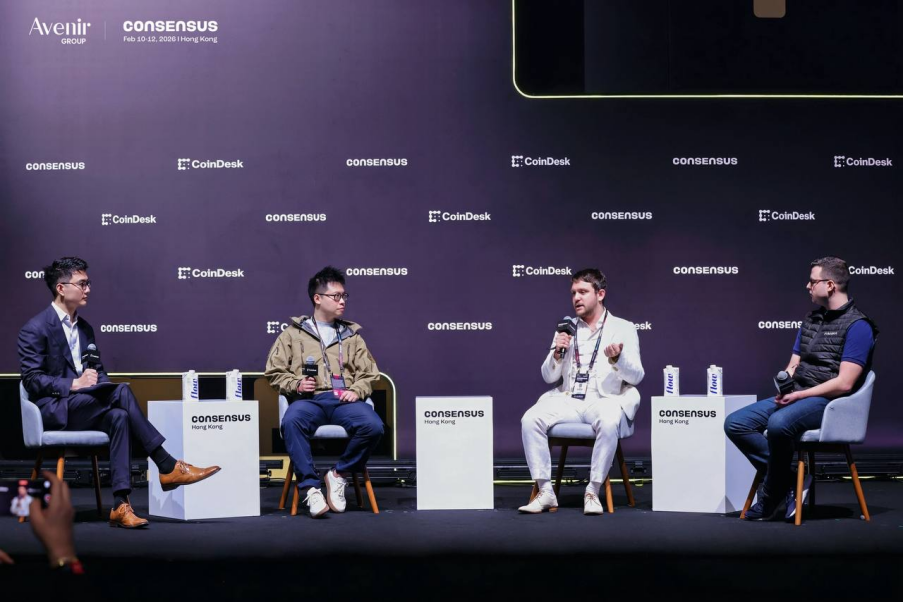
Avenir Group, an investment group dedicated to promoting the integration of traditional finance and digital assets, has observed that as the scale of institutional participation grows, the completeness of infrastructure is increasingly impacting institutional capital efficiency. As an official partner of Consensus Hong Kong 2026, Avenir Group initiated a roundtable discussion titled "Next-Generation Institutional Trading Infrastructure." Industry leaders from global leading tech brokerage Tiger Brokers, Swiss FINMA-regulated crypto bank AMINA Bank AG (“AMINA Bank”), and leading multi-asset institutional trading platform CoinRoutes systematically deconstructed the reasons behind constrained capital efficiency in a multi-asset environment and jointly explored potential evolutionary directions.
Industry Consensus: A Foundational Restructuring from "Asset-Oriented" to "Capital-Oriented"

During the discussion, a core consensus was reached: the industry must shift from an "Asset-Centric" infrastructure framework to a "Capital-Centric" framework.

In the past, an asset-centric model, optimized for single asset classes, could meet demands. However, in the complex era of multi-asset markets, this model may lead to a certain degree of capital efficiency drain. When institutions manage traditional and digital assets in parallel, the inherent differences between these assets—from price volatility to clearing and settlement cycles—result in hidden capital occupation and execution friction. These are no longer mere operational inconveniences but can become significant structural constraints affecting overall capital efficiency.

Roundtable guests shared deep insights from different parts of the value chain:

· Holistic Capital Efficiency Utilization: Felix Huang Shuojun, Global Partner at Tiger Brokers International, pointed out that traditional markets improve capital utilization through margin interoperability; however, the inclusion of digital assets disrupts this synergy. Existing systems are often designed around "asset isolation" rather than "overall capital efficiency," making it difficult for institutions to achieve cross-asset capital allocation within a unified framework.

· Efficient Execution and Liquidity Linkage: Ian Weisberger, CEO and Co-Founder of CoinRoutes, added that misaligned clearing rhythms leave substantial funds idle during trading gaps. What institutions urgently need is unified execution capability across markets and for multi-leg strategies, as well as flexible rotation of positions and risk across different asset classes.

· Compliance-First Infrastructure: Myles Harrison, Chief Product Officer at AMINA Bank, emphasized that compliance is not the opposite of efficiency but a prerequisite for the safe operation of the system. The pain point lies in the industry's lack of a natively multi-asset supportive infrastructure that also possesses high transparency and scalability, thereby unlocking capital potential within a global compliance framework.

Jacob Zhong, Managing Partner of Strategic Investment and Cooperation at Avenir Group, stated: "Synthesizing industry insights, the direction of infrastructure evolution has become relatively clear. As institutional participation in multi-asset environments deepens, the market increasingly requires an infrastructure capable of unified cross-asset capital allocation, synchronized trading execution and clearing rhythms, and embedding compliance capabilities natively into the system (rather than as an afterthought patch). In this direction, more integrated and regulation-adaptive infrastructure is gradually becoming a crucial support for enhancing capital efficiency and enabling cross-asset operations at scale."

Building the Ecosystem Together: Advancing Financial Infrastructure Evolution Through Collaborative Action

At the conclusion of the thematic discussion, Avenir Group, Tiger Brokers, AMINA Bank, and CoinRoutes formally signed a Memorandum of Understanding (MOU) to explore potential future cooperation.

The integration of traditional finance and digital assets is not merely a technical or product-level consolidation but a progressive, systematic compliance engineering project. As multi-asset allocation becomes the norm, the competitive focus among institutions is shifting—it no longer depends solely on market access capabilities but on the systemic ability to manage and flexibly allocate capital under a compliance framework.

Avenir Group looks forward to collaborating with a broader range of financial institutions and technology partners. By fostering dialogue and cooperation across the entire ecosystem, Avenir Group aims to join hands with industry partners to jointly promote a more synergistic and scalable infrastructure path, gradually turning the enhancement of capital efficiency from an industry consensus into verifiable practice.

About Avenir Group

Avenir Group is a pioneering investment group focused on driving the integration of traditional finance and digital assets, building the financial infrastructure of the future. The group adopts an integrated "Investment—Incubation—Operation" strategy, with a core investment portfolio focusing on digital asset management, trading and financial services platforms, payment finance (PayFi) infrastructure, and real-world asset (RWA) tokenization, providing the industry with institutional-grade products and services, and continuously promoting financial innovation and the development of emerging technologies. As the largest institutional holder of Bitcoin ETFs in Asia, Avenir Group expands its business globally, covering Hong Kong, Singapore, Tokyo, London, San Francisco, and more. Leveraging robust capital strength and professional operational capabilities, the group is committed to becoming a strategic hub connecting Eastern and Western capital, driving efficient global capital flow and collaboration. Learn more: https://avenirx.com

Preguntas relacionadas

QWhat is the main shift in the narrative focus for institutional investors at Consensus Hong Kong 2026, as discussed by Avenir Group and partners?

AThe narrative focus is shifting structurally from exploratory allocation of crypto assets to their accelerated integration into institutional portfolios, highlighting the theme that cross-system friction is diluting capital efficiency despite multi-asset expansion.

QAccording to the roundtable, what fundamental change is needed in infrastructure frameworks to improve capital efficiency in multi-asset environments?

AThe industry must transition from an 'Asset-Centric' infrastructure framework to a 'Capital-Centric' one to enable unified capital scheduling across assets, synchronized execution and settlement rhythms, and natively embedded compliance capabilities.

QWhat specific capital efficiency challenge did Felix Huang Shuojun from Tiger International highlight regarding digital assets?

AHe pointed out that while traditional markets improve capital utilization through margin interoperability, the inclusion of digital assets disrupts this synergy. Existing systems designed for 'asset isolation' rather than 'overall capital efficiency' hinder unified cross-asset capital scheduling.

QHow did Ian Weisberger of CoinRoutes and Myles Harrison of AMINA Bank contribute to the discussion on infrastructure needs?

AIan Weisberger emphasized the need for unified execution capabilities across markets and flexible rotation of positions and risk between asset classes, citing idle funds due to misaligned settlement cycles. Myles Harrison stressed the necessity for native multi-asset infrastructure with high transparency and scalability that operates within global compliance frameworks to unlock capital potential.

QWhat action did Avenir Group and its partners take following the roundtable discussion, and what is their broader goal?

AThey signed a strategic Memorandum of Understanding (MOU) to explore future collaboration. Avenir Group aims to work with financial institutions and tech partners to promote dialogue and cooperation, advancing more synergistic and scalable infrastructure paths to turn capital efficiency consensus into verifiable practice.

Lecturas Relacionadas

Can Generative Models Finally Be Trained End-to-End? The Core Is a For Loop

This article introduces a novel training paradigm for generative models called Explorative Modeling (XM), which enables true end-to-end training. Traditionally, powerful generative models like autoregressive and diffusion models are not trained end-to-end. They are trained to predict a single small step but require iterative multi-step sampling for inference. This "exposure bias" leads to error accumulation and limits performance. The core challenge XM addresses is "mode blurring." In generative tasks, a single input (e.g., "generate a dog") corresponds to many valid outputs (multiple modes). Standard training objectives like reconstruction loss force the model to average these modes, producing unrealistic, blurry outputs. To avoid this, existing models break generation into many small, almost deterministic steps, sacrificing end-to-end training. XM tackles this by restructuring the training loop itself. Its key insight is to amplify "generative expressivity." For each training input, instead of generating one sample, the model generates K candidate outputs. Only the candidate closest to the real data is used for computing the loss and updating the model via backpropagation. This simple "best-of-K" mechanism is implemented as a short for-loop. By exploring multiple possibilities, the model learns to distribute its guesses across different modes rather than collapsing to their uninformative average. The paper demonstrates that "exploration" acts as a new, powerful scaling axis. Gains from XM increase with model size, data scale, and compute. Experiments show improvements in FID scores for image generation and significant efficiency gains, sometimes outperforming larger models without exploration. When pushed to the limit, XM enables fully single-step, end-to-end generative models. In robotics tasks, an "Explorative Policy" matched the performance of a 100-step Diffusion Policy with a single forward pass, drastically improving inference speed. While the best-of-K concept is not entirely new, the authors' contribution lies in formally understanding it as a direct method to boost generative expressivity without fragmenting the generation process. This work suggests that as models scale, enhancing exploration during training may become crucial for overcoming fundamental performance bottlenecks.

marsbitHace 10 min(s)

Can Generative Models Finally Be Trained End-to-End? The Core Is a For Loop

marsbitHace 10 min(s)

Annual Salary of Millions Competing for Electricians, Meta Rushes to Open Its Own Technical School

The AI boom is facing an unexpected bottleneck: a severe shortage of skilled construction workers and electricians. As tech giants like Meta, OpenAI, and Alphabet race to build massive data centers—such as OpenAI's $16 billion "Stargate" project—they are hitting a critical labor wall. The U.S. needs an estimated 130,000 more electricians, 240,000 construction workers, and 150,000 supervisors by 2030 for AI infrastructure alone, but tens of thousands of electrician jobs go unfilled each year. While AI companies offer high premiums, with electricians earning up to $280,000 annually, worker scarcity still causes massive losses—delays on a single project can cost $14.2 million per month. The complexity of building AI data centers, which require immense power (equivalent to powering hundreds of thousands of homes), sophisticated electrical systems, and advanced liquid cooling solutions, demands highly skilled technicians who are in short supply. To combat this, companies are investing heavily in training. Meta has committed $115 million to a free training school offering tuition, housing, and stipends, targeting 5,000 new workers. OpenAI is partnering with unions to secure skilled labor. These efforts are paying off, with a significant rise in Gen Z interest in trade schools over college. However, the power demands are staggering. AI data centers are driving a rapid surge in electricity consumption, projected to account for up to 12% of U.S. power use by 2028 and raising costs for consumers. Furthermore, the construction boom is project-based, leading to a potential future glut of trained workers once building peaks, which could depress wages industry-wide. The race for AI supremacy now depends as much on skilled hands as on advanced chips.

marsbitHace 1 hora(s)

Annual Salary of Millions Competing for Electricians, Meta Rushes to Open Its Own Technical School

marsbitHace 1 hora(s)

Trading

Spot
活动图片