Comprehensive Analysis of Canton Network: Wall Street's Blockchain Ambition

marsbitPublicado a 2026-03-15Actualizado a 2026-03-15

Resumen

Canton Network is positioned at the convergence of key crypto trends, including real-world asset tokenization, institutional blockchain adoption, privacy infrastructure, and stablecoin settlements. It has attracted major financial institutions like DTCC, Nasdaq, and Broadridge, which are deploying real workflows such as treasury tokenization, repo financing, and collateral management. The network is designed for regulated entities, offering granular transaction privacy and validator-level control while maintaining interoperability. Its architecture separates execution from coordination, using validator nodes operated by participants and synchronizers for atomic settlement. Key adoptions include DTCC tokenizing U.S. Treasuries, Broadridge processing trillions in repo transactions, and Nasdaq integrating its Calypso platform. Tokenomics are usage-driven, with weekly CC burns increasing by 216% since TGE, and the burn-to-mint ratio rising to 0.90, nearing a deflationary state. Despite generating the highest revenue among L1s in February, Canton trades at a discount to peers, possibly due to high emissions and its perception as financial infrastructure. Catalysts include regulatory clarity from the Clarity Act and DTCC’s broader tokenization platform launch in late 2026. Risks include token concentration, with 54% of CC held by a few entities, though these are largely operational holdings. Canton aims to become a core coordination layer for tokenized financial markets.

Source: Blockworks Research

Author: Kunal Doshi

Compilation and Editing: BitpushNews

Several of the most important narratives in the crypto space are beginning to converge: including the tokenization of real-world assets (RWA), institutional-grade blockchain adoption, privacy infrastructure, and stablecoins as a settlement rail.

Canton Network is at the intersection of these trends and has assembled the industry's most powerful group of institutional participants.

Major financial institutions, including DTCC (The Depository Trust & Clearing Corporation), Nasdaq, Broadridge, and several global banks, have already deployed real-world workflows on the network covering treasury tokenization, repo financing, collateral management, and payments.

If this trend continues, Canton could become the coordination layer for the tokenized financial market, with assets, cash, and collateral moving between institutions in real-time. As more financial activity flows through the network, the volume of transaction coordination increases, driving up network revenue and token burn, pushing the network towards deflation.

Key Takeaways

  • Architecture designed for regulated institutions. Canton supports granular transaction privacy and validator-level control while maintaining interoperability between applications, addressing key compliance hurdles faced by institutions.
  • Adoption spans the entire institutional financial stack. DTCC is bringing regulated collateral on-chain; Broadridge processes over $7 trillion in repo activity monthly; Nasdaq is integrating Canton with its Calypso risk and collateral management platform.
  • Network effects may increase coordination activity. As more institutions join and transact with each other, the number of counterparties increases, and more transactions are routed through the "Global Synchronizer," driving higher CC burn.
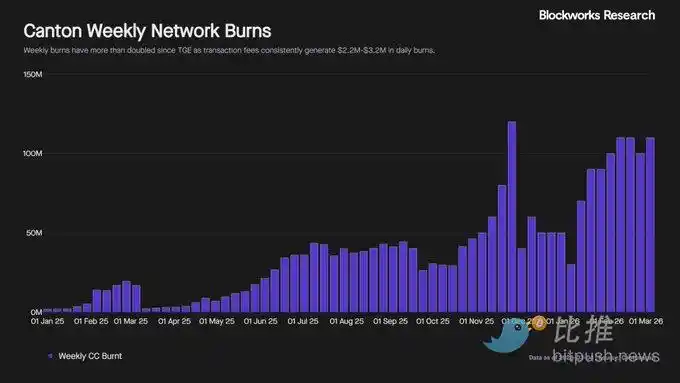
  • Tokenomics increasingly driven by usage. Since the Token Generation Event (TGE), the weekly burn has grown by 216%, and the burn-to-mint ratio has risen to 0.90. If activity continues to expand, the network will approach a potentially deflationary state.
  • Valuation remains discounted relative to peers. Canton generated the highest revenue (REV) among major L1 networks in February, but its trading multiples are lower, possibly reflecting recent inflation and the market viewing it more as financial infrastructure than a general-purpose public chain.
  • Regulatory clarity and institutional rollouts are key catalysts. The passage of the Clarity Act and DTCC's broader tokenization platform launch in the second half of 2026 could accelerate institutional adoption and increase the volume of assets and transactions moving on Canton.
  • Token concentration remains a potential risk. Approximately 54% of the circulating CC is held by a small number of network participants, although many of these balances are operational rewards rather than speculative holdings.

Pain Points of Institutional Tokenization

Tokenization promises faster settlement, lower reconciliation costs, and more efficient capital utilization. But in practice, most blockchain designs force institutions to choose between regulatory compliance and the ability to transact across a shared network.

The Basel Committee on Banking Supervision has made it clear that the choice of infrastructure directly impacts regulatory treatment. Banks tokenizing traditional assets must demonstrate robust governance, clear validator control, strong data privacy, and sound operational risk management. If these conditions are not met, tokenized exposures could face significantly higher capital charges, eroding the economic benefits tokenization is meant to bring.

  • Public permissionless blockchains offer interoperability and composability, but transaction data is visible to validators and potentially the entire market. For regulated institutions, broadcasting information about liquidity needs, margin movements, or collateral positions is unacceptable. Even anonymized activity can leak commercially sensitive insights. Institutions need to know who validates their transactions and who has access to their data.
  • Private blockchains restrict access but introduce fragmentation. Each network becomes a silo, limiting asset liquidity and cross-platform composability. Privacy is often implemented at a broad channel level, and participants might still see more activity than a strict "need-to-know" basis allows.

Thus, institutions face a structural trade-off: public networks lack sufficient control, while private networks lack meaningful interoperability. Canton aims to bridge this gap by combining granular privacy and validator-level control with shared synchronization and atomic settlement across independent applications.

Network Architecture and Privacy Model

Canton separates execution from coordination. Smart contracts written in Daml run on validator nodes operated by participating institutions and application providers. Each organization runs its own validator node, which serves as its gateway to the network and only validates transactions it participates in. This design allows institutions to maintain control over their infrastructure and transaction validation.

Validators connect to a Synchronizer, responsible for routing and ordering messages between parties. The Synchronizer ensures multi-party transactions are settled atomically and consistently among participants. It does not validate transactions and cannot view transaction data, as all messages are end-to-end encrypted. The Synchronizer only orders the encrypted payloads, similar to a post office handling sealed envelopes.
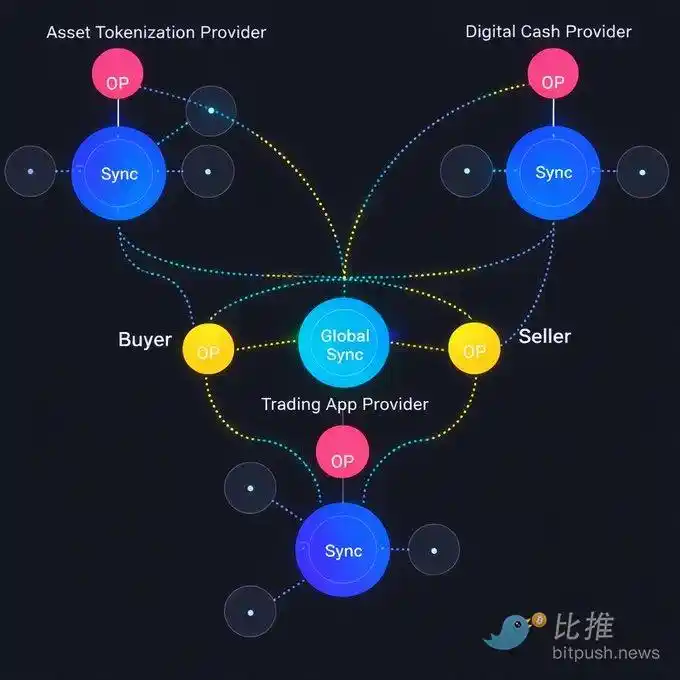
Canton supports multiple synchronizers. The Global Synchronizer acts as a shared public coordination layer operated by "Super Validators" using Byzantine Fault Tolerant (BFT) consensus. It provides a neutral backbone, allowing independent applications and institutions to interoperate while maintaining the flexibility of a connected ecosystem.

Network Participants

Validators: Infrastructure nodes operated by institutions. They store contract state, validate participating transactions, and provide application interfaces for users and services.

Applications: Business logic deployed on validators. They define the contract rules and data permissions for use cases like stablecoins, repo, custody, and tokenized assets.

Super Validators: Operate the Global Synchronizer and ensure decentralized message ordering for the public network. While validators only validate transactions they participate in, Super Validators maintain the shared coordination layer.

Governance is kept transparent through the Canton Foundation and follows institutional standards. Anyone can view or submit Canton Improvement Proposals (CIPs). The Super Validators operating the Global Synchronizer vote on key decisions, including upgrades and changes to code and services. The Canton Foundation supports the development and oversight of the Global Synchronizer, ensuring governance actions are publicly visible and members are involved. The Foundation runs a node on behalf of its members and participates in governance votes, helping to maintain the network's neutrality and trust.

Institutional Adoption to Date

DTCC Integrates DTC-Custodied Treasuries with Canton

DTCC is a core post-crisis infrastructure provider for the US capital markets. Through its central securities depository subsidiary (DTC), it custodies and protects over $100 trillion in assets, including stocks, ETFs, money market instruments, and more. Its decision to tokenize a subset of DTC-custodied Treasuries on Canton represents a structural step towards bringing core market collateral on-chain.

After receiving a "No Action Letter" from the SEC (Securities and Exchange Commission), DTCC announced plans to mint a subset of DTC-custodied Treasuries on Canton, with its MVP (Minimum Viable Product) targeted for the first half of 2026. These are not synthetic assets; the tokenized Treasuries retain the same CUSIP, meaning they remain the same security legally and operationally within existing market infrastructure. Participants can use the asset in traditional systems or in tokenized form without changing its legal status.

DTCC has also joined Canton as a Super Validator, operating infrastructure for the Global Synchronizer and participating in network governance.

More important than the issuance are the use cases proven. A Canton working group including Bank of America, Circle, Citadel, Cumberland, Société Générale, Tradeweb, and Virtu has completed real-time on-chain US Treasury financing for stablecoins. These transactions include weekend repos, atomic settlement, and real-time collateral reuse. DTCC's move brings regulated collateral on-chain, and these transactions demonstrate that these assets can be actively financed and mobilized at an institutional scale.

Broadridge: Institutional Repo at Production Scale

Broadridge's Distributed Ledger Repo (DLR) platform currently processes over $350 billion in daily transaction volume. Repos (repurchase agreements) are short-term collateralized financing backed by assets like US Treasuries and are a core liquidity engine for global capital markets. This activity is already running in production on Canton.
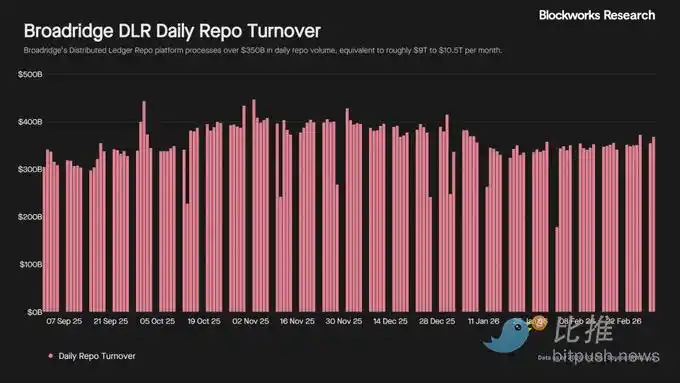
DLR has been operational since 2021, with a user base including major banks, broker-dealers, and traditional asset managers. The platform integrates with existing market infrastructure, including custodians, front-office trading systems, and back-office settlement platforms, allowing institutions to onboard with minimal operational disruption.

Within DLR, key components of the repo lifecycle are handled on-chain, including the custody of tokenized collateral, execution of repo trades, and settlement of cash and securities between counterparties. Certain operational processes remain off-chain, such as archival record-keeping and updates to control over the underlying collateral held in traditional custodian accounts. As DTCC plans to bring regulated, high-quality collateral directly onto Canton, the associated repo financing can also occur on-chain, which would increase activity on the Broadridge DLR platform.

Nasdaq: On-Chain Margin and Collateral Infrastructure

Nasdaq has completed a pilot connecting its Calypso platform to the Canton Network. Calypso is one of the most widely used institutional systems for managing risk, margin, and collateral among global banks and asset managers. This pilot demonstrated how on-chain infrastructure can integrate directly with existing institutional risk systems.

The test was conducted jointly by QCP, Primrose Capital, and Digital Asset. Enterprises can automatically calculate margin requirements on-chain in real-time and move collateral between counterparties, while continuing to use their existing portfolio and risk systems. For institutions operating across time zones and asset classes, this reduces operational friction and improves capital efficiency.

Nasdaq has also joined Canton as a Super Validator. This builds on Nasdaq's strategic investment in Digital Asset (the creator of Canton), with other investors including BNY (Bank of New York), iCapital, and S&P Global.

Other Key Institutional Partners

Several other global institutions are building applications on Canton. JPMorgan plans to natively introduce JPM Coin to the network for 24/7 institutional cash and collateral settlement. London Stock Exchange Group (LSEG) is launching its digital clearing house on Canton to support real-time post-trade workflows. Lloyds Banking Group executed the UK's first production-grade tokenized Treasury and deposit transaction on the network.

These initiatives are supported by a growing number of Super Validators operated by Digital Asset, Tradeweb, Cumberland, and others.

Institutional Impact

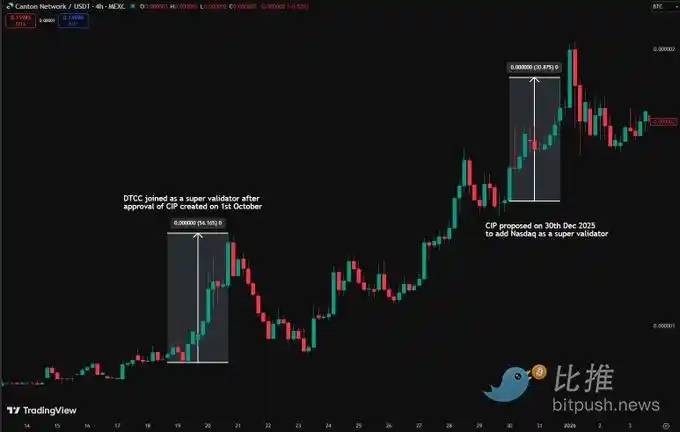
Announcements of major financial institutions becoming Super Validators have served as short-term price catalysts. Following the confirmations of DTCC and Nasdaq as Super Validators, CC outperformed BTC by 54% and 31%, respectively, over the subsequent two days. This move likely reflects increased market confidence that globally recognized financial institutions are committing to the network at the infrastructure and governance level, not just at the application level.
Beyond narrative-driven price movements, these developments could translate into sustained network activity:

  • Nasdaq's work focuses on collateral management. Margin recalculations, collateral pledging, and portfolio adjustments are high-frequency activities. If these workflows move on-chain between independent institutions, they will generate ongoing coordination transactions.
  • DTCC and Broadridge represent the asset and funding layers. DTCC brings regulated collateral on-chain, while Broadridge already facilitates repo financing activity at scale. Tokenizing an asset is a one-time act; the real potential lies in these Treasuries being repeatedly financed, pledged, and reused among counterparties.

Currently, much of the activity from large institutions runs in private synchronization environments, not through the Global Synchronizer. Therefore, this activity has not yet contributed substantially to the Global Synchronizer's message flow. However, as more independent institutions onboard and begin transacting with each other, the demand for coordination will increase. Each new participant expands the number of potential counterparties, enhancing the network effects of the entire system. Transactions spanning multiple validators are routed through the Global Synchronizer. As the scale of cross-institutional financing and collateral activity grows, the message volume will translate into higher CC burn.

Tokenomics

Transactions spanning multiple validators are ordered through the Global Synchronizer, where fees are paid by burning CC. Fees are priced in "USD per MB of transaction data" but settled in CC using an on-chain conversion rate. These fees are burned rather than paid to validators, directly reducing the token supply. This structure allows institutions to pay predictable, USD-based infrastructure costs while linking network usage to token supply dynamics.

Burn Trends: Since TGE, the weekly CC burn has grown by 216%, from 46.2 million to approximately 100 million. In USD terms, daily fees in recent weeks have ranged between $2.2 million and $3.2 million. As a percentage of the circulating supply, the weekly burn rate has increased from 0.14% to 0.26%, with some weeks even exceeding 0.30%.
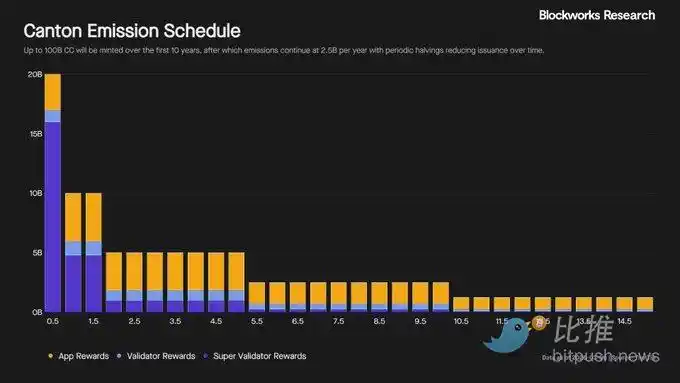
  • Emission Model: CC follows a pure earn model. There was no pre-allocation to investors, team, or foundation. All tokens are minted through network participation. A total of 100 billion CC can be minted over the first 10 years, followed by a fixed annual emission of 2.5 billion thereafter.

  • Halvings: Periodic halvings reduce the output over time. The most recent occurred on January 12, 2026, cutting the annual emission from 20 billion to 10 billion.

Reward Distribution: Newly minted tokens are distributed to Applications, Validators, and Super Validators. Over time, the allocation focus has shifted: the emission share for Super Validators has decreased from 80% at launch to 20% currently, while Application rewards have increased from 15% to 62%. The system is intentionally transitioning from early infrastructure incentives to application-driven incentives.
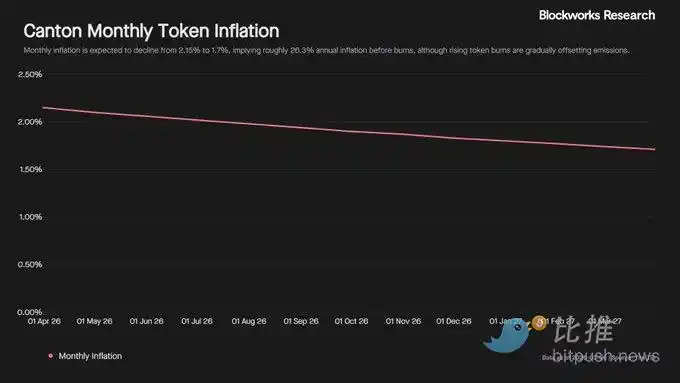
Inflation vs. Deflation: The current monthly inflation rate is gradually decreasing from 2.15% to 1.7% (approx. 26.3% annualized). While still high relative to other L1s, the burn rate is rapidly closing the gap. Since TGE, the daily burn-to-mint ratio has risen from 0.16 to 0.90.
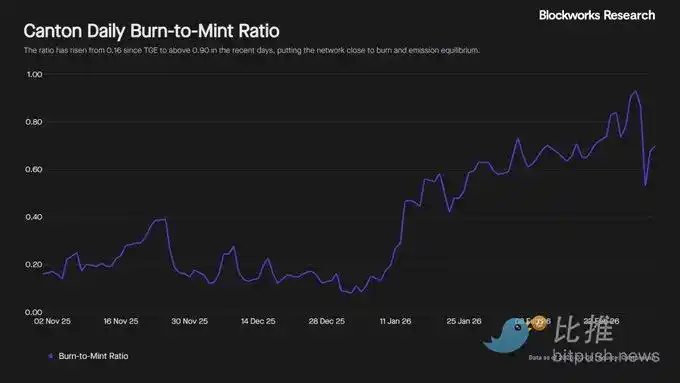
At the current rate, Canton is approaching a balance point where daily burn equals daily mint. If the burn ratio consistently exceeds 1, the network will enter net deflation, directly addressing a primary investor concern.

Active Applications and Emerging Use Cases

Looking at the top 10 applications by reward share, the number of active earners is steadily expanding, indicating a growing, healthy ecosystem. At current prices, approximately $82.2 million worth of CC is distributed to applications monthly. This creates significant economic incentives for builders, who can also pass rewards on to end-users to bootstrap liquidity and usage.
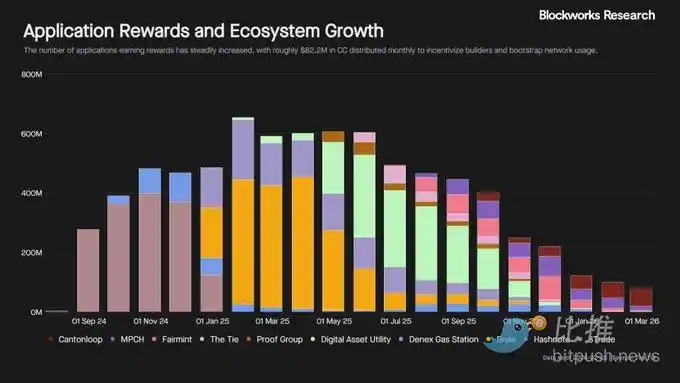
  • Brale: Currently leads in reward share. It has constructed a bridge converting USDC and USDT into Canton-native equivalents, enabling private, institutional-grade payments and settlement. It effectively serves as the ecosystem's on/off-ramp, allowing treasury and capital markets participants to move cash on-chain without exposing transaction details.

  • Hashnote: (Acquired by Circle in January 2025) brings yield-bearing collateral on-chain via USYC, a tokenized reverse repo product with assets under management exceeding $1 billion. USYC can be used for margin, collateral, and trading workflows while preserving privacy. Subscription fees are paid in CC, and Hashnote redistributes part of the rewards to connected validators.

Other top reward earners include infrastructure and tooling services: Denex Gas Station (bandwidth management), Cantara (peer-to-peer billing), Fairmint (on-chain equity issuance), The Tie (analytics services), 5North’s Loop (wallet provider), and Digital Asset’s DA Utility (asset tokenization standard).

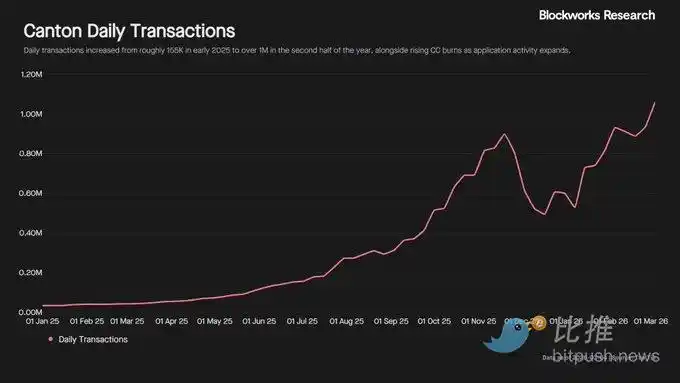
As the application base expands, network activity has increased dramatically. Daily transaction volume grew from around 155,000 in the first half of 2025 to over 1 million in the second half.
Circle's launch of USDCx is a significant recent development. USDCx is a privacy-preserving stablecoin, 1:1 backed by USDC in Circle's reserves. Only transacting parties can view the details, addressing a major obstacle to institutional stablecoin adoption.

In February 2026, a multinational corporation executed the first private on-chain stablecoin payroll on Canton. The transaction was powered by Toku (managing payroll logic) and Cantor8 (providing secure employee wallets).

Valuation Analysis

In terms of network revenue (REV), defined as paid block space and settlement coordination fees, Canton generated the highest revenue among major L1s in February, at $74.7 million, roughly 2.8 times that of second-place Solana.

We use the 10-year supply milestone of 100 billion to estimate the Fully Diluted Valuation (FDV). In practice, Canton's future supply is dynamic due to ongoing burns.
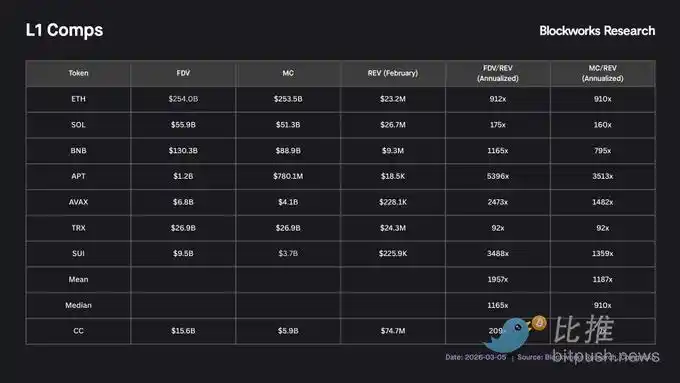
Despite a conservative adjustment for future supply expansion, Canton still trades at a significant discount to other L1 networks on both Market Cap/Revenue (MC/REV) and FDV/Revenue (FDV/REV) multiples.

  • Reason 1: Recent token emissions are high.

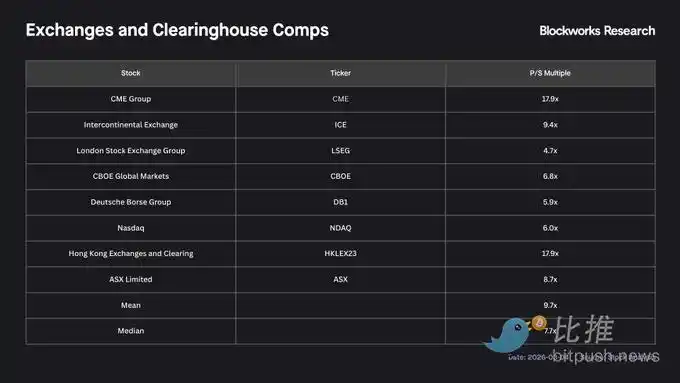
  • Reason 2: The market's interpretation of Canton's role. The market currently views it as financial infrastructure rather than a general-purpose public chain. Compared to traditional financial market infrastructure providers like CME, Nasdaq, ICE, and LSEG (which typically trade at multiples around 8x), Canton's valuation is more in line with them.
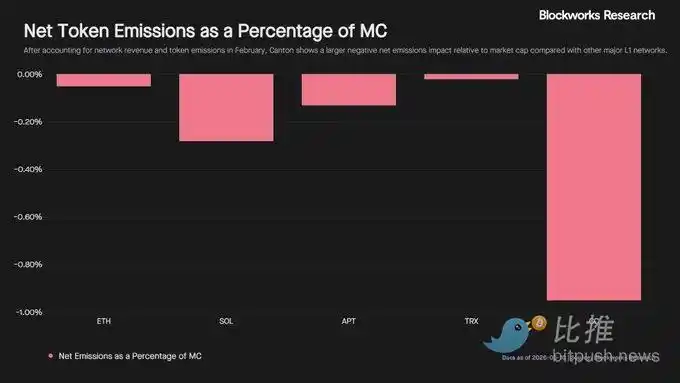
Additional upside potential could stem from the network beginning to support applications that generate sustained on-chain activity, such as prediction markets, perpetual trading, and lending markets.
  • Unhedged: The first privacy prediction market on Canton, has processed over 10 million CC in trading volume.
  • CantonSwap: A decentralized exchange, already ranked among the top 25 reward-receiving applications.
  • Franklin Templeton: Its BENJI tokenized money market fund is live on the network.

Potential Catalysts

Clarity Act: A potential regulatory catalyst. This legislation would help define the regulatory treatment of digital assets and blockchain infrastructure in the US, reducing uncertainty for banks and clearinghouses. The current probability of it being signed into law in 2026 is predicted to be around 60% on Polymarket.

DTCC Tokenization Platform Rollout: DTCC plans to launch a production-grade platform in the second half of 2026. If Canton is used as the settlement environment, it would significantly expand the asset range and transaction activity.

Potential Risks
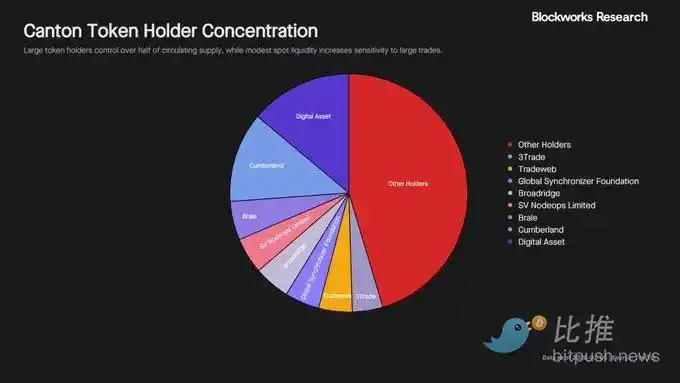
Token Concentration: CC ownership is concentrated among a small number of participants. The top reward recipients collectively hold approximately 54% of the circulating supply. If large holders cash out, it could create selling pressure.

Limited Market Liquidity: To date, the depth (around -2%) on the Bybit spot market is approximately $350,000; this means that even relatively small trades can significantly impact price action if large position holders choose to reduce their holdings, thereby exacerbating market volatility. However, over time, market liquidity is expected to improve if more exchanges list the token. Since the beginning of the year, exchanges like OKX and Robinhood have listed CC, which should gradually increase its trading depth and broaden market access.

Context: It's important to note that these balances primarily belong to core contributors and infrastructure providers and are operational rather than speculative in nature. The Canton Foundation recently approved a proposal allowing Super Validators to lock up part of their rewards to maintain validator weight, which should help strengthen long-term alignment and reduce the likelihood of large-scale sell-offs.

Conclusion

Canton represents one of the most credible attempts to bring traditional financial infrastructure on-chain. Its architecture is designed around institutional needs, and early adoption by organizations like DTCC, Nasdaq, and Broadridge indicates the network is gaining traction.

While much activity is still in its early stages, with the dual expansion of institutional and application activity, Canton may increasingly become a core coordination layer for financial markets.


Lecturas Relacionadas

Arbitrum Pretends to Be the Hacker, 'Steals' Back the Money Lost by KelpDAO

Title: Arbitrum Poses as Hacker to Recover Stolen Funds from KelpDAO Last week, KelpDAO suffered a hack resulting in nearly $300 million in losses, marking the largest DeFi security incident this year. Approximately 30,765 ETH (worth over $70 million) remained on an Arbitrum address controlled by the attacker. In an unprecedented move, Arbitrum’s Security Council utilized its emergency authority to upgrade the Inbox bridge contract, adding a function that allowed them to impersonate the hacker’s address and initiate a transfer without access to its private key. The council’s action, approved by 9 of its 12 members, moved the stolen ETH to a frozen address in a single transaction before reverting the contract to its original state. The operation was coordinated with law enforcement, which attributed the attack to North Korea’s Lazarus Group. Community reactions are divided: some praise the recovery of funds, while others question the centralization of power, as the council can upgrade core contracts without governance votes. However, such emergency mechanisms are common among major L2s. Despite the partial recovery, over $292 million was stolen in total, with more than $100 million in bad debt on Aave and remaining funds scattered across other chains. The incident highlights escalating security challenges in DeFi, with state-sponsored hackers employing advanced tactics and L2s responding with elevated countermeasures.

marsbitHace 6 min(s)

Arbitrum Pretends to Be the Hacker, 'Steals' Back the Money Lost by KelpDAO

marsbitHace 6 min(s)

iQiyi Is Too Impatient

The article "iQiyi Is Too Impatient" discusses the controversy surrounding the Chinese streaming platform IQiyi's recent announcement of an "AI Actor Library" during its 2026 World Conference. IQiyi claimed over 100 actors, including well-known names like Zhang Ruoyun and Yu Hewei, had joined the initiative. CEO Gong Yu suggested AI could enable actors to "star in 14 dramas a year instead of 4" and that "live-action filming might become a world cultural heritage." The announcement quickly sparked backlash. Multiple actors named in the list issued urgent statements denying they had signed any AI-related authorization agreements. This forced IQiyi to clarify that inclusion in the library only indicated a willingness to *consider* AI projects, with separate negotiations required for any specific role. The incident, which trended on social media with hashtags like "IQiyi is crazy," is presented as a sign of the company's growing desperation. Facing intense competition from short-video platforms like Douyin and Kuaishou, as well as Bilibili and Xiaohongshu, IQiyi's financial performance has weakened, with revenues declining for two consecutive years. The author argues that IQiyi is "too impatient" to tell a compelling AI story to reassure the market, especially as it pursues a listing on the Hong Kong stock exchange. The piece concludes by outlining three key "AI questions" IQiyi must answer: defining its role as a tool provider versus a content creator, balancing the "coldness" of AI with the human element audiences desire, and properly managing the interests of platforms, actors, and viewers. The core dilemma is that while AI can reduce costs and increase efficiency, it risks creating homogenized, formulaic content and devaluing human performers.

marsbitHace 1 hora(s)

iQiyi Is Too Impatient

marsbitHace 1 hora(s)

Trading

Spot
Futuros

Artículos destacados

Qué es $S$

Entendiendo SPERO: Una Visión General Completa Introducción a SPERO A medida que el panorama de la innovación continúa evolucionando, la aparición de tecnologías web3 y proyectos de criptomonedas juega un papel fundamental en la configuración del futuro digital. Un proyecto que ha atraído la atención en este campo dinámico es SPERO, denotado como SPERO,$$s$. Este artículo tiene como objetivo reunir y presentar información detallada sobre SPERO, para ayudar a entusiastas e inversores a comprender sus fundamentos, objetivos e innovaciones dentro de los dominios web3 y cripto. ¿Qué es SPERO,$$s$? SPERO,$$s$ es un proyecto único dentro del espacio cripto que busca aprovechar los principios de descentralización y tecnología blockchain para crear un ecosistema que promueva la participación, la utilidad y la inclusión financiera. El proyecto está diseñado para facilitar interacciones de igual a igual de nuevas maneras, proporcionando a los usuarios soluciones y servicios financieros innovadores. En su esencia, SPERO,$$s$ tiene como objetivo empoderar a los individuos al proporcionar herramientas y plataformas que mejoren la experiencia del usuario en el espacio de las criptomonedas. Esto incluye habilitar métodos de transacción más flexibles, fomentar iniciativas impulsadas por la comunidad y crear caminos para oportunidades financieras a través de aplicaciones descentralizadas (dApps). La visión subyacente de SPERO,$$s$ gira en torno a la inclusividad, buscando cerrar brechas dentro de las finanzas tradicionales mientras aprovecha los beneficios de la tecnología blockchain. ¿Quién es el Creador de SPERO,$$s$? La identidad del creador de SPERO,$$s$ sigue siendo algo oscura, ya que hay recursos públicos limitados que proporcionan información de fondo detallada sobre su(s) fundador(es). Esta falta de transparencia puede derivarse del compromiso del proyecto con la descentralización, una ética que muchos proyectos web3 comparten, priorizando las contribuciones colectivas sobre el reconocimiento individual. Al centrar las discusiones en torno a la comunidad y sus objetivos colectivos, SPERO,$$s$ encarna la esencia del empoderamiento sin señalar a individuos específicos. Como tal, comprender la ética y la misión de SPERO sigue siendo más importante que identificar a un creador singular. ¿Quiénes son los Inversores de SPERO,$$s$? SPERO,$$s$ cuenta con el apoyo de una diversa gama de inversores que van desde capitalistas de riesgo hasta inversores ángeles dedicados a fomentar la innovación en el sector cripto. El enfoque de estos inversores generalmente se alinea con la misión de SPERO, priorizando proyectos que prometen avances tecnológicos sociales, inclusión financiera y gobernanza descentralizada. Estas fundaciones de inversores suelen estar interesadas en proyectos que no solo ofrecen productos innovadores, sino que también contribuyen positivamente a la comunidad blockchain y sus ecosistemas. El respaldo de estos inversores refuerza a SPERO,$$s$ como un contendiente notable en el dominio de proyectos cripto que evoluciona rápidamente. ¿Cómo Funciona SPERO,$$s$? SPERO,$$s$ emplea un marco multifacético que lo distingue de los proyectos de criptomonedas convencionales. Aquí hay algunas de las características clave que subrayan su singularidad e innovación: Gobernanza Descentralizada: SPERO,$$s$ integra modelos de gobernanza descentralizada, empoderando a los usuarios para participar activamente en los procesos de toma de decisiones sobre el futuro del proyecto. Este enfoque fomenta un sentido de propiedad y responsabilidad entre los miembros de la comunidad. Utilidad del Token: SPERO,$$s$ utiliza su propio token de criptomoneda, diseñado para servir diversas funciones dentro del ecosistema. Estos tokens permiten transacciones, recompensas y la facilitación de servicios ofrecidos en la plataforma, mejorando la participación y la utilidad general. Arquitectura en Capas: La arquitectura técnica de SPERO,$$s$ apoya la modularidad y escalabilidad, permitiendo la integración fluida de características y aplicaciones adicionales a medida que el proyecto evoluciona. Esta adaptabilidad es fundamental para mantener la relevancia en el cambiante paisaje cripto. Participación de la Comunidad: El proyecto enfatiza iniciativas impulsadas por la comunidad, empleando mecanismos que incentivan la colaboración y la retroalimentación. Al nutrir una comunidad sólida, SPERO,$$s$ puede abordar mejor las necesidades de los usuarios y adaptarse a las tendencias del mercado. Enfoque en la Inclusión: Al ofrecer tarifas de transacción bajas e interfaces amigables para el usuario, SPERO,$$s$ busca atraer a una base de usuarios diversa, incluyendo a individuos que anteriormente pueden no haber participado en el espacio cripto. Este compromiso con la inclusión se alinea con su misión general de empoderamiento a través de la accesibilidad. Cronología de SPERO,$$s$ Entender la historia de un proyecto proporciona información crucial sobre su trayectoria de desarrollo y hitos. A continuación se presenta una cronología sugerida que mapea eventos significativos en la evolución de SPERO,$$s$: Fase de Conceptualización e Ideación: Las ideas iniciales que forman la base de SPERO,$$s$ fueron concebidas, alineándose estrechamente con los principios de descentralización y enfoque comunitario dentro de la industria blockchain. Lanzamiento del Whitepaper del Proyecto: Tras la fase conceptual, se lanzó un whitepaper completo que detalla la visión, los objetivos y la infraestructura tecnológica de SPERO,$$s$ para generar interés y retroalimentación de la comunidad. Construcción de Comunidad y Primeras Interacciones: Se realizaron esfuerzos de divulgación activa para construir una comunidad de primeros adoptantes y posibles inversores, facilitando discusiones en torno a los objetivos del proyecto y obteniendo apoyo. Evento de Generación de Tokens: SPERO,$$s$ llevó a cabo un evento de generación de tokens (TGE) para distribuir sus tokens nativos a los primeros seguidores y establecer liquidez inicial dentro del ecosistema. Lanzamiento de la dApp Inicial: La primera aplicación descentralizada (dApp) asociada con SPERO,$$s$ se puso en marcha, permitiendo a los usuarios interactuar con las funcionalidades centrales de la plataforma. Desarrollo Continuo y Alianzas: Actualizaciones y mejoras continuas a las ofertas del proyecto, incluyendo alianzas estratégicas con otros actores en el espacio blockchain, han moldeado a SPERO,$$s$ en un jugador competitivo y en evolución en el mercado cripto. Conclusión SPERO,$$s$ se erige como un testimonio del potencial de web3 y las criptomonedas para revolucionar los sistemas financieros y empoderar a los individuos. Con un compromiso con la gobernanza descentralizada, la participación comunitaria y funcionalidades diseñadas de manera innovadora, allana el camino hacia un paisaje financiero más inclusivo. Como con cualquier inversión en el espacio cripto que evoluciona rápidamente, se anima a los posibles inversores y usuarios a investigar a fondo y participar de manera reflexiva con los desarrollos en curso dentro de SPERO,$$s$. El proyecto muestra el espíritu innovador de la industria cripto, invitando a una mayor exploración de sus innumerables posibilidades. Mientras el viaje de SPERO,$$s$ aún se desarrolla, sus principios fundamentales pueden, de hecho, influir en el futuro de cómo interactuamos con la tecnología, las finanzas y entre nosotros en ecosistemas digitales interconectados.

72 Vistas totalesPublicado en 2024.12.17Actualizado en 2024.12.17

Qué es $S$

Qué es AGENT S

Agent S: El Futuro de la Interacción Autónoma en Web3 Introducción En el paisaje en constante evolución de Web3 y las criptomonedas, las innovaciones están redefiniendo constantemente cómo los individuos interactúan con las plataformas digitales. Uno de estos proyectos pioneros, Agent S, promete revolucionar la interacción humano-computadora a través de su marco agente abierto. Al allanar el camino para interacciones autónomas, Agent S busca simplificar tareas complejas, ofreciendo aplicaciones transformadoras en inteligencia artificial (IA). Esta exploración detallada profundizará en las complejidades del proyecto, sus características únicas y las implicaciones para el dominio de las criptomonedas. ¿Qué es Agent S? Agent S se presenta como un marco agente abierto innovador, diseñado específicamente para abordar tres desafíos fundamentales en la automatización de tareas informáticas: Adquisición de Conocimiento Específico del Dominio: El marco aprende inteligentemente de diversas fuentes de conocimiento externas y experiencias internas. Este enfoque dual le permite construir un rico repositorio de conocimiento específico del dominio, mejorando su rendimiento en la ejecución de tareas. Planificación a Largo Plazo de Tareas: Agent S emplea planificación jerárquica aumentada por la experiencia, un enfoque estratégico que facilita la descomposición y ejecución eficiente de tareas complejas. Esta característica mejora significativamente su capacidad para gestionar múltiples subtareas de manera eficiente y efectiva. Manejo de Interfaces Dinámicas y No Uniformes: El proyecto introduce la Interfaz Agente-Computadora (ACI), una solución innovadora que mejora la interacción entre agentes y usuarios. Utilizando Modelos de Lenguaje Multimodal de Gran Escala (MLLMs), Agent S puede navegar y manipular diversas interfaces gráficas de usuario sin problemas. A través de estas características pioneras, Agent S proporciona un marco robusto que aborda las complejidades involucradas en la automatización de la interacción humana con las máquinas, preparando el terreno para una multitud de aplicaciones en IA y más allá. ¿Quién es el Creador de Agent S? Si bien el concepto de Agent S es fundamentalmente innovador, la información específica sobre su creador sigue siendo elusiva. El creador es actualmente desconocido, lo que resalta ya sea la etapa incipiente del proyecto o la elección estratégica de mantener a los miembros fundadores en el anonimato. Independientemente de la anonimidad, el enfoque sigue siendo en las capacidades y el potencial del marco. ¿Quiénes son los Inversores de Agent S? Dado que Agent S es relativamente nuevo en el ecosistema criptográfico, la información detallada sobre sus inversores y patrocinadores financieros no está documentada explícitamente. La falta de información disponible públicamente sobre las bases de inversión u organizaciones que apoyan el proyecto plantea preguntas sobre su estructura de financiamiento y hoja de ruta de desarrollo. Comprender el respaldo es crucial para evaluar la sostenibilidad del proyecto y su posible impacto en el mercado. ¿Cómo Funciona Agent S? En el núcleo de Agent S se encuentra una tecnología de vanguardia que le permite funcionar de manera efectiva en diversos entornos. Su modelo operativo se basa en varias características clave: Interacción Humano-Computadora Similar a la Humana: El marco ofrece planificación avanzada de IA, esforzándose por hacer que las interacciones con las computadoras sean más intuitivas. Al imitar el comportamiento humano en la ejecución de tareas, promete elevar las experiencias de los usuarios. Memoria Narrativa: Empleada para aprovechar experiencias de alto nivel, Agent S utiliza memoria narrativa para hacer un seguimiento de las historias de tareas, mejorando así sus procesos de toma de decisiones. Memoria Episódica: Esta característica proporciona a los usuarios una guía paso a paso, permitiendo que el marco ofrezca apoyo contextual a medida que se desarrollan las tareas. Soporte para OpenACI: Con la capacidad de ejecutarse localmente, Agent S permite a los usuarios mantener el control sobre sus interacciones y flujos de trabajo, alineándose con la ética descentralizada de Web3. Fácil Integración con APIs Externas: Su versatilidad y compatibilidad con varias plataformas de IA aseguran que Agent S pueda encajar sin problemas en ecosistemas tecnológicos existentes, convirtiéndolo en una opción atractiva para desarrolladores y organizaciones. Estas funcionalidades contribuyen colectivamente a la posición única de Agent S dentro del espacio cripto, ya que automatiza tareas complejas y de múltiples pasos con una intervención humana mínima. A medida que el proyecto evoluciona, sus posibles aplicaciones en Web3 podrían redefinir cómo se desarrollan las interacciones digitales. Cronología de Agent S El desarrollo y los hitos de Agent S pueden encapsularse en una cronología que resalta sus eventos significativos: 27 de septiembre de 2024: El concepto de Agent S fue lanzado en un documento de investigación integral titulado “Un Marco Agente Abierto que Usa Computadoras Como un Humano”, mostrando las bases del proyecto. 10 de octubre de 2024: El documento de investigación fue puesto a disposición del público en arXiv, ofreciendo una exploración profunda del marco y su evaluación de rendimiento basada en el benchmark OSWorld. 12 de octubre de 2024: Se lanzó una presentación en video, proporcionando una visión visual de las capacidades y características de Agent S, involucrando aún más a posibles usuarios e inversores. Estos marcadores en la cronología no solo ilustran el progreso de Agent S, sino que también indican su compromiso con la transparencia y la participación comunitaria. Puntos Clave Sobre Agent S A medida que el marco Agent S continúa evolucionando, varios atributos clave destacan, subrayando su naturaleza innovadora y potencial: Marco Innovador: Diseñado para proporcionar un uso intuitivo de las computadoras similar a la interacción humana, Agent S aporta un enfoque novedoso a la automatización de tareas. Interacción Autónoma: La capacidad de interactuar de manera autónoma con las computadoras a través de GUI significa un salto hacia soluciones informáticas más inteligentes y eficientes. Automatización de Tareas Complejas: Con su metodología robusta, puede automatizar tareas complejas y de múltiples pasos, haciendo que los procesos sean más rápidos y menos propensos a errores. Mejora Continua: Los mecanismos de aprendizaje permiten a Agent S mejorar a partir de experiencias pasadas, mejorando continuamente su rendimiento y eficacia. Versatilidad: Su adaptabilidad en diferentes entornos operativos como OSWorld y WindowsAgentArena asegura que pueda servir a una amplia gama de aplicaciones. A medida que Agent S se posiciona en el paisaje de Web3 y criptomonedas, su potencial para mejorar las capacidades de interacción y automatizar procesos significa un avance significativo en las tecnologías de IA. A través de su marco innovador, Agent S ejemplifica el futuro de las interacciones digitales, prometiendo una experiencia más fluida y eficiente para los usuarios en diversas industrias. Conclusión Agent S representa un audaz avance en la unión de la IA y Web3, con la capacidad de redefinir cómo interactuamos con la tecnología. Aunque aún se encuentra en sus primeras etapas, las posibilidades para su aplicación son vastas y atractivas. A través de su marco integral que aborda desafíos críticos, Agent S busca llevar las interacciones autónomas al primer plano de la experiencia digital. A medida que nos adentramos más en los reinos de las criptomonedas y la descentralización, proyectos como Agent S sin duda desempeñarán un papel crucial en la configuración del futuro de la tecnología y la colaboración humano-computadora.

330 Vistas totalesPublicado en 2025.01.14Actualizado en 2025.01.14

Qué es AGENT S

Cómo comprar S

¡Bienvenido a HTX.com! Hemos hecho que comprar Sonic (S) sea simple y conveniente. Sigue nuestra guía paso a paso para iniciar tu viaje de criptos.Paso 1: crea tu cuenta HTXUtiliza tu correo electrónico o número de teléfono para registrarte y obtener una cuenta gratuita en HTX. Experimenta un proceso de registro sin complicaciones y desbloquea todas las funciones.Obtener mi cuentaPaso 2: ve a Comprar cripto y elige tu método de pagoTarjeta de crédito/débito: usa tu Visa o Mastercard para comprar Sonic (S) al instante.Saldo: utiliza fondos del saldo de tu cuenta HTX para tradear sin problemas.Terceros: hemos agregado métodos de pago populares como Google Pay y Apple Pay para mejorar la comodidad.P2P: tradear directamente con otros usuarios en HTX.Over-the-Counter (OTC): ofrecemos servicios personalizados y tipos de cambio competitivos para los traders.Paso 3: guarda tu Sonic (S)Después de comprar tu Sonic (S), guárdalo en tu cuenta HTX. Alternativamente, puedes enviarlo a otro lugar mediante transferencia blockchain o utilizarlo para tradear otras criptomonedas.Paso 4: tradear Sonic (S)Tradear fácilmente con Sonic (S) en HTX's mercado spot. Simplemente accede a tu cuenta, selecciona tu par de trading, ejecuta tus trades y monitorea en tiempo real. Ofrecemos una experiencia fácil de usar tanto para principiantes como para traders experimentados.

704 Vistas totalesPublicado en 2025.01.15Actualizado en 2025.03.21

Cómo comprar S

Discusiones

Bienvenido a la comunidad de HTX. Aquí puedes mantenerte informado sobre los últimos desarrollos de la plataforma y acceder a análisis profesionales del mercado. A continuación se presentan las opiniones de los usuarios sobre el precio de S (S).

活动图片