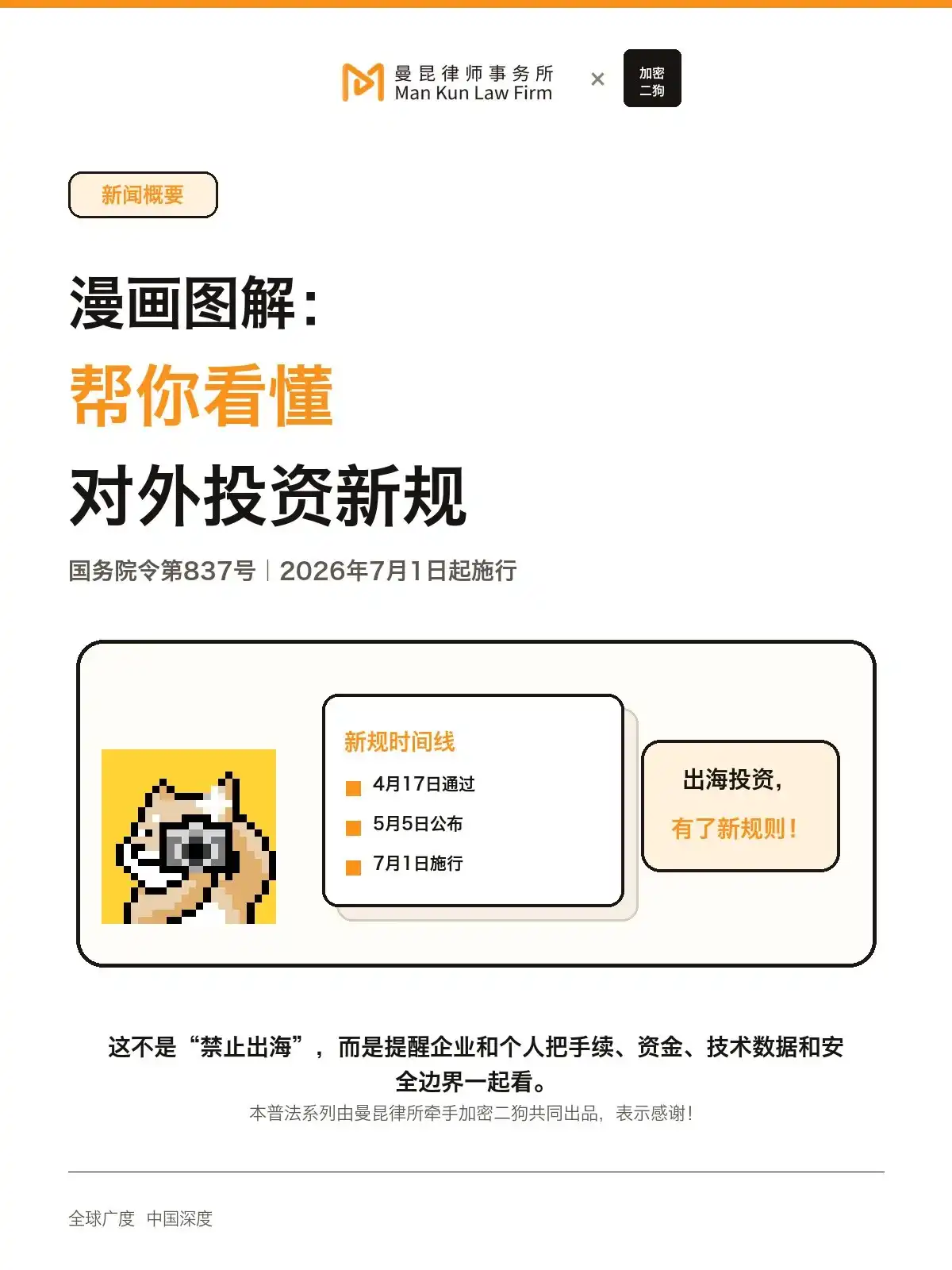
Comics Illustration: Helping You Understand China's New Regulations on Outbound Investment

marsbitPublicado a 2026-06-01Actualizado a 2026-06-01

Resumen

Summary: Understanding China's New Regulations on Overseas Investment The State Council has announced new regulations on overseas investment, effective July 1, 2026. The core message is not a prohibition on international investment, but a call for both companies and individuals to operate with strong regulatory awareness. Here are the key points: 1. **Scope is Broad:** The rules apply not only to companies but also to other organizations and individual residents. 2. **Definition of Investment is Wide:** It encompasses not just capital transfers but also asset contributions, obtaining equity or rights, financing, providing guarantees, and direct or indirect acquisition of rights related to overseas entities or assets. 3. **Companies Must Plan Comprehensively:** Beyond simple ownership charts, firms need clear plans covering the investing entity, required approvals or filings, fund transfer paths, and compliance with technology, data, and security reviews. 4. **Individuals Should Prioritize Compliance:** Before focusing on returns, individuals must first assess their eligibility, understand legal channels for capital outflow, know what they are acquiring, and identify responsible parties in case of issues. 5. **Penalties are Significant:** Violations can result in fines and potentially restrictions on future overseas investment activities. In essence, overseas investment remains possible, but it must be approached with regulatory compliance as a fundamental priority, no...

Author: Liu Honglin, Mankun Blockchain

The State Council has promulgated the "State Council Regulations on Outbound Investment," which will take effect from July 1, 2026.

This is not simply a matter of "cannot go overseas."

More accurately, it serves as a reminder to enterprises and individuals: outbound investment must follow rules.

To understand this new regulation, keep the following points in mind first:

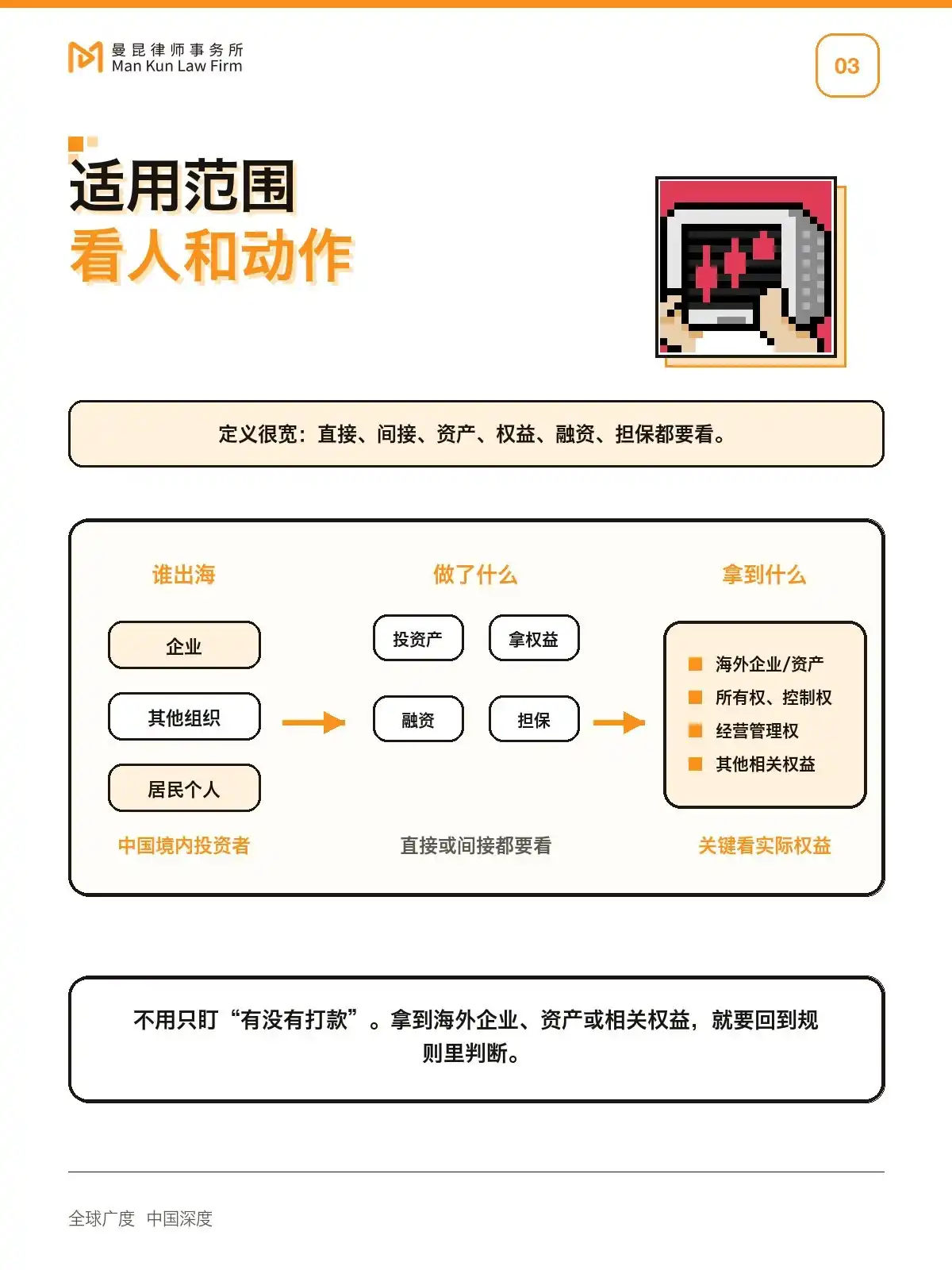
1️⃣ It's not just enterprises that are regulated. The scope of investors includes domestic enterprises, other organizations, and resident individuals.

2️⃣ It's not just about transferring money. Acquiring assets, obtaining equity rights, providing financing or guarantees, and directly or indirectly acquiring rights and interests related to overseas enterprises or assets all require assessment.

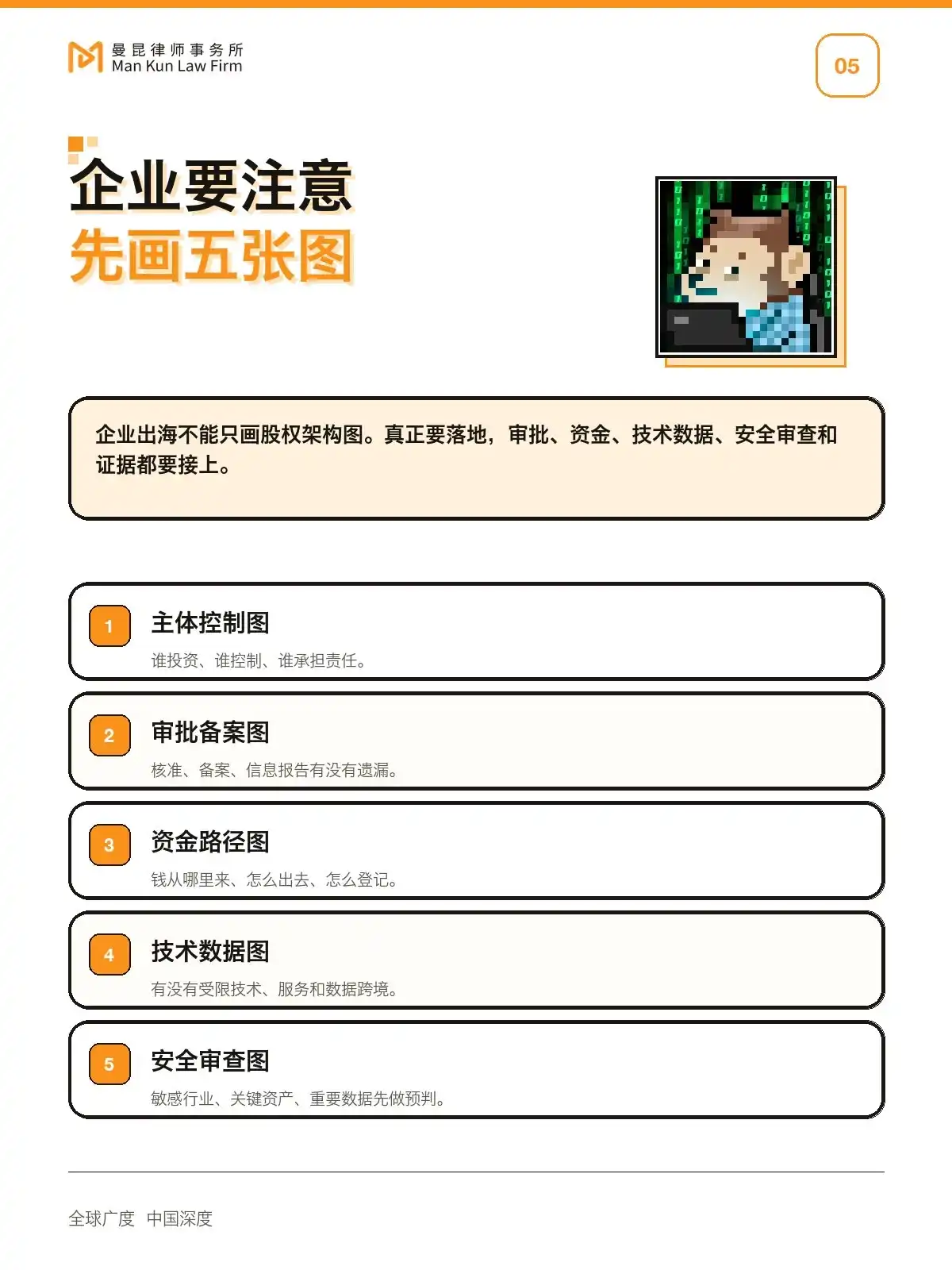
3️⃣ Enterprises shouldn't just draw equity structure charts. They also need to clearly chart the entities, approval/filing procedures, fund flow paths, technology, data, and security reviews.

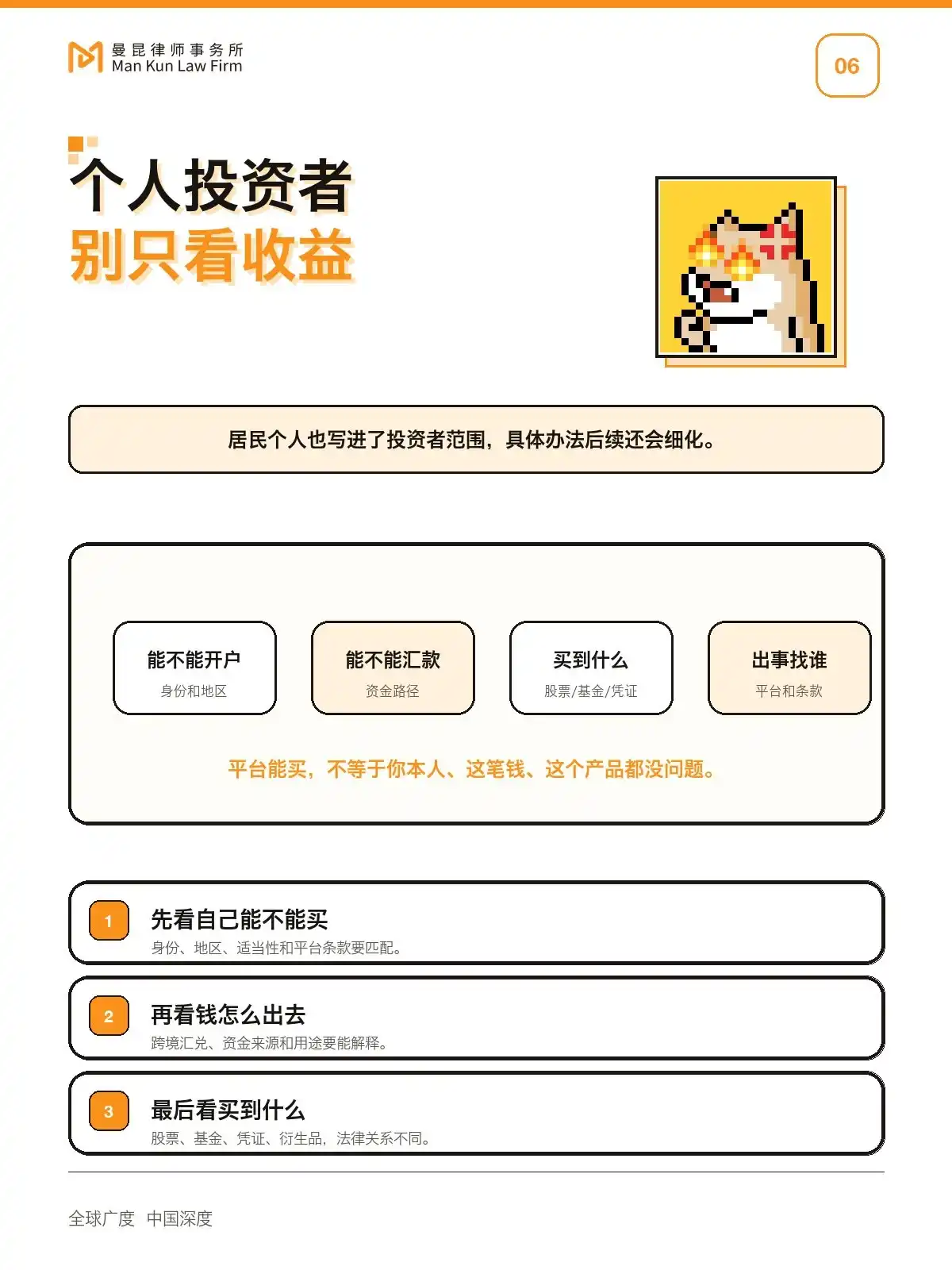
4" Individuals shouldn't just look at returns. First, consider whether you are eligible to invest, how the funds will go out, what you are actually buying, and whom to turn to if something goes wrong.

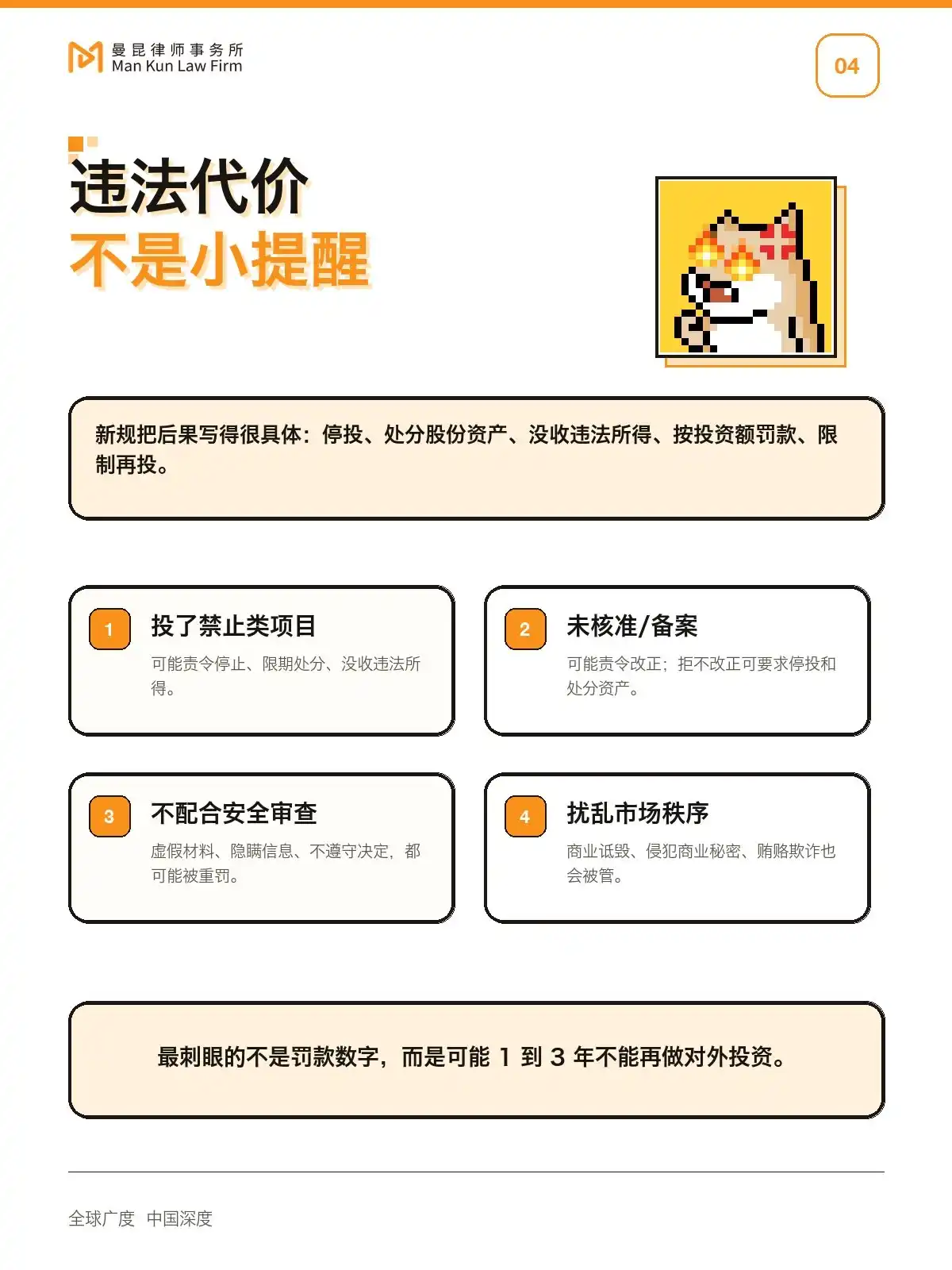
5️⃣ The price of non-compliance is not light. Beyond fines, there may be restrictions on continuing outbound investment activities.

In a nutshell: Outbound investment is not prohibited, but it cannot be pursued solely based on commercial opportunities.

The above is for general information sharing only and does not constitute legal advice or investment recommendations.

Preguntas relacionadas

QWhat is the core message of China's new regulations on outward investment according to the article?

AThe core message is that outward investment is not prohibited, but it must be conducted with a strong awareness of and compliance with the rules. The regulations emphasize that decisions cannot be based solely on commercial opportunities.

QWho is covered as 'investors' under these new regulations?

AThe regulations cover not only domestic enterprises but also other domestic organizations and resident individuals. All are explicitly included within the scope of investors subject to the rules.

QWhat are some of the forms of outward investment mentioned that require consideration under the new rules?

AThe rules apply not just to monetary transfers. Activities like investing assets, acquiring equity interests, providing financing, offering guarantees, and obtaining rights related to overseas entities or assets, either directly or indirectly, all fall under consideration.

QWhat additional requirements do enterprises need to prepare for besides their corporate ownership structure charts?

AEnterprises must also clearly outline and prepare documentation related to the involved entities, the processes for obtaining necessary approvals or filings, the paths for fund transfers, and considerations for technology, data, and security reviews.

QWhat are the potential consequences for violating these regulations?

ABeyond financial penalties, violators may face restrictions or prohibitions on their ability to continue engaging in outward investment activities in the future.

Lecturas Relacionadas

Reddit Crypto Discussion: Tech Stocks Surge for 8 Months, Is the Crypto Community Starting to 'Accept Fate'?

Reddit Crypto Discussion: Has the Community 'Given Up' as Tech Stocks Soar? A recent post on Reddit's r/CryptoMarkets asking if the crypto market feels "dead" compared to surging tech stocks has sparked intense debate. The discussion highlights a community grappling with underperformance: Bitcoin is down ~44% from its October 2025 high and ~20% YTD in 2026, while the S&P 500 and Nasdaq 100 have gained significantly. The debate features classic opposing views. Some users, citing Bitcoin's history, are "cycle believers" who anticipate a return to form, arguing it has "died" many times before. Others counter that crypto's narratives keep shifting without delivering a stable, compelling real-world use case beyond speculation. A prevalent third view pinpoints AI as the core issue: the tech sector's transformative boom is absorbing all attention and capital, while crypto lacks a comparable, impactful utility. Data supports the pessimistic mood. Bitcoin spot ETFs saw their largest monthly net outflow in May 2026 (~$2.3B), indicating institutional de-risking. The Crypto Fear & Greed Index has fallen to "Fear" levels. When asked about the timing of a potential market rotation back to crypto, answers are uncertain. A key practical point raised is the current high-interest-rate environment, which makes stable yields from cash and bonds attractive, reducing incentive to move into volatile assets like crypto. The underlying anxiety, as one user summarized, is "opportunity cost"—the worry about missing gains elsewhere while waiting for a crypto revival.

marsbitHace 39 min(s)

Reddit Crypto Discussion: Tech Stocks Surge for 8 Months, Is the Crypto Community Starting to 'Accept Fate'?

marsbitHace 39 min(s)

Chatbot has been burning money for three years, is it still the 'New Continent' of the AI era?

For years, the AI industry has been guided by a singular "map" — the belief that the AI era's "new continent" would be found in the Chatbot, a super-app akin to the mobile internet's super-apps. This belief was fueled by ChatGPT's explosive 2022 debut. However, three years of heavy investment reveal a different reality: the Chatbot-as-ultimate-entry-point model is struggling. The core issue is economic. Chatbots defy traditional internet economics. Unlike apps with near-zero marginal cost, each AI query consumes significant, expensive compute. More users mean higher costs, not profits. OpenAI, despite ~900M weekly active users, reportedly loses money. The expected network effects and data flywheels that power internet giants are weak in Chatbots, as one user's interactions don't improve another's experience. Monetization is a major hurdle. The subscription model faces low conversion rates, especially in China where users expect AI to be free. The "free + ads" model also struggles. Chatbot interactions often lack commercial intent, and inserting ads compromises the trust essential for an answer engine. Perplexity's minimal ad revenue and subsequent pivot away from ads highlight this difficulty. Switching between Chatbots is easy, making user loyalty low and competition a potential race to the bottom on price. Data suggests the standalone Chatbot's growth is slowing, and user engagement (avg. ~6 mins/day) pales compared to apps like TikTok. The product form itself is limiting; studies show nearly half of interactions are simple Q&A, trapping AI's potential in a passive, single-turn "cage." A contrasting, more successful path is emerging, exemplified by Anthropic. With over 85% of its ~$30B annualized revenue from enterprises, it focuses on AI as a productivity tool, not a companion. The rise of AI Agents (like OpenClaw) and the integration of AI into existing workflows (e.g., Google's AI Overviews, Apple Intelligence in OS) signal a shift. The future may not be a dominant Chatbot app, but AI embedded seamlessly into social apps, operating systems, and hardware — a capability-layer revolution, not a new distribution container. The conclusion is clear: the old "map" centered on a standalone Chatbot super-app is leading to a dead end. To find the true valuable "continent" of the AI era, the industry must update its navigation to prioritize deep integration, practical utility, and sustainable economics over a generic conversation window.

marsbitHace 53 min(s)

Chatbot has been burning money for three years, is it still the 'New Continent' of the AI era?

marsbitHace 53 min(s)

Trading

Spot
Futuros
活动图片