Coinbase to acquire The Clearing Company in prediction markets push

cointelegraphPublicado a 2025-12-22Actualizado a 2025-12-22

Resumen

Coinbase has agreed to acquire The Clearing Company, an on-chain prediction markets startup, as part of its strategy to become an "Everything Exchange." The acquisition, expected to close in January, will expand Coinbase’s offerings beyond digital assets to include prediction markets spanning politics, sports, and culture. The Clearing Company, founded earlier this year and backed by Coinbase Ventures, recently applied to become a Derivatives Clearing Organization with the CFTC. Coinbase views prediction markets as a major growth opportunity, citing regulatory developments and potential tax advantages over traditional gambling. The move aligns with broader industry interest in event-based markets, with players like Polymarket and Kalshi also active in the space.

Coinbase has agreed to acquire The Clearing Company, an on-chain prediction markets startup that spans digital assets, politics, sports, and culture, as it expands its push to become an “Everything Exchange” offering a broad range of investment products.

In an announcement shared with Cointelegraph, Coinbase said it has entered into a definitive agreement to acquire The Clearing Company, with the transaction expected to close in January. Financial terms of the deal were not disclosed.

The acquisition marks a rapid turnaround for The Clearing Company, which was founded earlier this year and counted Coinbase Ventures among its investors in a $15 million funding round alongside Union Square Ventures, Haun Ventures and several other venture firms and angel investors.

The Clearing Company is an on-chain prediction markets platform built by veterans of the cryptocurrency, prediction markets, and cloud infrastructure sectors. It was founded by Toni Gemayel, who previously worked with prediction market platforms Polymarket and Kalshi. Its broader team brings experience from companies including Polymarket, 0x, Dune and Coinbase.

Coinbase unveiled the acquisition less than a week after announcing its entry into prediction markets as part of its broader “Everything Exchange” strategy in partnership with Kalshi.

At the same time, Coinbase stated it will begin offering stock trading, further broadening its product lineup beyond digital assets.

Taken together, the acquisition highlights how event-based markets are moving closer to the regulated financial mainstream, with cryptocurrency infrastructure increasingly serving as the backbone for emerging market types.

“The Everything Exchange is a unified platform to trade crypto, equities, and everything else people want to trade,” Max Branzburg, Coinbase’s vice president of product management, told Cointelegraph. “Prediction markets are an important part of that platform.”

A Coinbase spokesperson added that markets tied to real-world outcomes represent “a natural extension of modern financial infrastructure.”

Source: Haun Ventures

This momentum is unfolding alongside a shifting regulatory landscape. Last month, The Clearing Company applied with the US Commodity Futures Trading Commission to become a Derivatives Clearing Organization, in a step that could further integrate prediction markets into established financial frameworks.

Related: Coinbase borrows Kalshi’s playbook, sues three states over prediction markets

Why Coinbase is betting on prediction markets

Coinbase’s push into prediction markets comes as the company increasingly views the sector as a major growth opportunity rather than a niche product.

In its latest market outlook report, which was covered by Cointelegraph, Coinbase identified prediction markets as one of the most important categories to watch through 2026, citing rising user engagement, regulatory clarity, and expanding real-world use cases.

In the report, Coinbase pointed to a tax provision in President Donald Trump’s “One Big Beautiful Bill,” which would limit the deductibility of gambling losses against winnings to 90%, down from the current 100%.

While the change may appear modest, Coinbase warned it could result in taxpayers being taxed on so-called “phantom income,” even in cases where net winnings are minimal or losses are incurred.

In this environment, Coinbase argued that prediction markets, which rely on contracts structurally similar to derivatives, could emerge as a more tax-efficient alternative to traditional sportsbooks and casinos, particularly if they are treated differently under the tax code.
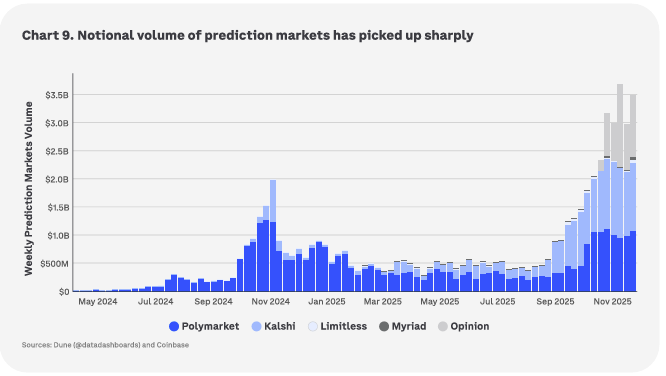
Prediction market activity has surged since the 2024 US presidential election. Source: Coinbase

While prediction markets remain a relatively nascent industry, the space is already dominated by a handful of major players. Chief among them is Polymarket, a decentralized platform built on the Polygon network that allows users to trade on political, economic, and cultural outcomes using blockchain-based contracts.

Kalshi has also emerged as a leading centralized player, operating under US regulatory oversight. Meanwhile, publicly traded sports betting company DraftKings has entered the prediction markets space, with plans to eventually offer crypto-linked contracts.

DraftKings would join a growing list of companies signaling interest in the sector, including Bitnomial Clearinghouse, a derivatives clearing organization, and crypto exchange Gemini.

Related: Polymarket shows stronger retention than most DeFi, wallets and exchanges

Criptos en tendencia

Preguntas relacionadas

QWhat is the main reason for Coinbase's acquisition of The Clearing Company?

ACoinbase is acquiring The Clearing Company to expand its push into prediction markets as part of its broader strategy to become an 'Everything Exchange' offering a wide range of investment products.

QWhen is the acquisition of The Clearing Company by Coinbase expected to be finalized?

AThe transaction is expected to close in January, though the specific financial terms of the deal were not disclosed.

QWhat regulatory step did The Clearing Company take recently to integrate prediction markets into established financial frameworks?

AThe Clearing Company applied with the US Commodity Futures Trading Commission (CFTC) to become a Derivatives Clearing Organization.

QAccording to Coinbase, why could prediction markets emerge as a more tax-efficient alternative to traditional sports betting?

ACoinbase argues that prediction markets, which use contracts similar to derivatives, could be more tax-efficient if treated differently under the tax code, especially in light of a proposed provision that would tax 'phantom income' from gambling even with minimal net winnings or losses.

QName two major existing players in the prediction markets space mentioned in the article.

ATwo major players mentioned are Polymarket, a decentralized platform on Polygon, and Kalshi, a centralized platform operating under US regulatory oversight.

Lecturas Relacionadas

Will the Fed Definitely Raise Interest Rates in September? How Will Crypto and U.S. Stocks Withstand the Pressure?

The market's expectation for a September Fed rate hike surged dramatically in early August, jumping from under 50% to over 80% within a week. This shift followed a contentious July FOMC meeting, where a 9-3 vote to hold rates revealed growing dissent from hawkish members advocating for an immediate hike to combat persistent inflation. The primary catalyst for this repricing is rising oil prices, driven by renewed geopolitical tensions around the Strait of Hormuz, which threaten global supply. Energy costs directly influence inflation metrics, making the upcoming July CPI report (due August 12th) a critical data point. If it shows inflation reaccelerating, the probability of a September hike will solidify. For Bitcoin and crypto assets, this is typically bearish news. Bitcoin continues to behave as a high-beta, liquidity-sensitive risk asset. A rate hike raises the opportunity cost of holding non-yielding assets and could drive capital toward money markets, pressuring crypto prices in the short term. However, historical patterns suggest that if a hike is perceived as the end of a tightening cycle rather than the start, any negative price impact may be brief. U.S. stocks, particularly crypto-linked equities like Coinbase and growth-oriented tech stocks, are also vulnerable. Higher rates increase discount rates in valuation models, putting pressure on high-multiple companies. This coincides with a pivotal tech earnings season where investor focus has shifted from massive AI capital expenditure to tangible revenue and cash flow generation. Companies with negative cash flow and weak growth narratives could face heightened volatility if borrowing costs rise in September. In summary, a September Fed hike has evolved into a mainstream market scenario. Key factors to watch are oil prices, the July CPI report, and Fed communications, which will determine the final decision and its impact on volatile crypto and equity markets.

marsbitHace 4 min(s)

Will the Fed Definitely Raise Interest Rates in September? How Will Crypto and U.S. Stocks Withstand the Pressure?

marsbitHace 4 min(s)

A 'Overlooked' Market Event: Joint US-Japan-South Korea Intervention, Rare US Treasury Involvement, and Bessent's Quiet 'Market Rescue'?

Summary: The United States, Japan, and South Korea executed their largest coordinated foreign exchange intervention in nearly 30 years. The action targeted depreciation pressure on the Japanese yen and South Korean won. This move is seen as a significant effort by the US to stabilize the financial markets of its key allies and prevent the spillover of risks. Key details: * Japan reportedly intervened on July 30 using approximately 8.45 trillion yen (about $52.8 billion). South Korean authorities also intervened that day, selling dollars to support the won. * Notably, the US Treasury Department intervened directly in yen markets for the first time in roughly 30 years. The New York Fed, reportedly acting on behalf of the Treasury, sold euros to buy yen via Goldman Sachs and Morgan Stanley on July 31. Analysts view the use of the euro-yen pair as a way to alleviate yen pressure without adding selling pressure to the US dollar. * Prior to the action, the New York Fed conducted "rate checks" on both USD/JPY and EUR/JPY, a newer signaling tool that falls between verbal and physical intervention. The intervention is interpreted as going beyond traditional currency stabilization. Analysts, such as Michael Hartnett of Bank of America, suggest it resembles a "Price Keeping Operation" for the AI era. The core US objectives are perceived to be: 1. Preventing rapid yen depreciation from triggering a sharp rise in Japanese government bond yields. 2. Containing financial stress from spreading across Asian markets like South Korea and Japan. 3. Reducing the risk of disorderly capital flows impacting the US bond market. This coordinated action underscores the importance of Japan and South Korea as critical partners in the US semiconductor and AI supply chain. Stabilizing their financial markets is seen as vital to mitigating risks to the broader tech industry and the US market itself. The intervention coincides with market pressures, including the KOSDAQ index hitting a low since October 2022. While seen as a move to control volatility, some analysts caution it may not fundamentally reverse existing market trends.

marsbitHace 7 min(s)

A 'Overlooked' Market Event: Joint US-Japan-South Korea Intervention, Rare US Treasury Involvement, and Bessent's Quiet 'Market Rescue'?

marsbitHace 7 min(s)

Will the Federal Reserve Definitely Raise Interest Rates in September? How Will Cryptocurrencies and US Stocks Bear the Pressure?

In early August 2024, market expectations for a September Federal Reserve rate hike surged dramatically, from below 50% to over 80%, driven by renewed inflation concerns. This shift followed a contentious July FOMC meeting where a 9-3 vote to hold rates revealed a growing hawkish faction advocating for an immediate hike, citing prolonged above-target inflation. The key catalyst is escalating conflict near the Strait of Hormuz, which has pushed oil prices up approximately 20% in July, threatening to reignite inflation. The next critical data point is the July CPI report on August 12th; a hot reading could solidify hike expectations. For crypto assets, particularly Bitcoin, this represents near-term pressure. Bitcoin continues to exhibit high-beta, risk-on characteristics, making it sensitive to tightening liquidity and higher opportunity costs. However, historical precedent suggests that if a hike is perceived as the cycle's end rather than its start, the negative impact may be brief, with markets quickly pivoting to anticipate future rate cuts. U.S. stocks, especially crypto-linked equities like Coinbase and high-valuation tech stocks, face amplified volatility. Higher rates increase discount rates in valuation models, pressuring growth stocks. This coincides with a pivotal tech earnings season where investor focus has shifted from massive AI capital expenditures to demonstrable revenue and cash flow generation. Companies with negative cash flows and weak growth narratives could see severe pressure if a September hike materializes, as financing costs would rise. Key indicators to watch include oil prices, upcoming inflation data, and Fed commentary at events like the Jackson Hole symposium.

Odaily星球日报Hace 7 min(s)

Will the Federal Reserve Definitely Raise Interest Rates in September? How Will Cryptocurrencies and US Stocks Bear the Pressure?

Odaily星球日报Hace 7 min(s)

Trading

Spot

Artículos destacados

Cómo comprar PUSH

¡Bienvenido a HTX.com! Hemos hecho que comprar Push Protocol (PUSH) sea simple y conveniente. Sigue nuestra guía paso a paso para iniciar tu viaje de criptos.Paso 1: crea tu cuenta HTXUtiliza tu correo electrónico o número de teléfono para registrarte y obtener una cuenta gratuita en HTX. Experimenta un proceso de registro sin complicaciones y desbloquea todas las funciones.Obtener mi cuentaPaso 2: ve a Comprar cripto y elige tu método de pagoTarjeta de crédito/débito: usa tu Visa o Mastercard para comprar Push Protocol (PUSH) al instante.Saldo: utiliza fondos del saldo de tu cuenta HTX para tradear sin problemas.Terceros: hemos agregado métodos de pago populares como Google Pay y Apple Pay para mejorar la comodidad.P2P: tradear directamente con otros usuarios en HTX.Over-the-Counter (OTC): ofrecemos servicios personalizados y tipos de cambio competitivos para los traders.Paso 3: guarda tu Push Protocol (PUSH)Después de comprar tu Push Protocol (PUSH), guárdalo en tu cuenta HTX. Alternativamente, puedes enviarlo a otro lugar mediante transferencia blockchain o utilizarlo para tradear otras criptomonedas.Paso 4: tradear Push Protocol (PUSH)Tradear fácilmente con Push Protocol (PUSH) en HTX's mercado spot. Simplemente accede a tu cuenta, selecciona tu par de trading, ejecuta tus trades y monitorea en tiempo real. Ofrecemos una experiencia fácil de usar tanto para principiantes como para traders experimentados.

251 Vistas totalesPublicado en 2024.12.13Actualizado en 2026.06.02

Cómo comprar PUSH

Discusiones

Bienvenido a la comunidad de HTX. Aquí puedes mantenerte informado sobre los últimos desarrollos de la plataforma y acceder a análisis profesionales del mercado. A continuación se presentan las opiniones de los usuarios sobre el precio de PUSH (PUSH).

活动图片













