Coinbase Secures Conditional OCC Approval For National Trust Charter – Details

bitcoinistPublicado a 2026-04-03Actualizado a 2026-04-03

Resumen

Coinbase, the largest US crypto exchange, has received conditional approval from the Office of the Comptroller of the Currency (OCC) to establish Coinbase National Trust Company. This marks a significant step toward becoming a federally regulated crypto custodian. The company clarified that this charter does not make it a commercial bank, and it will not take retail deposits or engage in fractional reserve banking. Instead, it aims to bring federal regulatory uniformity to its custody and market infrastructure business. This approval validates Coinbase's regulatory approach and allows it to expand its reach and conduct new business. It also signals a shift in the federal regulatory framework to align with the evolving crypto landscape. However, the move faces opposition from US banks and lawmakers, including the American Bankers Association and Senator Elizabeth Warren, who have raised concerns about regulatory arbitrage and called for delays until clearer rules are established. Coinbase joins other firms like Ripple, Circle, and Fidelity that have also received similar OCC approvals.

Coinbase, the largest crypto exchange in the US, has achieved a major milestone after securing a key approval from the main banking regulator, which could unlock a broader market for the company.

Coinbase Wins Major OCC Approval

On Thursday, Coinbase announced it received conditional approval from the Office of the Comptroller of the Currency (OCC) to charter Coinbase National Trust Company, marking a crucial step to becoming a federally regulated crypto custodian.

In the official statement, Coinbase outlined the scope of the charter, explaining that the company is not becoming a commercial bank and will not take retail deposits or engage in fractional reserve banking.

“This charter is about bringing federal regulatory uniformity to the custody and market infrastructure business we have been building for years. The OCC charter was designed precisely for this purpose — to provide clear oversight over assets in safekeeping — and that is exactly how we intend to use it,” the announcement read.

The conditional OCC approval allows Coinbase to “build the next chapter of finance,” the company noted, bolstered by the regulatory confidence, and validates its approach of “engaging with regulators, earning their trust, and operating to the highest standards.”

Moreover, the approval signals that the federal regulatory framework is transforming to align with the evolving landscape that crypto has been gradually shaping.

In an interview, Greg Tusar, Co-CEO of Coinbase Institutional, affirmed that “the ability to have a federal framework for our custody business is important,” adding that “this is about us growing our reach and being able to conduct new business that we may not have been able to before.”

Crypto Trust Banks Face Opposition

Coinbase applied for the charter last October and has now joined the list of firms that have received the main banking regulator’s approval. As reported by Bitcoinist, the OCC approved conditional bank charters for Ripple, Circle, BitGo, Paxos, and Fidelity in December.

In February, stablecoin platform Bridge, owned by Stripe, and crypto exchange Crypto.com announced they had also secured the OCC’s conditional approval to establish a national trust bank. However, US banks have raised concerns that the approvals could blur the lines between banking activities and lead to regulatory arbitrage.

Nearly two months ago, the American Bankers Association (ABA) asked the banking regulator to postpone its review of applications for crypto bank charters, suggesting that the approvals should wait until key regulatory uncertainties are resolved.

In its letter, ABA called for patience as emerging regulatory frameworks take shape, proposing that the review process continue when the US Congress completes the rules that will ultimately govern many recent applicants for the OCC’s charter.

The banking lobby cited uncertainty surrounding emerging business models, the need for increased transparency in the charter application and decision-making processes, and the absence of finalized federal oversight as key reasons for the proposed delay.

US Senator Elizabeth Warren also sent a letter to Comptroller Jonathan Gould asking the banking regulator to pause its review of the Trump Family’s main crypto venture, World Liberty Financial, which applied for a national trust charter in January.
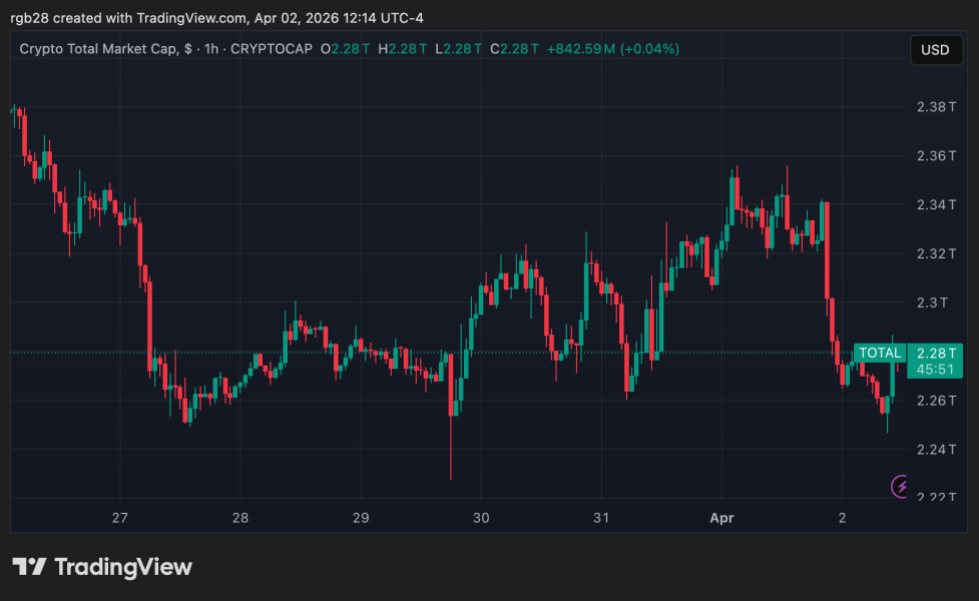
Total crypto market capitalization is at $2.28 trillion on the one-week chart. Source: TOTAL on TradingView


Preguntas relacionadas

QWhat is the significance of Coinbase securing conditional approval from the OCC?

AIt allows Coinbase to charter the Coinbase National Trust Company, marking a crucial step toward becoming a federally regulated crypto custodian and unlocking a broader market for the company.

QWhat does the OCC charter enable Coinbase to do, according to the company's statement?

AThe charter brings federal regulatory uniformity to Coinbase's custody and market infrastructure business, providing clear oversight over assets in safekeeping without engaging in commercial banking or taking retail deposits.

QWhich other companies have received conditional bank charters from the OCC, as mentioned in the article?

ARipple, Circle, BitGo, Paxos, Fidelity, Bridge (owned by Stripe), and Crypto.com have also secured conditional approval from the OCC for national trust bank charters.

QWhat concerns have US banks raised regarding the OCC's approval of crypto trust charters?

AUS banks are concerned that the approvals could blur the lines between banking activities and lead to regulatory arbitrage.

QWhy did the American Bankers Association (ABA) ask the OCC to postpone its review of crypto bank charter applications?

AThe ABA cited uncertainty surrounding emerging business models, the need for increased transparency in the application process, and the absence of finalized federal oversight as key reasons for the proposed delay.

Lecturas Relacionadas

Can Generative Models Finally Be Trained End-to-End? The Core Is a For Loop

This article introduces a novel training paradigm for generative models called Explorative Modeling (XM), which enables true end-to-end training. Traditionally, powerful generative models like autoregressive and diffusion models are not trained end-to-end. They are trained to predict a single small step but require iterative multi-step sampling for inference. This "exposure bias" leads to error accumulation and limits performance. The core challenge XM addresses is "mode blurring." In generative tasks, a single input (e.g., "generate a dog") corresponds to many valid outputs (multiple modes). Standard training objectives like reconstruction loss force the model to average these modes, producing unrealistic, blurry outputs. To avoid this, existing models break generation into many small, almost deterministic steps, sacrificing end-to-end training. XM tackles this by restructuring the training loop itself. Its key insight is to amplify "generative expressivity." For each training input, instead of generating one sample, the model generates K candidate outputs. Only the candidate closest to the real data is used for computing the loss and updating the model via backpropagation. This simple "best-of-K" mechanism is implemented as a short for-loop. By exploring multiple possibilities, the model learns to distribute its guesses across different modes rather than collapsing to their uninformative average. The paper demonstrates that "exploration" acts as a new, powerful scaling axis. Gains from XM increase with model size, data scale, and compute. Experiments show improvements in FID scores for image generation and significant efficiency gains, sometimes outperforming larger models without exploration. When pushed to the limit, XM enables fully single-step, end-to-end generative models. In robotics tasks, an "Explorative Policy" matched the performance of a 100-step Diffusion Policy with a single forward pass, drastically improving inference speed. While the best-of-K concept is not entirely new, the authors' contribution lies in formally understanding it as a direct method to boost generative expressivity without fragmenting the generation process. This work suggests that as models scale, enhancing exploration during training may become crucial for overcoming fundamental performance bottlenecks.

marsbitHace 49 min(s)

Can Generative Models Finally Be Trained End-to-End? The Core Is a For Loop

marsbitHace 49 min(s)

Annual Salary of Millions Competing for Electricians, Meta Rushes to Open Its Own Technical School

The AI boom is facing an unexpected bottleneck: a severe shortage of skilled construction workers and electricians. As tech giants like Meta, OpenAI, and Alphabet race to build massive data centers—such as OpenAI's $16 billion "Stargate" project—they are hitting a critical labor wall. The U.S. needs an estimated 130,000 more electricians, 240,000 construction workers, and 150,000 supervisors by 2030 for AI infrastructure alone, but tens of thousands of electrician jobs go unfilled each year. While AI companies offer high premiums, with electricians earning up to $280,000 annually, worker scarcity still causes massive losses—delays on a single project can cost $14.2 million per month. The complexity of building AI data centers, which require immense power (equivalent to powering hundreds of thousands of homes), sophisticated electrical systems, and advanced liquid cooling solutions, demands highly skilled technicians who are in short supply. To combat this, companies are investing heavily in training. Meta has committed $115 million to a free training school offering tuition, housing, and stipends, targeting 5,000 new workers. OpenAI is partnering with unions to secure skilled labor. These efforts are paying off, with a significant rise in Gen Z interest in trade schools over college. However, the power demands are staggering. AI data centers are driving a rapid surge in electricity consumption, projected to account for up to 12% of U.S. power use by 2028 and raising costs for consumers. Furthermore, the construction boom is project-based, leading to a potential future glut of trained workers once building peaks, which could depress wages industry-wide. The race for AI supremacy now depends as much on skilled hands as on advanced chips.

marsbitHace 2 hora(s)

Annual Salary of Millions Competing for Electricians, Meta Rushes to Open Its Own Technical School

marsbitHace 2 hora(s)

Trading

Spot
活动图片




