Coinbase Q1 Earnings Report: Nearly $4 Billion Loss, Trading Volume Halved. Can AI + RWA Turn Things Around?

链捕手Publicado a 2026-05-08Actualizado a 2026-05-08

Resumen

Coinbase's Q1 2026 earnings report revealed a net loss of $394 million, largely driven by $482 million in unrealized losses on its crypto asset holdings. Total revenue fell 31% year-over-year to $1.41 billion. Transaction revenue declined 40% to $756 million, reflecting a market-wide slump in crypto trading volumes. Consumer trading was particularly weak, down 48%, though Coinbase's global spot market share rose to a record 8.6%. Key bright spots included institutional trading revenue, which grew 37%, and a surge in derivatives activity following the Deribit acquisition. Subscription and services revenue of $584 million was more resilient, with stablecoin revenue up 11% to $305 million. Adjusted EBITDA remained positive at $303 million. Ahead of earnings, Coinbase announced a 14% workforce reduction (~700 employees) to accelerate its transition to an "AI-native" organizational model. Strategically, the company is pursuing its "Everything Exchange" vision, expanding into derivatives and predictive markets. Its partnership with Circle on USDC remains a core revenue moat, with over 25% of the stablecoin's $80 billion supply held on its platform. The company is actively engaged in shaping stablecoin legislation like the CLARITY Act. Despite significant losses and cyclical pressures, Coinbase is positioning itself as a broader on-chain financial infrastructure provider.

On May 7th, after the US stock market closed, Coinbase released its first-quarter financial report for 2026. The data showed the company's total revenue was $1.41 billion, a year-on-year decrease of 31%.

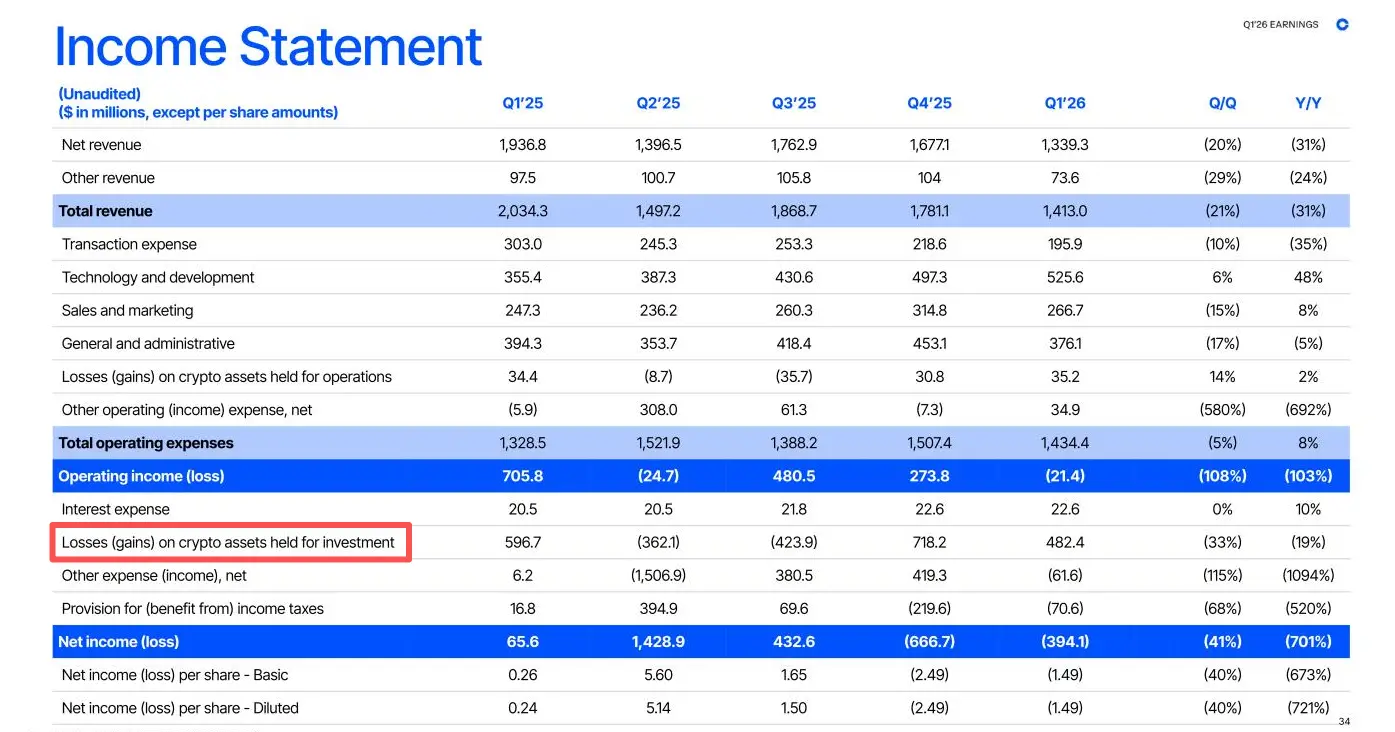
Dragged down by unrealized losses on held crypto assets, the company recorded a net loss of $394 million, with a loss per share of $1.47. In contrast, the company achieved a net profit of $66 million in the same period last year.

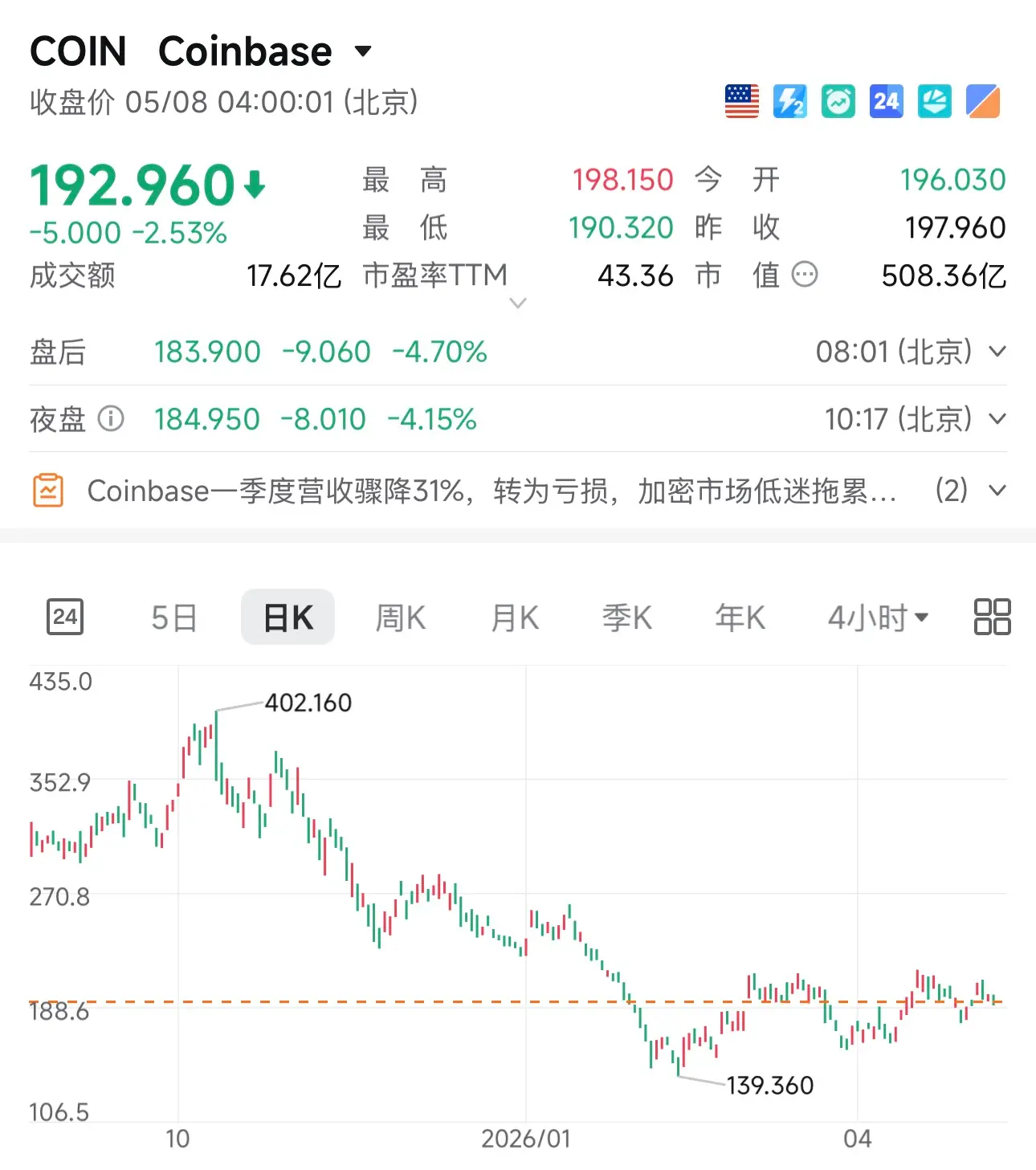
Following the earnings release, Coinbase's stock price fell approximately 4.7% in after-hours trading. The cumulative decline for the year-to-date has now exceeded 15%.
Transaction Revenue Down 40%, Institutional and Stablecoin Business as Bright Spots

Most of Coinbase's loss this quarter came from paper losses.

Behind the net loss of $394 million is an unrealized loss of $482 million from the company's investment crypto assets. This loss is accounted for with market price fluctuations and does not represent an actual cash outflow.

Excluding this portion, the company's adjusted net loss was only $45.6 million, and adjusted EBITDA remained positive at $303 million, with an operating loss of approximately $21.4 million.
The crypto market was generally weak in Q1. The price of Bitcoin fell from over $97,000 in early January to around $63,000 in early February, hovering below $70,000 by the end of the period. Market sentiment shifted rapidly, and retail trading activity contracted significantly. According to CoinGlass data, global crypto spot trading volume in Q1 was approximately $1.94 trillion, down about 44% year-on-year.

As a result, the company's total transaction revenue declined 40% to $756 million, with consumer transaction revenue at $567 million, a 48% year-on-year drop. Despite the halving of trading volume, Coinbase's global crypto spot market share rose to a record high of 8.6%, ranking fourth among global spot exchanges.

The institutional side, however, showed a completely different trend. The company's institutional transaction revenue reached $136 million, a 37% year-on-year increase. More notably, the derivatives business stood out, with derivatives trading volume growing 169% year-on-year, benefiting from the consolidation of Deribit acquired in August 2025. The collateral pledged by derivatives clients also surged from $27.4 million at the end of last year to $333 million at the end of this quarter, an increase of more than 10 times.

In terms of subscription and services revenue, the company recorded $584 million for the quarter, a 14% year-on-year decline, a significantly smaller drop than the transaction business. This segment's share of total net revenue increased to 44%. Notably, stablecoin revenue was $305 million, up 11% year-on-year, one of the few bright spots this quarter. Total assets on the platform stood at $294.4 billion at the end of the quarter.

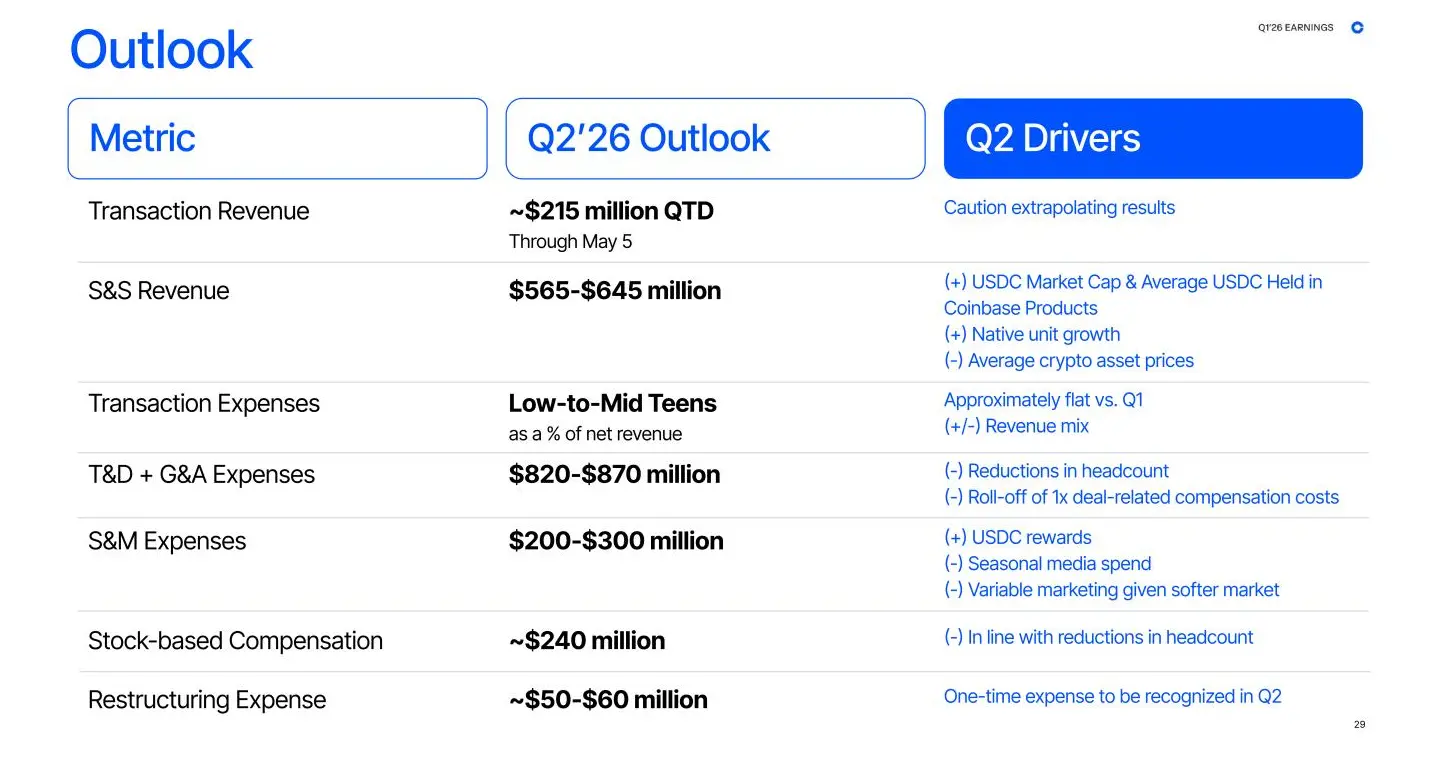
For Q2, management's outlook is generally cautious. The company disclosed that transaction revenue through May 5th was approximately $215 million, but management emphasized that current market volatility is high and this figure does not represent the trend for the entire quarter. The guidance range for subscription and services revenue is $565 million to $645 million, with the midpoint slightly above Q1's $584 million, indicating management's continued confidence in this revenue line. Restructuring expenses related to the recent layoffs, amounting to $50 to $60 million, will be recognized in Q2. Cost pressure is expected to ease significantly thereafter.
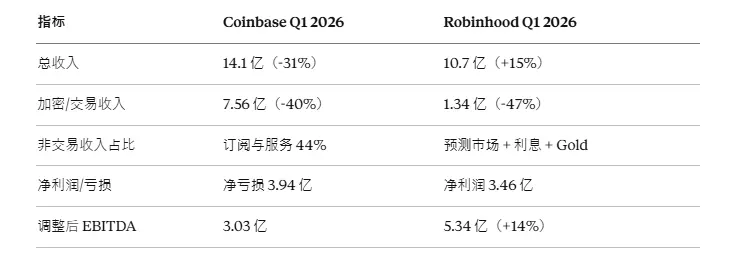
It is worth noting that Robinhood's Q1 earnings report presented a different picture. Its total revenue increased 15% year-on-year to $1.07 billion, with a net profit of $346 million and adjusted EBITDA reaching $534 million.

Examining the structure, the quality of this growth warrants scrutiny. Crypto-related revenue also declined 47% to $134 million. The company mainly filled the gap with three business segments: revenue from prediction market contracts skyrocketed 320%, becoming the largest incremental source; net interest income grew 24% to $359 million; and Gold subscription service revenue grew 32% to $50 million.

Additionally, Robinhood secured the role of sole initial trustee for the Trump account, investing approximately $100 million in related setup costs.

This quarter, Robinhood sustained growth through the policy tailwinds of prediction markets and the Trump account, while Coinbase bet on a longer-term transformation under the pressure of halved trading volumes.
Defensive Moves: Laying Off 700 Employees, What Is the Company Restructuring?

On May 5th, just two days before the earnings release, Coinbase announced cutting approximately 700 jobs, representing about 14% of its global workforce.

CEO Brian Armstrong stated that this restructuring aims to bring the company back to startup speed and accelerate the transition to an AI-native organization. The goal is to refactor Coinbase into an organization with intelligence at its core, augmented by humans at the edges.

Coinbase defines this approach as "AI-native"—not just introducing AI tools into the existing organization, but redesigning the company's operational model from the ground up. Company data shows a 78% year-on-year increase in engineer pull requests per capita. Team structures have been reorganized from traditional 10-person pods to AI-Native pods consisting of 2-3 people plus AI agents. Core service integration test coverage tripled within six months.
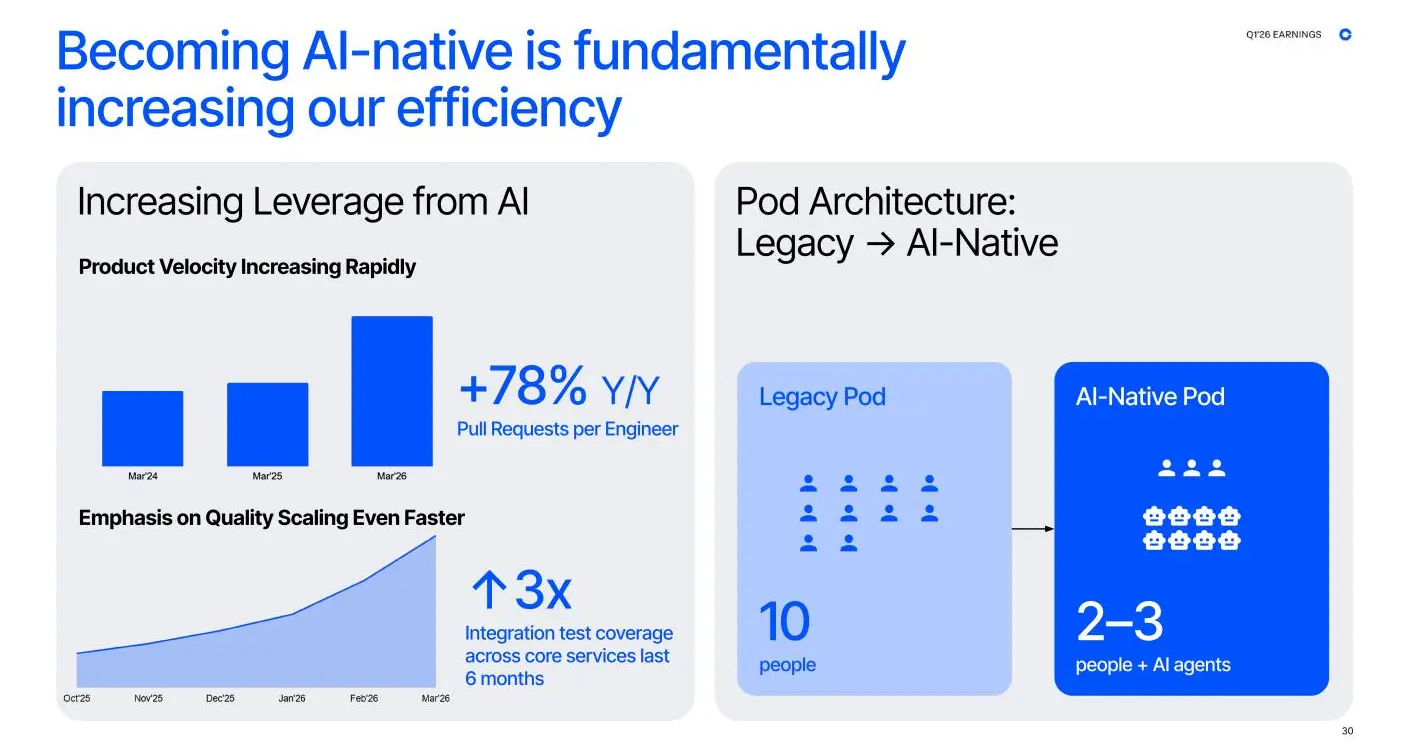
However, the financial implications need to be carefully considered. Omar, a partner at crypto venture capital firm Dragonfly, estimates that this layoff could save the company approximately $225 million in annual salary costs. But the full-year 2026 expense guidance indicates that, excluding the impact of increased USDC rewards, expenses will be roughly flat year-on-year. In other words, a significant portion of the cost savings from layoffs is offset by investments in user incentive programs.

It is also worth noting that over the past year or so, OpenAI has poached at least six senior marketing executives from Coinbase, including former CMO Kate Rouch, Sarah Russell, and others. Sarah Wolf, head of marketing for the Base chain, moved to Anthropic. Coinbase officially characterized these departures as normal personnel movement, but it is noteworthy that while the company is using AI to restructure its organization and reduce headcount, it is also supplying AI companies with marketing talent who best understand branding and growth.

When asked about potential future layoffs, CFO Alesia Haas stated, "We can't predict the future, but as a public company, we will always do what is best for the company."

Offensive Moves: Building On-Chain Financial Infrastructure

The "Everything Exchange" Blueprint

At the end of last year, Armstrong proposed the strategic goal of an "Everything Exchange"—transforming Coinbase from a primarily spot crypto platform into a comprehensive multi-asset platform encompassing derivatives, commodities, futures, and prediction market contracts, allowing users to avoid switching between different platforms.

Q1 data shows strong growth in derivatives, prediction markets, and decentralized exchanges. On the Base chain, stablecoin transactions initiated by AI agents already account for 90% of total chain transaction volume. Derivatives trading volume reached a record high, with contract business exceeding spot trading for the first time.

With initial results showing, the company has continued to double down recently, including: investing in Centrifuge to secure the tokenization infrastructure for RWA; taking a stake in Kemet to integrate institutional derivatives channels; launching the stablecoin credit fund CUSHY; obtaining the OCC national trust charter to clear the compliance hurdle for institutional custody; and partnering with AWS to integrate wallet infrastructure and the x402 protocol into Amazon Bedrock's AgentCore payment system, enabling AI agents to autonomously complete micropayments using USDC.

The Stablecoin Moat

Beyond expanding trading categories, the stablecoin business constitutes a deeper revenue moat for Coinbase.

According to Coinbase's revenue-sharing agreement with Circle, 100% of the earnings generated by USDC held on the Coinbase platform go to Coinbase, while off-platform USDC earnings are split approximately 50/50 between the two parties.

USDC's market capitalization has now reached a record high of approximately $80 billion, with over 25% held on the Coinbase platform. The balance on the platform has grown nearly 10-fold compared to three years ago. As USDC adoption continues to expand, Coinbase's share of the pie grows proportionally.

However, this revenue stream is not without risks. This quarter, the average interest rate declined by 67 basis points, negatively impacting stablecoin revenue by approximately $57.5 million. Changes in the interest rate environment may weaken the resilience of this revenue line.

CFO Alesia Haas emphasized during the earnings call, "Our USDC contract automatically renews every three years, and it renews in perpetuity. This contract cannot be terminated." CLO Paul Grewal added immediately, "We expect to continue our partnership with Circle on the same terms going forward."

These statements were clearly addressing market concerns about stablecoin regulation legislation. Regarding the CLARITY Act, Coinbase has engaged in a prolonged game of chess:

  • In January, it withdrew support due to unfavorable earnings provisions, causing the Senate to delay the vote;
  • In March, it rejected a new draft again, causing Circle's stock price to plummet 20% in a single day;
  • In early May, a compromise text emerged, prohibiting "pay for hold" but retaining space for rewards tied to real activities. Armstrong replied "Mark it up" on X, and Grewal also publicly expressed being "very confident" about the bill passing this summer.

The true value of this game is that Coinbase is not just complying with rules but participating in shaping them. The legal teams, compliance processes, and regulatory communication capabilities required to repackage yield products constitute a resource barrier that smaller exchanges cannot replicate in the short term.

In other words, once the CLARITY Act is enacted, the advantages of leading platforms will be solidified by legislation. Regulatory clarity is beneficial for the entire industry, but the deepest beneficiaries will always be the few capable of sitting at the negotiation table.

However, it is noteworthy that after the bill passes, there will be a 12-month rule-making phase, and the final boundaries are yet to be defined, leaving uncertainties.

Conclusion

With trading volume halved and a net loss of $394 million, Coinbase's earnings report once again reminds the market that the company remains strongly tied to the crypto cycle. There is no shortage of skeptical voices questioning whether the AI narrative represents a genuine transformation or merely a wrapper for declining business performance.

Brian Armstrong has repeatedly emphasized, "All finance will eventually move on-chain." As crypto increasingly resembles traditional finance, Coinbase is also striving to make itself look more like a mature financial infrastructure company. This might be the answer it is offering in the current cycle.


Preguntas relacionadas

QWhat were the key factors contributing to Coinbase's Q1 2026 net loss of $394 million?

ACoinbase's Q1 2026 net loss of $394 million was primarily driven by $482 million in unrealized losses on its investment portfolio of crypto assets due to market price declines. Excluding this mark-to-market impact, the adjusted net loss was $45.6 million.

QHow did Coinbase's consumer and institutional trading revenues perform in Q1 2026, and what is the 'Everything Exchange' strategy?

AIn Q1 2026, Coinbase's consumer transaction revenue fell 48% to $567 million, while institutional transaction revenue grew 37% to $136 million. The 'Everything Exchange' strategy aims to transform Coinbase from a primarily spot crypto platform into a multi-asset platform covering derivatives, commodities, futures, and prediction markets, creating a one-stop financial platform.

QWhat cost-saving measure did Coinbase announce alongside its earnings, and what is its broader organizational transformation goal?

ACoinbase announced a layoff of approximately 700 employees, about 14% of its workforce, aimed at saving an estimated $225 million in annual compensation costs. The broader goal is to accelerate its transformation into an 'AI-native' organization, fundamentally redesigning operations around AI agents to increase speed and efficiency.

QWhy is USDC stablecoin revenue significant for Coinbase, and what are the associated risks?

AUSDC revenue is a significant and growing income stream for Coinbase, reaching $305 million in Q1 (up 11% YoY). Its importance stems from a revenue-sharing agreement with Circle. However, this revenue faces risks from potential regulatory changes like the CLARITY Act, which could restrict yield products, and from sensitivity to interest rate fluctuations, which negatively impacted Q1 revenue by approximately $57.5 million.

QHow does Coinbase's Q1 2026 performance and outlook compare to its competitor Robinhood's?

ACoinbase's Q1 performance was challenged, with total revenue down 31% and a net loss, largely due to crypto market weakness. In contrast, Robinhood reported 15% revenue growth and a net profit of $346 million. However, Robinhood's crypto revenue also fell 47%; its growth was fueled by other segments like prediction markets and net interest income, while Coinbase is investing heavily in long-term infrastructure and diversification.

Lecturas Relacionadas

A Nation Blocks Chips, a Giant Buys a Nuclear Power Plant: Why It's Time to Seriously Consider DeAI

**Title: Great Powers Blockade Chips, Giants Buy Nuclear Plants: Why It's Time to Seriously Consider DeAI** In May 2026, the US closed loopholes for Chinese firms to acquire advanced NVIDIA chips via overseas subsidiaries. That same month, Kenya halted a $1B geothermal data center project involving Microsoft, fearing its immense energy consumption. Meanwhile, Huawei announced mass production of its Ascend AI chip. These disparate events underscore a new reality: the competition for computing power ("compute") has escalated beyond the tech industry, becoming a geopolitical and infrastructural battleground. A new era of oligopoly is forming, with control over the AI stack—from GPU chips (NVIDIA) and cloud platforms (AWS, Azure, Google Cloud) to foundational models (OpenAI, Anthropic)—concentrating in a few Western "AI Octopus" corporations. This centralization creates systemic risks: pricing power and platform lock-in for users, infrastructure fragility, and a widening "compute divide" that threatens to marginalize nations without independent AI capacity. An "AI Iron Curtain" is deepening through export controls. In response, some nations like Saudi Arabia and the UAE are investing heavily to buy compute power, aiming to transition from oil to AI economies. The EU seeks to triple its compute capacity by 2030 to reduce dependency. However, the spending gap is vast, with four US tech giants alone planning ~$750B in AI capex for 2026. The race is increasingly constrained by energy, with AI tasks consuming up to 1000x more power than web searches, pushing firms to even acquire nuclear plants. This landscape is fueling interest in Decentralized AI (DeAI). It proposes a third way: using open protocols to coordinate a global network of idle GPUs, independent developers, and data centers, creating an AI infrastructure without a single controlling entity. Leveraging blockchain and cryptographic verification, DeAI aims to break market concentration, disperse energy demands, reduce geopolitical dependencies, and enhance transparency. While still nascent in performance and stability, DeAI's core promise is not immediate superiority but providing a crucial alternative architecture to resist monopoly, censorship, and centralized power. As specialized AI hardware costs fall and open-source models flourish, the window to build this foundation is open. The very existence of such competition serves as a vital check against the inevitable abuse of concentrated power.

marsbitHace 32 min(s)

A Nation Blocks Chips, a Giant Buys a Nuclear Power Plant: Why It's Time to Seriously Consider DeAI

marsbitHace 32 min(s)

Outpoll Review: A Prediction Market Platform Built for Active Traders

Outpoll Review: A Prediction Market Platform Built for Active Traders In recent years, prediction markets have grown from a niche sector to a mainstream arena, attracting billions in trading volume and institutional capital. However, the user experience and tools for traders have not kept pace. Outpoll, a new global prediction market platform, aims to fill this gap by providing enhanced trading infrastructure for active and professional traders. Built on standard prediction market principles, Outpoll allows users to trade on the outcome of specific events. It uses fully collateralized contracts with USDC settlement, charges a competitive 0.1% fee per trade, and provides clear settlement rules upfront to minimize disputes. A key focus for Outpoll is its professional-grade trading tools. The platform supports limit and market orders, as well as take-profit and stop-loss orders for open positions—features uncommon in prediction markets. For automated trading, Outpoll offers comprehensive REST and WebSocket APIs, enabling portfolio management, price arbitrage, and integration with existing tools. The platform also features a creator-led market model, where approved experts and community leaders can create and manage markets for niche topics under platform supervision. Its integrated interface combines news feeds directly with trading functions, allowing users to monitor events and manage positions seamlessly. Outpoll launched with a native Android app (available on Google Play) and plans an iOS version later this year. In summary, Outpoll distinguishes itself with trader-focused tools, practical APIs, transparent and collateralized markets, integrated news, and an expanding creator program. For active traders, its advanced order types and API access alone make it a platform worth watching. Outpoll is now globally accessible via outpoll.com and Google Play.

marsbitHace 40 min(s)

Outpoll Review: A Prediction Market Platform Built for Active Traders

marsbitHace 40 min(s)

Bitwise: Crypto Becomes a Contrarian Investment, Three Logics to Understand the Current Market

**Summary** Matt Hougan, Bitwise's CIO, analyzes the current crypto market through three key lenses, arguing it has shifted from a momentum-driven to a contrarian investment. **1) Crypto Becomes a Contrarian Play:** The market is weak, with major assets like Bitcoin and Ethereum down significantly. Capital has moved to hot sectors like AI, leaving crypto as an "unloved" asset class. This transforms crypto investing from trend-following to a test of patience and fundamental analysis. Investors now favor projects with solid fundamentals (e.g., Hyperliquid) over speculative ones. **2) Regulatory Overhang:** The uncertain fate of the U.S. CLARITY Act, a major crypto regulatory framework, is a key headwind. With its passage in 2024 seen as far from guaranteed (estimates range from 30-55%), institutional capital remains on the sidelines, choosing less risky alternatives like AI stocks. The market needs clarity—whether the bill passes or fails—more than any specific outcome to move decisively. **3) Capital Rotates to New Fundamentals:** This cycle differs from past bear markets where money fled to Bitcoin. Now, capital seeks smaller assets with strong use cases. While major cryptos fell in May 2024, tokens like Hyperliquid (+72%), Zcash (+50%), and XLM (+44%) rallied on their specific fundamentals. This rotation confirms the new contrarian, fundamentals-driven logic and signals the bear market may be in its later stages. **Conclusion:** Short-term pressure persists due to regulatory uncertainty and competition from AI narratives. Investing in crypto now requires a contrarian mindset—acting against the crowd and focusing on fundamental value. Patience and targeting high-quality projects based on their merits are essential for capturing long-term gains.

marsbitHace 1 hora(s)

Bitwise: Crypto Becomes a Contrarian Investment, Three Logics to Understand the Current Market

marsbitHace 1 hora(s)

ChatGPT Might Be Disappearing Soon

OpenAI announced at its "Intelligence at Work" event that its coding assistant, Codex, will be fully integrated into the ChatGPT app within weeks. This move marks a strategic shift from a conversational AI (Chat) towards a unified "agentic" platform capable of execution. Codex, originally launched to compete with Anthropic's Claude Code, has grown rapidly to 5 million weekly active users, with 20% being non-developers like analysts and designers. Its enterprise revenue now constitutes 40% of OpenAI's total. The integration is the first step in creating a super-app combining ChatGPT (interface), Codex (execution engine), and the Atlas browser (web access). OpenAI also unveiled new Codex features: specialized Agent plugins for six professional roles, an "Annotations" tool for direct document editing, and a "Sites" function to turn work into shareable web apps. Internally, this reflects a power shift; the Codex team now leads core product strategy. While the ChatGPT brand remains for its vast user base, the platform's future is focused on autonomous agents that perform tasks, not just chat. The article notes that competition with Claude Code pushed OpenAI's development, with Codex competing on cost-effectiveness and accessibility rather than raw coding quality. It concludes that the essence of "ChatGPT" is evolving from a chatbot into an AI agent platform, with the name potentially becoming a legacy symbol of its original function.

marsbitHace 1 hora(s)

ChatGPT Might Be Disappearing Soon

marsbitHace 1 hora(s)

Trading

Spot
Futuros

Artículos destacados

Cómo comprar 4

¡Bienvenido a HTX.com! Hemos hecho que comprar 4 (4) sea simple y conveniente. Sigue nuestra guía paso a paso para iniciar tu viaje de criptos.Paso 1: crea tu cuenta HTXUtiliza tu correo electrónico o número de teléfono para registrarte y obtener una cuenta gratuita en HTX. Experimenta un proceso de registro sin complicaciones y desbloquea todas las funciones.Obtener mi cuentaPaso 2: ve a Comprar cripto y elige tu método de pagoTarjeta de crédito/débito: usa tu Visa o Mastercard para comprar 4 (4) al instante.Saldo: utiliza fondos del saldo de tu cuenta HTX para tradear sin problemas.Terceros: hemos agregado métodos de pago populares como Google Pay y Apple Pay para mejorar la comodidad.P2P: tradear directamente con otros usuarios en HTX.Over-the-Counter (OTC): ofrecemos servicios personalizados y tipos de cambio competitivos para los traders.Paso 3: guarda tu 4 (4)Después de comprar tu 4 (4), guárdalo en tu cuenta HTX. Alternativamente, puedes enviarlo a otro lugar mediante transferencia blockchain o utilizarlo para tradear otras criptomonedas.Paso 4: tradear 4 (4)Tradear fácilmente con 4 (4) en HTX's mercado spot. Simplemente accede a tu cuenta, selecciona tu par de trading, ejecuta tus trades y monitorea en tiempo real. Ofrecemos una experiencia fácil de usar tanto para principiantes como para traders experimentados.

738 Vistas totalesPublicado en 2025.10.20Actualizado en 2026.06.02

Cómo comprar 4

Discusiones

Bienvenido a la comunidad de HTX. Aquí puedes mantenerte informado sobre los últimos desarrollos de la plataforma y acceder a análisis profesionales del mercado. A continuación se presentan las opiniones de los usuarios sobre el precio de 4 (4).

活动图片