Coinbase Posts $394 Million Loss In Q1 2026 — And The Worst May Not Be Over

bitcoinistPublicado a 2026-05-08Actualizado a 2026-05-08

Resumen

Coinbase reported a net loss of $394 million for Q1 2026, a sharp reversal from a $65.6 million profit a year ago. This missed analyst expectations as total revenue fell 30.5% to $1.41 billion, largely driven by a 23% decline in transaction revenue due to lower crypto trading volumes and prices. A significant factor was $482 million in unrealized losses on crypto holdings, primarily linked to Bitcoin's price drop. Excluding that, the adjusted net loss was $46 million. While subscription and services revenue remained strong at $584 million and adjusted EBITDA was positive, the results highlight the exchange's continued sensitivity to crypto market cycles. This follows recent workforce reductions and shows operating margin collapsing to -1.5%. The quarter underscores that despite its institutional standing, Coinbase's path to durable profitability remains tied to volatile crypto market conditions.

Coinbase reported a net loss of $394 million for the first quarter of 2026, swinging from a $65.6 million profit in the same period last year and missing Wall Street expectations on both revenue and earnings per share — as a sharp pullback in crypto prices and trading volumes hit the exchange’s core business harder than analysts had anticipated.

The results, reported by Bloomberg after market close on May 7, showed total revenue of $1.41 billion — a 30.5% year-over-year decline and a miss against the analyst consensus of approximately $1.51 billion. On a per-share basis, Coinbase posted a GAAP loss of $1.49 against expectations of a $0.29 profit — a significant miss that sent shares down roughly 4% in after-hours trading.
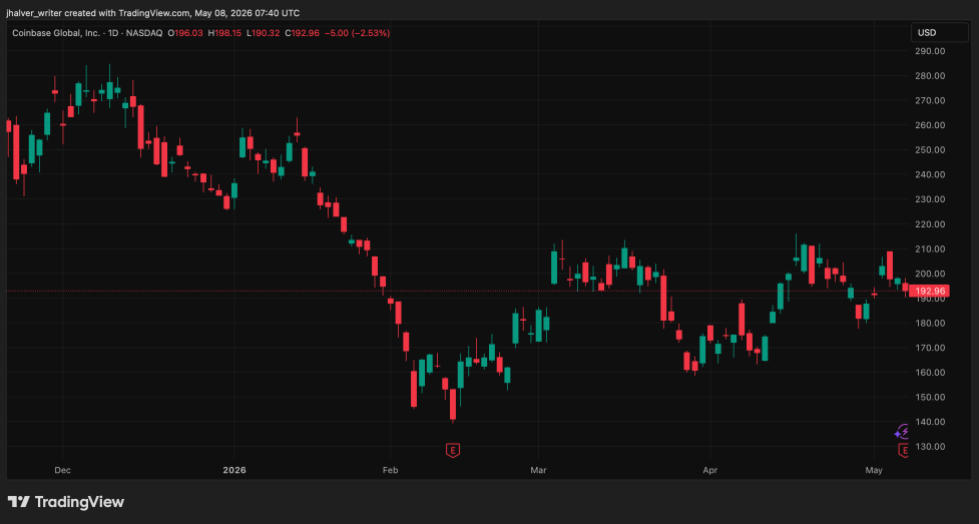
COIN's price records a modest loss following their Q1 earnings report, as seen on the daily chart. Source: COINUSD on Tradingview

What Drove Coinbase To A Loss

The single largest drag on the quarter was $482 million in unrealized losses on crypto assets held for investment, tied primarily to Bitcoin’s roughly 23% decline during Q1, a separate report from TheStreet crypto claims. Strip out that mark-to-market impact and the adjusted net loss narrows to $46 million — a meaningful distinction, but one that still reflects a materially weaker operating environment than the prior year.

Transaction revenue, the exchange’s primary revenue engine, came in at $755.8 million — down 23% quarter-over-quarter and below the $805.2 million analysts had projected. The main driver was straightforward: total crypto market capitalization and spot trading volumes declined more than 20% quarter-over-quarter, per Investing.com, pulling Coinbase’s most volatile revenue line with it.

Not everything was negative. Subscription and services revenue reached $584 million — representing 44% of net revenue — while stablecoin revenue hit $305 million on record average USDC holdings of $19 billion in Coinbase products. Adjusted EBITDA came in at $303 million, marking the company’s 13th consecutive positive quarter on that metric, per CFO Alesia Haas on the earnings call.

A Quarter That Confirms The Pattern

The Q1 loss arrives just days after Coinbase announced a 14% reduction in its workforce — approximately 700 roles — citing the need to restructure around AI-driven operations. Taken together, the layoffs and the earnings miss paint the picture of an exchange managing through a difficult cycle rather than riding one.

Operating margin collapsed to -1.5% from 34.7% in the year-ago quarter, underlining how quickly Coinbase’s profitability profile can shift when crypto markets pull back. The company closed the quarter with over $10 billion in cash and equivalents, per the earnings call transcript, which provides a substantial buffer — but does little to address the structural revenue sensitivity that has defined every down cycle in the exchange’s short public history.

For the nascent sector, Coinbase’s Q1 results serve as a reminder that even the most institutionally established crypto exchange remains tightly tethered to market conditions — and that the road to durable profitability runs directly through the unpredictable terrain of crypto price cycles.

Cover image from Grok, COINUSD chart from Tradingview

Preguntas relacionadas

QWhat were Coinbase's reported Q1 2026 financial results in terms of net loss and revenue?

ACoinbase reported a net loss of $394 million for Q1 2026, swinging from a $65.6 million profit in Q1 2025. Total revenue was $1.41 billion, a 30.5% year-over-year decline.

QWhat was the largest single factor contributing to Coinbase's Q1 2026 loss according to the article?

AThe single largest drag was $482 million in unrealized losses on crypto assets held for investment, primarily tied to Bitcoin's roughly 23% decline during the quarter.

QHow did Coinbase's transaction revenue perform in Q1 2026 compared to analyst expectations?

ATransaction revenue came in at $755.8 million, which was down 23% quarter-over-quarter and below the $805.2 million analysts had projected.

QDespite the overall loss, which areas of Coinbase's business showed positive performance in Q1 2026?

ASubscription and services revenue reached $584 million, representing 44% of net revenue. Stablecoin revenue hit $305 million on record average USDC holdings. Adjusted EBITDA was $303 million, marking the 13th consecutive positive quarter on that metric.

QWhat recent operational decision by Coinbase, mentioned alongside the earnings, highlights its response to a difficult cycle?

AJust days before the earnings report, Coinbase announced a 14% reduction in its workforce (approximately 700 roles), citing a restructuring around AI-driven operations.

Lecturas Relacionadas

70% of the Public Opposes AI, Americans Hope the U.S. Loses the AI War

70% of Americans believe AI development is moving too fast, with growing public resistance evolving from online criticism to real-world protests and violence. This widespread anti-AI sentiment stems from fears of job losses, rising utility costs, environmental damage, threats to democracy, and financial instability. Key incidents illustrate the backlash: Google's former CEO Eric Schmidt was loudly booed at a graduation for promoting AI; AI company ads are vandalized; protests and even violent attacks target AI firms and data centers. Polls show deep public pessimism and strong local opposition to data center construction, often surpassing resistance to nuclear power plants. The core grievances are economic and practical: AI is seen as automating jobs, concentrating wealth, and increasing household electricity and water bills due to massive data center resource demands. Environmentalists also oppose AI's high energy use and carbon emissions. This opposition has turned AI into a major political issue in the US. While the Trump administration prioritizes AI innovation for global competition, bipartisan pushback is growing. Democrats and factions within the MAGA movement are forming temporary alliances to support stricter regulations and local bans on new data centers, pressuring the administration to choose between its tech industry backers and its voter base. The situation highlights a profound national divide over AI's future.

marsbitHace 29 min(s)

70% of the Public Opposes AI, Americans Hope the U.S. Loses the AI War

marsbitHace 29 min(s)

Agents Take Over Traffic Distribution Power: What Are Tencent, ByteDance, and Alibaba Competing For?

In the race to dominate the AI era's entry point, China's tech giants—Tencent, ByteDance, and Alibaba—are aggressively deploying AI Agents to control the future of traffic distribution. Alibaba is pursuing a dual-track "closed loop + openness" strategy. Its Qianwen app is evolving into a super-Agent integrated across its ecosystem (Taobao, Alipay, etc.) to handle complex tasks like travel planning. Concurrently, it is opening its platform to external brands (Luckin Coffee, KFC) and has launched a B2B Agent platform, "Wukong," targeting enterprise automation. Its other flagship, Quark, aims to be an "AI super search box" for information and tasks. ByteDance is executing an omnipresent "sprawl strategy." Its Doubao app boasts over 300 million monthly active users and is evolving into a default AI entry point for daily life, with plans for paid versions and e-commerce integration. Its core weapon is the Kouzi platform, a visual "AI assembly factory" for developers to build custom Agents. ByteDance is also pushing hardware integration, collaborating on AI phones and developing smart glasses to embed Doubao everywhere. Tencent is playing its long-held "ultimate card" by quietly embedding an AI Agent directly into WeChat. This Agent, accessible via a swipe, can understand user commands and automatically execute tasks by calling upon WeChat's millions of mini-programs (e.g., finding and ordering coffee). This leverages WeChat's unparalleled 1.4-billion-user ecosystem to position the app as an AI-powered "service operating system," a move that could dramatically reshape the competitive landscape. The core battleground is shifting from competing for "user screen time" to competing to be the "default execution layer" for user intent. The business model is evolving from an "attention economy" to an "intent economy," where the Agent that can most efficiently fulfill a user's need gains control over service access and token flow. This represents a fundamental change in how users connect with digital services, making the fight for the Agent入口 (entry point) a pivotal moment for redefining industry leadership in the AI age.

marsbitHace 2 hora(s)

Agents Take Over Traffic Distribution Power: What Are Tencent, ByteDance, and Alibaba Competing For?

marsbitHace 2 hora(s)

Trading

Spot
Futuros
活动图片





