Coinbase and Ripple CEOs Join CFTC Advisory Panel Overseeing Digital Assets

TheNewsCryptoPublicado a 2026-02-13Actualizado a 2026-02-13

Resumen

The U.S. Commodity Futures Trading Commission (CFTC) has formed a new advisory committee focused on digital assets, appointing key industry leaders including Coinbase CEO Brian Armstrong and Ripple CEO Brad Garlinghouse. The committee, established under the Digital Commodities Consumer Protection Act, will provide expertise on regulatory and market developments. It includes representatives from crypto exchanges, stablecoin issuers, derivatives desks, and blockchain firms. The group will meet at least four times in 2026 to address issues like compliance, risk management, market transparency, and regulatory coordination. Their input will help shape future CFTC rules and oversight approaches for digital asset markets.

The United States Commodity Futures Trading Commission announced appointments to a new committee that would provide advice on regulatory and industry developments regarding digital assets. Coinbase CEO Brian Armstrong confirmed his position as a member of the committee representing crypto exchange interests. The advisory committee also has Ripple CEO Brad Garlinghouse as a member, offering information from a prominent payments blockchain company. The committee has various members representing companies in digital assets, finance, and blockchain technology. The committee also has members from a company that issues a stablecoin and a derivatives desk manager.

CFTC Chairman Rostin Behnam stated the committee would assist in helping regulators grasp the intricacies of the digital market. The members would contribute their expertise and knowledge from the digital asset marketplace. This advisory committee would meet at least four times in 2026 to discuss the problems regulators face in their work. The CFTC formed the committee through the Digital Commodities Consumer Protection Act’s powers. They would concentrate their focus on market issues such as compliance and risk management.
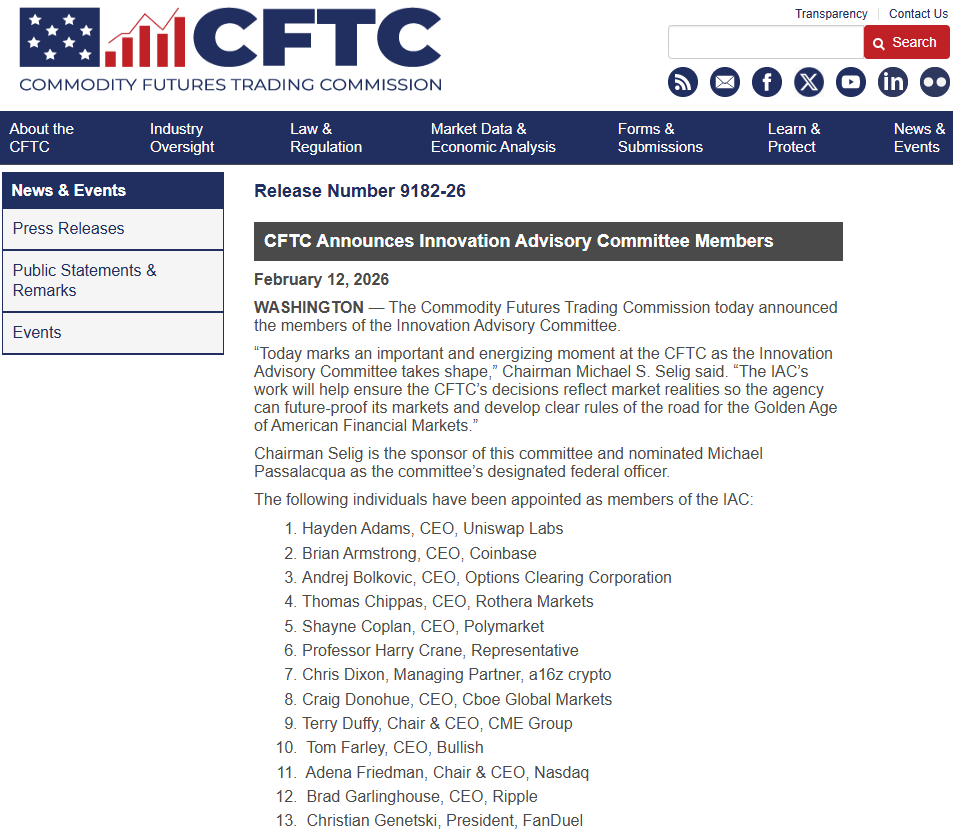
The committee has executives from companies such as Paxos, Cumberland, Galaxy Digital, among other companies. A representative of the stablecoin issuer has knowledge of liquidity and a framework for redemption. The diversity of the group is evident since there is knowledge on trading platforms, derivatives exchanges, and blockchain operations. The members of the CFTC’s advisory panel are compliance experts and know legal issues. The committee has experts from fintech and blockchain-based think tanks. The experts know derivatives exchanges, clearing operations, and blockchain operations.

Committee Aims and Regulatory Role

The Advisory Group will review options for enhancing digital asset markets under U.S. laws. The members will be able to review the risk issues faced by participants in the digital markets, whether retail or institutional. The members will also give opinions on compliance issues faced and law enforcement. The panel may also discuss transparency issues in digital markets in the U.S. The issue of coordination between U.S. regulatory authorities may also come up.

The committee members may assist the CFTC in oversight roles for new technologies. These could involve data infrastructures and market settlement systems. The contributions from the members to the CFTC may shape the proposals for future rules set forth by the agency.

Highlighted Crypto News:

U.S. Bankers Urge OCC to Slow Crypto Trust Bank Charters

TagsBlockchainBrad GarlinghouseCFTCCoinbaseCryptocurrencyexchangePaxosRipple

Preguntas relacionadas

QWho are the two prominent CEOs appointed to the CFTC's new advisory committee for digital assets?

ACoinbase CEO Brian Armstrong and Ripple CEO Brad Garlinghouse.

QWhat is the primary purpose of the CFTC's newly formed advisory committee?

ATo provide advice on regulatory and industry developments regarding digital assets and assist regulators in grasping the intricacies of the digital market.

QHow many times is the advisory committee scheduled to meet in 2026?

AAt least four times.

QWhich act granted the CFTC the power to form this digital assets advisory committee?

AThe Digital Commodities Consumer Protection Act.

QBesides crypto exchanges, what other types of companies are represented on the committee?

AA stablecoin issuer, a derivatives desk manager, fintech companies, blockchain-based think tanks, and companies like Paxos, Cumberland, and Galaxy Digital.

Lecturas Relacionadas

Bitcoin Withdrawals Continue: 8 Years of Storage in a Coldcard Cold Wallet Ended in Zero

Coldcard Hardware Wallet Hacked: Losses Mount Due to Vulnerable Seed Generation A critical vulnerability in Coldcard hardware wallets has led to a continued wave of fund thefts. According to Galaxy Research, the total stolen has reached 1,367.05 BTC (approx. $88.6 million) from 4,585 addresses, a significant increase from the initial 594.5 BTC reported on July 30, 2026. Most of the stolen funds remain on the attackers' addresses. The issue is not with the current firmware, which Coinkite has updated, but with seed phrases generated on vulnerable devices between March 2021 and the release of fixed firmware versions. Due to a programmer error, devices switched from using a hardware random number generator to the software-based Yasmarang generator, which was initialized with publicly accessible data like the chip's serial number. This made the seed phrases predictable through offline brute-force attacks, meaning wallets remain at risk until funds are moved to a new wallet generated with the patched firmware. Affected devices include Mk2/Mk3 with firmware 4.0.1–4.1.9 (and up to 5.0.3), Mk4/Mk5 up to version 5.6.0, and Q models up to 1.5.0Q. The only exceptions are seeds created with a high-entropy method like at least 50 independent dice rolls or a strong unique BIP-39 passphrase. All other owners must generate a new seed on the fixed firmware and transfer their assets. A case highlighting the human impact involves a 39-year-old long-term investor who lost 2 BTC (approx. $130,000) in minutes. He had accumulated the Bitcoin over eight years through physical labor, viewing it as a financial lifeline and a retirement plan in a country suffering from hyperinflation. His story underscores that even conservative "buy and hold in cold storage" strategies can be compromised by such underlying technical flaws. From a technical perspective, this incident echoes historical failures where weak random number generators undermined cryptographic security, challenging the assumption that offline storage is automatically foolproof.

cryptonews.ruHace 2 hora(s)

Bitcoin Withdrawals Continue: 8 Years of Storage in a Coldcard Cold Wallet Ended in Zero

cryptonews.ruHace 2 hora(s)

Trading

Spot
活动图片





