Coinbase Accuses Australian Banks of Unlawful Regulatory Ban as Maxi Doge Pumps

bitcoinistPublicado a 2026-02-03Actualizado a 2026-02-03

Resumen

Coinbase has accused major Australian banks of imposing an unlawful "shadow ban" on crypto transfers, effectively de-banking users under the guise of scam prevention. This has created barriers for retail investors moving fiat into crypto, driving interest in on-chain assets like meme coins. Maxi Doge ($MAXI) is highlighted as a leading project capitalizing on this trend, promoting a "Leverage King" culture with trading competitions and staking rewards. The token has attracted significant whale activity, with two purchases totalling $503K, and has raised $4.5M in its ongoing presale. Priced at $0.0002802, it offers dynamic APY staking and aims to avoid typical pump-and-dump cycles.

Tensions are boiling over Down Under. Coinbase has formally accused major Australian banks of imposing a shadow ban on the industry.

Executives argue that banks are systematically restricting transfers to crypto platforms, effectively ‘de-banking’ users without a clear mandate. That opacity creates a massive headache (and a crisis of confidence) for retail investors just trying to move their own money.
Banks usually cite ‘scam prevention’ as the excuse for blocking exchanges.

But industry insiders see it differently: it’s an anti-competitive moat designed to stifle digital assets. This leaves Aussie investors in limbo—unable to move fiat freely, even though they’re legally entitled to trade.

That tension highlights a strange market quirk. While banking gateways jam up, the on-chain economy is actually accelerating. Why? Traders want assets that don’t need a bank manager’s permission. When fiat rails choke, capital rotates into high-volatility sectors that live entirely on-chain. It’s the perfect storm for ‘culture coins.’

Leading the charge is Maxi Doge ($MAXI), a project mixing gym-bro aesthetics with a decentralized trading ethos.

Buy your $MAXI right here.

Maxi Doge Builds Leverage King Culture Amidst Fiat Restrictions

As TradFi tries to gatekeep the market, Maxi Doge ($MAXI) frames itself as the antidote: a 240-lb canine juggernaut built for the ‘grind.’ Most meme tokens rely on flash-in-the-pan viral moments. Maxi Doge? It’s pushing a specific ‘Leverage King’ culture. It targets retail traders who might lack whale capital but have the guts to chase outsized returns, exactly the crowd banks are alienating.

The narrative is all about ‘lifting’ portfolios. It works through Holder-Only Trading Competitions, where members compete for leaderboard rewards based on ROI. This gamifies trading, turning solitary chart-watching into a communal sport. Plus, with a ‘Maxi Fund’ treasury for liquidity, the team (relatively unknown until now) signals they’re building for longevity, not a quick exit.

For traders tired of slow-moving regulated finance, the appeal is the raw risk/reward profile. ‘Never skip leg day’ isn’t just a meme here. It’s a metaphor for holding through volatility to hit the kind of gains traditional banks simply can’t offer.

Check out the Maxi Doge presale.

Whale Wallets Accumulate $503K as Presale Hits Major Milestone

Smart money seems to be tuning out the regulatory noise. Etherscan data shows two high-net-worth whales scooped up $503K in Maxi Doge recently, with a massive single buy of $251K on October 11, 2025. That’s institutional-sized volume. It suggests big players are positioning themselves before the token hits public exchanges.

According to the official presale page, Maxi Doge has raised a staggering $4.5M so far and it’s still going.
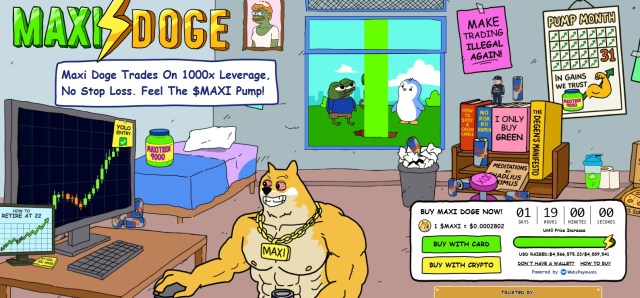
Frankly, the market is hungry for utility-driven memes. Tokens are sitting at $0.0002802, an entry point before the wider retail masses arrive. Beyond the raise, the tech includes dynamic APY staking. This lets holders earn passive yield through daily smart contract drops, incentivizing holding rather than quick flips.

Heavy whale accumulation mixed with staking mechanics breaks the typical ‘pump and dump’ mold. With the ‘Maxi Fund’ locking in liquidity and the presale entering its final laps, the market structure looks surprisingly solid at these levels.

Explore the Maxi Doge presale.

The information provided in this article does not constitute investment advice. Cryptocurrency markets are highly volatile. Always conduct your own research.


Criptos en tendencia

Preguntas relacionadas

QWhat is Coinbase accusing major Australian banks of doing?

ACoinbase is accusing major Australian banks of imposing a 'shadow ban' by systematically restricting or blocking bank transfers to cryptocurrency exchanges, effectively de-banking users without a clear regulatory mandate.

QAccording to the article, what reason do banks typically give for blocking transactions to crypto exchanges?

ABanks typically cite 'scam prevention' as the excuse for blocking transactions to cryptocurrency exchanges.

QWhat is the name of the meme token and its ticker that is leading the charge as an alternative during these banking restrictions?

AThe meme token is called Maxi Doge and its ticker is $MAXI.

QHow much money have high-net-worth 'whales' accumulated in Maxi Doge recently, according to Etherscan data mentioned in the article?

AAccording to Etherscan data, high-net-worth whales have accumulated $503,000 in Maxi Doge recently, including a single buy of $251,000.

QWhat is the total amount raised in the Maxi Doge presale as reported in the article?

AThe Maxi Doge presale has raised a total of $4.5 million so far, according to the official presale page.

Lecturas Relacionadas

Will the Fed Definitely Raise Interest Rates in September? How Will Crypto and U.S. Stocks Withstand the Pressure?

The market's expectation for a September Fed rate hike surged dramatically in early August, jumping from under 50% to over 80% within a week. This shift followed a contentious July FOMC meeting, where a 9-3 vote to hold rates revealed growing dissent from hawkish members advocating for an immediate hike to combat persistent inflation. The primary catalyst for this repricing is rising oil prices, driven by renewed geopolitical tensions around the Strait of Hormuz, which threaten global supply. Energy costs directly influence inflation metrics, making the upcoming July CPI report (due August 12th) a critical data point. If it shows inflation reaccelerating, the probability of a September hike will solidify. For Bitcoin and crypto assets, this is typically bearish news. Bitcoin continues to behave as a high-beta, liquidity-sensitive risk asset. A rate hike raises the opportunity cost of holding non-yielding assets and could drive capital toward money markets, pressuring crypto prices in the short term. However, historical patterns suggest that if a hike is perceived as the end of a tightening cycle rather than the start, any negative price impact may be brief. U.S. stocks, particularly crypto-linked equities like Coinbase and growth-oriented tech stocks, are also vulnerable. Higher rates increase discount rates in valuation models, putting pressure on high-multiple companies. This coincides with a pivotal tech earnings season where investor focus has shifted from massive AI capital expenditure to tangible revenue and cash flow generation. Companies with negative cash flow and weak growth narratives could face heightened volatility if borrowing costs rise in September. In summary, a September Fed hike has evolved into a mainstream market scenario. Key factors to watch are oil prices, the July CPI report, and Fed communications, which will determine the final decision and its impact on volatile crypto and equity markets.

marsbitHace 10 min(s)

Will the Fed Definitely Raise Interest Rates in September? How Will Crypto and U.S. Stocks Withstand the Pressure?

marsbitHace 10 min(s)

A 'Overlooked' Market Event: Joint US-Japan-South Korea Intervention, Rare US Treasury Involvement, and Bessent's Quiet 'Market Rescue'?

Summary: The United States, Japan, and South Korea executed their largest coordinated foreign exchange intervention in nearly 30 years. The action targeted depreciation pressure on the Japanese yen and South Korean won. This move is seen as a significant effort by the US to stabilize the financial markets of its key allies and prevent the spillover of risks. Key details: * Japan reportedly intervened on July 30 using approximately 8.45 trillion yen (about $52.8 billion). South Korean authorities also intervened that day, selling dollars to support the won. * Notably, the US Treasury Department intervened directly in yen markets for the first time in roughly 30 years. The New York Fed, reportedly acting on behalf of the Treasury, sold euros to buy yen via Goldman Sachs and Morgan Stanley on July 31. Analysts view the use of the euro-yen pair as a way to alleviate yen pressure without adding selling pressure to the US dollar. * Prior to the action, the New York Fed conducted "rate checks" on both USD/JPY and EUR/JPY, a newer signaling tool that falls between verbal and physical intervention. The intervention is interpreted as going beyond traditional currency stabilization. Analysts, such as Michael Hartnett of Bank of America, suggest it resembles a "Price Keeping Operation" for the AI era. The core US objectives are perceived to be: 1. Preventing rapid yen depreciation from triggering a sharp rise in Japanese government bond yields. 2. Containing financial stress from spreading across Asian markets like South Korea and Japan. 3. Reducing the risk of disorderly capital flows impacting the US bond market. This coordinated action underscores the importance of Japan and South Korea as critical partners in the US semiconductor and AI supply chain. Stabilizing their financial markets is seen as vital to mitigating risks to the broader tech industry and the US market itself. The intervention coincides with market pressures, including the KOSDAQ index hitting a low since October 2022. While seen as a move to control volatility, some analysts caution it may not fundamentally reverse existing market trends.

marsbitHace 14 min(s)

A 'Overlooked' Market Event: Joint US-Japan-South Korea Intervention, Rare US Treasury Involvement, and Bessent's Quiet 'Market Rescue'?

marsbitHace 14 min(s)

Will the Federal Reserve Definitely Raise Interest Rates in September? How Will Cryptocurrencies and US Stocks Bear the Pressure?

In early August 2024, market expectations for a September Federal Reserve rate hike surged dramatically, from below 50% to over 80%, driven by renewed inflation concerns. This shift followed a contentious July FOMC meeting where a 9-3 vote to hold rates revealed a growing hawkish faction advocating for an immediate hike, citing prolonged above-target inflation. The key catalyst is escalating conflict near the Strait of Hormuz, which has pushed oil prices up approximately 20% in July, threatening to reignite inflation. The next critical data point is the July CPI report on August 12th; a hot reading could solidify hike expectations. For crypto assets, particularly Bitcoin, this represents near-term pressure. Bitcoin continues to exhibit high-beta, risk-on characteristics, making it sensitive to tightening liquidity and higher opportunity costs. However, historical precedent suggests that if a hike is perceived as the cycle's end rather than its start, the negative impact may be brief, with markets quickly pivoting to anticipate future rate cuts. U.S. stocks, especially crypto-linked equities like Coinbase and high-valuation tech stocks, face amplified volatility. Higher rates increase discount rates in valuation models, pressuring growth stocks. This coincides with a pivotal tech earnings season where investor focus has shifted from massive AI capital expenditures to demonstrable revenue and cash flow generation. Companies with negative cash flows and weak growth narratives could see severe pressure if a September hike materializes, as financing costs would rise. Key indicators to watch include oil prices, upcoming inflation data, and Fed commentary at events like the Jackson Hole symposium.

Odaily星球日报Hace 14 min(s)

Will the Federal Reserve Definitely Raise Interest Rates in September? How Will Cryptocurrencies and US Stocks Bear the Pressure?

Odaily星球日报Hace 14 min(s)

Trading

Spot

Artículos destacados

Cómo comprar BAN

¡Bienvenido a HTX.com! Hemos hecho que comprar Comedian (BAN) sea simple y conveniente. Sigue nuestra guía paso a paso para iniciar tu viaje de criptos.Paso 1: crea tu cuenta HTXUtiliza tu correo electrónico o número de teléfono para registrarte y obtener una cuenta gratuita en HTX. Experimenta un proceso de registro sin complicaciones y desbloquea todas las funciones.Obtener mi cuentaPaso 2: ve a Comprar cripto y elige tu método de pagoTarjeta de crédito/débito: usa tu Visa o Mastercard para comprar Comedian (BAN) al instante.Saldo: utiliza fondos del saldo de tu cuenta HTX para tradear sin problemas.Terceros: hemos agregado métodos de pago populares como Google Pay y Apple Pay para mejorar la comodidad.P2P: tradear directamente con otros usuarios en HTX.Over-the-Counter (OTC): ofrecemos servicios personalizados y tipos de cambio competitivos para los traders.Paso 3: guarda tu Comedian (BAN)Después de comprar tu Comedian (BAN), guárdalo en tu cuenta HTX. Alternativamente, puedes enviarlo a otro lugar mediante transferencia blockchain o utilizarlo para tradear otras criptomonedas.Paso 4: tradear Comedian (BAN)Tradear fácilmente con Comedian (BAN) en HTX's mercado spot. Simplemente accede a tu cuenta, selecciona tu par de trading, ejecuta tus trades y monitorea en tiempo real. Ofrecemos una experiencia fácil de usar tanto para principiantes como para traders experimentados.

680 Vistas totalesPublicado en 2024.12.11Actualizado en 2026.06.02

Cómo comprar BAN

Discusiones

Bienvenido a la comunidad de HTX. Aquí puedes mantenerte informado sobre los últimos desarrollos de la plataforma y acceder a análisis profesionales del mercado. A continuación se presentan las opiniones de los usuarios sobre el precio de BAN (BAN).

活动图片












