Code Is Getting Cheaper, Licenses Are Getting More Valuable: The Real Moat of Fintech in the AI Era

marsbitPublicado a 2026-03-16Actualizado a 2026-03-16

Resumen

"The article argues that in the AI era, code is becoming cheaper, but true competitive advantages in Fintech come from hard-to-replicate elements like banking licenses, underwriting data from credit losses, and proprietary risk models trained on real transaction volumes. While traditional software companies face compressed margins as AI lowers both development and distribution costs, Fintech's real moats lie in regulatory compliance, risk management, and data accumulation—areas where AI actually strengthens incumbents. Companies that own the "fin" side (licenses, risk-bearing, proprietary data) will benefit from AI, while those relying solely on "tech" (software interfaces built atop others' infrastructure) will suffer from eroding differentiation. The new arbitrage is no longer about applying software valuations to financial economics, but about owning the foundational elements of finance itself."

Author: Matt Brown

Compiled by: Deep Tide TechFlow

Deep Tide Introduction: Matrix VC partner Matt Brown presents a counterintuitive argument: AI is making code increasingly cheaper, but it's making the truly hard-to-replicate elements in Fintech—banking licenses, underwriting data accumulated from credit losses, risk control models fed by real transaction volumes—more valuable than ever before.

"You can't vibe-code your way into a banking charter," a phrase that captures the core of the entire article.

This is not just a Fintech analysis; it's a map of "what moats are stronger" in the AI era.

Full Text Below:

The term "Fintech" has long relied on ambiguity arbitrage within its name.

"Fin" implies a flood of emails from .gov domains, months-long audits, compliance officers who know your SAR filing history better than you do, and weekday trips to Charlotte or Washington D.C. "Tech" implies a sleek mobile app, a 10x user experience, and discussing investments over coffee at Blue Bottle.

"Fin" and "tech" have always existed on a spectrum, but the market has typically rewarded those Fintech companies that act as much like "tech" and as little like "fin" as possible.

This is understandable. In 2021, the gross profit pool for software was about $0.7 trillion, commanding high premium valuations. The gross profit pool for financial services was an order of magnitude larger, yet valued much more conservatively. Fintech allowed you to arbitrage both sides: the economics of financial services, paired with the valuation multiples of software companies.

The size of this profit pool also tells you where the real money is. Financial services generate the most gross profit among global industries. The "fin" side of Fintech is not only more defensive; it's a vastly larger market.
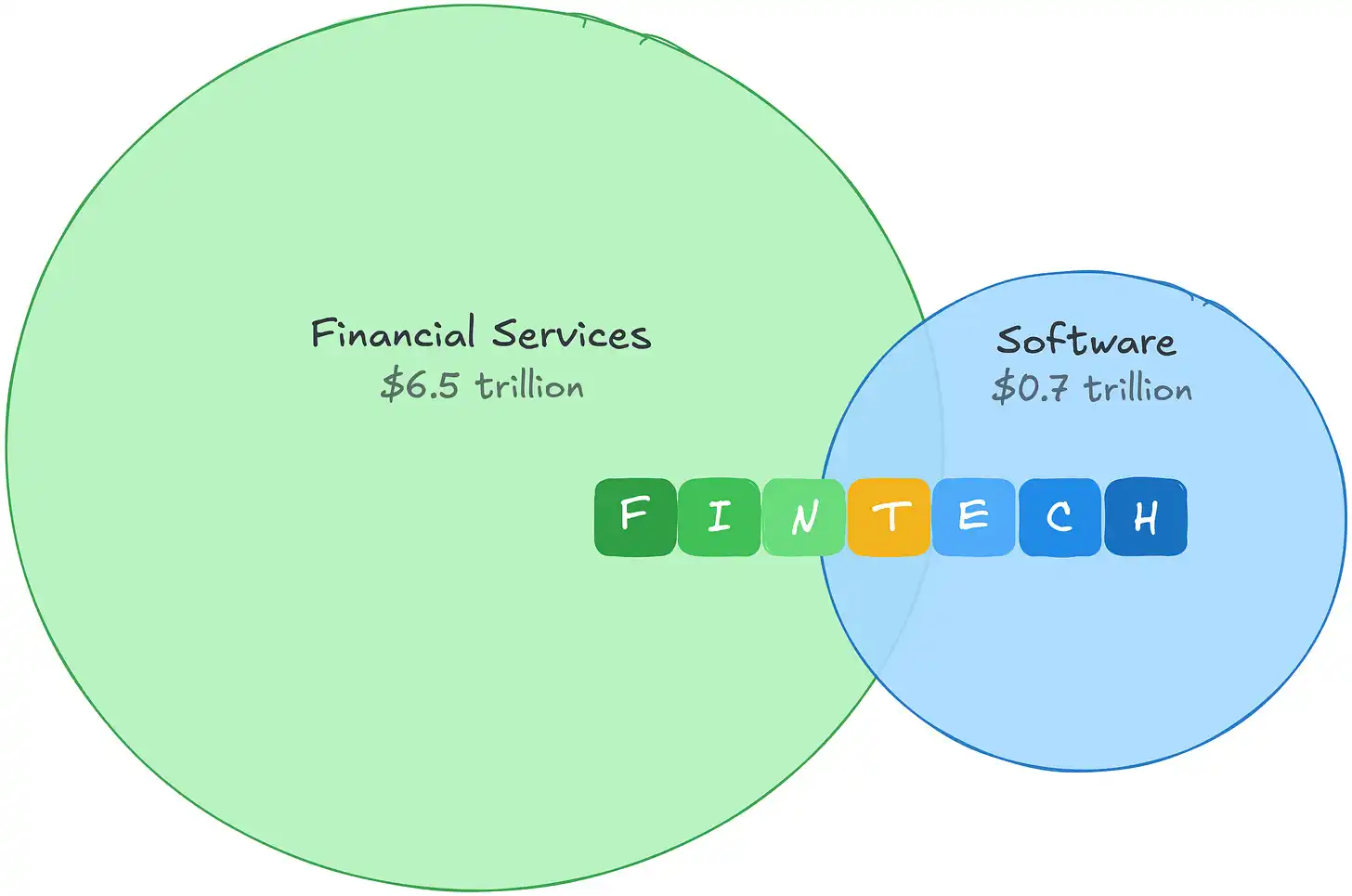
Then AI, and the arbitrage space vanished. As investors repriced "what code is worth in a world where code is getting cheaper," software valuations compressed. Fintech companies, being categorized by the market as software companies, were caught in the crossfire.

But the market got the categorization wrong. Fintech's costs, and its moats, were never in the code, and in the face of AI-driven cost compression, they look increasingly anti-fragile.

A Tale of Two Cost Structures

Software once had one of the best business models in history: code was expensive to produce, but once written, distribution was nearly free. The gap between "expensive to build" and "free to distribute" was the margin. If you were a SaaS company spending 22 to 25% of revenue on R&D, that expenditure was also your barrier to entry. Competitors couldn't easily replicate something that took years and tens of millions of dollars to build.

AI compresses this gap from the top. If code is both cheap to build *and* cheap to distribute, margins narrow. The wall keeping competitors out gets lower, more players enter, and pricing power erodes.

If your business *is* software, this is a real problem. But Fintech's spend isn't engineering spend. Follow the money, and the difference becomes obvious quickly.

PayPal spends 9% of revenue on R&D; Block spends 12%. This isn't because Fintech engineering isn't important—Stripe's engineering capability is world-class and a real competitive advantage. It's that most of the money doesn't flow to engineering.

The money flows to the "fin". Unlike R&D spend, these costs don't just produce the product; they produce the moat:

Credit Losses Buy Underwriting Data

Affirm spends 35% of its revenue on credit losses and funding costs *before* it pays a single engineer. Every dollar lost to a bad loan is repayment data a competitor doesn't get. A new entrant training a model on synthetic data has no real benchmark. You cannot build a reliable loss history on synthetic data alone.

Compliance Spend Buys Regulatory Permission

Wise dedicates a third of its employees to compliance and financial crime prevention across 65+ regulatory licenses. Money transmitter licenses in 50 states, BSA/AML compliance programs, bank charter requirements. These aren't advantages you build; they're permissions you continually earn. You can't vibe-code your way into a banking charter.

Volume Buys Proprietary Data

Toast's Payments segment has gross margins around 22%, far below its 70% SaaS margins, but generates nearly twice the gross profit dollars. Those costs buy merchant-level transaction data, which in turn feeds Toast Capital, which has originated over $1 billion in loans. Adyen's risk models are trained on transaction patterns across 30+ markets.

Fintech Margins Were Never High, and That's the Point

Payment companies have gross margins of 20 to 50%, not 80%. But low margins don't equal a weak business. Fintech margins are low because a huge portion of the costs are generating compounding advantages. And even the costs that don't generate advantages are outside the reach of AI-driven cost compression.

AI makes every one of these moats stronger. Better models push down loss rates, better fraud detection reduces chargebacks, better compliance tools let smaller teams hold more licenses. AI doesn't replace the moat; it rewards the companies that chose to build in the hardest parts of Fintech: money movement, risk-taking, proprietary data, and regulation.

So the real argument isn't just "AI helps Fintech," but that AI is shifting value away from product surface area and towards proprietary data, risk-taking capacity, regulatory permission, and distribution embedded in real money movement. If you're building in these areas, AI is compounding in your direction. If your differentiation is in the code, AI is compounding in the opposite direction.

Demand-side growth continues, too. Every vibe-coded checkout flow is a new fraud vector, every autonomously transacting AI agent is a chargeback risk. The more that gets built on top of Fintech infrastructure, the more indispensable that infrastructure itself becomes.

"Fin" is Where You Win

This realization is already forcing smart Fintech founders to rethink their place on the "fin" vs. "tech" spectrum:

Do we take and price risk ourselves, or pass it to a counterparty and let them take the profit?

Do we own the regulatory relationship, or rent it from someone who does?

Is every transaction making our own risk model sharper, or training someone else's?

Is our ledger the source of truth for data, or an incomplete mirror of someone else's ledger?

This distinction splits the Fintech landscape in two. Companies that own the regulatory relationships, take their own credit losses, and accumulate transaction data are building moats that AI will deepen. Companies that rent the "fin"—slapping a better interface on a partner bank's charter, a BaaS provider's ledger, someone else's risk model—face the exact same problem as SaaS companies. Their differentiation was in the code, and the code just got cheaper.
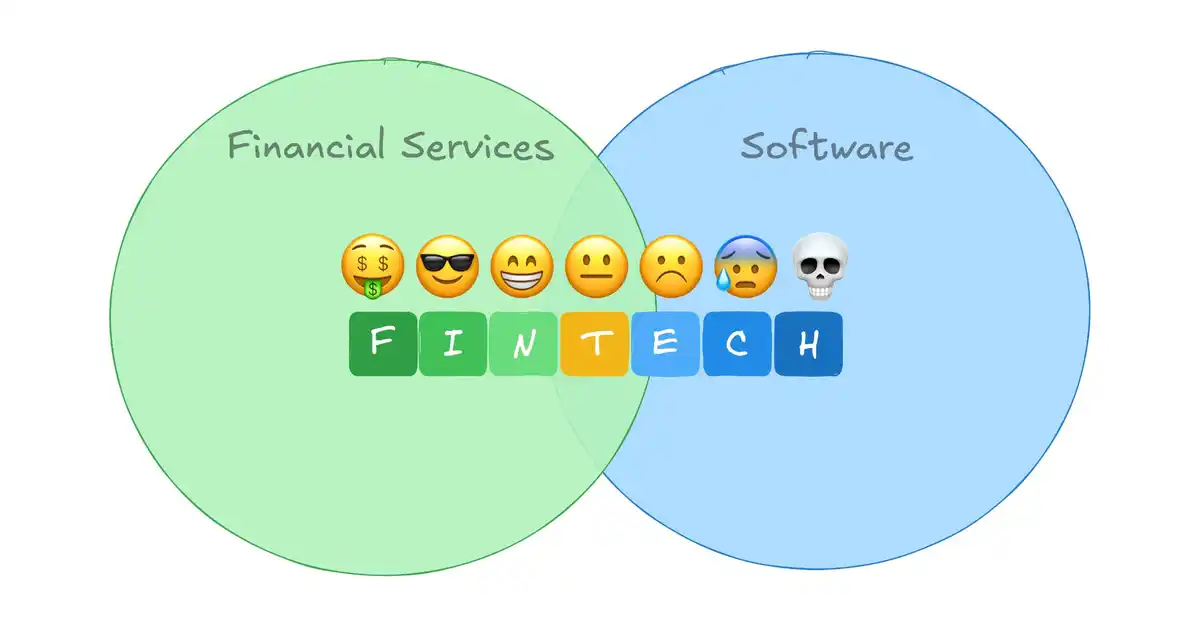
The old arbitrage of applying software multiples to financial services economics is dead. The new arbitrage is simpler: own the "fin".


Criptos en tendencia

Preguntas relacionadas

QAccording to the article, why are banking licenses and underwriting data becoming more valuable in the AI era?

ABecause AI makes code cheaper to produce and distribute, but it cannot replicate hard-to-obtain assets like banking licenses (which require regulatory approval and compliance) or real underwriting data (built from actual credit losses and transaction histories). These elements form defensible moats that AI actually strengthens.

QHow does AI impact the cost structure and moats of traditional software companies versus Fintech companies?

AAI compresses the profit margins of traditional software companies by making code cheaper to build and distribute, lowering entry barriers and eroding pricing power. In contrast, Fintech companies' moats—built on regulatory licenses, proprietary data from transactions, and credit risk experience—are not only resistant to AI-driven cost compression but are actually enhanced by AI through better models for risk and compliance.

QWhat are some examples of Fintech companies investing in 'fin' moats rather than 'tech' differentiation?

AExamples include: Affirm spending 35% of revenue on credit losses and funding costs to build underwriting data; Wise investing heavily in compliance across 65+ regulatory licenses; and Toast using low-margin payment processing to gather proprietary transaction data that fuels its lending business (Toast Capital).

QWhat key questions should Fintech founders ask to determine if they are building a durable AI-era moat?

AFounders should ask: Do we take and price risk ourselves or pass it to partners? Do we own regulatory relationships or rent them? Does each transaction improve our own risk models or train someone else's? Is our ledger a source of truth or an incomplete copy of another ledger?

QHow does the article characterize the shift in valuation dynamics for Fintech companies in the age of AI?

AThe old arbitrage of applying software valuation multiples to Fintech businesses is disappearing. The new arbitrage is owning the 'fin' elements—regulatory licenses, risk-bearing capabilities, and proprietary data—which AI makes more valuable, rather than relying solely on 'tech' (code and user experience) which is becoming commoditized.

Lecturas Relacionadas

STRC Major De-pegging's First Financial Report, How Will Strategy Repair Its Capital Flywheel?

Bitcoin treasury company Strategy released its Q2 2026 earnings report on July 31. Despite a 6.9% year-over-year revenue increase to $122 million, the company recorded a net loss of $8.22 billion, largely due to $8.32 billion in unrealized losses from Bitcoin price fluctuations. As of quarter-end, Strategy holds 843,775 BTC with an average cost of $75,000 per coin, and Bitcoin per share increased. The report highlights a critical shift in Strategy's capital model following the de-pegging of its key financing tool, STRC (Strategic Coin), which fell below its $100 target. Management's top priority is restoring STRC to its target value, aiming for a recovery by September 8. They rule out discounted STRC issuances and plan to maintain its dividend yield at 12%, instead focusing on bolstering its $3.75 billion cash reserve. Strategy has moved from a one-way "buy-and-hold" Bitcoin strategy to active capital management. This new approach, part of its "Digital Credit Capital Framework," involves flexibly managing its balance sheet across four elements: BTC, USD cash, common stock (MSTR), and digital credit securities like STRC. This allows for BTC monetization (having sold $218.4 million in BTC so far), strategic repurchases of discounted securities, and debt optimization, as seen with a $1.5 billion convertible bond buyback. The company's future hinges on two key tests: successfully re-pegging STRC to restore market confidence in its digital credit system, and a long-term recovery in Bitcoin's price to ultimately support its growth thesis.

marsbitHace 26 min(s)

STRC Major De-pegging's First Financial Report, How Will Strategy Repair Its Capital Flywheel?

marsbitHace 26 min(s)

STRC's First Financial Report Post-Depegging, How is Strategy Restoring the Capital Flywheel?

On July 31, 2026, Bitcoin treasury company Strategy released its Q2 financial report. Despite a 6.9% year-over-year increase in revenue to $122 million, the company recorded a substantial net loss of $8.22 billion, primarily due to $8.32 billion in unrealized losses from Bitcoin holdings. While Strategy's core Bitcoin strategy remains intact—its holdings grew 11% to 843,775 BTC—the company is undergoing a fundamental shift in its capital model. Following the de-pegging of its key financing tool, the STRCoin (STRC), from its $100 target in May, Strategy has pivoted from a one-directional "raise funds, buy Bitcoin" cycle to a more dynamic, multi-asset capital management approach. A key part of this new framework is the "Monetization Program," through which Strategy has sold approximately $218.4 million worth of BTC to bolster liquidity. The company's top priority is repairing STRC's peg, committing not to issue discounted shares until it returns to its target range. It has initiated a $1 billion buyback program for discounted digital credit securities, having repurchased $28.9 million face value of STRC so far. Management aims to restore the peg around September 8, 2026. Strategy now actively manages a matrix of assets: Bitcoin (for accumulation or strategic sales), USD cash reserves (now at $3.75 billion), common stock (MSTR), and digital credit securities like STRC. This allows for tactical moves like repurchasing discounted debt or equity to capture value. The future success of Strategy's "capital flywheel" hinges on two factors: the short-term ability to successfully re-peg STRC to restore market confidence in its digital credit system, and the long-term price trajectory of Bitcoin, upon which its entire investment thesis ultimately depends.

Odaily星球日报Hace 31 min(s)

STRC's First Financial Report Post-Depegging, How is Strategy Restoring the Capital Flywheel?

Odaily星球日报Hace 31 min(s)

With Two Consecutive Quarters of Losses, Coinbase Must Rely on Paths Beyond Trading

Coinbase posted its second consecutive quarterly net loss of $359 million on $1.22 billion in revenue for Q2, highlighting its vulnerability to crypto market cycles where weaker prices and lower volatility reduce user trading. However, the report also reveals a strategic shift in its business model. Despite a 25% quarter-over-quarter decline in global spot trading volume, Coinbase increased its market share to a company-record 10.3%. This suggests its position as a compliant U.S. on-ramp is strengthening even in a cooler market. A key development is the diversification of revenue streams. Transaction revenue fell to $599 million, nearly equaling subscription and services revenue of $555 million. Stablecoin services, generating $292 million, are becoming a crucial revenue "floor." This income, derived from interest on the $20 billion average USDC balance held on its platform, is less tied to daily trading activity. Furthermore, while spot trading volume dropped significantly, derivatives volume held steady at $1.03 trillion. Coinbase is pushing to integrate spot, stablecoin, and derivatives liquidity to create a more interconnected and sticky ecosystem for users. The GAAP net loss includes non-cash expenses like stock-based compensation and crypto asset valuation changes. Its adjusted EBITDA remained positive at $208 million for the 14th straight quarter, indicating core operations can cover ongoing costs. The company is also reducing expenses to manage the downturn. The central question moving forward is whether Coinbase's growing market share, stablecoin revenues, and expanding product integration can sufficiently offset the inherent cyclicality of its core trading business during future market contractions.

marsbitHace 46 min(s)

With Two Consecutive Quarters of Losses, Coinbase Must Rely on Paths Beyond Trading

marsbitHace 46 min(s)

Trading

Spot

Artículos destacados

Cómo comprar ERA

¡Bienvenido a HTX.com! Hemos hecho que comprar Caldera (ERA) sea simple y conveniente. Sigue nuestra guía paso a paso para iniciar tu viaje de criptos.Paso 1: crea tu cuenta HTXUtiliza tu correo electrónico o número de teléfono para registrarte y obtener una cuenta gratuita en HTX. Experimenta un proceso de registro sin complicaciones y desbloquea todas las funciones.Obtener mi cuentaPaso 2: ve a Comprar cripto y elige tu método de pagoTarjeta de crédito/débito: usa tu Visa o Mastercard para comprar Caldera (ERA) al instante.Saldo: utiliza fondos del saldo de tu cuenta HTX para tradear sin problemas.Terceros: hemos agregado métodos de pago populares como Google Pay y Apple Pay para mejorar la comodidad.P2P: tradear directamente con otros usuarios en HTX.Over-the-Counter (OTC): ofrecemos servicios personalizados y tipos de cambio competitivos para los traders.Paso 3: guarda tu Caldera (ERA)Después de comprar tu Caldera (ERA), guárdalo en tu cuenta HTX. Alternativamente, puedes enviarlo a otro lugar mediante transferencia blockchain o utilizarlo para tradear otras criptomonedas.Paso 4: tradear Caldera (ERA)Tradear fácilmente con Caldera (ERA) en HTX's mercado spot. Simplemente accede a tu cuenta, selecciona tu par de trading, ejecuta tus trades y monitorea en tiempo real. Ofrecemos una experiencia fácil de usar tanto para principiantes como para traders experimentados.

455 Vistas totalesPublicado en 2025.07.17Actualizado en 2026.06.02

Cómo comprar ERA

Discusiones

Bienvenido a la comunidad de HTX. Aquí puedes mantenerte informado sobre los últimos desarrollos de la plataforma y acceder a análisis profesionales del mercado. A continuación se presentan las opiniones de los usuarios sobre el precio de ERA (ERA).

活动图片