Claude Design was actually a 'side project' born out of intense competition.
Behind it lies a story involving two engineers and one designer.
The story begins with the release of Opus 4.5 in November 2025.
At that time, Nate Parrott was the sole designer in the Claude Code VS Code project, working alongside two engineers.
Anthropic product designer Nate Parrott recounts the entire birth process of Claude Design in the first person on the official blog.
The three of them worked together on one thing: transforming Claude Code, which could only be operated via command line in a terminal, into an interface that ordinary people could understand and use smoothly.
By the end of September, the product entered beta, everything was normal; then in November, Opus 4.5 was released. Parrott described the subsequent scene as follows:
The two engineers suddenly started delivering work frantically, producing much more than before, while he remained at his original speed.
Soon, he fell behind.
"I need to find a way to catch up," Parrott thought.
So, he tinkered with a small tool in his spare time, specifically to help himself keep up with the engineering pace.
And this 'side project' later became Claude Design, used by over a million people in its first week after launch.
Engineering Takes Off First, Design Gets Left Behind
The heart-wrenching part of this story is that AI didn't uniformly increase everyone's speed; instead, it first sent engineering into overdrive.
Consequently, Parrott's design work quickly became the slowest link in the entire workflow chain.
The turning point was November 24, 2025, the day Opus 4.5 was released.
According to Parrott's recollection, the delivery pace of the entire Claude Code team noticeably accelerated after that. The output of the two engineers increased significantly, while his design output remained at the original speed.
This forced him to find a way to catch up.
This also exposes the most easily overlooked side of the AI wave: its initial impact is often not about whether a certain job will disappear, but about disrupting the previously matched rhythms between different workflows.
For example, once engineering accelerates, any环节 like design, product, or marketing that cannot keep up will instantly become a new bottleneck.
A One-Month Side Experiment, From 'AI Writing Design' to 'AI Writing HTML'
Parrott's initial idea was straightforward.
Claude Code was a purely text-based terminal tool. He initially followed this line of thinking, treating design as a text-based task:
Bundle the terminal output, a few interface screenshots, and a one-sentence requirement and throw it to Claude, saying "This is the feature we want to add, design it."
The results, however, were not ideal.
For about a month, he treated this as a side project: not officially approved, just advancing it bit by bit in his spare time.
Gradually, he stumbled upon the real solution: Claude is particularly good at writing HTML.
We're accustomed to thinking of HTML as something for making web pages.
But Parrott's epiphany was that HTML is actually a very rich interactive visual medium: slideshows, video files, PDFs... anything they can do, you can do with a webpage.
So he stopped asking Claude to "draw designs," and instead had it "produce HTML," then wrapped it in an interface: chat on the left, real-time preview on the right. You say something, and the right side changes accordingly.
The breakthrough Parrott found wasn't in "making AI draw pictures," but in "using HTML as a unified visual canvas": slideshows, interactive prototypes, animations, web pages could now enter the same generation and editing pipeline.
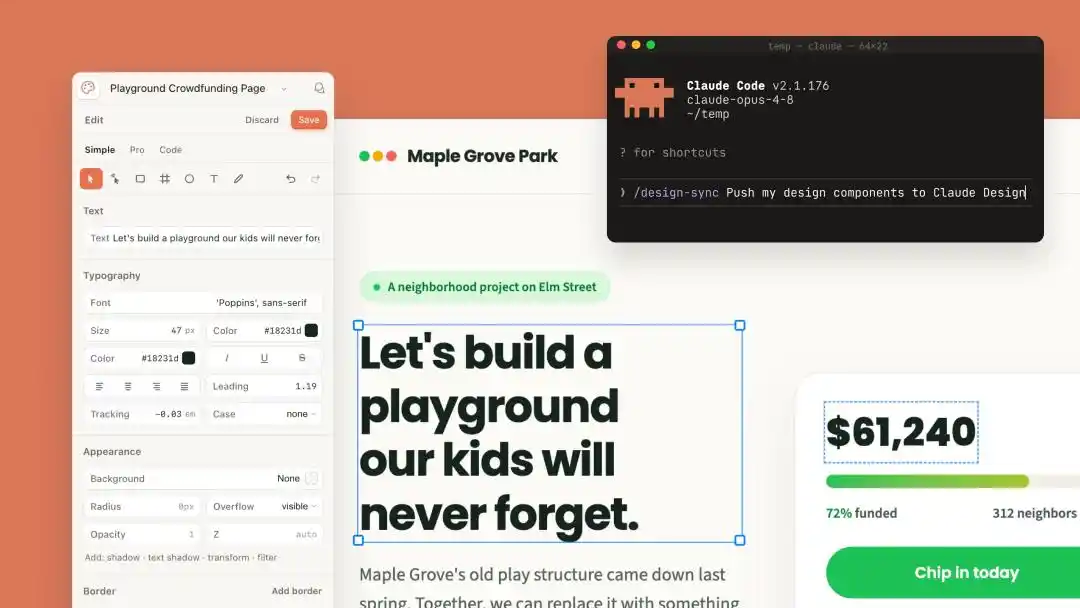
The Claude Design workspace: conversation on the left, canvas on the right, mirroring Parrott's original prototype idea.
HTML Alone Isn't Enough, the Brand System is the Key
Just being able to write HTML is still far from "usable."
In Parrott's view, the core of product design is translating your understanding of the product and brand into every specific design action.
So he spent considerable time distilling the essence of the Anthropic brand—fonts, color schemes, assets, and design principles—into the prompts.
This way, when he inputs requirements into the AI, the generated designs are naturally closer to Anthropic's standards.
He packed this whole system into a small internal prototype and shared it with the team. Product designers immediately started using it to create interactive prototypes.
Making a clickable prototype in traditional design tools means you have to draw out every state of every interface and manually link them one by one.
In Claude Design, you just throw the materials at Claude, say "make it run," and what it produces comes with a link that you can directly share with colleagues like a document.
This later became the core capability of the entire product.
Today, when you start using Claude Design, during the first configuration, it reads your code repository and design files, automatically assembling a design system for the team.
Every subsequent project automatically applies your colors, fonts, and components. Larger teams can assign an administrator to lock down a standard system that no one can alter arbitrarily.
An Offsite Meeting Turns a Side Project into a Main Project
What truly made Parrott feel "this is it" was during an idea pitch session at an Anthropic Labs team offsite.
He found that almost everyone there was using this tool to cobble together slides. Many were even doing it on the fly, right before their turn to speak during the meeting.
It was this scene that convinced the Labs team to officially allocate resources to the project. From that moment, a side project became a real product.
Anthropic had already validated this path with Claude Design once before.
On January 13, 2026, Anthropic announced the expansion of Labs, bringing in Instagram co-founder Mike Krieger and Ben Mann to lead it, positioning it as an incubator for experimental products at the forefront of Claude's capabilities.
Claude Code started from a research preview and grew into a billion-dollar product in six months.
Claude Design followed the same path: one person's private experiment, to internal designers voluntarily adopting it, to colleagues "voting with their feet" during idea pitches, and finally Labs allocating resources, releasing a public research preview, and transitioning to beta.
Not a single step in this chain was planned top-down.
AI-native products are often not designed; they are 'used' into existence internally.
Value Shifts Forward, Designers Are No Longer Just 'Outputting Mockups'
Once Claude Design became an official product, its positioning quickly changed.
They stopped seeing it as just a tool for creating interface mockups.
Slideshows, landing pages, printable single-page PDFs, emails, animations, social media graphics—any task involving visual communication, it can handle.
Parrott's own description is that it operates "one level above product design": what you and Claude are refining together are those visual materials primarily used for communication and ideation.
The division of labor is clear: Claude Design handles the early stages—rapid exploration, comparing directions, building consensus; Claude Code handles the later stages—actual production development.
The two can also interconnect: use /design-sync to pull in the design system, use /design to make changes directly in the terminal, with MCP bridging the middle.
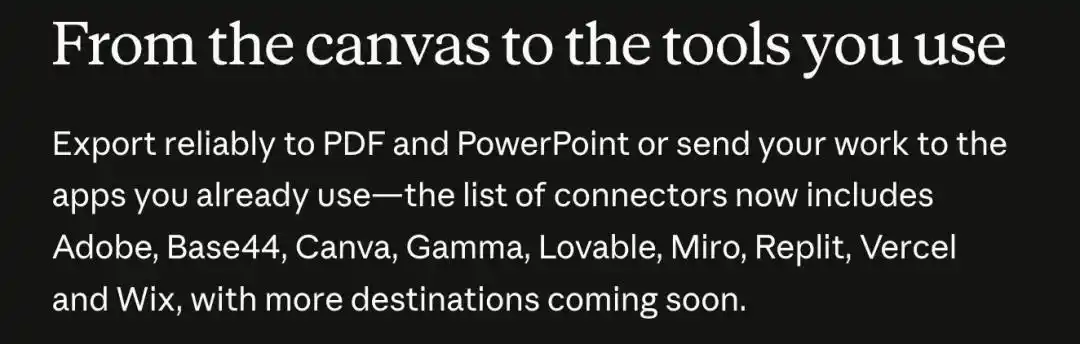
Claude Design can export to PDF, PPTX, HTML, and integrates with tools like Canva, Adobe, Gamma, Miro, Replit, Vercel, Wix.
Finished work can be exported to PDF, PPTX, HTML, and sent with one click to tools like Canva, Adobe, Gamma, Miro, Replit, Vercel, Wix for further work.
However, Claude Design is not an image generation model. Parrott admits: It's not suitable for making logos. Your existing logos, images, and brand assets need to be imported yourself.
For actually writing production software ready for launch, Anthropic still recommends using Claude Code diligently.
Ultimately, Claude Design is an early-stage tool, not a mature production development platform.
The more models can handle writing code, the more valuable work shifts forward. The value of designers turns towards choosing directions, building systems, judging quality, and driving consensus.
Back to the initial scenario.
When the two engineers beside him suddenly accelerated, Parrott, the sole designer in the group, was left behind. He didn't just wait; he took matters into his own hands and built a tool to catch up.
Who would have thought this tool would later be used by millions.
So, when your work is impacted by AI and you feel anxious, perhaps learn from Parrott's move: use AI to build yourself a new tool, or find such a tool, and open up a new situation.
References:
https://claude.com/blog/how-the-product-designer-who-built-claude-design-uses-it-to-explore-ideas-before-building-them?utm_source=chatgpt.com
https://www.anthropic.com/news/claude-design-anthropic-labs?utm_source=chatgpt.com
This article is from the WeChat public account "New Zhiyuan", author: ASI启示录